Number: 602
Region: Pacific County
Launched: 2020
Site Captains: Megan Bungum and Rachel Flannery
Tokeland is a site with significant historical status, to the story of green crab in Washington and much deeper in time as well. Within the Crab Team monitoring network, this site plays an important role as it’s situated where Willapa Bay meets the Pacific Ocean, a location with a legacy longer than recorded history of supporting the peoples who have lived there.
A Deep History at the Mouth of the Bay
The Shoalwater Bay Indian Tribe has stewarded Toke Point, in northern Willapa Bay, and the surrounding area as part of their ancestral lands. However, by 1855 the tribe only retained a small parcel of land at the base of the peninsula (which would eventually be established as a reservation for the Shoalwater Bay Indian Tribe by President Johnson in 1866). This area is named after Chief Toke, who spent summers there with his family.
In 1885, as part of the settler displacement of the tribe from their ancestral lands, settlers Lizzie and William Kindred built a two-story farmhouse on the plot that would eventually become the Tokeland Hotel. The Kindreds have long since gone but the town of Tokeland remains, and several sites in the area are still associated with the name, including the slough on the north side of the peninsula, as well as the island that makes up the opposite shore.
These places have even older names, however, and prior to their removal, the Shoalwater thrived off rich and diverse foods living at the sea at the Nukaunlth village site. The Shoalwater Bay Indian Tribe continues to prosper in and steward the lands, waters, and shorelines of the region. As part of their partnership in Shoalwater Seafoods, the tribe carries on their legacy of first foods to farm and harvest oysters from the tribe’s tidelands in Willapa Bay, including their famed Toke Point oyster.
More recently, concerns are growing that the Toke Point oyster, along with the other shellfish and marine resources on which the tribe and region rely, is at risk from the increasing abundance of green crabs in Willapa Bay, where green crabs were first captured in Washington dating back to 1998.
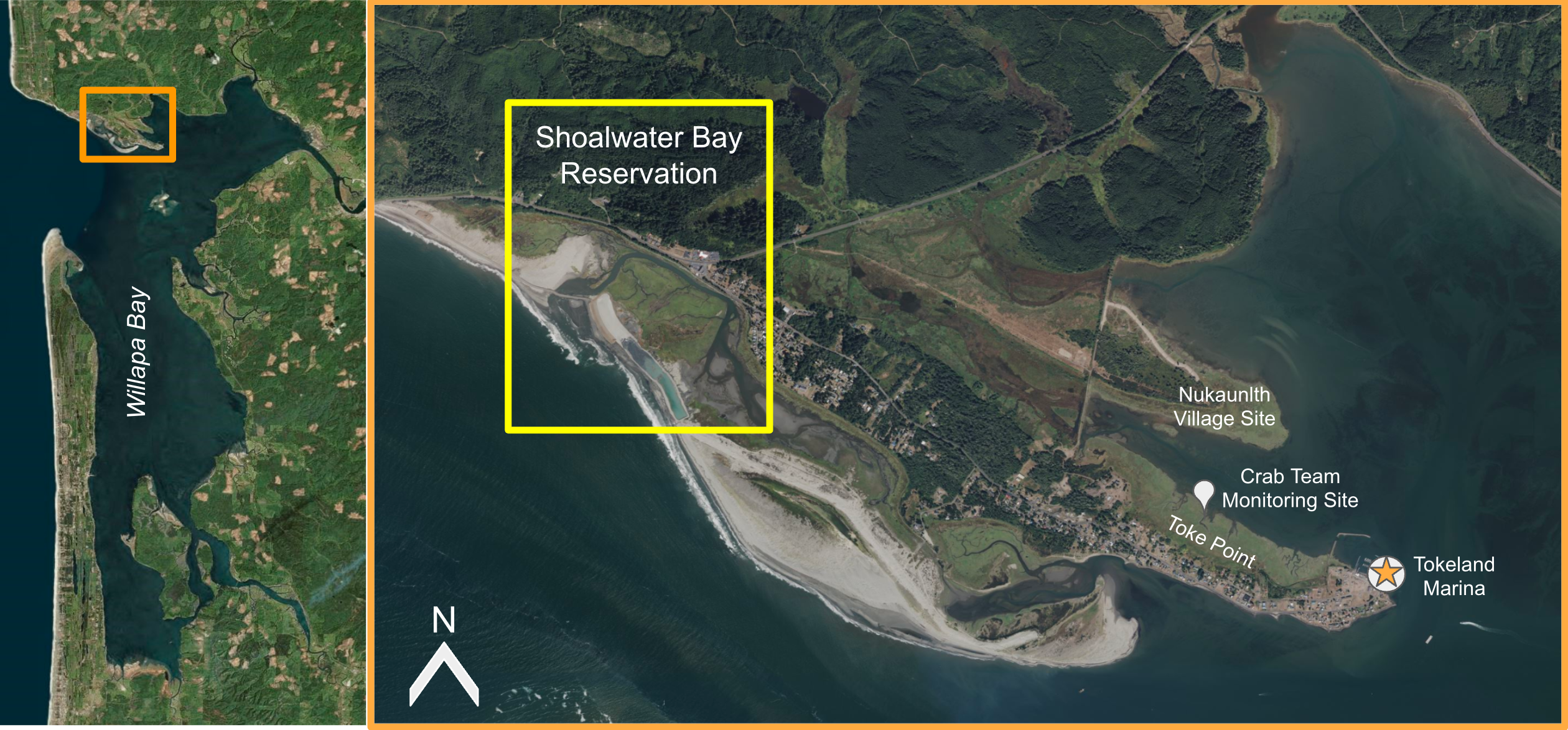
Map of Tokeland area. Left panel shows Willapa Bay with orange box showing location of Tokeland enlarged in right panel. Crab Team monitoring site indicated by white pin, and marina by orange star. Click to enlarge.
Green Crabs Come … and Gone and Back Again?
Following that first detection of green crab, the focus of efforts were to figure out the scale of the problem. In the very first years of work to detect and eliminate green crab from Willapa Bay, most trapping centered on the Long Beach peninsula from Nahcotta to Stackpole. That stretch seemed to be a hotspot based on anecdotal accounts from shellfish growers, while growers in the Tokeland area rarely reported sightings. It wasn’t until a baywide trapping effort in 2000, that WDFW captured three green crabs in Kindred slough, a catch repeated the following year.
One of the first efforts to study green crab closely in the Tokeland area was led by Crab Team cofounder, Sean McDonald, at the time a graduate student in the UW School of Aquatic and Fishery Sciences. Sean and fellow grad student, Kirstin Holsman, spent the summer of 2002, conducting trapping surveys throughout the bay. They set up camp at My Suzie’s RV Park adjacent to the Tokeland Marina, which provided a good base for working the bay by boat. The Tokeland region itself remained relatively little explored with respect to green crabs, but given proximity, Sean and Kirsten took on a number of projects in Tokeland to learn how green crabs were using shorelines.
One example was trying to better understand green crab habitat preferences on the West Coast. Sean shared, “At the time, the highly invasive saltmarsh cordgrass Spartina alterniflora was widespread throughout the bay, and it was clear green crab were using it as a habitat. Our initial trapping work in Kindred Slough supported the pattern but it wasn’t possible to determine if they preferred Spartina over other habitats.” Using acoustic telemetry and other techniques, all observations they made indicated that green crab showed affinity for three dimensional structure that can provide protection, including Spartina and channeled shoreline. Today, focusing on structural features is central to the way trappers target green crab habitat, but was still a new insight at the time.
Though efforts to catch green crab in the marshes of Willapa Bay had been in full swing during the early 2000’s, the global “dot-com bubble” popped and funding for most green crab activities evaporated. By July 2003, WDFW had ceased all trapping activities. Somewhat fortunately, the timing appeared to coincide with what looked like a failure of green crabs to establish a self-recruiting population in the bay. This lull lasted for more than a decade, with years where green crabs were undetected, even by monitoring targeting the species. Numbers really started to heat up again following the 2015/2016 El Nino events, once again raising alarm and the need for coordinated action.
A Growing Crisis in Willapa Bay: The Shoalwater Bay Tribe Takes Action
In 2020, Larissa Ritzman, a longtime biologist for the Shoalwater Tribe, first encountered an unexpected and growing threat in Willapa Bay. Despite over a decade of working in the region and a deep connection to its marine ecosystems, she only became aware of European green crabs when Crab Team reached out as part of a coast-wide green crab assessment, and agreed to partner with WSG and WDFW in trapping the crabs in the Tokeland area, including a pilot monitoring site behind the Tokeland Hotel in Kindred Slough.
In short order, Ritzman went from surprised to alarmed. That August and September, initial Crab Team monitoring efforts with her crew in Kindred Slough, as well as trapping elsewhere on reservation and trust lands, found as many as 4 green crabs per trap, an abundance practically unheard of at the time in Washington. By 2021, the scale of the problem was undeniable. Trapping efforts across tribal tidelands yielded a staggering 5,000 crabs over the course of the season.
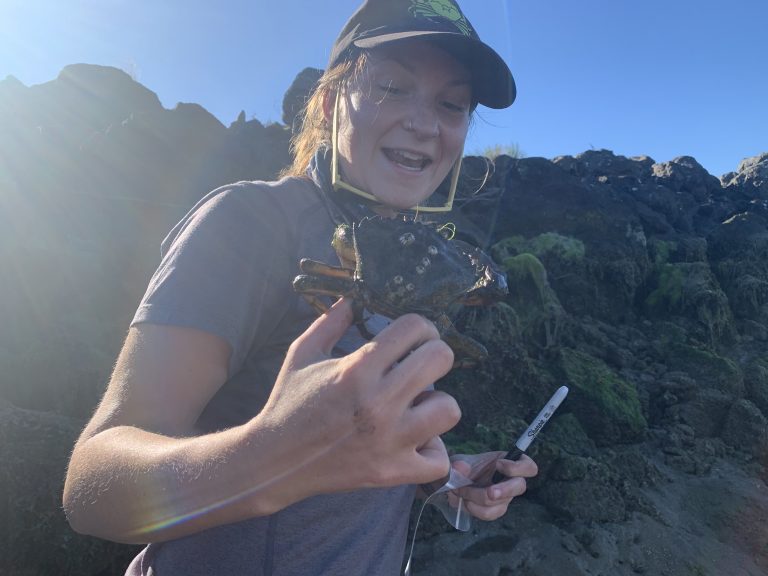
Former Crab Team Coastal Specialist, Alex Stote, wrangles a large barnacled green crab trapped during a removal effort at the Tokeland Marina. Photo: R. Coleman/WDFW
The Shoalwater Bay Tribe quickly shifted from monitoring to active control, drawing on partnerships and innovative approaches to tackle the rapidly growing green crab population. Larissa and her team began experimenting with trap designs, bait types, and trapping schedules to improve their catch rates. They discovered that traditional Fukui and minnow traps could be greatly augmented by the use of shrimp traps. Using airboats, they accessed hard-to-reach areas with the highest crab densities, allowing them to expand their efforts. “It’s been eye-opening,” Larissa shared, “and an ongoing journey for sure. Whether it’s a good journey or a bad journey, I don’t know, but it’s a journey.”
One big leap on that journey was an emergency declaration made by the tribal council after the alarming observations of the 2021 trapping season. Along with similar statements made by other tribes, this set the stage for Washington to declare a Green Crab Emergency in 2022. Having such political will behind the management of a biological invasion is a very rare and valuable opportunity to bring substantial resources to the table, or the mud, in the efforts to control population growth and spread.
Reflecting on the progress made since 2020, Larissa remains realistic about the challenge as well as the resource constraints the tribe faces, but ultimately hopeful. “We’ve caught more crabs this year than in the first three years combined,” she says. With no dedicated staff for green crab management, the tribe relies on a dynamic team balancing other critical responsibilities, and adaptability has been crucial. “My staff have turned into engineers,” she jokes, referencing their work redesigning shrimp pots and other gear to improve efficiency. To maximize the impact her staff is able to have locally, Larissa has prioritized activities to focus on controlling the population. In the meantime, the Washington Department of Fish and Wildlife has taken on the role of monitoring the Crab Team network site. The information from monitoring efforts are vitally important to helping untangle changing population trends from the ever-improving trapping practices that groups like Shoalwater are developing.
Tokeland Trends and Tools
Unfortunately, observations from recent monitoring underscore an ever-growing invasion. This August, at the Tokeland Crab Team site, WDFW trapped the greatest number of green crabs ever captured in a single monthly survey – 99 green crabs in just 6 traps. They picked up one additional crab by hand from the slough, just to make a nice round hundo. WDFW Biologist Rachel Flannery reflects, “While the site increasingly caught more crab throughout the season, it feels incredibly worthwhile to put time and effort into collecting such important data and removing such aggressive species from our waters.”
Over the past five seasons, monitoring at this site has illuminated important regional patterns in the green crab invasion. Being so close to the mouth of Willapa Bay, Tokeland is particularly exposed to larvae being washed in from large source populations outside the bay. This pattern also shows up in the size of crabs seen at the site. The figure below shows four of the five Crab Team monitoring sites in Willapa Bay. Tokeland and Stackpole, as closest to the mouth, have many more small crabs than Nahcotta or Cutthroat. Most of the larvae that settle there are likely still coming from outside Willapa bay, but increasingly, as populations grow in southern portions of the estuary, larvae are being locally produced as well.
The vulnerability of the region to larvae from other locations means that for the Shoalwater Bay Tribe, the fight against green crabs is an uphill battle. Depending on seasonal conditions, the work they do to trap and remove crabs can be offset by the arrival of more larvae. But the same monitoring data shows signs of progress at Tokeland. From 2021 to 2023, it became much less common to capture particularly large crabs in monitoring efforts – a signal that control trapping is impacting the population of green crabs by “crabbing down the population.”
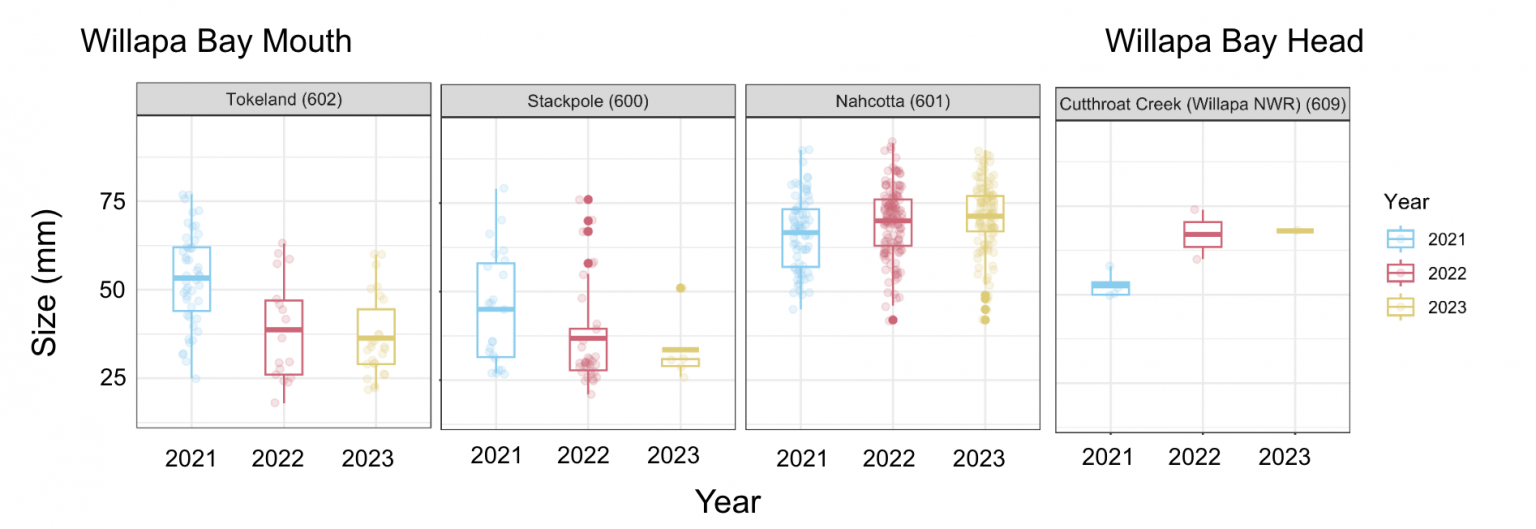
The size of crabs captured at four monitoring sites in Willapa Bay, ranging frm the mouth of the bay (Tokeland) to the hea of the bay (Cutthroat). Sites near the mouth like Tokeland and Stackpole, receive many more young crabs than sites further in, likely due to influx of larvae from sites outside the bay. These sites are also seeing success in removing larger older crabs from the population by trapping. Click to enlarge
The tribe’s commitment to preserving the ecological health of Willapa Bay remains steadfast. Larissa has secured grants to begin restoring shellfish beds but must now consider how green crabs could undermine these efforts. For Larissa, the fight against green crabs is personal. “It all started with Sea Grant. It was Alex and those guys who began our foray into everything green crab. I have to thank her for that.” While the road ahead is uncertain, the Shoalwater Bay Tribe’s dedication to their ancestral lands and waters continues to guide their response. For Larissa and her team, the battle against green crabs is about more than just numbers—it’s about protecting the heart of their community.
— Lisa Watkins, Emily Grason, P. Sean McDonald, and Ben Rubinoff
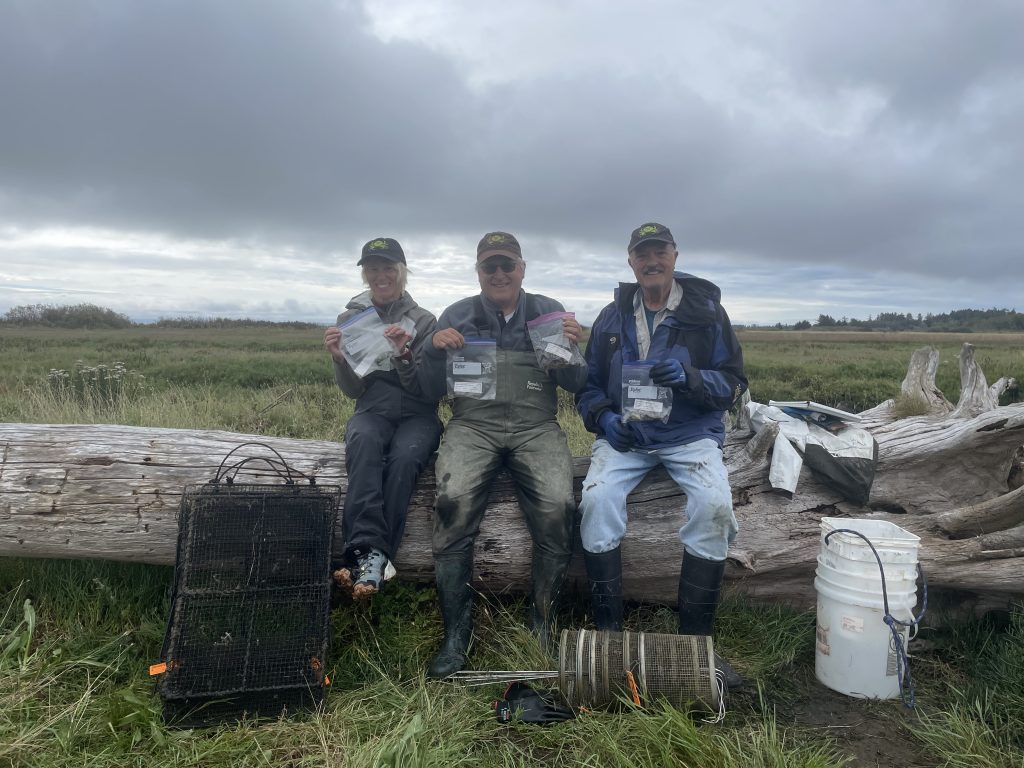
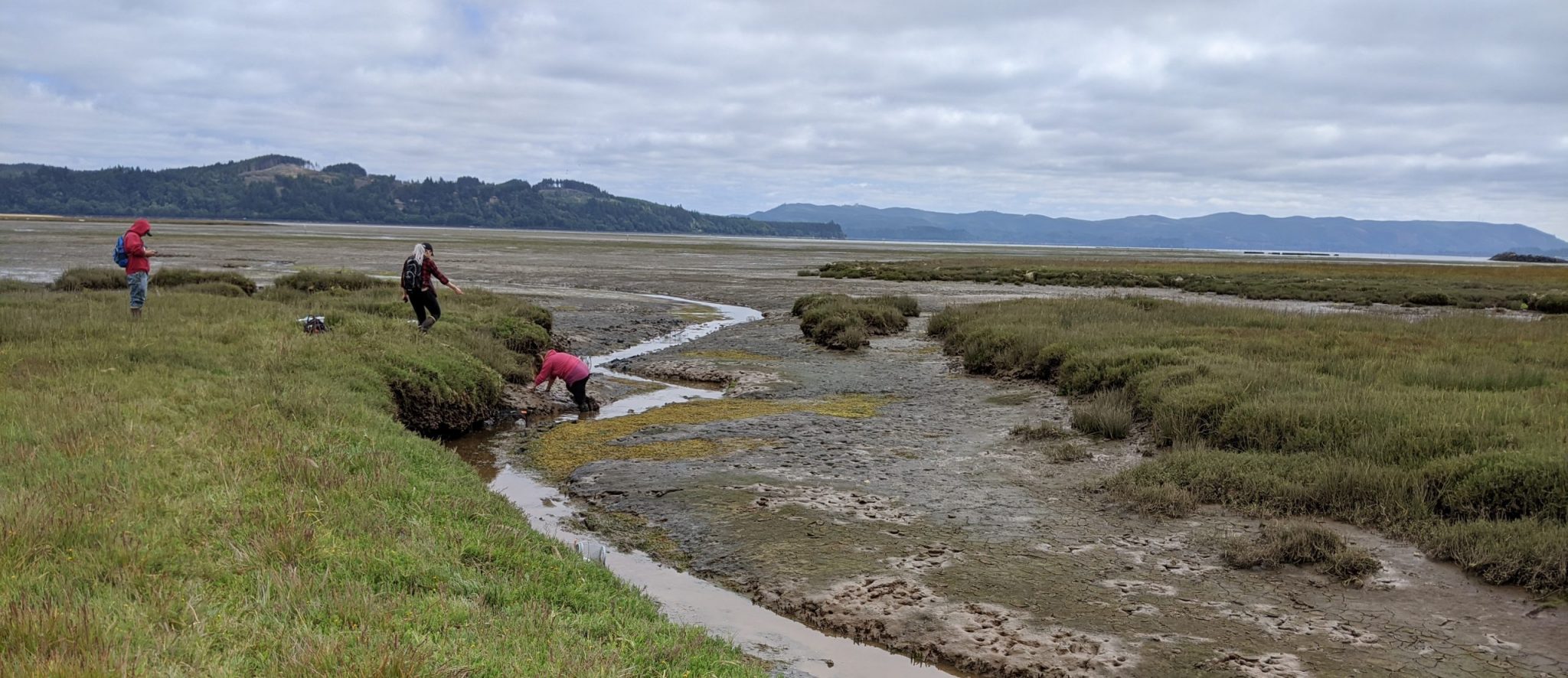
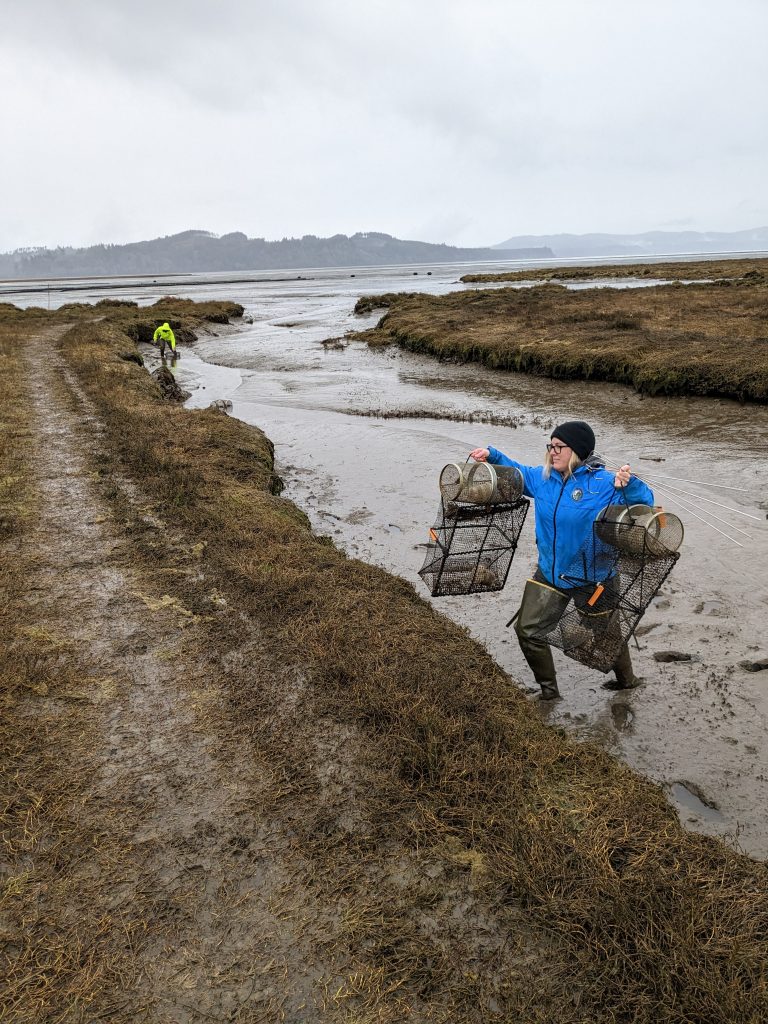
Header image caption: Monitors from the Shoalwater Bay Indian Tribe trapping at the mouth of the channel at site #602 in 2020. Photo credit: Alex Stote
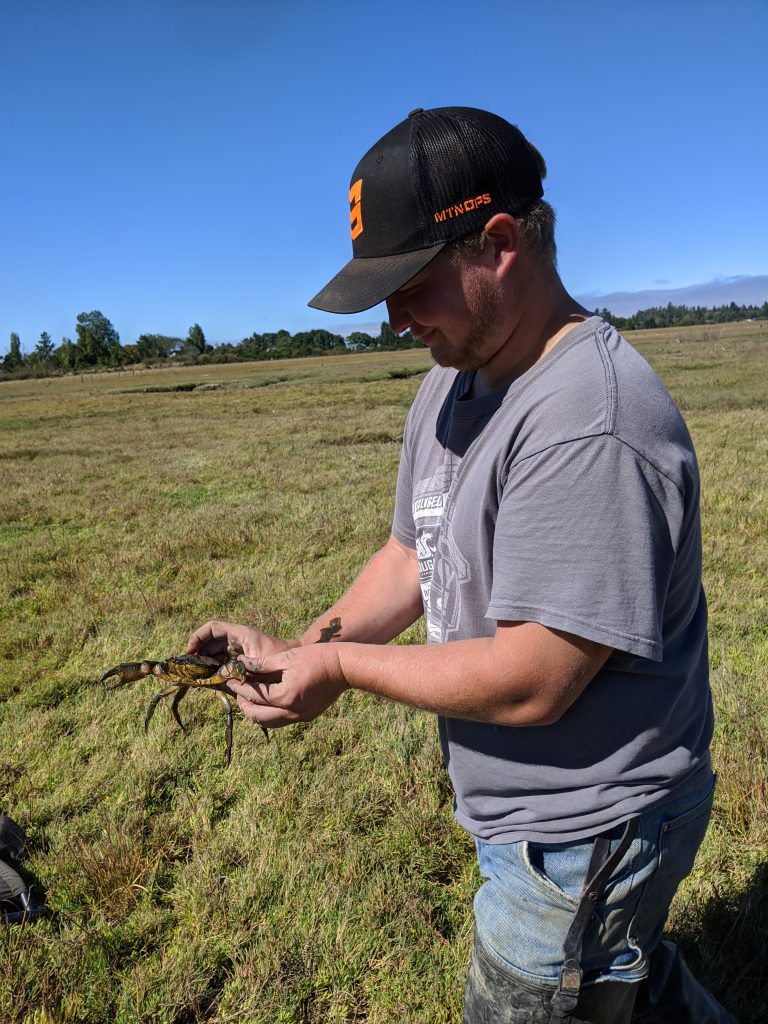
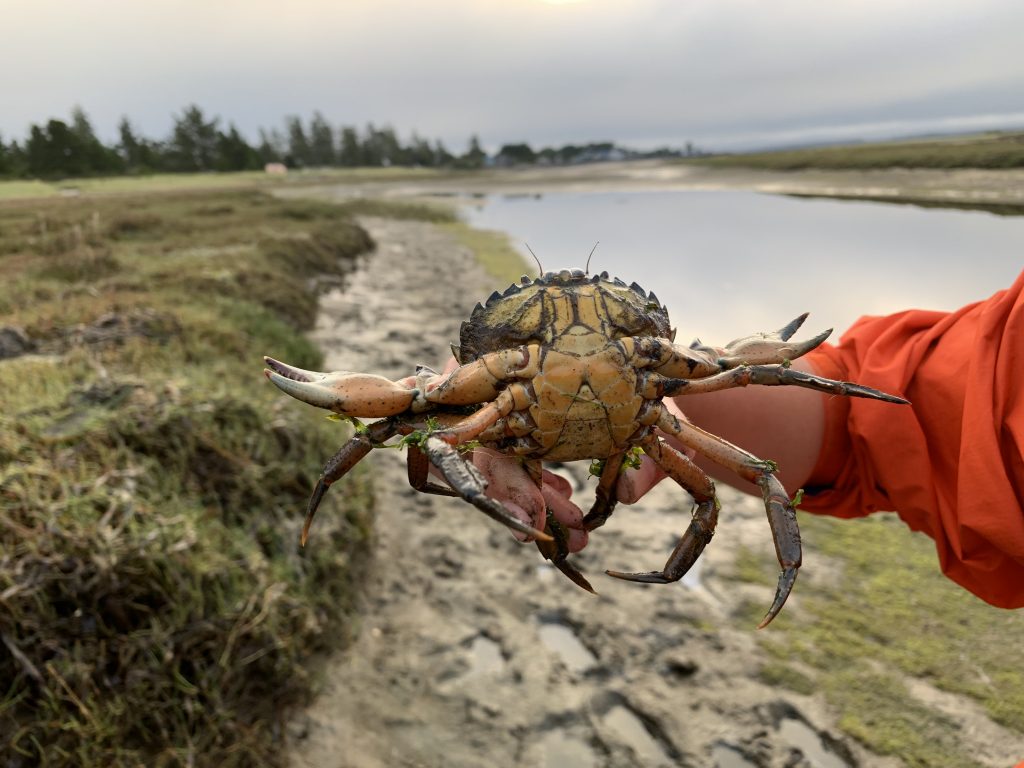
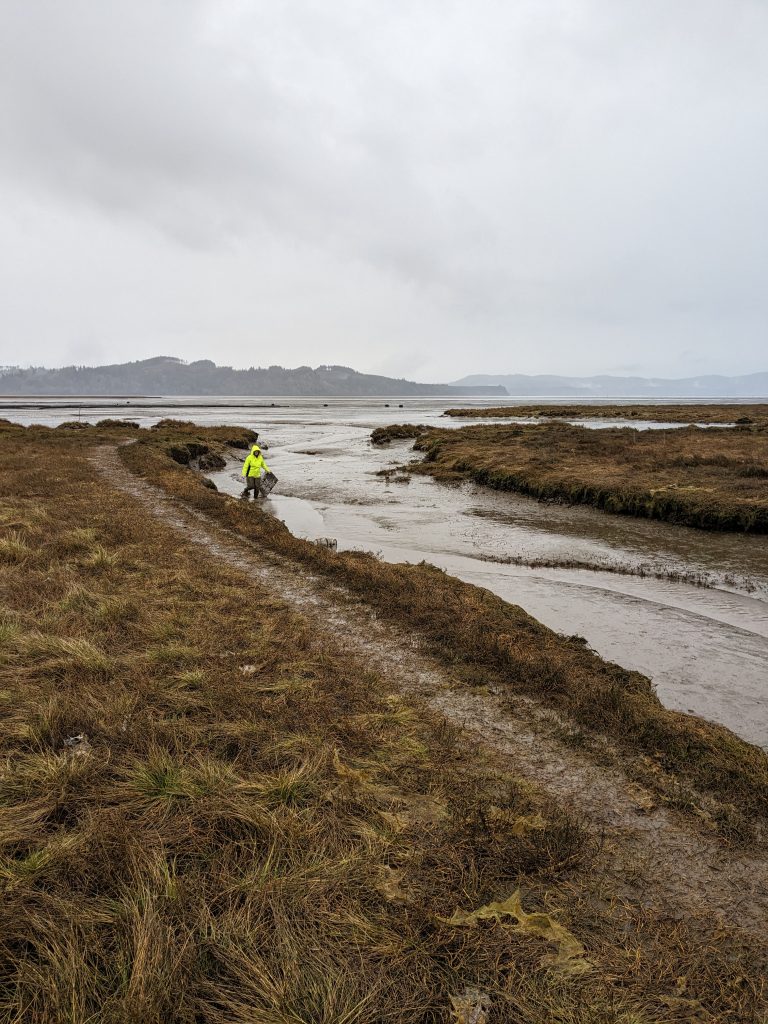
Photo Gallery
We love to get the virtual experience of monitoring with all of the Crab Team volunteers. Do you have a photo to share? Send it to crabteam@uw.edu. (Click on arrows to scroll, and photos to enlarge for more detail.)