
Green Crab Migration and Movement
One of the most pressing issues for management of European green crabs in the Pacific Northwest is to better understand how green crabs, as adults, move across the water bodies they inhabit. We are increasingly learning about the oceanographic influence of tides, currents, and storms on how larvae are transported into and around Washington shorelines (Du et al. 2024). Even though adult crabs are thought to move shorter distances, knowing adult movement patterns is also critical, enabling more effective trapping, and hopefully reducing population sizes. Some of the basic questions that we have are:
- How far do green crabs travel on a given tide or series of tides?
- Do they use different tidal elevations or habitat types at different times of year?
- Do males and females move differently, or target different habitat types?
- Are there microhabitat types (e.g, types of vegetation or other cover) that green crabs spend time in that we aren’t trapping them in?
Answers to these questions apply directly to strategies for green crab control efforts and tell us, for instance, how large of an area a single trap might attract green crabs from. They could also suggest where we place traps at different times of year to catch the most crabs, or how we interpret observed catch rates based on where, when, and how traps were set.
What we Know from Trapping Observations
We have – at least in part – some insight to these questions. The most readily available information is just a sense of where we find crabs by trapping and when. Trappers have long observed that green crabs are, compared to the warmer months, less conspicuous during winter and much harder to find and trap; they become less active and often hunker down for long periods. As a result they are less likely to be captured in baited traps that are frequently set in intertidal areas (their preferred habitat during warmer months). In areas where green crab numbers are low this can give the impression that they’ve all but disappeared. Little is known about where they go and what they do in the colder, darker months of the year. Until recently, most wintertime observations of green crabs came from shellfish growers, who sometimes encountered crabs nestled among their gear in shallow subtidal areas. The first detections in Samish Bay were made this way, and reports from growers in Willapa Bay in 2016 and 2017 occurred during the winter. As waters warm and day length increases, green crabs start to show up in greater numbers in intertidal traps in the spring.
Movement Studies
This information isn’t perfect. Trapping only tells you one location that the crabs are using – the place you set the traps! There’s always the possibility, and the fear, that crabs are spending most of their time somewhere else that you aren’t looking. So why not ask the crabs to tell us where they are hiding out?
One way to track movement of green crabs over longer periods is a mark-release-recapture study. Crabs are individually tagged and released, and if they are found again, most often in another trap set, we can learn the crab’s position at at least two time points. If the crab is released again (and falls for the bait again), we can gather additional time points and locations for individual crabs, ultimately resulting in a better picture of the range and movement of an individual crab, as opposed to the location of a population.
Mark-release-recapture studies can be technically and logistically challenging, and with an invasive species, the idea of releasing (and re-releasing) a crab back into the environment is not always easy to swallow, or even allowed. Other challenges include loss of the tags, especially due to molting, and the fact that recaptures are somewhat rare, meaning a LOT of crabs have to be tagged, and a LOT of traps have to be set to be able to get good information. One group currently working on tracking crabs this way is the Makah Fisheries department. For the past two years, the Makah team has been using this type of study to understand how green crabs in two river systems of Makah Bay (the Wa’atch and Tsoo-Yess) are using the rivers and adjacent beach habitat.
Early Forays into Crab Telemetry
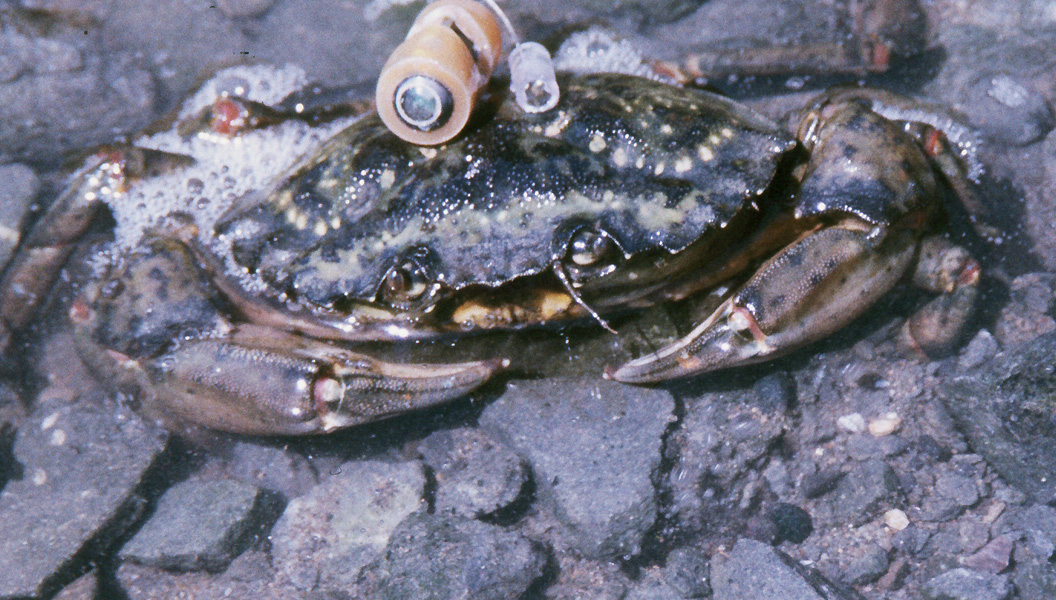
Another method to track animal movement is acoustic telemetry. Like the radio collars and tags used to track elk, wolves, lions, and even bees, crabs can be affixed with acoustic pingers. Crab Team co-PI Sean McDonald used active acoustic telemetry to track European green crabs in California (July, 2001) and Washington (July 2002). At the time, the tags were relatively small, about the size of a pen cap, battery-powered devices that emitted a coded acoustic signal (or “ping”) that could be detected with a directional hydrophone. By triangulating on these unique signals, the research team could accurately determine a crab’s location. Re-locating the crabs at regular intervals enables researchers to establish the position of the crab at multiple time points, similar to recaptures in mark-release-recapture studies, but often with a higher “re-sighting” rate since the researchers go out to find the crabs. In Sean’s case, these re-sight efforts took place four times a day, about every six hours or so – yes, even snorkeling at night, in the dark – for two weeks! “It was painstaking work but it allowed us to acquire very precise information on movements and the habitats green crabs occupy.”
Most crabs in this study (9 each from both locations) stayed within a few hundred meters of where researchers tagged and released them, often opting to hunker down among rocks or vegetation rather than venturing long distances. The crabs tagged near Tokeland, for instance, tended to move laterally along the shoreline and around the marina jetty, frequently utilizing native marsh vegetation, patches of cordgrass, or rip-rap. Rather than undertaking lengthy migrations between deeper water refuges and higher intertidal feeding grounds, as had been observed in Dungeness crabs in other studies (Holsman et al. 2006), green crabs, on average, remained in an area not much larger than a basketball court.
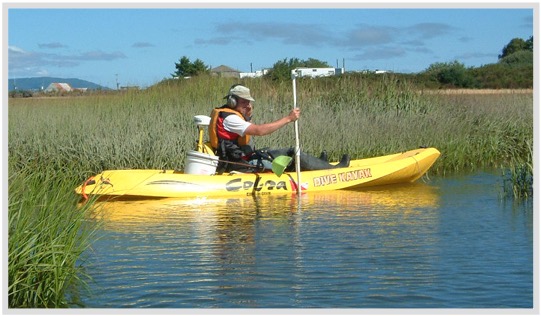
Sean McDonald submerges the directional hydrophone to listen for pings from tagged green crabs at Tokeland, WA. (Photo courtesy of Sean McDonald)
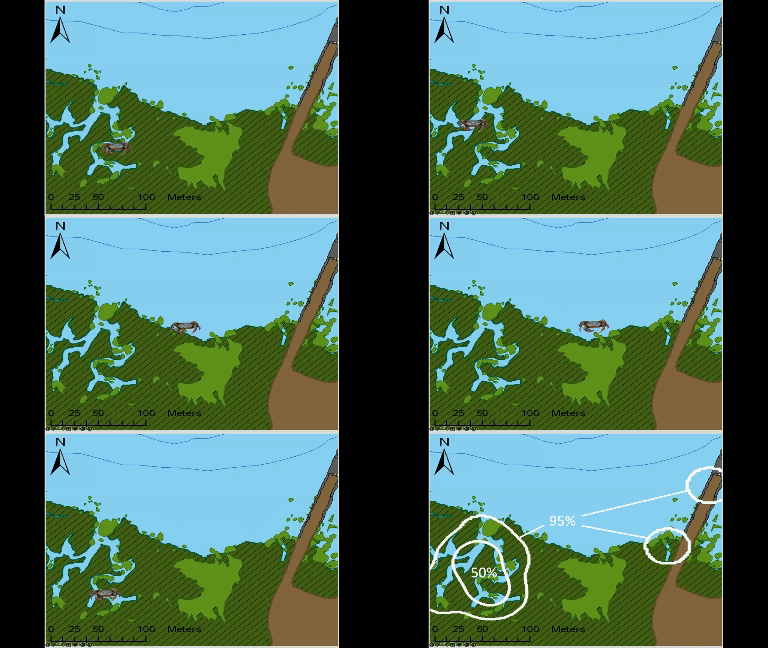
Animated GIF of movement of an individual green crab tagged and tracked at Kindred Slough in Tokeland as part of Sean McDonald’s research. The white circles at the end of the looped animation show the areas where the crab spent 50% and 95% of the total tracked time over two weeks.
Time and Tides Bring Better Tech
Early telemetry data added to our understanding of green crab behavior, and confirmed some of the conjectures from trapping observations, but they were quite limited. Efforts were restricted by both battery life (about two weeks) and researcher endurance (also about two weeks). Seasonal migratory patterns of green crab are likely also important, but crabs would need to be tracked for much longer than two weeks to be able to directly observe where they go in the cooler months.
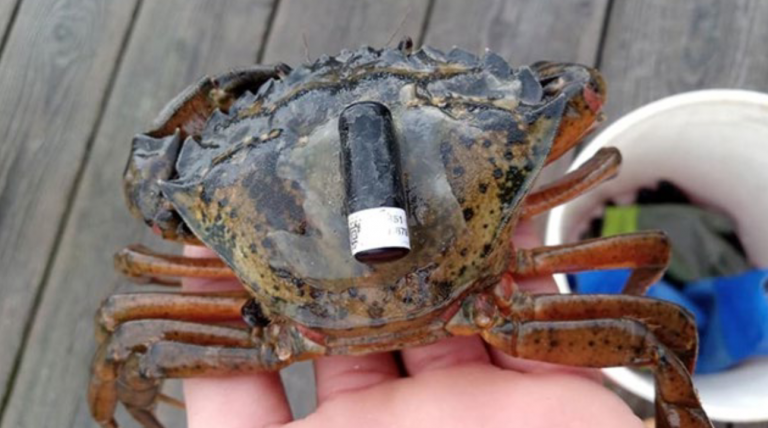
Green crab with acoustic tag used by Curtis Roegner in recent tracking studies. Photo courtesy of C. Roegner
Luckily, recent technological advancements in telemetry gear and battery life have created new and affordable tools that are beginning to shed some light on the hidden world of green crabs and researchers in several regions are taking a peek. A research team based in Maine recently used passive acoustic telemetry to investigate winter movements in the Webhannet River Estuary (Zarrella-Smith et al. 2022). Similar to Sean’s research, the team affixed “pingers” to a number of crabs and released them back into the estuary. However, rather than chasing down the crabs with a hydrophone, they were able to use a series of automated receivers positioned throughout the estuary, and listen in on the crabs’ pings remotely. Thanks to improved battery life, and lower impact on researchers, the team tracked 22 crabs in this way for nearly a year (July 2018 through April 2019).
Much like our earlier observations from the West Coast, it turns out these crabs stuck to their own little areas of the estuary, with each area being about 300-600 m (or roughly 3-6 American football fields) in length. But when the temperature dropped below 10°C, the crabs generally moved downstream. In the winter, nine of the crabs were found to be “overwintering” in the deeper waters of the lower estuary, likely to avoid the cold.
Closer to home, Dr. Curtis Roegner and other researchers from NOAA’s Northwest Fisheries Science Center set out to conduct a similar study in Willapa Bay. In September of 2022, Dr. Roegner and his team (shout out to Zach Forster and David Beugli who are both Crab Team monitors!) deployed two arrays of passive acoustic receivers in the vicinity of Nahcotta and tagged forty green crabs. Their goal was to better understand what green crabs do during winter. They retrieved the data at the end of February, 2023 (after 139 days of tracking) and began processing it. The early results are providing additional evidence of seasonal activity, or rather, seasonal inactivity.
“There were a few localized movements…”, said Dr. Roegner, “but most stayed put. In contrast, the majority of the sixteen Dungeness [crabs] we tagged moved away [from the release location and array]”.
Roegner’s team noted that more than half of the tagged green crab remained at the release site for the entire observation period, whereas all of the Dungeness crabs left the area by about day 14 (Roegner et al. 2023). The winter study also showed that green crabs do use shallow subtidal habitats during these colder months, but are still in the intertidal about 30% of the time. This is in agreement with observations by shellfish growers that can find them in their deeper gear in colder weather. By contrast, Dungeness crabs were almost strictly observed in subtidal habitats. Similar to the way trapping captures more green crabs around protective habitat structure, Roegner’s telemetry confirmed that green crabs did spend more time around oyster bags and reefs. Lastly, though the majority of travel distances were small, less than 300 m, some long forays did occur, indicating that in winter, green crabs can, on occasion, migrate out of a site, and to another.
The Next Move is Ours
These studies continue to improve our resolution of the highly seasonal movements and activity patterns of green crabs. Green crabs appear to predominantly occupy high intertidal habitat (greater than 0 feet above Mean Lower Low Water; MLLW) throughout much of the spring and summer. During this period, the crabs occupy a variety of structured habitat, like shell and marsh vegetation, for shelter and show a particular affinity for shallow sloughs, pools, and jetties, and most of the time they don’t travel very far. Once the weather cools in autumn and the days grow shorter, activity levels decline and the crabs may move into slightly deeper water to take refuge in the shallow subtidal zone.
These studies have confirmed some of the patterns observed in trapping efforts. By knowing where green crabs are spending more of their time, and when, trappers can target their gear to match seasonal movement. It would make sense, for instance, to focus trapping at intertidal elevations in the summer, but shift traps slightly deeper in the winter to account for “the hunker factor.”
-P. Sean McDonald and Emily Grason
Header image: Green crab with a slightly older version of acoustic tags used in early 2000’s California and Washington studies. Photo: P. Sean McDonald.