
This page provides tools and resources for active Crab Team monitors who have been through a Crab Team training workshop. If you are not already a monitor with the program, visit the Monitoring Network page to find out more about how to join up.
Below you will find guides, presentations, and learning resources for the sampling protocol and identification. A frequently asked question section provides insight into the hows and whys of sampling and we’ve shared tips and tricks crowdsourced from monitors over the years to help make sampling even smoother.
Monitoring Tools
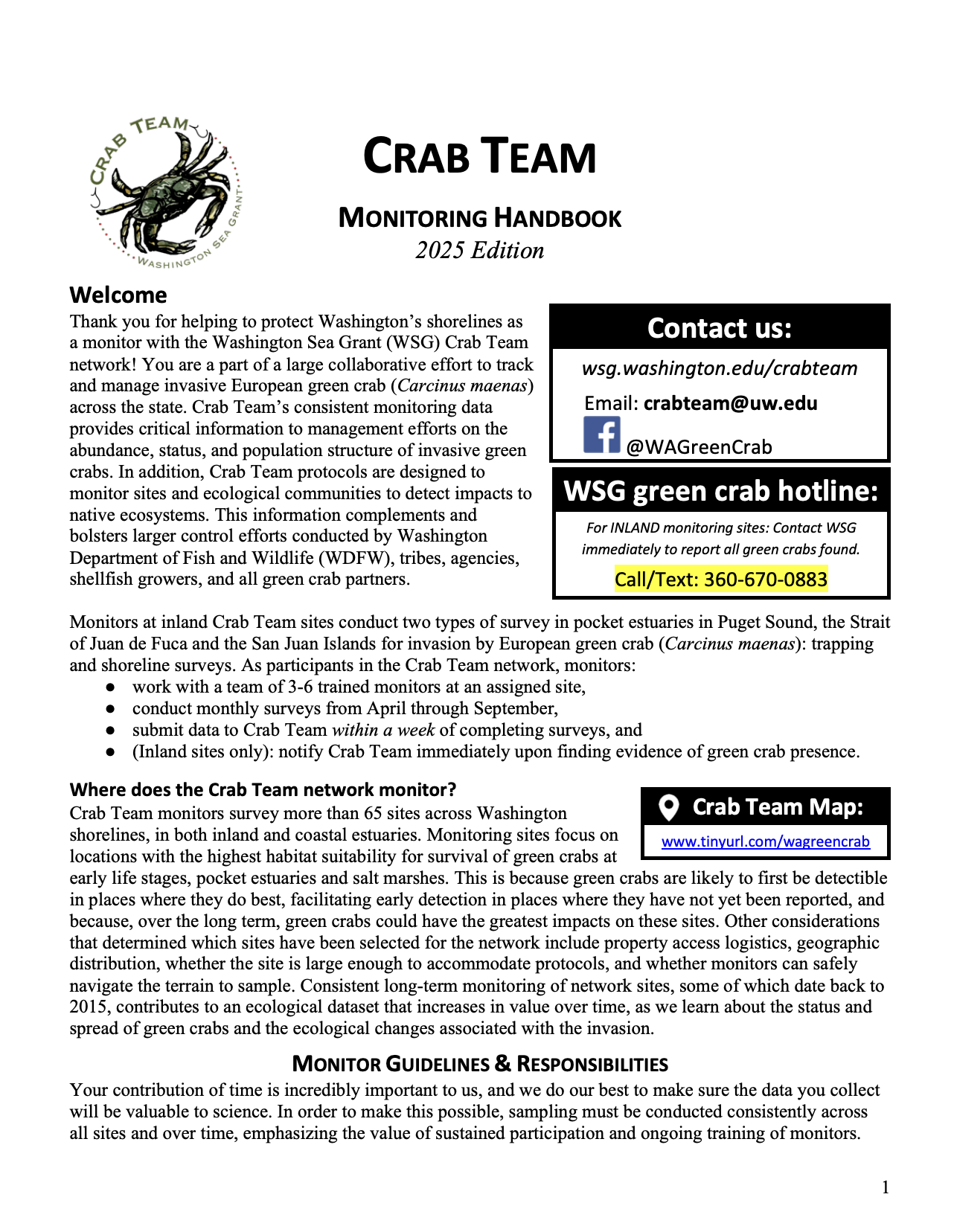
Monitor Handbook
The Handbook reviews protocols for trapping, hunting molts and submitting data. A monitoring protocol “cheat sheet” is included.
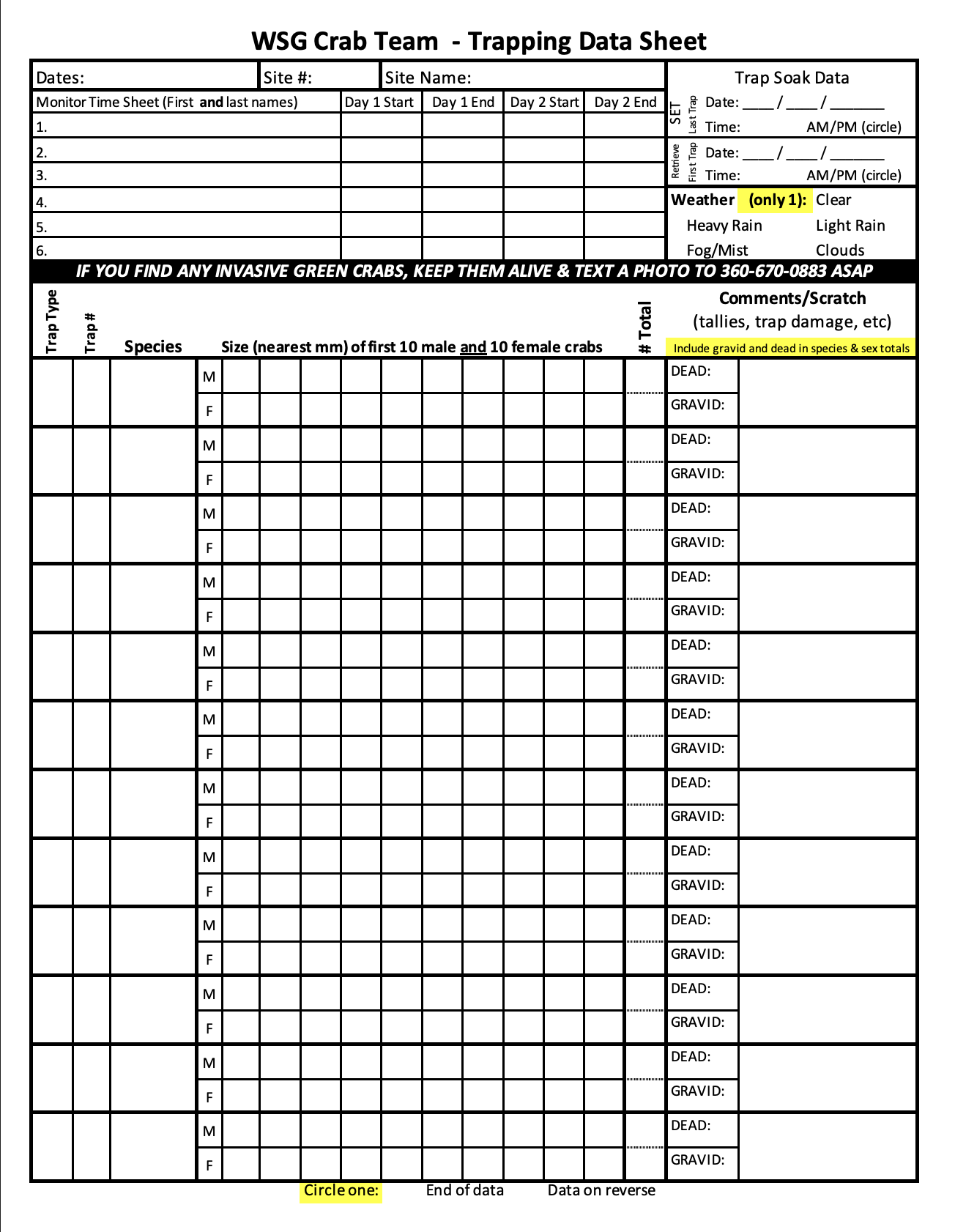
Trapping Data Sheet
This data collection sheet is the required method for monitors to record trapping data.
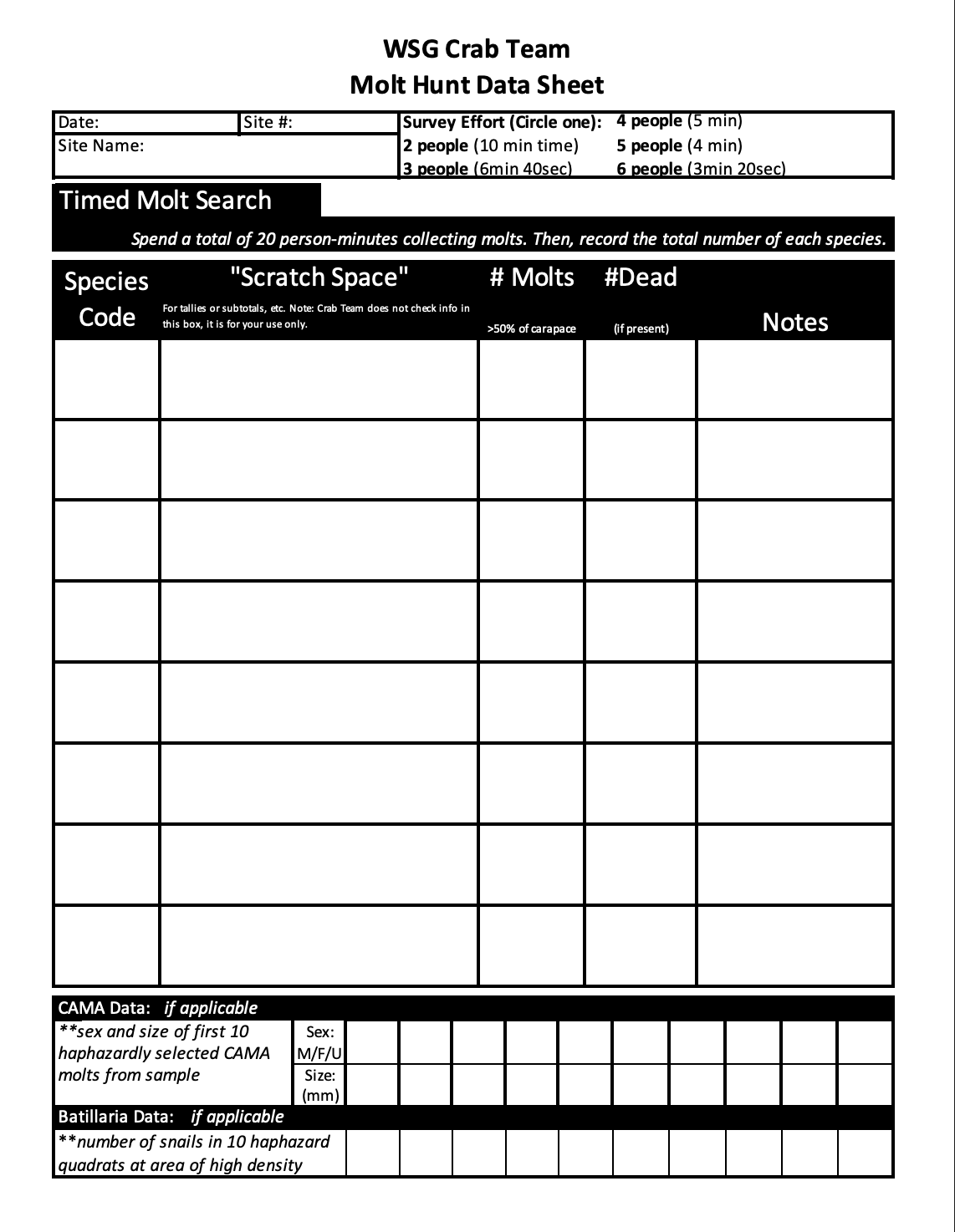
Molt Hunt Data Sheet
This data collection sheet is the required method for monitors to record molt hunt data.
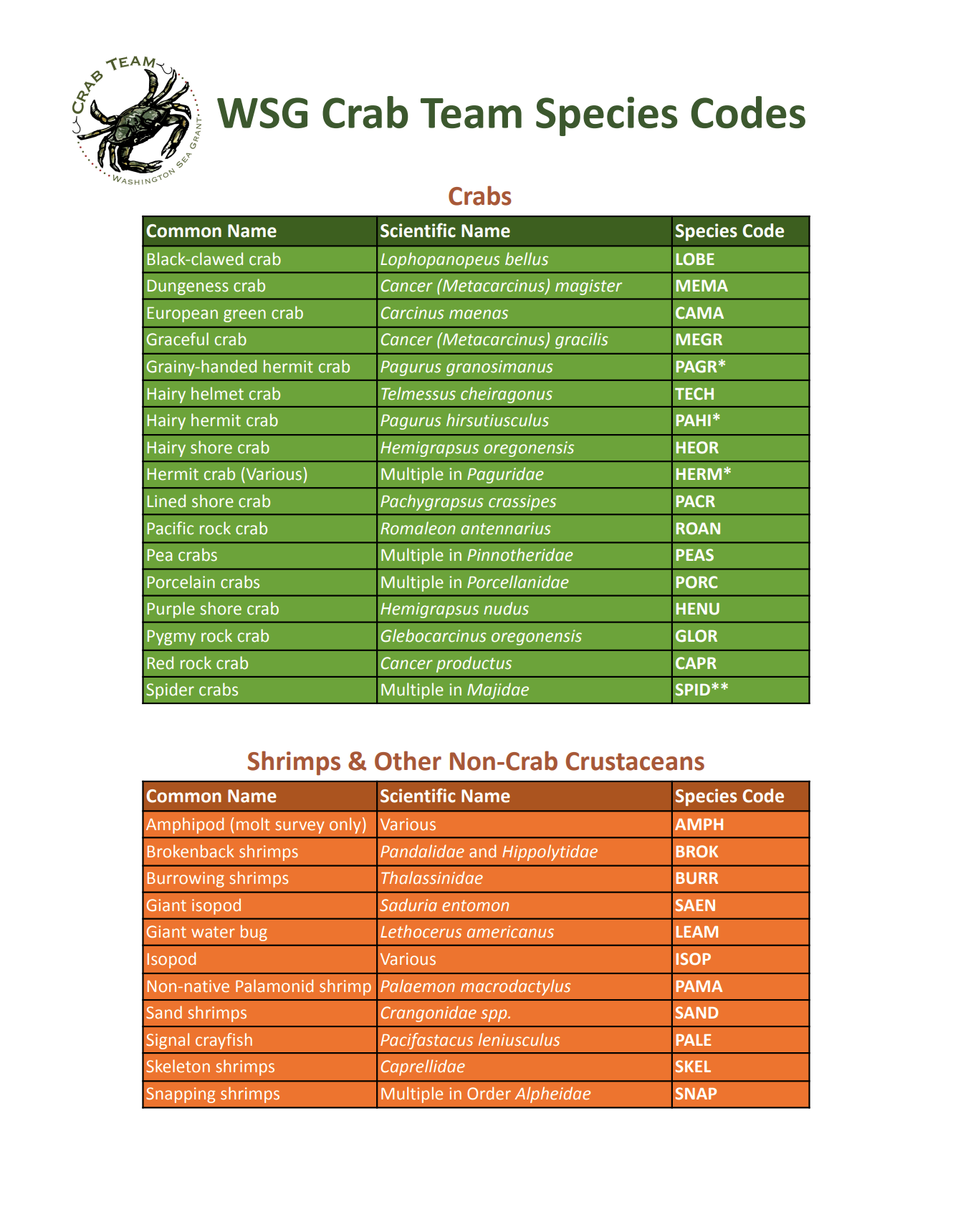
Species Codes
Lists all of the species codes monitors are likely to encounter in the field.
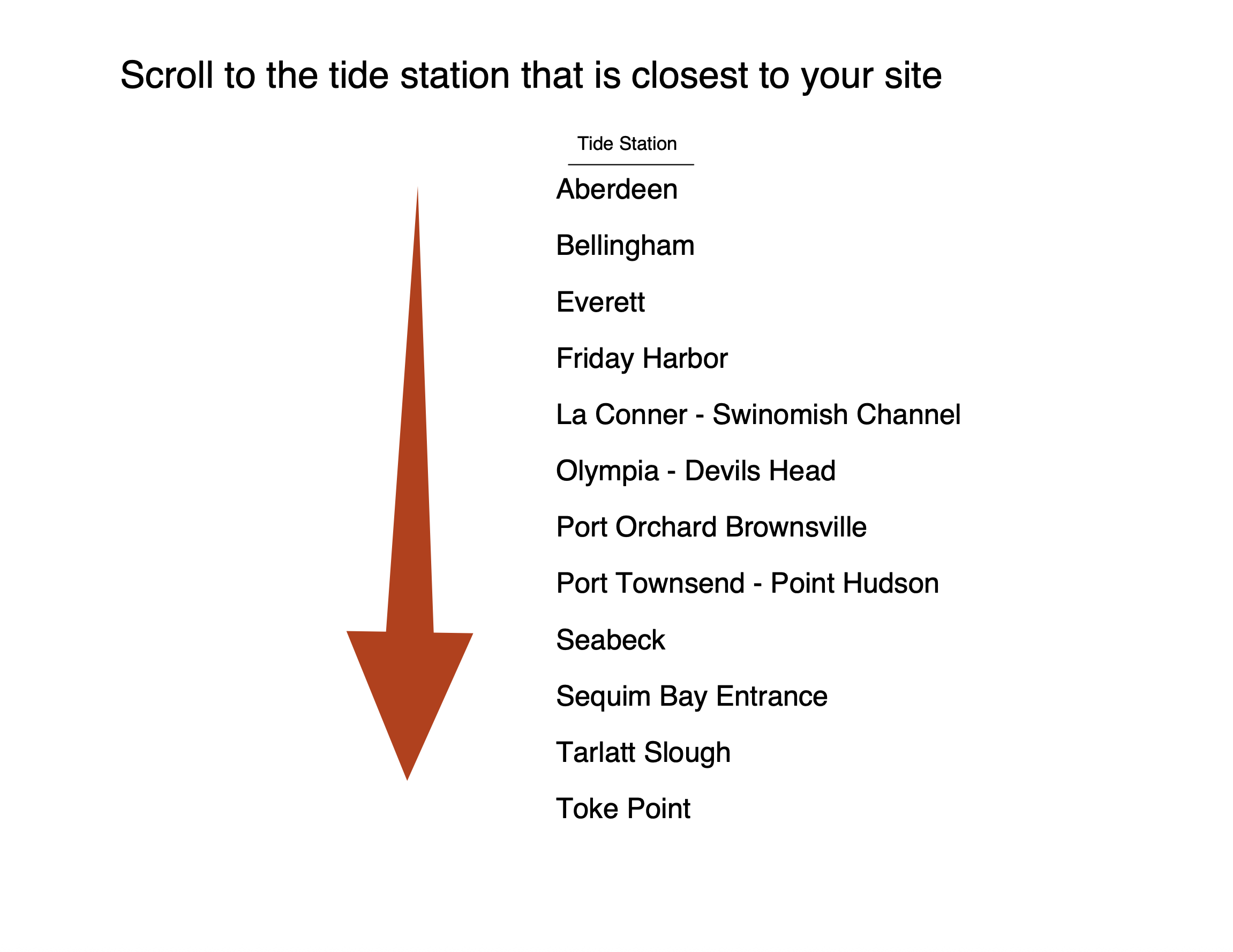
Stoplight Calendars
Guides monitors toward the best sampling dates.
Site Map
The Site Map includes the location of active monitoring sites as well as a coarse-scale assessment of the best habitats for European green crab in the Salish Sea. The date and location of green crab captures for nearly all sites within the Salish Sea — except data on crabs captured on the Lummi Reservation, which is maintained by the Lummi Nation — is also included.
This map is presented for informational purposes only, please contact Crab Team directly if you would like to use data for research or management.
Protocol Presentations
Recorded presentations describe each of the protocols for you to review at your own pace. Several include questions to check your understanding.
Introductions and Guidelines
Provides background and guidelines for WSG Crab Team protocols.
Trapping
Reviews the WSG Crab Team baited trapping protocol.
Molt Hunt
Reviews the WSG Crab Team molt hunt protocol.
Data Submission
Guidance for submitting data from WSG Crab Team sampling.
Crabber’s Code
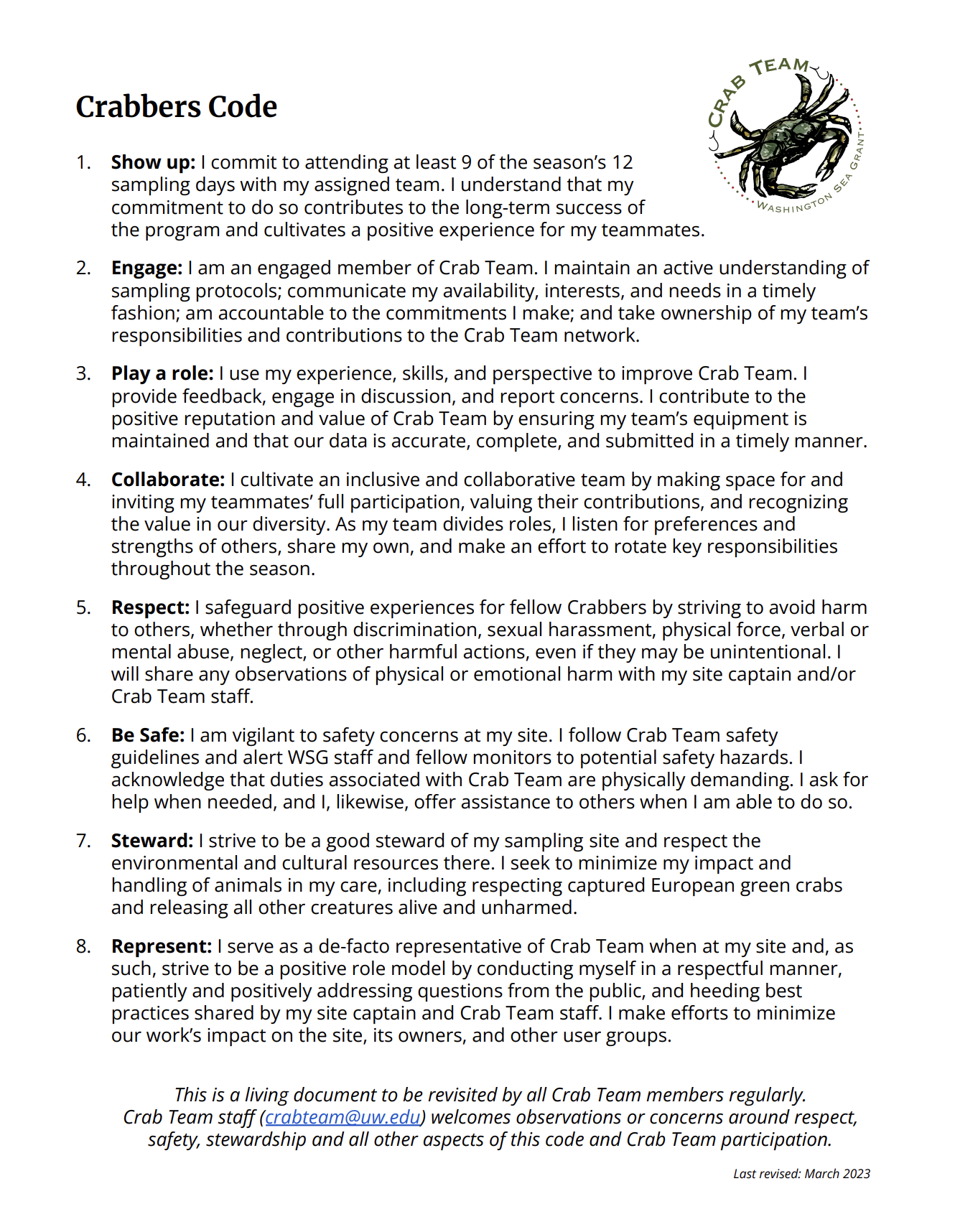
Crab Team monitors and staff co-developed these community agreements to guide our work together. You can learn more about how the code was written on our blog.
Identification Resources
Guides
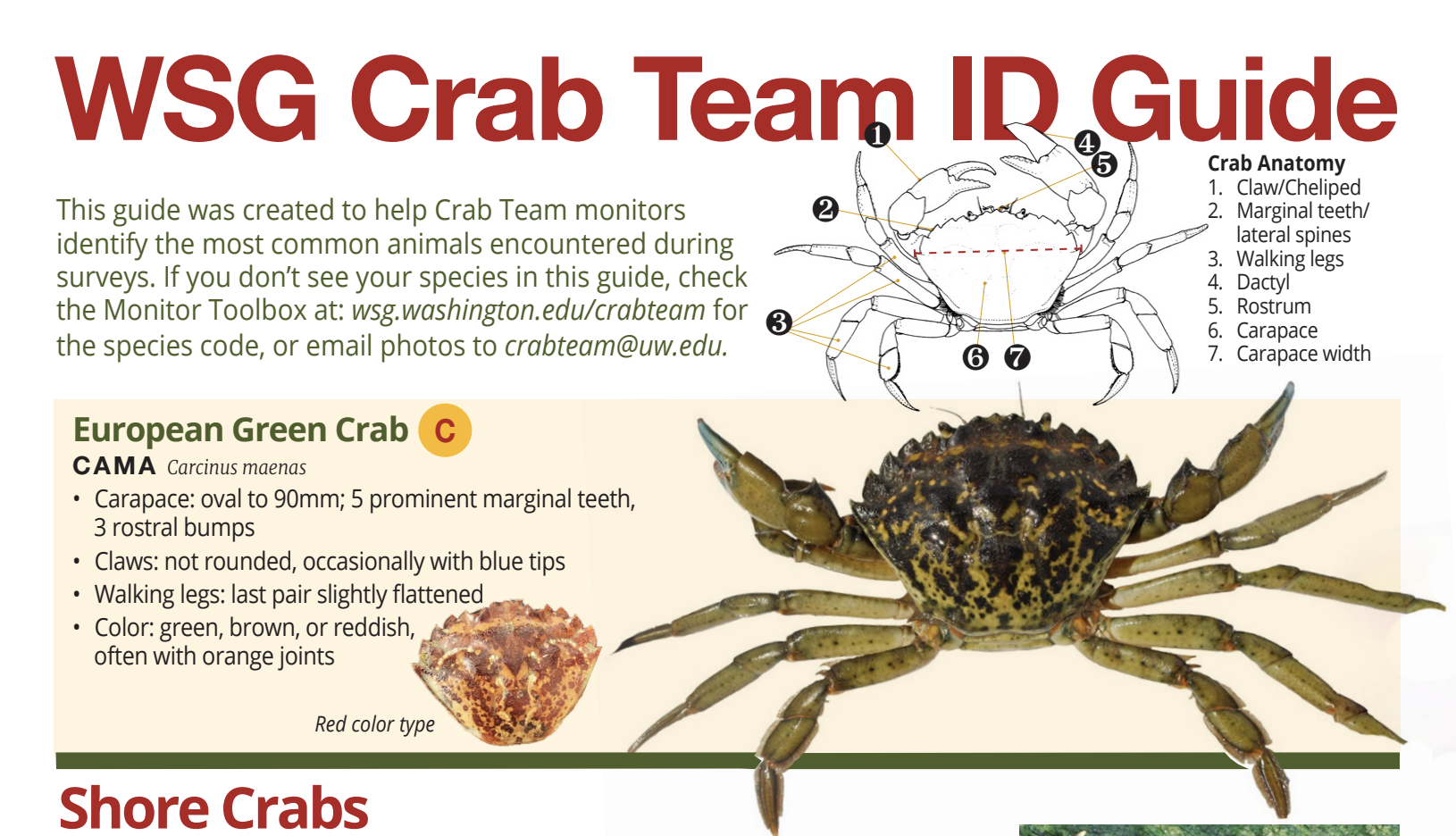
All Species
Helps monitors identify the most common animals encountered during surveys. It includes the “crabdomen guide,” a collection of images to help distinguish between male and females of common crab species.
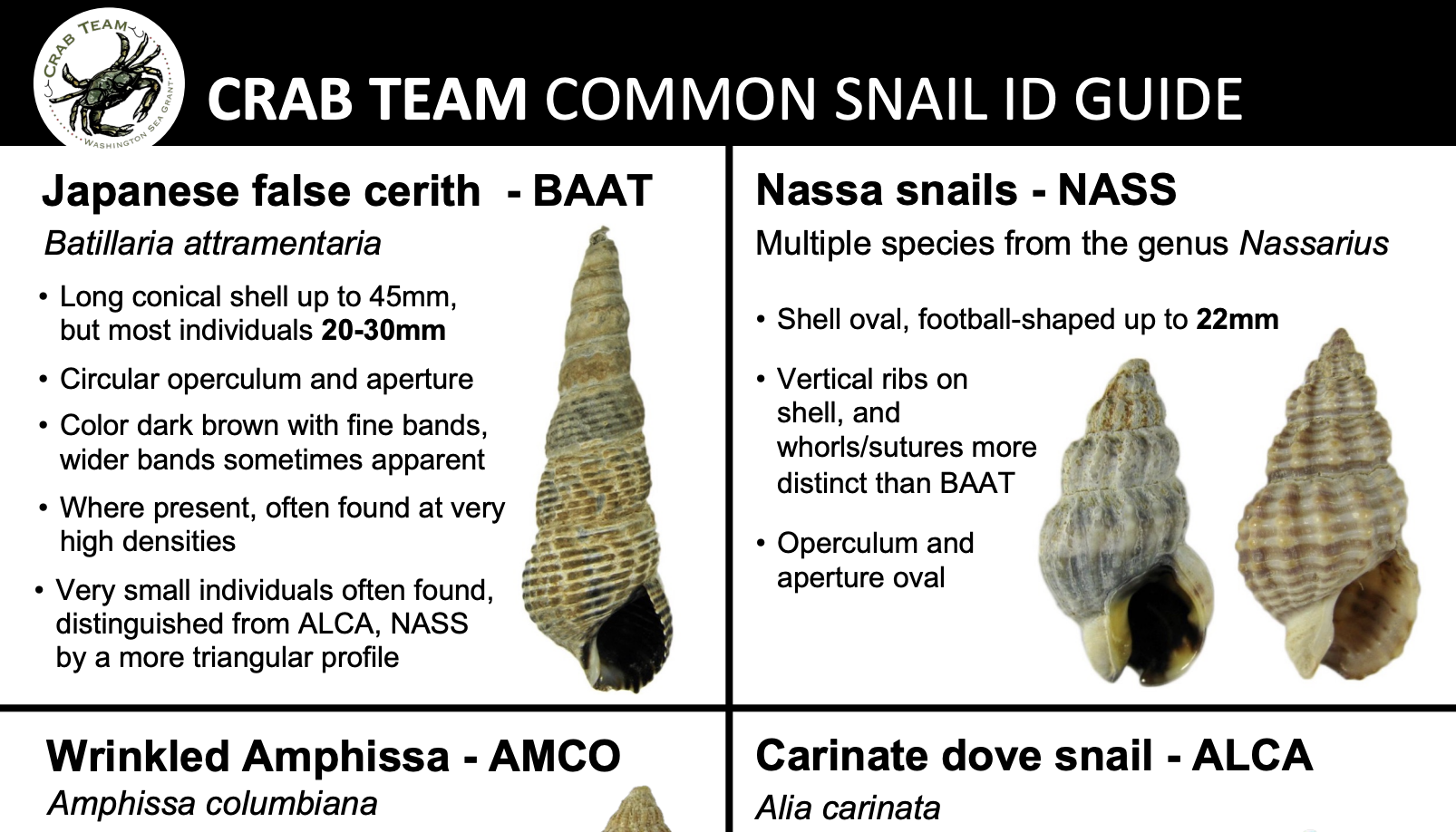
Snails
Helps you distinguish among 10 common types of snails.
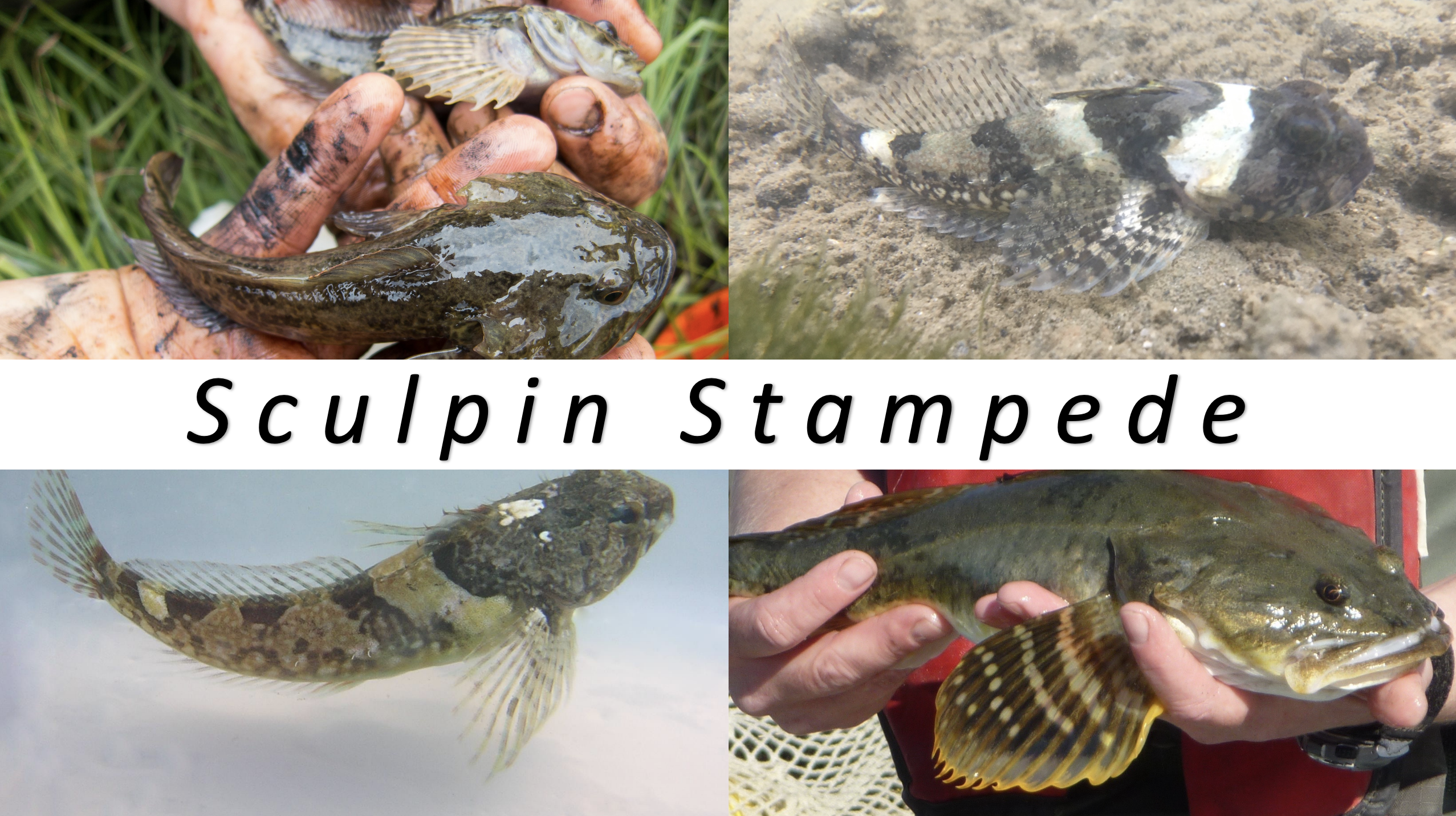
Sculpins
Helps you distinguish among the common species of sculpin (a type of fish). This quick comparison sheet and these flashcards are also great for distinguishing LEAR vs OLMA and COAS sculpins.
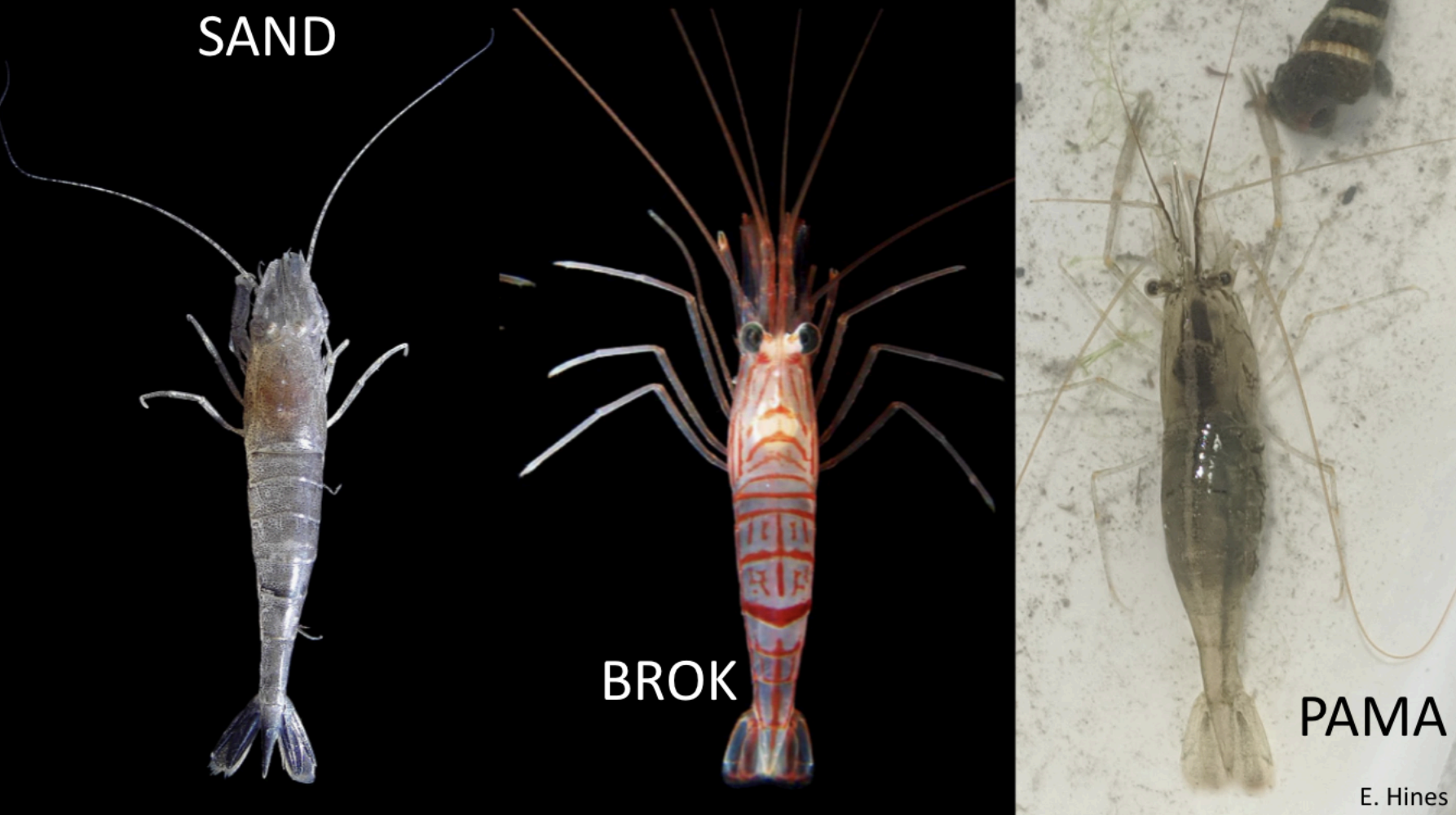
Shrimps
Helps you distinguish among three different types of shrimp.
Videos
Green Crab Identification Tutorial
This video tutorial by Marine Ecologist Emily Grason provides a concise overview of how to identify European green crab.
HEOR, HENU, HE-WHO?
These resources can help you distinguish purple shore crabs from hairy shore crabs.
Additionally, check out the HENU-HEOR Comparison Chart!
Diversity Bonanza
Flashcard Resources
Want to improve your identification skills? These decks of flashcards are designed to help you learn to quickly distinguish among easily-confused species of crab.
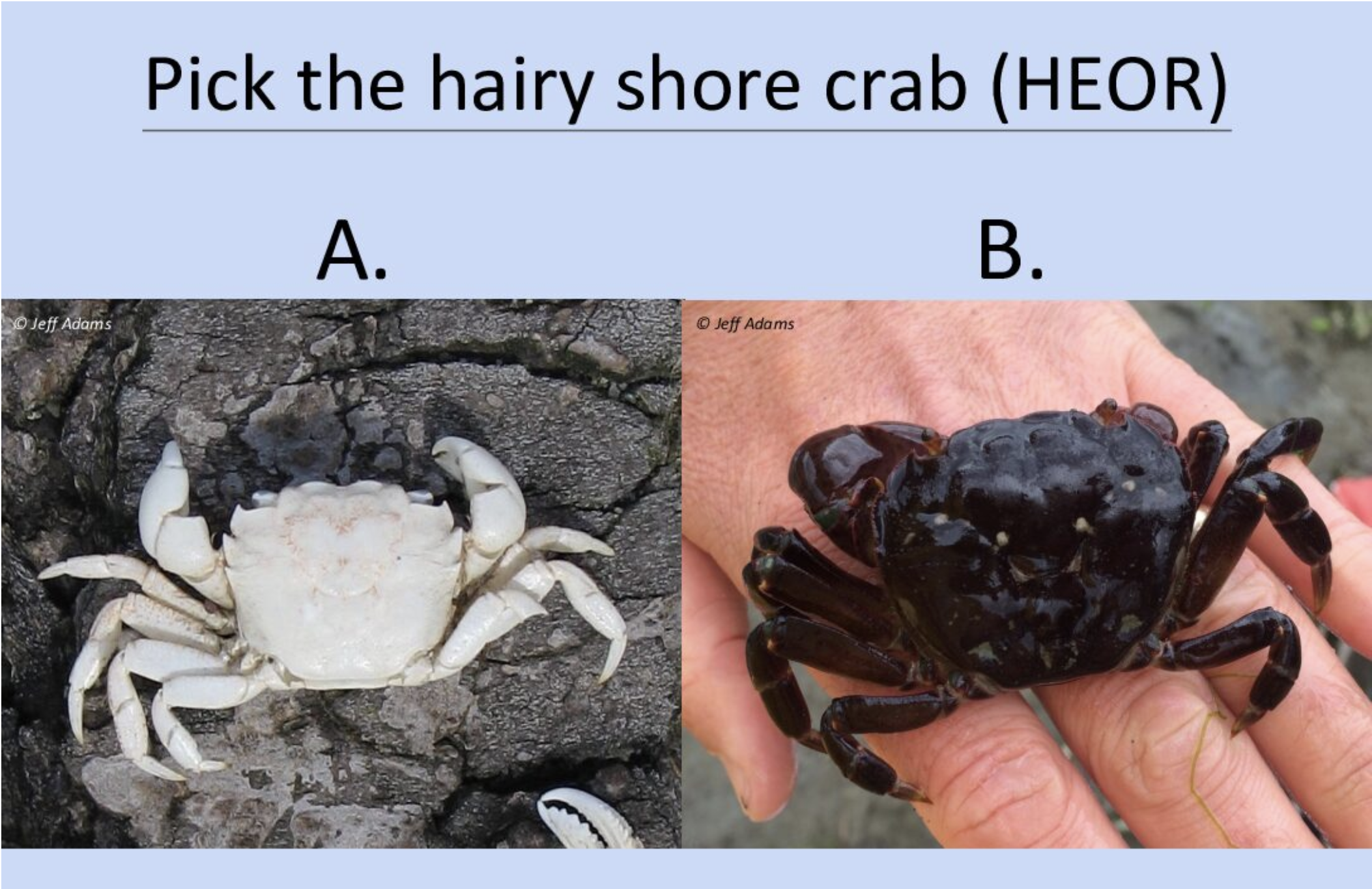
Similar shore crabs: hairy shore crab vs. purple shore crab
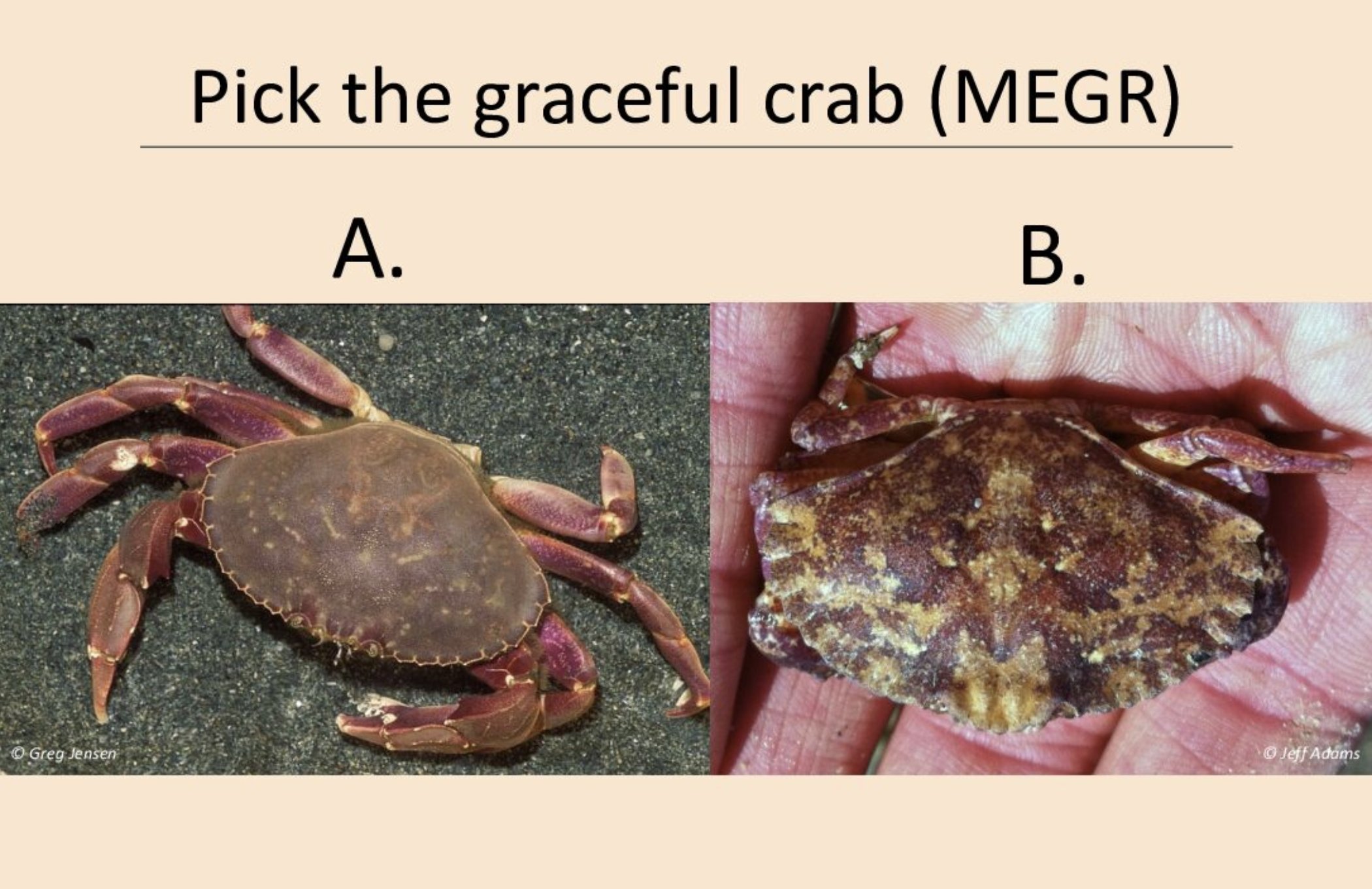
Comparing Cancrids: Dungeness vs. Graceful vs. Red Rock crabs
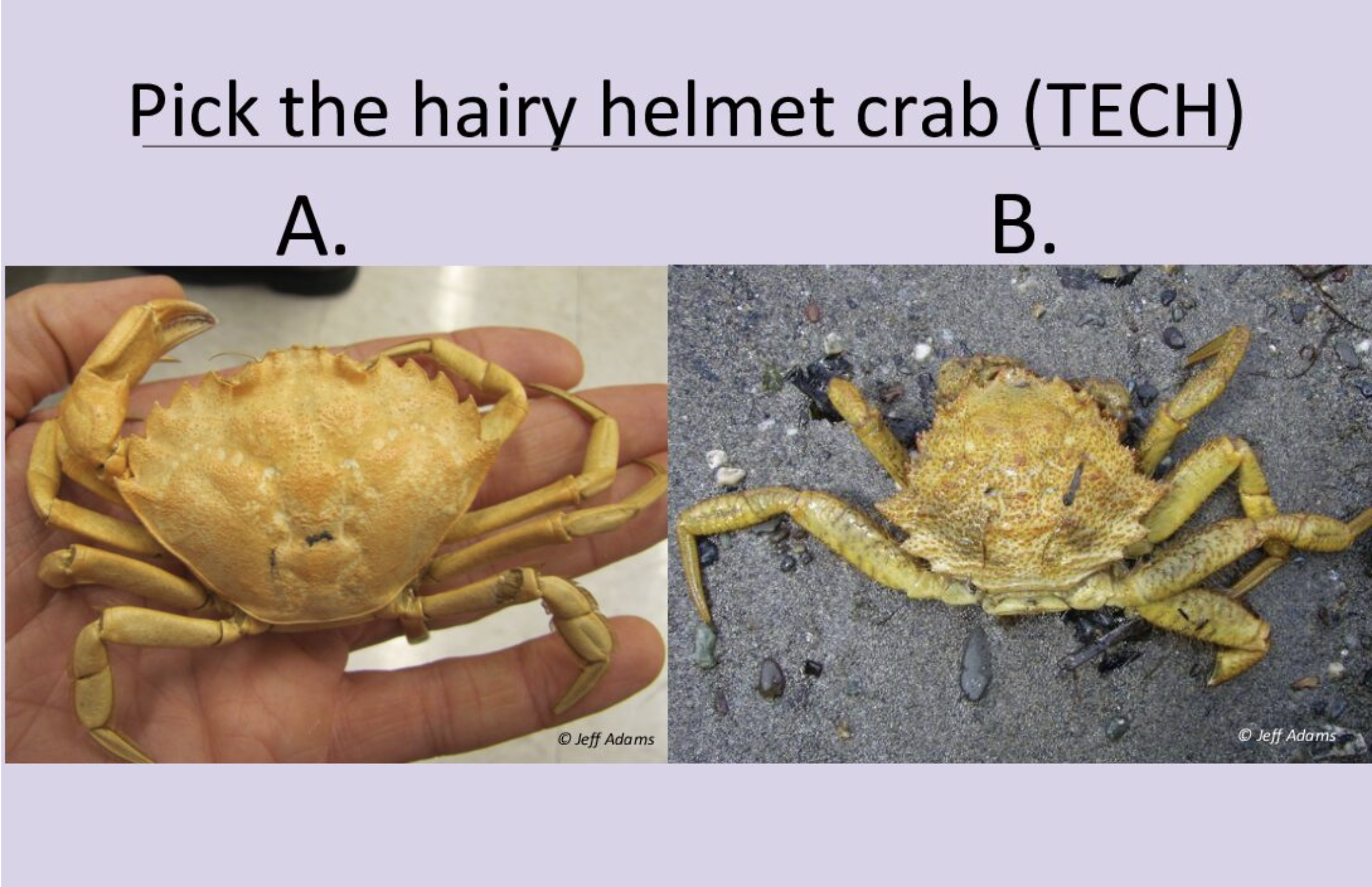
Rare finds: native hairy helmet &. spider crabs vs. invasive green crabs
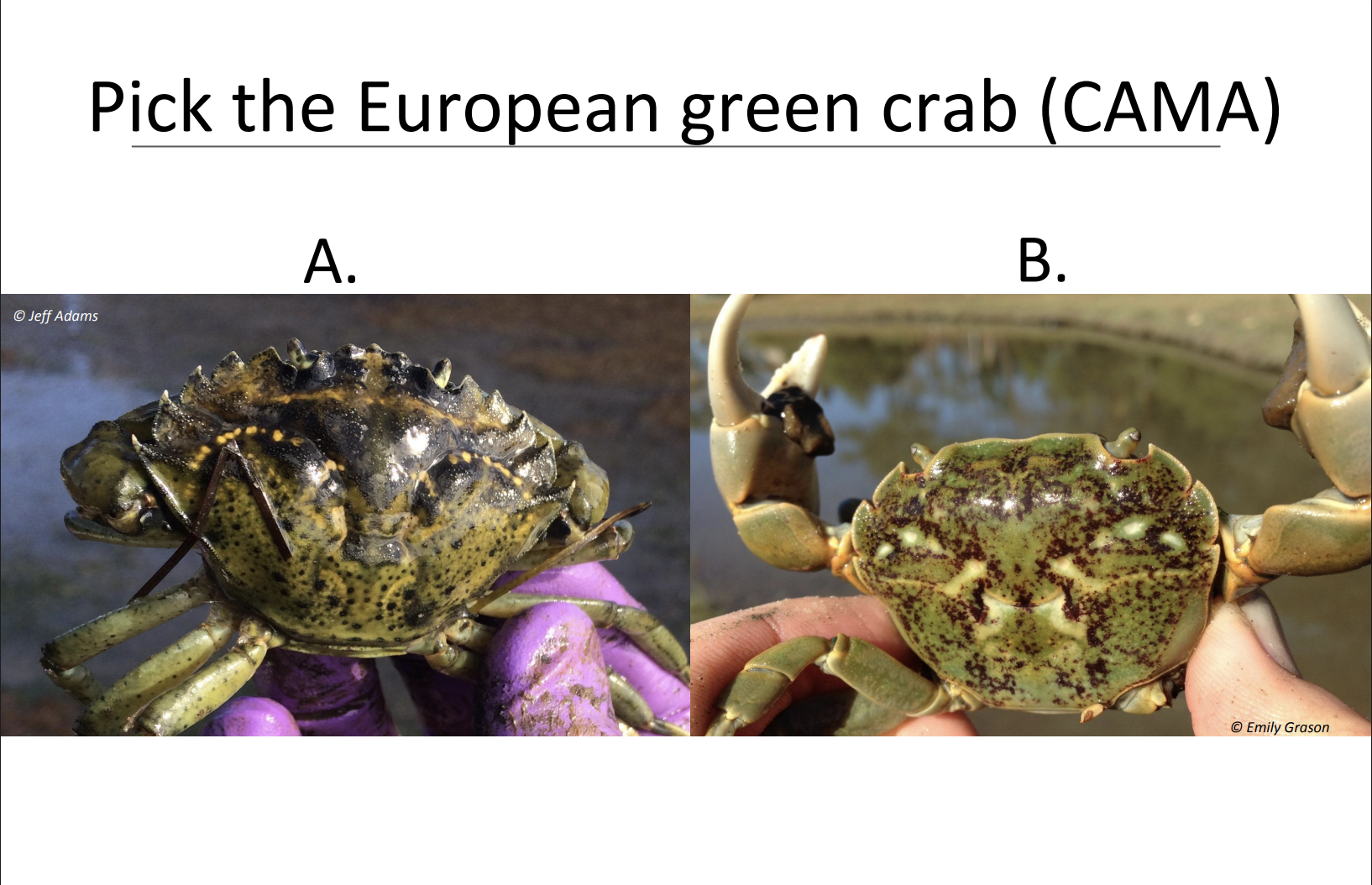
Find the invader: invasive green crabs vs native crabs
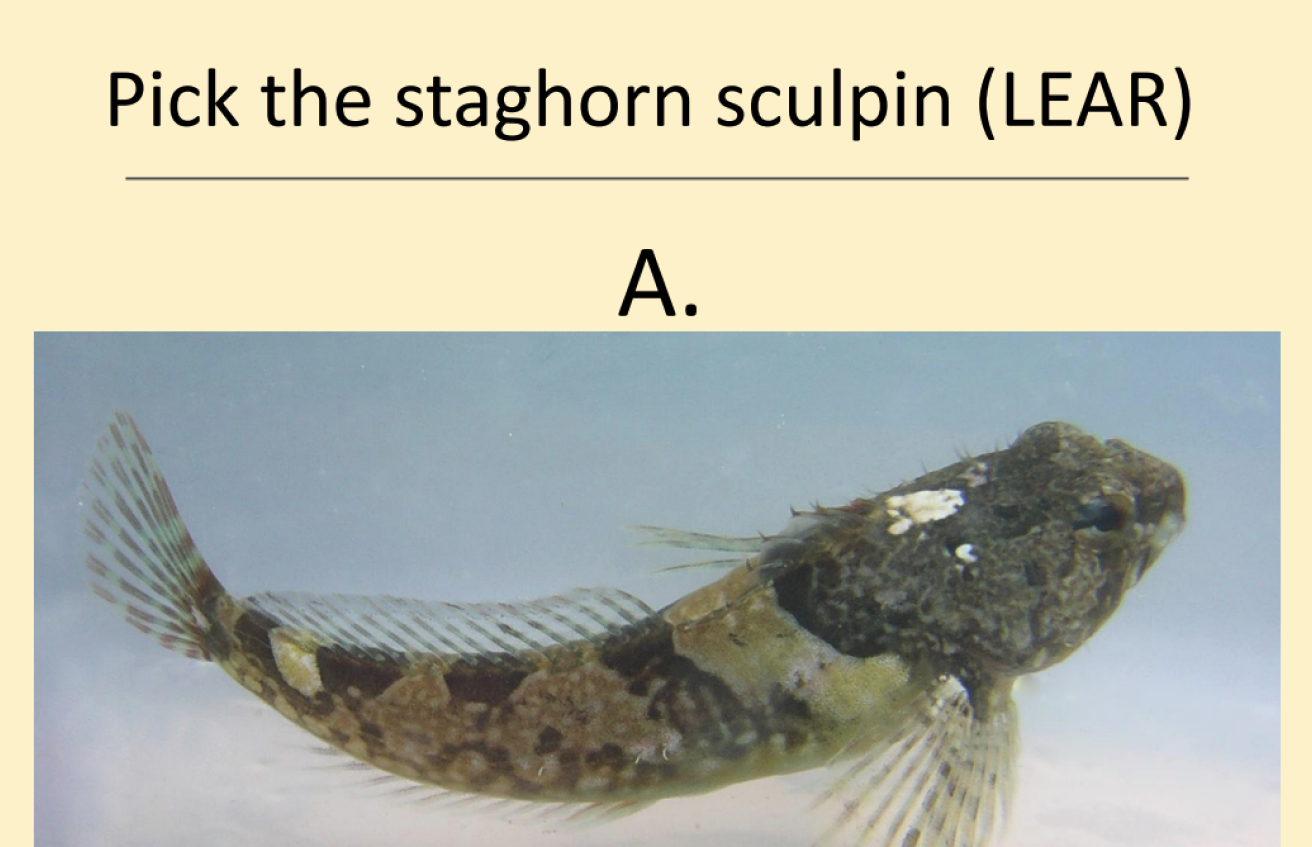
Sculpins: LEAR vs OLMA and COAS
Find Something You Can’t Identify?
As always, we are available to help you identify everything you find while surveying. When emailing Crab Team with questions, be sure to send multiple photos. Your photos should:
- Include something in them for scale, like the calipers, scale bar, or coin
- Be taken from multiple angles (top view, side view, etc.) and distances (from close-up and from further away)
When you have your photos, email us at crabteam@uw.edu.
Monitoring Outputs
Data collected by monitors informs critical reports and research on green crab.
Reports
Track the green crab invasion over time
Research
Informs shoreline management
Frequently Asked Questions
Where and when do I submit data or data sheets?
Please submit data gathered each month electronically (as below) within a week of completing sampling. After your final sampling for the season has been approved, please mail us the hard copies of the data sheets in the pre-addressed envelope you received at the beginning of the season. If the envelope is no longer available, use the general WSG mailing address:
Crab Team
Washington Sea Grant
Condon Hall
Box 355060
3900 7th Ave NE
Seattle, WA 98195
To submit data electronically each month:
1. Verify completeness of data sheets. Check that site and data information, full names of monitors and hours are all completed. Ensure each row in the trapping data sheet is clearly totaled in the correct column. If you have questions about species identification, please get these answered before you submit your data sheets, so the data submission is complete.
2. Scan or take a photograph of data sheets. Your phone is often adequate for this, but quality can often be improved (and file size decreased) by using a scanner, or a scanning app on your phone. Open all the datasheet images before sending to verify they are readable.
3. Rename files according to the convention. This might require transferring files to your computer, as not all phones allow you to easily rename photos. All file names should follow the basic format:
Site Number
Year (two digit, e.g. 26)
Month (single digit, e.g. 6, rather than 06 for June)
Content, either “Trap” or “Molt” for data sheets, and trap type and number (corresponding to photo card) for trap photos.
Examples: 333.26.6.Trap.pdf 333.26.6.Minnow.1.jpg
4. Email all images to crabteam@uw.edu. Multiple emails are fine if necessary. File sharing websites like Google Drive and Dropbox also work for us. Make sure that if you have the chance to select the file size for photographs, that you choose at least “Large” or “Actual” size. Selecting Medium or Small will result in pictures that are too low resolution to see details necessary for species identification. Photos of trap contents should ideally be at least 1MB in size to enable us to view hairs on the legs of crabs.
How do I get more ____________?
We try to provide you with everything we think you will need at the beginning of the trapping season. Sometimes, however, you just run out of something, or calipers are jammed by the mud. We will do our best to replace any gear you have run out of. Just try to give us enough time to get it to you. If there is some piece of equipment that would make your monitoring easier, email us at crabteam@uw.edu.
How do I decide what time to schedule monitoring?
A basic outline of the important things to think about when scheduling monitoring is included in the Monitor Handbook (above). Molt surveys can be conducted any day of the month that the shore is accessible, but you will need to think about the tide cycles for timing trap surveys. You need to know the tidal elevation of your site, specifically the height at which you will set your traps. Most Crab Team traps are at a +4’ tide. Looking at a tide chart will help you predict what times the traps will be under water (fishing) or exposed. A good website for tide charts is NOAA Tides and Currents, and TideGraph is an excellent app for iOS.
Traps should be submerged in saltwater for the entire time they are set for a few reasons: first, so they are always fishing; second, so any live organisms are constantly kept in water and will be in good condition to be released; and third, so terrestrial animals and people are less likely to touch the traps.
Look for days when:
- The daytime low tide drops below the elevation of your traps (+5’ is a good general rule);
- The subsequent overnight high tide (when crabs are most actively foraging and attracted to traps) will be above the top of your traps;
- The overnight higher-low tide stays above the elevation of your traps (again +5’ in general); and
- The ebbing tide on the retrieval day occurs during daylight hours, and gets low enough that you can retrieve your traps.
Time your trapping so that traps go into the water on the rising tide, just as the water is rising to cover your traps. On the next day, retrieve traps at the earliest time the water is dropping low enough to reach your traps.
Many sites retain some water on even the lowest tides, like a lagoon or a deep channel. If this is the case at your site, you will have more flexibility about when your traps will be under water. It is still best practice, however, to set the trap on the rising tide and retrieve it on the ebbing tide, because it will reduce the amount of time that animals in the traps are confined.
Every site is different, and Crab Team staff can help you think through your site and what will work best to keep people and animals safe.
Additional Tools:
- “Stoplight” calendars show you the best days for sampling based on tides for your region. You’ll still have to look at a tide chart to select a time to deploy and retrieve the traps, and you will have to verify the tides work at your particular site. Check the Monitoring Tools section, above, for tide calendars for your region.
Scheduling polls: Once you have days and times that will be suitable for sampling, you can query your group using a scheduling poll. Some we use are Doodle and WhenisGood.
How do I record a species I can’t identify?
Part of our goal in this project is to have the highest quality dataset possible. With that in mind, we always try to identify every organism to the species level. Our Identification Guide has many of the species that we think you are likely to see in your surveys. However, each site is different, and we can’t list absolutely everything you might encounter. In addition, some groups, like sculpins, can be really difficult to tell apart because there are many similar species.
If you find an organism, but aren’t sure what it is, contact us. We love playing Sherlock and trying to solve puzzles of mystery organisms! Take several photos from different angles and levels of magnification, and include some items for scale so we can see how big it is. If it is a molt that you can’t identify, you can keep the molt so we can get the specimen from you to be 100% positive.
On your data sheet, you can use a place holder, such as “Unknown species A/B/C/etc.” until we can figure out what the organism is. We will provide you with the information you need to use on your data sheet. Thus, please wait to email your data sheets until you have identified all the organisms to the species level.
If you know the species, but aren’t sure of the code, check the list of species codes which includes all taxa observed during Crab Team monitoring. If you know the scientific name of the species, the code is generally the first two letters of the genus name and the first two letters of the species name: CAMA is CArcinus MAenas. As always, adding more detailed information in the notes column, and emailing us to confirm before sending in the data will speed up the process. In most cases, additional photo documentation will be needed to verify species that aren’t in the ID guide, so be sure to take photos and submit them with your questions.
What do you mean by selecting crabs “haphazardly”? Why does it matter?
Haphazard sampling, which is distinct from “random” sampling in the strict sense, is a common feature of many ecological studies. It is a practice that attempts to balance statistical rigor with field practicality, and reduce both human and crab bias in determining which crabs get measured. Reducing these biases is the best way to be sure that the subsample of crabs we measure closely matches the true sizes of all the crabs in each trap.
The short answer about the best way to do it is:
1. Close your eyes (reduce human bias),
2. Gently mix the crabs in the bin (reduce crab bias),
3. Select the first one that you grab and measure it.
Caution: You might want to modify this if you are dealing with larger, “pinchier” crabs!
A more detailed explanation of why we use haphazard selection is available in our blog.
Is this crab a male or female?
In general, females have wider abdominal flaps than males, helpful for carrying eggs they brood. But the relative width and shape of the sex difference can vary depending on the crab species. In juvenile crabs of many species, the abdomen of females does not reach the full width of an adult female.
This blog post talks about distinguishing between crab sexes, and our identification guide includes the “crabdomen guide,” a collection of images to help distinguish between male and females of common crab species.
One particularly confusing scenario occurs with hairy shore crabs (Hemigrapsus oregonensis, HEOR) which can be infected with a parasitic isopod that feminizes the males — that is, it causes the males to look more like females in the shape of their abdominal flaps. The effects of this parasite on hairy shore crabs are detailed on our blog.
If you come across a HEOR that doesn’t quite look like either male or female, assume it is a “feminized male”, and count it as a male. Record the carapace with (if it’s one of the 10 you haphazardly select to measure) in one of the 10 boxes, and include it in the total number of males for that trap. Though not required, you’re welcome to make notes of any feminized males you catch in the notes section for that trap.
As always, if you aren’t sure what you are looking at, take good notes and send us several close up photos to ID for you. Please send us these photos and questions before you submit your data, so the data sheet you submit is complete.
How do I know if it’s a molt or a dead crab?
Though it may seem like an easy distinction, sometimes it can be tricky to discern whether the shell in your hand is a molt or a dead crab. To help you get to the bottom of it, we’ve outlined four questions you can ask yourself. More details about distinguishing molts and dead crabs are outlined on our blog.
1. Is there any obvious trauma? Some predators will leave specific clues behind after munching on crab shells. For example, gulls tend to peck out the center of the abdomen.
2. How heavy is it? Molts are typically much lighter than dead crabs with tissue still intact. But the difference may be slight if the dead crab has fully dried.
3. Does it open? Because molting crabs essentially climb out the back of their shells, the shell of a molt should easily open on a hinge (much like a jewelry box). If it’s hard to open, it’s more likely a dead crab. But this feature is size dependent. The molts of shore crabs (HEOR and HENU) rarely open easily once dry, so this is not a useful question for that group.
4. What’s inside? Molted shells should be quite clean inside, while dead crabs may contain goo or crust of internal tissue. However, molts keep the feathery gill covering, which can look a lot like residual gills.
If you come across a shell that you’re not sure about, take some notes on your molt data sheet and snap some close up photos from different angles. Send them our way, and we’ll help make the call. Please remember to send us these photos and questions before you send us your data, so that your data are complete upon submission.
Why do we use two types of trap?
The minnow and Fukui traps target different sizes and shapes of organisms. The minnow trap has a smaller opening and mesh size, meaning it catches smaller critters than the Fukui. We use both traps because we are trying to get a snapshot of everything that lives in pocket estuaries. “Zeros” are also very important data points in our sampling scheme. So, even if one type of trap is more often empty at your site, we are learning something about what isn’t at your site relative to other sites in the network!. A more detailed explanation of why we use two types of traps is shared in our blog.
What happens to my data after I submit it?
Crab Team data goes through a rigorous review and validation process before it’s entered into spreadsheets. Raw data is shared with agencies and organizations that own or manage the monitoring sites. Additionally, the data is analyzed by our team and used to write reports and publications. A detailed description of the data review process is outlined on our blog.
Why do we use mackerel as bait?
Believe it or not, quite a bit of thought went into what type of bait we would use for monthly Crab Team monitoring. There are two critical aspects: it’s smelly, and we can use it consistently across the entire network and over time, ensuring comparability of data. Learn more about how we landed on mackerel as our bait of choice in our blog.
How can we be good stewards of Crab Team monitoring sites?
The act of sampling can be a disturbance to a site — repeated visits to muddy habitats can trample vegetation over time, and being caught in a trap can stress native crabs and fish. Multiplied by more than 65 sites, six times per year over successive years, the cumulative effects could be substantial, and even reduce the resilience of sites to green crabs. Therefore, Crab Team has designed our monitoring protocol with the goal of being good stewards of Washington’s shorelines.
There are many ways you can protect the habitat from the impacts of sampling, including checking traps within 24 hours of setting them; using existing trails when possible to access sampling sites; quarantining the sampling gear, and more.
Read our full list of best practices to be a great steward of your site. Following all of these tips helps ensure that we can continue to monitor our Crab Team sites for years to come.
Why do we measure European green crabs?
European green crab size provides information like their age and their ecological role at the location they were trapped. Knowing the size and age of green crabs helps researchers understand invasion timing, population structure, population forecasting, as well as predation impacts. Learn more about why it’s important to measure green crabs in our blog post.
Why do we measure native crabs?
It is a crab eat crab world, so knowing the size of native crabs in addition to the size of European green crabs helps us predict the outcomes of interactions between different crab species. Learn more about documented crab interactions on our blog.
Why is taking good bin photos important?
Your bin photos may feel as easy as the click of a button, but they are the essential step in the protocol that allows the Crab Team dataset to be used by researchers. Namely, they are the tool for validating all your findings in our data quality control process. Learn more about why bin photos matter on our blog.
Tips and Tricks
After a decade of monitoring Washington’s shorelines for invasive European green crab, Crab Team monitors are seasoned pros. This crowd-sourced list of tips and tricks from Crab Team monitors can help make the process more accurate, efficient, and fun! Did we miss a tip? Send it our way at crabteam@uw.edu.
Gear
Sticky minnow traps? – In addition to giving them a thorough rinse, store minnow traps with old newspaper in between each half so they’re easier to pull apart. Still stuck? Roll the minnow traps, then grip the bottoms between your knees or feet, while rotating the top in a twisting motion (rather than pulling straight up) to get them unstuck.
5 gallon buckets do it all! They are great for carrying water for rinsing things, as seats, for carrying gear, and for helping you get out of the mud.
Clunky calipers? Spray the metal rod on calipers with cooking spray or another (environmentally safe) oil to make it easier to slide them open. Rinse them after each use to reduce jamming from rust and silt.
Heaps of HEOR? Bring extra dish tubs to make the process move faster, especially if you have a large team. One group can separate sexes while another group measures. A dedicated blue bin for the males, a dedicated pink bin for the females, and one additional bin (for anything not a hairy shore crab) can make the sorting process easier. On the side of the bin, try attaching a thumb clicker with velcro so you don’t have to keep a running tab, you just have to check the number on the clicker at the end.
April showers feeling chilly? In that first cold monitoring month, wear neoprene to help keep you warm (just make sure to rinse thoroughly afterwards).
Mired in mud? If it’s appropriate at your site, you can lay 2” x 4” boards down at particularly muddy areas to help prevent getting stuck. Be sure to remove these from the site when you are finished for the day and avoid damaging any vegetation.
Traps in the deep? Bring a tree pruner, garden rake, or gaff to grab the trap. Be careful not to rip the mesh of the Fukui traps as you pull them up, though. Garden rakes can also help you maintain balance and get out of the mud if you’re stuck.
Messy Mackerel? Several days prior to trapping, partially thaw your bait and load it into bait containers, then refreeze. When you thaw it again for monitoring, the bait will be preloaded which will save you time (and ick) at the site.
It’s the little things. Prep a small bag with small supplies (trap clips, zip ties, pens/pencils, photo tags, etc) and keep it with your data sheets so it’s easily accessible.
Muddy waters? Use the trap as a sieve, dunking the trap several times on retrieval to move as much sediment from the organisms. A sieve from a worm bin, or similar object, with small holes can be used to rinse critters before putting them into tubs. This helps pictures come out more clearly.
Feeling ambitious? One team designed the ultimate Crab Team tool by converting a garden cart into the “Crabbin Wagon”, an all terrain mobile monitoring system!
Critters
Helping with HEOR. Having a hard time telling HEOR and HENU molts apart? If there is a groove or cleft in the middle of the rostrum, it’s a HEOR (hairy shore crab). If the rostrum is flat, it’s a HENU (purple shore crab).
One shortcut to sexing HEOR and HENU, at least in the large crabs, is the claws. If you see a crab with huge pinchers, it’s almost certainly a male. Smaller males and all females have relatively smaller claws, so anything with small claws needs a closer look. Practice guessing a bit and test yourself before relying on this shortcut, and double-checks never hurt, but it can save some time.
Struggling with crab ID? Check out the crab identification resources above.
Crab Rodeo. Most crabs in your traps will be small HEORs, but on occasion, a few larger Cancrid crabs like MEMA or CAPR will find their way into Fukuis, and this is more common at some sites than others. Safely handling large crabs solo while simultaneously measuring is a master level skill in crab wrangling. To learn how, check out our demo video.
Floundering Fish. If a fish you caught in your trap looks a bit lethargic, try gently gliding it forward and backward through cool sea water. This moves oxygen over their gills and may help revive them. And find a sheltered place with cool water for release.
What is it?! If you’re unsure of a species, take multiple pictures from different angles and with something else in the photo to provide a sense of scale. Then send the pictures to Crab Team HQ. This also is important if you catch something you’ve never seen at your site before and to verify unusual finds. If you’re unsure of the species of a molt, bring it home to spend more time IDing. Send photos to Crab Team, and keep the molt in case we need to see it in person to identify it.
Hide and seek. If you think a shell is empty, there could be a grainy-handed hermit crab (PAGR) hiding in there because they choose shells that are much larger than their bodies. Leave the shell undisturbed for a little while to see if it starts to walk away. If a snail is in the shell, the opercular plate should be clearly visible no matter how far the snail has retracted
Finicky fish. Photographing fish for ID can be tricky as different photos are needed based on the shape of the fish (top-down for sculpin and flatfish, side photos for laterally compressed fish). Repurpose an old Brita pitcher as a “photarium”, allowing for shots from both angles. The flat sides of the square version of the pitcher prevent distortion of the shape of the fish when viewed from the side. (Tip from Jim H. of Harper Estuary)
While bin photos generally get decent top-down photos, you can also try a plastic bag filled with water for the side photos. Learn more about taking good bin photos on our blog.
Data Collection and Submission
Tallying Tips. If you have large numbers of crabs, try counting them in sets of five or ten — after you have measured your first 10 males and 10 females. Tally them on a separate piece of paper, and then move the final number to your data sheet. You can also use an “X” to tally for 10, which saves space as well as time.
Teamwork Makes the Data-Collection-Dream Work. Having multiple people measure and count simultaneously can speed things up, but careful coordination is required to keep from confusing the recorder. Try counting out five or ten of one sex a time (often males) before announcing them to the data recorder.
Scan with your Cam. Having trouble getting good pictures of your data sheets? There are many smartphone apps that can make PDFs using your camera. As a bonus this also usually makes for smaller file sizes.
ID Dilemma? Send photos of any unidentified critters to Crab Team HQ before submitting your data sheets. This way we can ID the critter for you, you can update your data sheet, and you only have to submit it once!
Teamwork
Make it a date. Lots of Crab Teamers enjoy making their monthly outings more social, often involving food!
- Go to a teammate’s house or a coffee shop after monitoring to count molts together.
- Wine and cheese on the deck is always a great way to celebrate a successful two days of monitoring.
- Meet for breakfast or brunch before heading out to your site.
Catch some rays.When scheduling your sampling, select a few rain dates in case the weather has other ideas about your planned monitoring days. It can also be helpful to have these back ups if someone has to cancel last minute.
Coordinate schedules like a pro. Every group has a different scheduling style: some groups prefer to schedule all their dates in advance while others schedule their monitoring dates each month as they go. Either way, there are great scheduling tools that you can use to find a time when everyone on the team can meet. Check out Doodle, When2Meet, or WhenIsGood.