
Boots in the Mud
The Crab Team monitoring network is a participatory science program that tracks European green crab and other shoreline species at more than 65 monitoring sites across Washington. Small teams of trained monitors set traps, conduct molt surveys, and record all species observed monthly from April through September.
The Crab Team monitoring network works towards two critical goals.
1. Detect European green crab at the earliest possible stage of invasion and monitor existing populations.
2. Build a long-term dataset on green crab and other organisms living in small, protected shoreline habitats, known as pocket estuaries.
There are more than 65 monitoring sites in the Crab Team network
Are you a current monitor?
Interested in seeing the fruits of more than a decade of monitoring?
Get started as a Crab Team monitor!
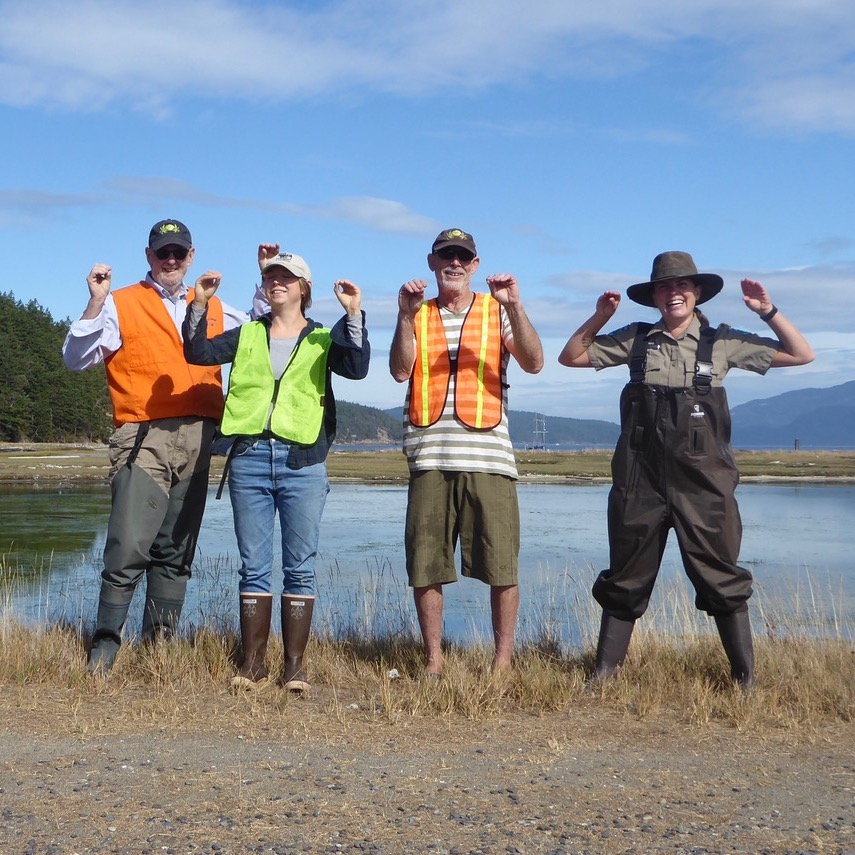
Ready to get your boots muddy? As a monitor, you will:
-
Attend a training workshop to learn the protocols and species identification
-
Be issued a permit to conduct this work
-
Join a small team of three to five monitors at a designated site
-
Visit the site monthly, April through September, to set traps and conduct surveys
-
Record all species observed
We welcome community members or staff at partner organizations to become monitors. Monitors should be comfortable carrying a small amount of gear over uneven terrain, occasionally working in imperfect weather conditions, walking in the mud, and handling crabs, fish, and other estuary critters. Because the timing of monitoring is tide-dependent, some availability during weekdays is helpful. We ask monitors to commit to at least 75% of the survey days. No prior experience in ecological monitoring or marine biology required — we will provide all necessary training and equipment.
We train new monitors in March each year to fill openings on existing teams. The three-part training series covers green crab ecology, species identification, and hands-on protocol practice through two virtual sessions and one half-day, in-person session.
To learn more about whether this program is a good fit for you, please:
1. Review the protocol summary video. This will give you a sense of what you will be doing and the typical field conditions for monitors.
2. Check out the map (see above) of Crab Team monitoring sites to see where you could be placed.
3. Read the Frequently Asked Questions (see below), which cover the time commitment, scope of training, and more.
If you’re ready to join Monitoring Network:
1. Fill out the interest form to be invited to the next training series, held annually in March.
2. Sign up for the Crab Team Newsletter to receive an annual notice when monitoring network trainings are scheduled, as well as biannual stories and updates from Crab Team.
Frequently Asked Questions
Timing
What is the time commitment to be a network monitor with Crab Team? Crab Team network sites are monitored monthly, from April through September, on two consecutive days each month (Day One to set traps, Day Two to retrieve them). Monitors are expected to attend at least nine out of the 12 trapping days for the season at their assigned site.
What time of the month does monitoring occur? Monthly monitoring opportunities are constrained by tide timing, and within those acceptable days each month, monitors will collaborate with their site team to set trapping times based on their own availability.
How long will I be out in the field at my site each monitoring day? Time at the site varies due to team strategies, site access, and monthly catch, but you can expect it to fall within 30 minutes to three hours per visit.
Site Teams
How many people are on a monitoring team? Sites are monitored by set teams of two to six monitors, with new folks assigned as space opens.
Are there specific roles within the monitoring team? Monitors from each team volunteer into roles of data submitter, “captain” (point-of-contact), and bait & gear steward (note: site gear gets overwintered locally by a monitor, as well). Some teams choose to assign many roles to a single individual for the season.
What are Crab Team sites like? Crab Team sites were selected for likelihood of survival of early green crab populations and for consistency across the network. They are typically salt marshes, tidal creek channels, tidal flats, or lagoons, all of which require some off-trail travel across uneven terrain to access. Many also require a walk across sticky, slippery, and at times ankle-deep mud. We do our best to match you to sites you can comfortably and safely navigate based on your abilities.
The map of Crab Team network sites shows where we monitor (see above).
Do I need to provide my own gear? Each team is provided all necessary gear, including everything from traps to magnifying glasses and first aid kits. Individuals should have clothing to keep them comfortable in the elements, that can get muddy, and they must provide their own footwear that fully covers their feet (no sandals). We recommend hip waders to access most sites.
Recruiting
When are new monitors recruited? New monitors are recruited in February of each year ahead of the required three-part new monitor training series each March.
How likely is it that I’ll be matched to a site? New monitors are assigned directly to a site based on accessibility & proximity, returning site roster size, and timing constraints. We receive high levels of interest from certain geographies and minimal response from others.
I haven’t been matched to a site. Can I still come to the Crab Team training? Given the capacity of Crab Team training spaces, we only invite folks to attend training if we’re able to match them with a site for the season. See below for other opportunities.
Training
How is training structured? All new monitors attend a three-part training series in March. These consist of two lunch-hour virtual sessions and one in-person practice offered at several locations across the region. These trainings are typically held during weekdays.
I’m not able to make any of the training times. Can I still be a part of monitoring this year? Training is required to participate in Crab Team, so if this year’s timing doesn’t work for your schedule, we’ll keep you on our lists to reach out to during next year’s recruitment if space opens at teams near you.
I don’t know anything about crabs or pocket estuaries. Can I still become a monitor? Yes! Zero prior knowledge is required to participate in this program. We will teach you everything you need to know – and more.
Other Opportunities
I’m not able to monitor with Crab Team this year, but I still want to get involved. What can I do?
If this year’s training options don’t work for you, if the physical or timing constraints of the monitoring network don’t work for you, if we can’t match you with a site, or if you just want MORE…
- Check out our Molt Search program as an open-to-all way to get involved with green crab monitoring.
Sign up for the Crab Team bi-annual newsletter to stay in the loop on pocket estuary ecology & green crab happenings.
Still have questions? Send an email to crabteam@uw.edu and we’ll be in touch!