
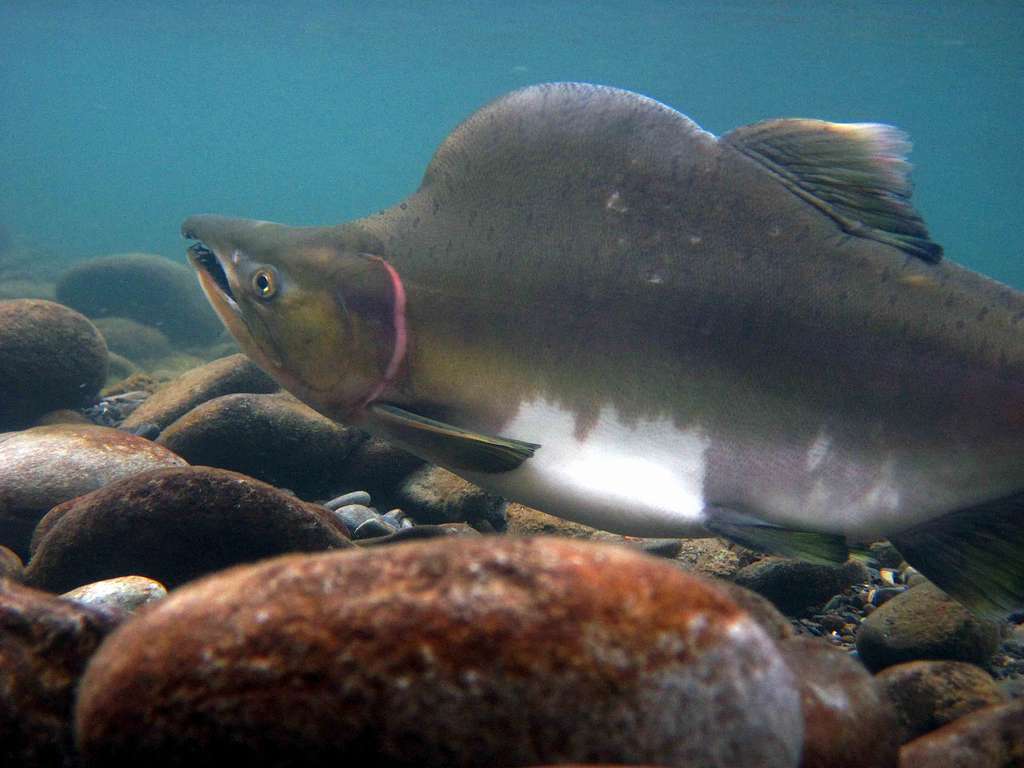
A pink salmon (Oncorhynchus gorbuscha) swimming up stream. Photo credit: John McMillan
Common Name and Species Names:
- Chinook salmon (Oncorhynchus tshawytscha)
- Chum salmon (Oncorhynchus keta)
- Sockeye salmon (Oncorhynchus nerka)
- Pink salmon (Oncorhynchus gorbuscha)
- Coho salmon (Oncorhynchus kisutch)
- Steelhead trout (Oncorhynchus mykiss)
- Cutthroat trout (Oncorhynchus clarkii)
Click on arrows to scroll, and photos to enlarge for the caption.
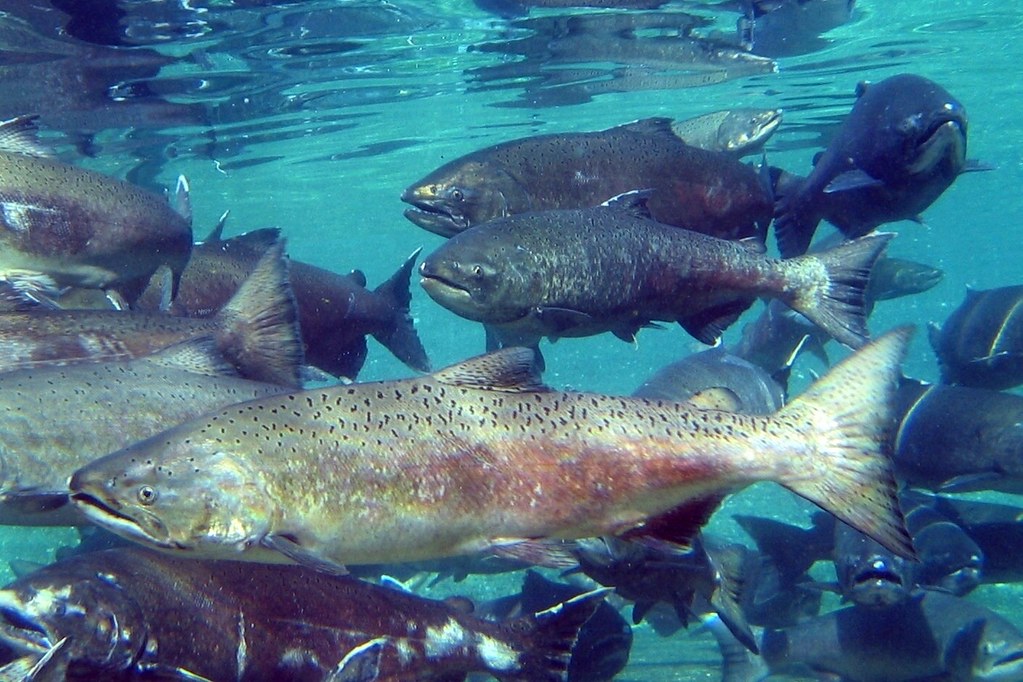
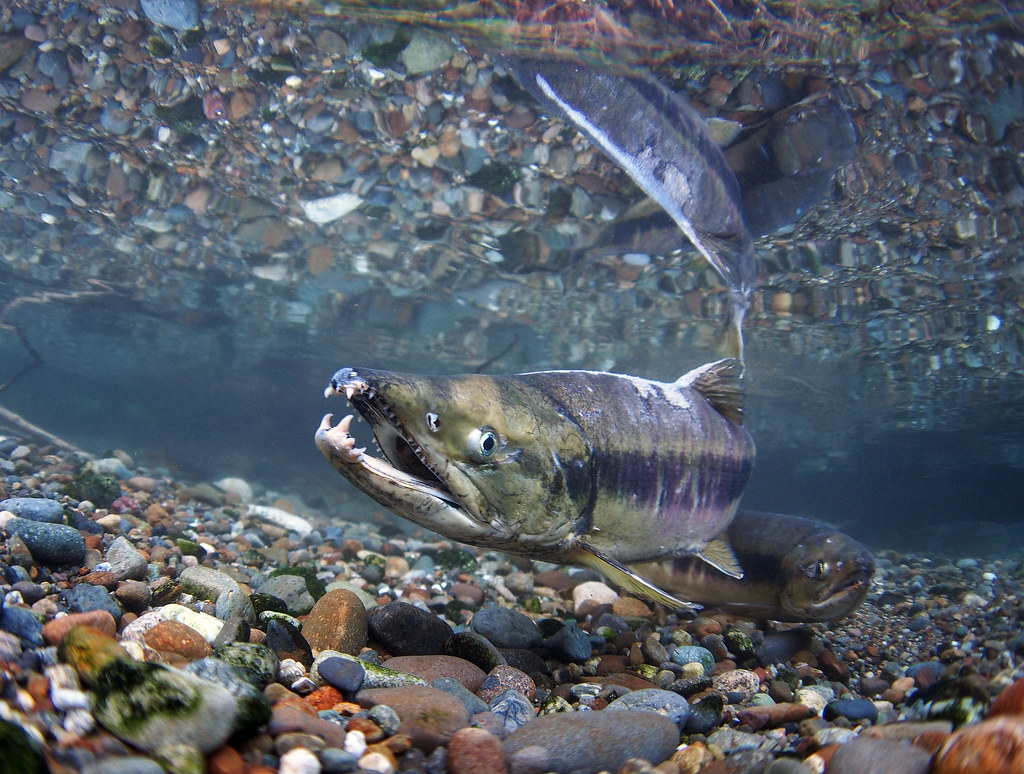
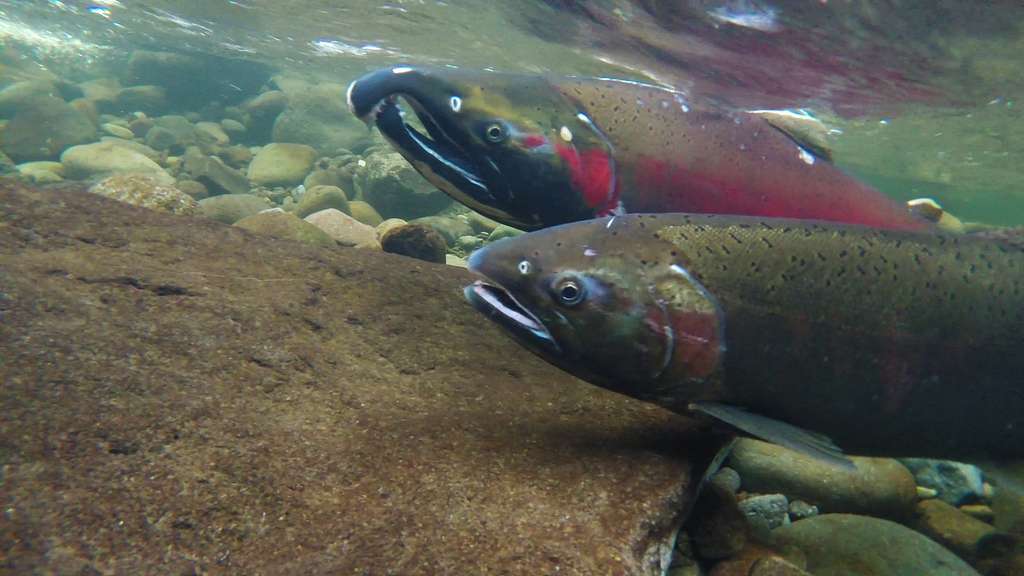
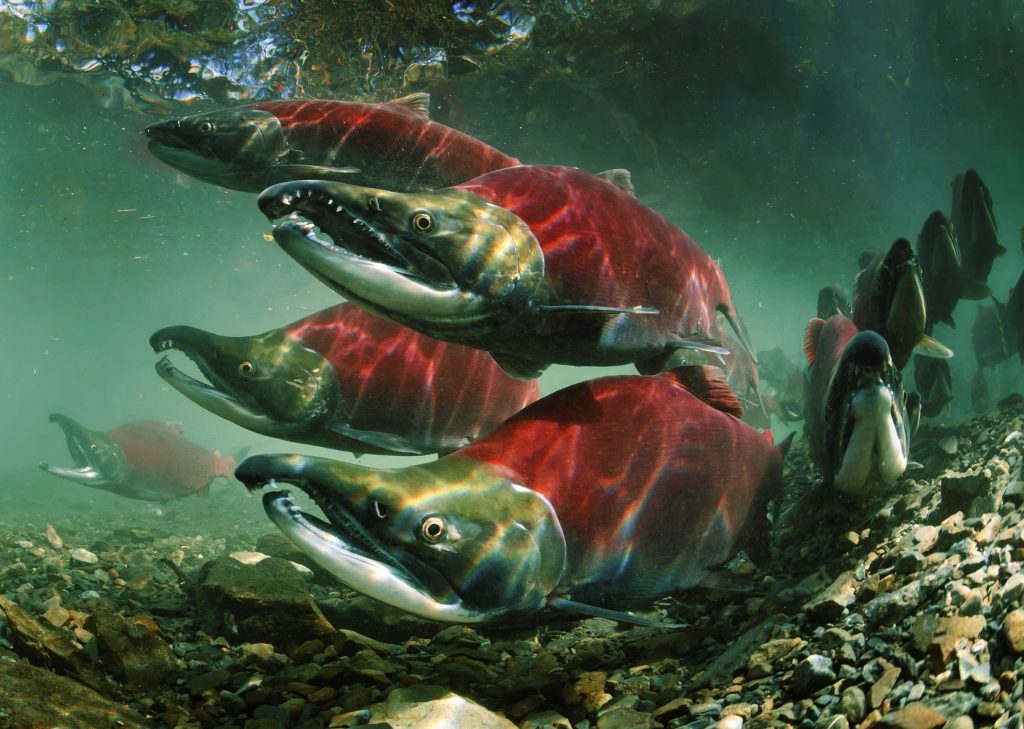
Creature Feature: Salmonids
Let’s talk about salmonids! We know ‘em, love ‘em, and maybe even love to eat ‘em but why are we dedicating a whole Creature Feature to ‘em?
Salmonids, including salmon and trout, are anadromous fishes, meaning they spend the early part of their life cycle in freshwater and most of their adult life in the open ocean before returning to their home stream to spawn and die. These fishes are culturally and economically important to our region and their migrations send them right through prime green crab habitat. This means that European green crabs could have potential impacts on these species, and also that there is a chance, if small, Crab Team monitors could encounter them while on site.
Most of the impacts we talk about with green crab are “direct,” the result of green crabs eating or competing with another species. But the impacts to salmon are more likely to be “indirect” – green crabs might harm salmonid populations by damaging habitats where they overlap. The pocket estuaries, salt marshes, and tide flats, where many Crab Team sites are monitored, tend to have little wave action, freshwater input from a surface stream, and are also tidally influenced. These factors combined provide fantastic habitat for juvenile salmonids as well as the forage fish that are important food for salmon as they grow larger. Unfortunately, European green crabs have been found to damage habitats through their burrowing and foraging behaviors. Green crabs can disturb eelgrass meadows by disrupting sediment or damaging eelgrass roots or runners while foraging for clams and other invertebrates. The loosening of sediments can expose or weaken eelgrass roots which then can be uprooted from wave action or currents. Green crabs have also been found to eat eelgrass, and while this is not their preferred source of food it can do in a pinch when green crab densities are high and there is increased competition for prey. Take a peek at our 2021 newsletter article for more information on the habitat impacts of green crabs!
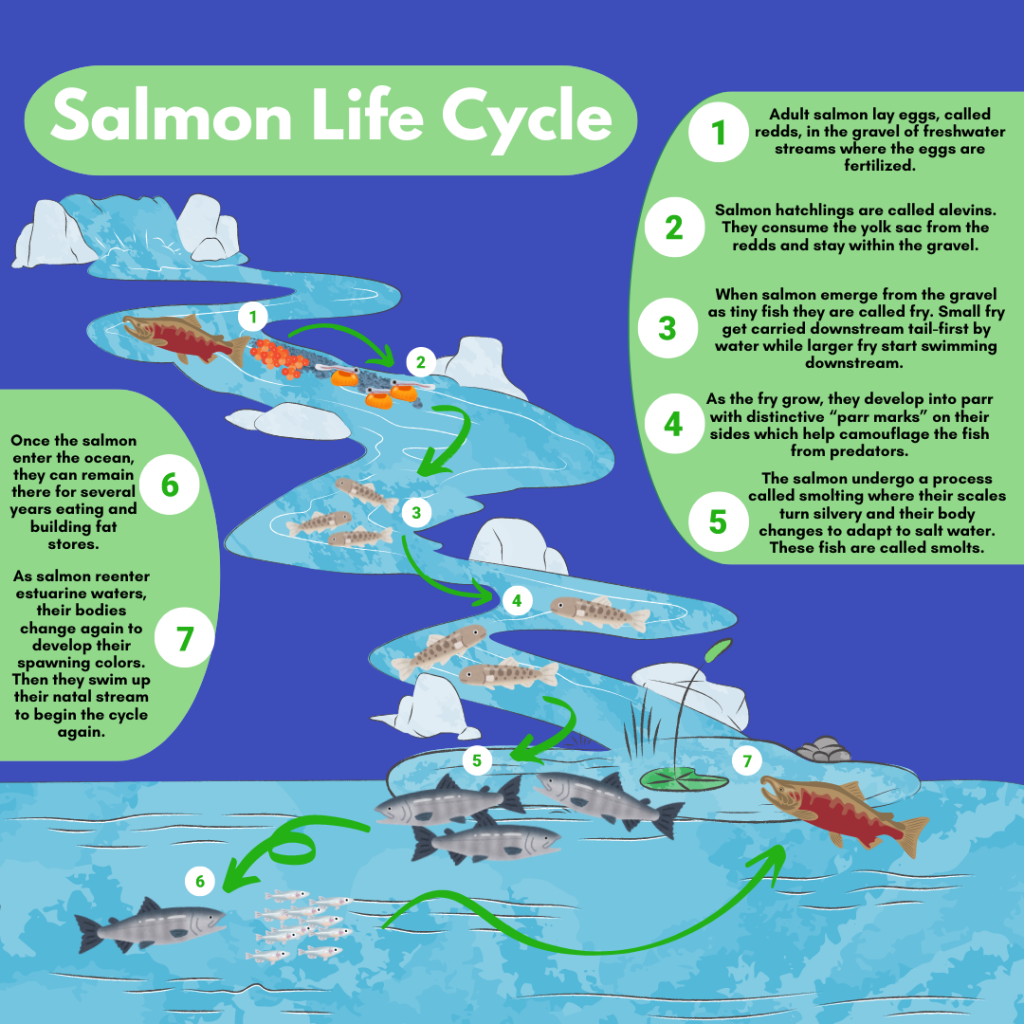
Salmon spend different parts of their lives migrating from stream to ocean and back again, bringing them through estuarine sites that green crabs favor more than once (5 and 7).
Clearing the Way for Salmonid Recovery
Salmon once lived in any river or stream that was not blocked by natural barriers. Today, salmonids face many obstacles in their journeys back and forth to and from the ocean. Whether traversing narrow culverts under roads or climbing tricky fish ladders, these fish are constantly fighting against man-made structures just to fulfill their lifecycle. There are an estimated 18,000 barriers that either partially or fully block salmonids from reaching spawning grounds in Washington state alone. Most of these barriers occur where roads cross streams and flow is restricted to pipes called culverts. If these culverts are poorly designed, they prevent salmon from swimming upstream, severely restricting spawning habitat. Other well known examples are large dams that not only block salmon passage upstream to spawning grounds, but also moderate river flow at the mouth, reducing the extent of delta marshes that offer shelter to migrating salmon.
Undoubtedly, tribes have been leaders in many efforts to protect and restore salmon populations, creating and using legislative protections for habitat and fish, and advocating for and implementing critical restoration efforts. Salmon are of existential importance to many tribes in Washington, and tribes retained the right to harvest fish in their “usual and accustomed” places when making treaties. The landmark court case that protects these rights, the Boldt Decision, ruled 50 years ago that tribes are entitled to half the salmon catch in the state. This decision, and the ESA listing of salmon populations are often the basis for the large scale of restoration efforts experts say is needed to stop the decline of salmon populations. Northwest Treaty Tribes sued the state of Washington in 2001 on the grounds that fish-blocking culverts reduced their treaty rights to harvest fish and since 2005, more than 3,700 barriers have been corrected. Yet, more funding is needed to meet the court-ordered deadline of correcting all identified barriers by 2030. The Lower Elwha Tribe was instrumental in advocating for the removal of the two Elwha dams, a process that started a decade ago and is seeing the return of coho harvest for the first time in 2023. The Stillaguamish Tribe has been partnering with WDFW to restore critical delta habitat at Leque Island and zis a ba.
Another type of restoration is improving nearshore vegetative buffers around key salmonid habitats. In Washington, it is estimated that 50-90% of areas along waterways have been extensively modified by human activity. These areas are important for salmonids as the vegetation provides shade from the sun that cools water and filters runoff providing cool, clean water for fish. A healthy nearshore vegetative buffer also contributes to habitat heterogeneity by dropping branches into the water which provides quality habitat for salmonid spawning or for refuge from predators.
One example of the importance of this kind of restoration work is the Jimmycomelately Creek and Estuary restoration led by the Jamestown S’Klallam Tribe. In 1999, only seven adult summer chum salmon returned to Jimmycomelately. Seeing the dire need of this population, work began in 2002 with channel realignment which moved the creek back to one of its historical channels which was first changed in the early 1900’s to create space for farming. The tribe also replaced the Highway 101 bridge that stretched over the creek to allow for better fish passage and accommodate flood flows. Later efforts focused on riparian and floodplain vegetation establishment and estuary restoration. All of this hard work has paid off and now Jimmycomelately Creek has had an average return of nearly 3,000 summer chum each year. Check out the Northwest Treaty Tribes website to learn more about projects related to habitat improvement that are underway in the region.
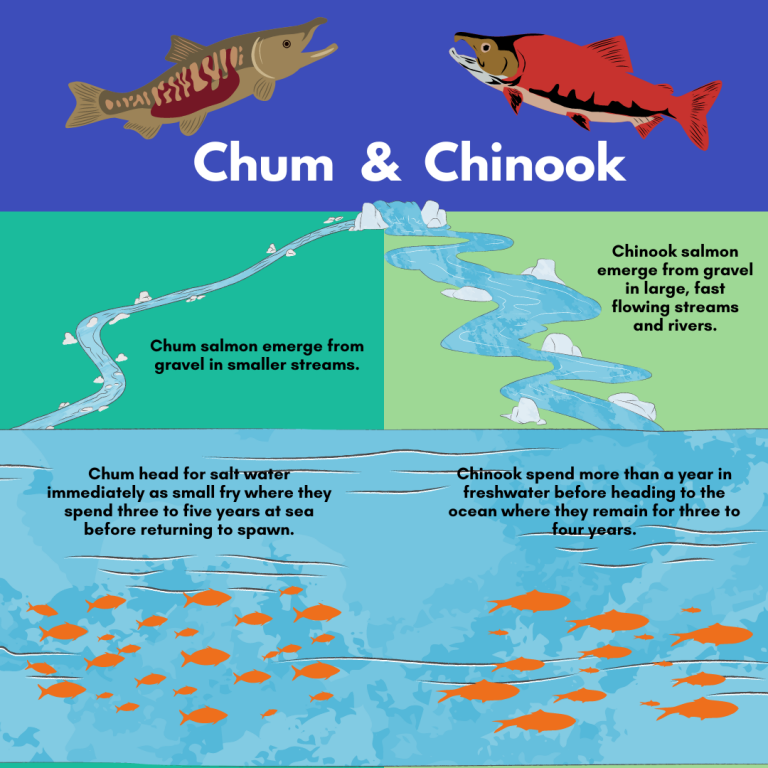
The life cycle timing and habitat preferences of salmon vary by species.
Crab Team Monitoring Efforts at Restoration Sites
Salmon restoration efforts quite often create and focus on nearshore habitat types that are also highly suitable for European green crab, so it’s no coincidence that more than a few restoration sites are also Crab Team monitoring sites. Some, like Jimmycomelately Creek (Site #199), and Cypress Island (Site #541), are “post-restoration,” that is, Crab Team didn’t start monitoring until after the restoration efforts took place. Others, like the Duckabush on Hood Canal (Site #138) and Titlow Lagoon in Tacoma (Site #299) are slated for restoration projects in the future.
The data monitors collect at these sites offer not only the chance to keep an eye out for green crab, but also a unique opportunity to improve the understanding of how restoration might benefit other species. Most restoration projects have limited budget for monitoring, meaning it might not last more than a year or two post restoration, and might only focus on salmonids, overlooking all the other native organisms that benefit from restoring natural shoreline features and flow. Crab Team fills the gap by tracking the shore crabs, and the sculpins, and the dungies as they return.
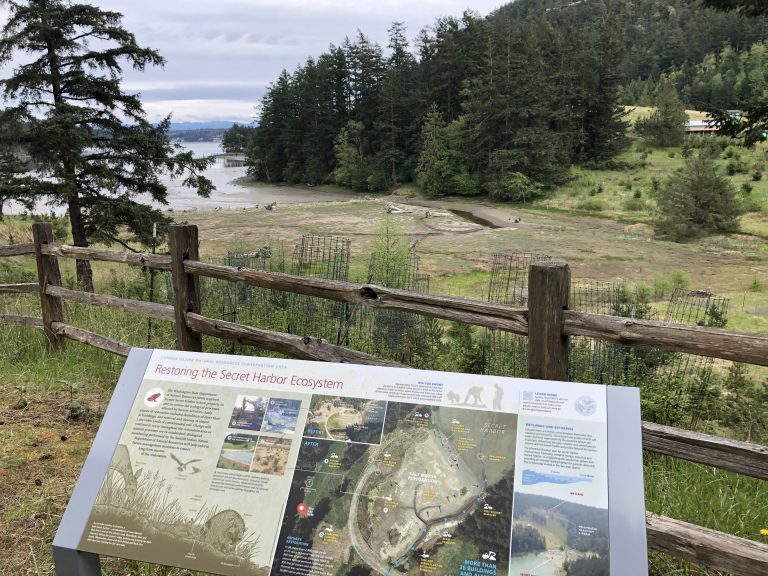
An interpretive sign showing the restoration of Cypress Island (site #541) overlooking the salt marsh. Photo credit: Emily Grason
The overlap in habitat also means that across the monitoring network there are a few sites where ESA-listed salmonid species might encounter Crab Team traps. The species/populations include Puget Sound Chinook salmon (Oncorhynchus tshawytscha), Hood Canal summer-run Chum salmon (O. keta), Ozette Lake Sockeye salmon (O. nerka) and Puget Sound Steelhead trout (O. mykiss). Thankfully, it’s extraordinarily rare for any salmonid to enter a green crab trap, and in 10 years of sampling, 15,351 trap sets, and more than 700,000 organisms trapped, Crab Team has never yet captured an ESA-listed salmonid. The few salmonids that have made an appearance include juvenile coho salmon (O. kisutch) heading out to adventure in the open ocean, and a couple coastal cutthroat (O. clarkii) on their trip back to their natal streams. While the risk of trapping salmonids as bycatch is low, it’s not impossible! Because of this, Crab Team has a five-year ESA permit that allows incidental take of these species. Monitors are all trained to look for and treat all salmonids and forage fish with extra care and attention, to ensure we can document any catch accurately and reduce the chance of harming them.
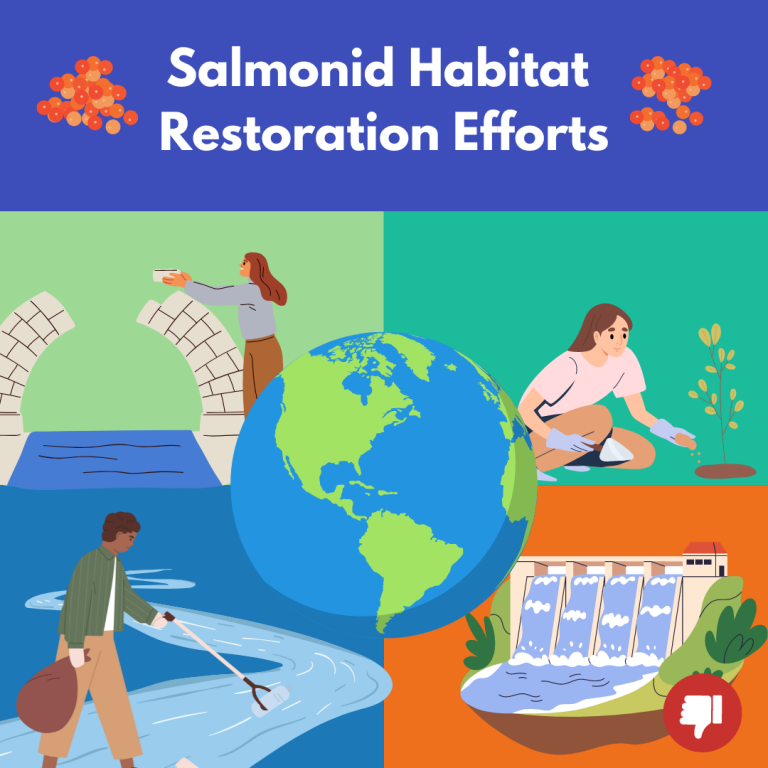
By keeping waterways clean from litter and pollutants, improving vegetative buffers around habitats and improving fish passage there are several ways we can be stewards to the habitats that salmonids depend on!
The significance of salmonids extends far beyond its role as a delicious food source. While these species rely on a variety of habitats, the presence of these fishes influences the health of entire ecosystems and are an essential part of the many cultures and economies of the Pacific Northwest. By taking special care of salmonids if they show up in Crab Team traps and by doing diligent monthly estuary monitoring, we can both protect salmonids and their habitats.
– Elyse Kelsey