
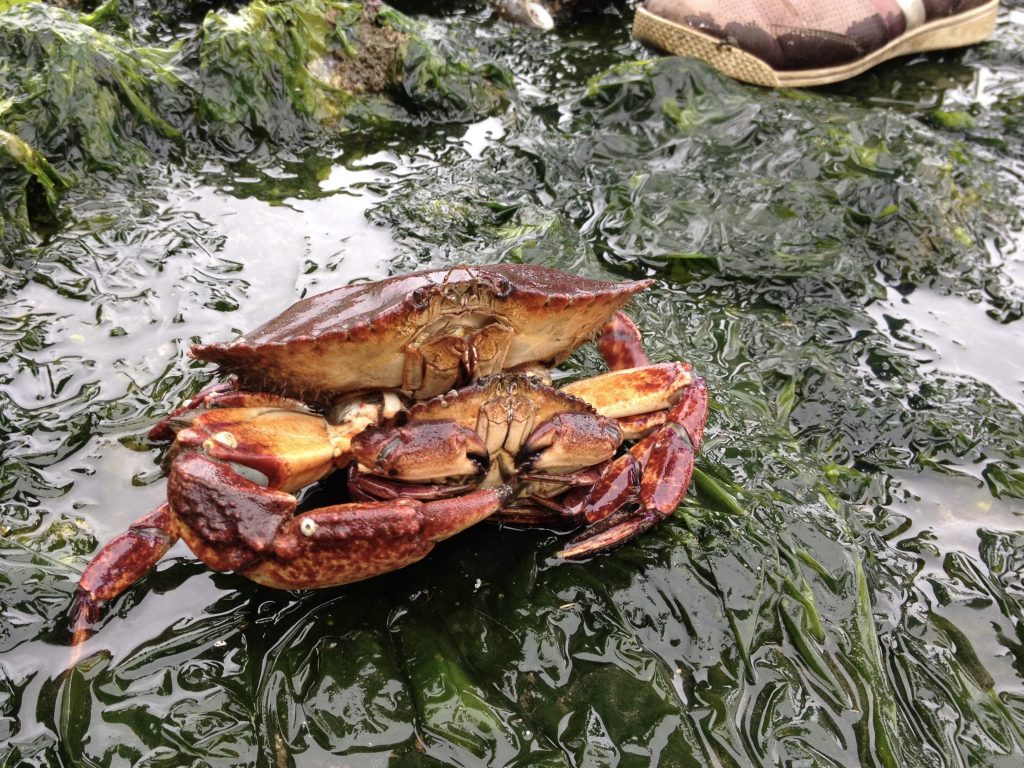
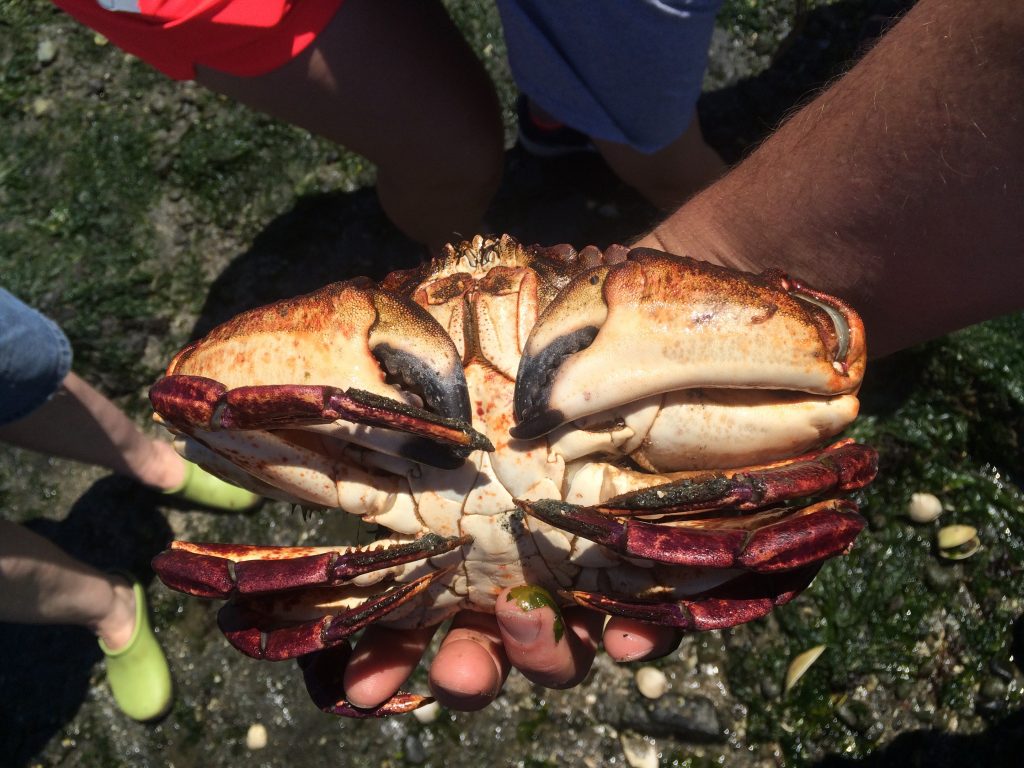
This male is carrying a smaller female in a guarding embrace, waiting for her to molt so that they can made. Photo: WSG/Jeff Adams
Featured Creature:
Species Name: Cancer productus
Common Name: Red rock crab
Species Code: CAPR
Geographic Range: Southwest Alaska to southern California
Size: up to 200mm (7.8″) carapace width
Habitats: diverse, but most commonly gravel/boulder beaches protected from surf
King Crush: Crab Team’s Red Rock Wrecking Ball
Though we are crab-crazy here at Crab Team, there are a number of crab species we don’t encounter as often as our heroes, HEOR, even if they are widespread and abundant in our region. One such character is the beefcake of the boulders, red rock crabs (Cancer productus, CAPR in Crab Team-ese). Compared to other species of “cancer” crabs, like graceful and Dungeness crabs, we don’t catch many rock crabs at Crab Team monitoring sites. This is largely because sites are chosen for their suitability for survival of young European green crabs – we want monitoring to be sensitive to the early stages of arrival of the invasive. But it turns out that red rocks are actually one native species that has a demonstrated history of being very effective at outcompeting and eating green crabs, even of similar size (Hunt et al. 2003). So we tend to select sites for early detection where we don’t expect to see rock crabs.
Crab Teaming Red Rocks
That said, there are a number of network sites where red rock crabs are trapped and few where they are even common. Through 2022, about a quarter of inland Crab Team sites had found at least one red rock crab in a trap and 10 percent of sites had collected 10 or more. Then there’s Blakely Harbor, where the monitoring team regularly pulls up several dozen rock crabs a month in their 6 traps (current record is 63 in September 2021!). Cumulatively, they’ve racked up nearly 1,000 red rocks since starting the site in 2016, accounting for almost 70% of all red rocks captured in Crab Team data. Sites with many red rocks, like Blakely, as well as Kiana, Fidalgo Trestle, and a few others, often see more wear and tear on their minnow traps, and it seems likely this is because rock crabs damage the traps trying to get in even though they can’t fit through the small openings! Thankfully for our traps, these sites are the exception in the trapping data. But even if they aren’t living at all the Crab Team sites, we do see signs of red rock regional abundance in molt surveys – all but a handful of Crab Team sites have reported at least one rock crab molt at their site.
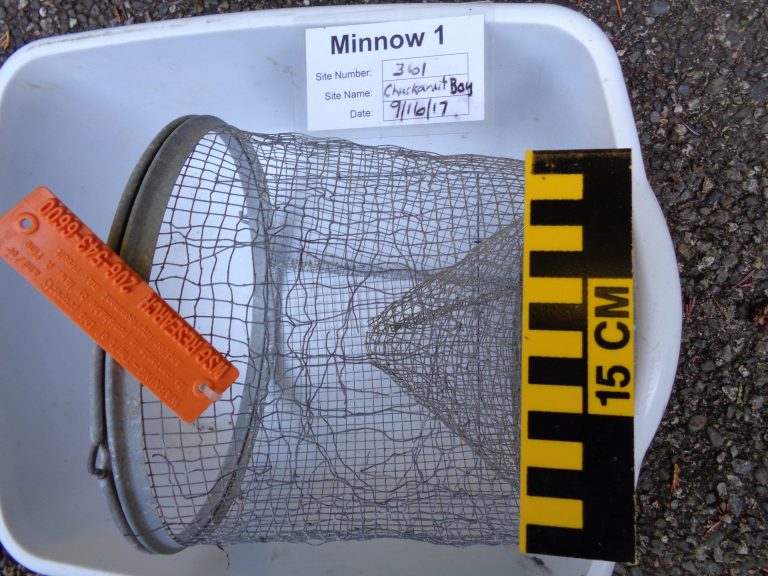
Back in 2017, monitors at Chuckanut Bay used to regularly catch large rock crabs. It’s likely this unsuspecting minnow trap was standing in between one of these crabs and the irresistible mackerel bait. Being too large to fit through the entrance, the crab took matters into its own claws.
King Klaw
Without a doubt, what makes rock crabs the undisputed intertidal heavyweight are their claws. As crabologist Sean McDonald likes to say, rock crabs “look like they spent too much time on arm day at the gym.” Rock crab claws are built for crushing. We can see this in not only the size of claws, but also their color, shape and dentition (yes, claws with teeth! Even more terrifying!). Rock crab claws are tall relative to their length, providing greater mechanical advantage for crunching (Yamada et al. 1998). The black tips of claws, which are also evident on a few other local species, are actually evidence of denser shell material at that part of the claw (Melnick et al. 1996), which helps rock crabs avoid damaging their claws when tackling tough prey like clams and snails. This suggests the rather astonishing possibility that their claw muscles are so strong that without reinforcement, they could break their own claws in trying to crush prey. And lastly, don’t forget those teeth! The bumps on the inside of the claws, referred to as dentition, are rounded and smooth, also helping reinforce the strength of the shell surface, and how effectively they can crunch apart the shells of other species.
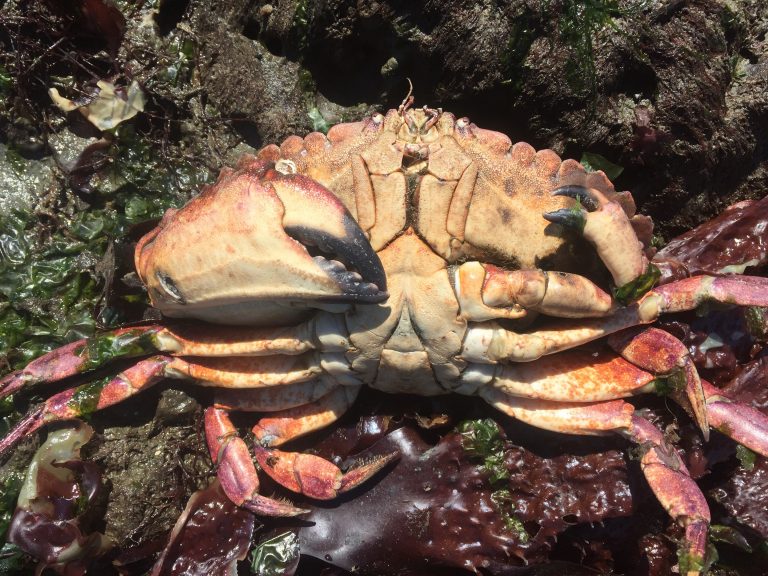
Claws are the defining feature of rock crabs. This crab’s right claw is full size, and the claw on the right is regrowing and has a lot of catching up to do to bring this crab back to fighting weight! Photo: WSG/Jeff Adams
For comparison, consider the claws of Dungeness crabs, which are quite long for their height, and can’t exert as much force for crushing relative to rock crabs. Additionally, the dentition of Dungie claws is relatively sharp, or serrated. Compared to rock crabs, Dungies are better adapted to subduing softer bodied prey. Or, when they tackle the same type and size of food, rock crabs and dungies use different strategies: rock crabs tend to crunch, but Dungies will doggedly chip and peel away at the opening of a snail until they can reach the soft body inside.
Muscle Beach
That said, even rock crabs will meet their match from time to time. A great example of an age-old “arms race” is that between crabs and snails. Rock crabs are such important predators of a number of species of snail, that the snails have evolved both physical and behavioral defenses in response to the threat of getting eaten by this species. Moon snails, those molluscan leviathans often detected through their sand collar egg cases on beaches, have evolved such thick shells that even rock crabs can only get at them by shell peeling. The frilly varices of the aptly named leafy hornmouth (Ceratostoma foliatum) grow so big to make it harder for rock crabs to crush them (Donovan et al. 1999).
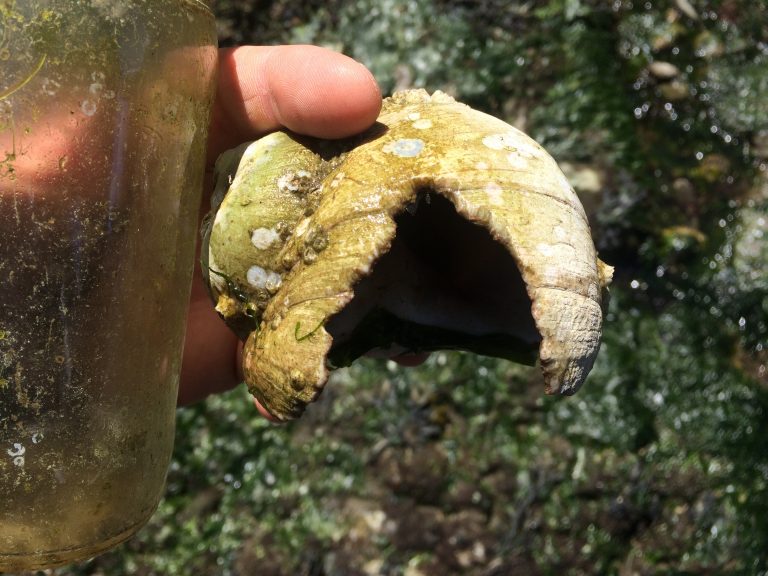
This moon snail likely fell victim to the steady chipping of a red rock crab. The snail could only retreat so far! Photo: WSG/Jeff Adams
Rock crabs even change the beaches without eating anything at all. Several native species of whelk (and at least one invasive species) actually stop feeding and hide just at the faintest whiff of a rock crab nearby (Bourdeau 2009a). The smell of rock crabs is also enough to cause the frilled dogwinkle (Nucella lamellosa) to change the shape of its shell, growing a thicker, more rotund shape and subduing its flamboyant namesake shell ornamentations, just to make it harder for rock crabs to hold and crush it (Palmer 1985, Bourdeau 2009b).
Of course, those claws aren’t just for acquiring food. If a male wants to keep his potential mate, he’s got to be able to brandish the big guns and hold his own against other suitors (while holding on to her). Without both fully developed claws, he’s at a disadvantage. That’s one of the reasons it’s not OK or legal in Washington’s recreational fishery to take a claw from a red rock and throw the crab back. While crabs do have special anatomical features that help them survive the loss of a claw, rapidly ripping off a claw can bypass those safety mechanisms, and crabs can bleed to death. Even if they lose a claw the “safe” way, those claws take at least three molts to grow back and a big crab won’t have enough molts left to replace a lost claw. That said, crabs can lose claws for lots of reasons, including escaping predators and in combat with competitors. It’s not uncommon to find red rocks missing or regrowing a claw. They may even compensate by beefing up their remaining claw (Brock et al., 1998).
Beach Bricks
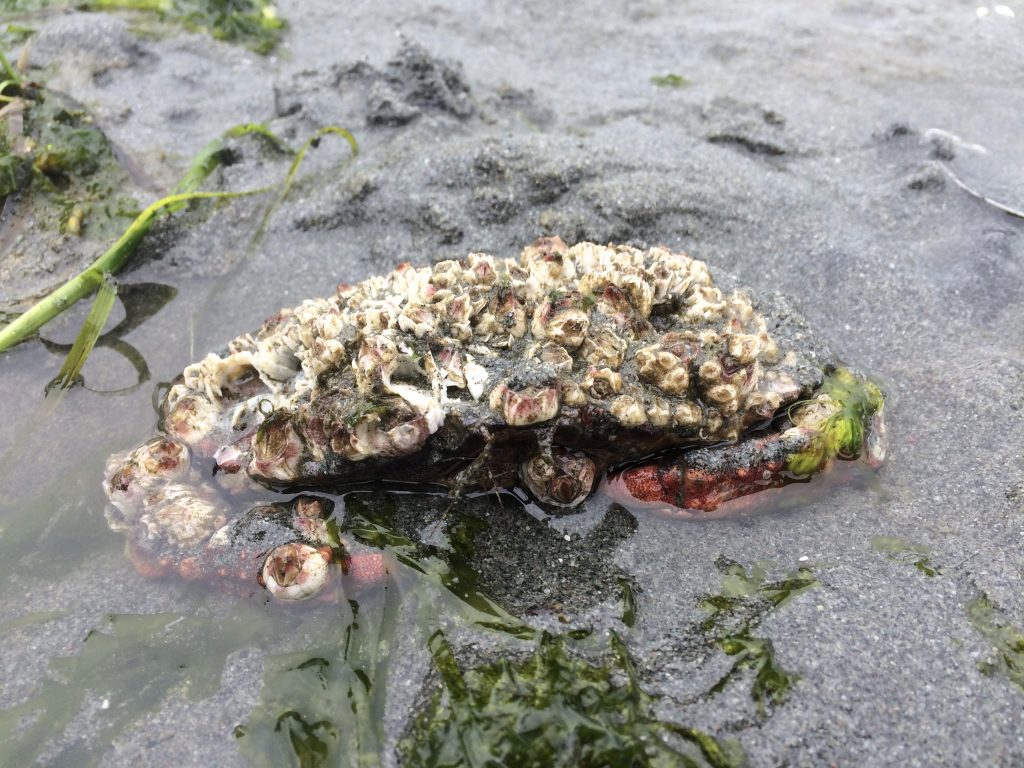
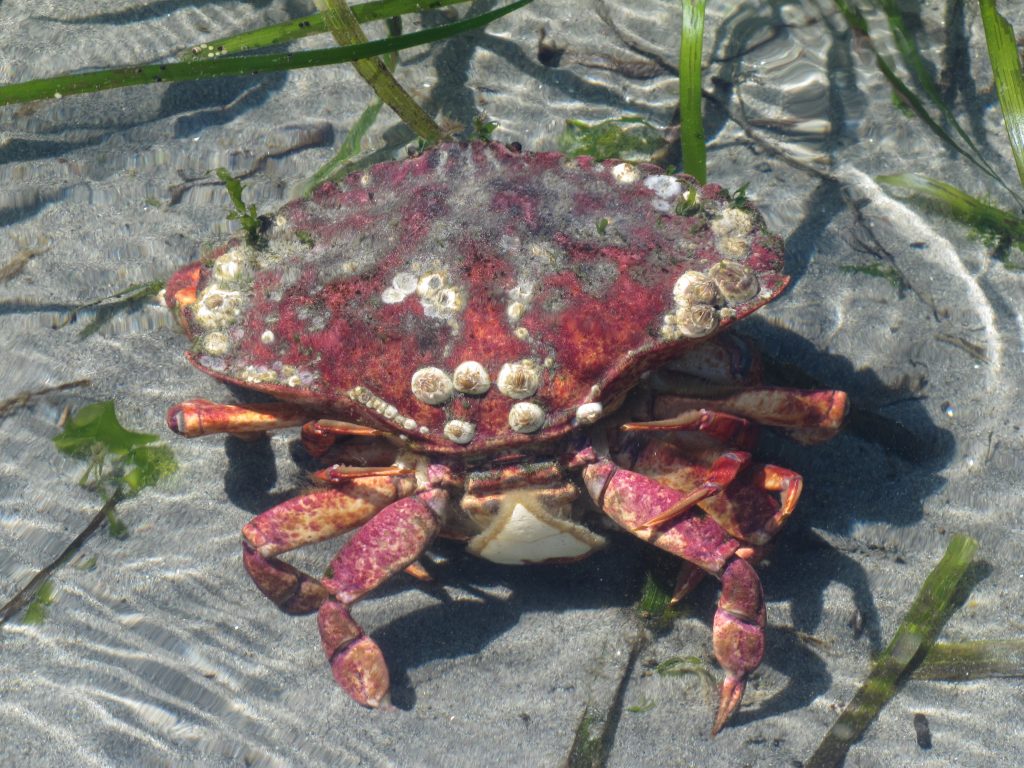
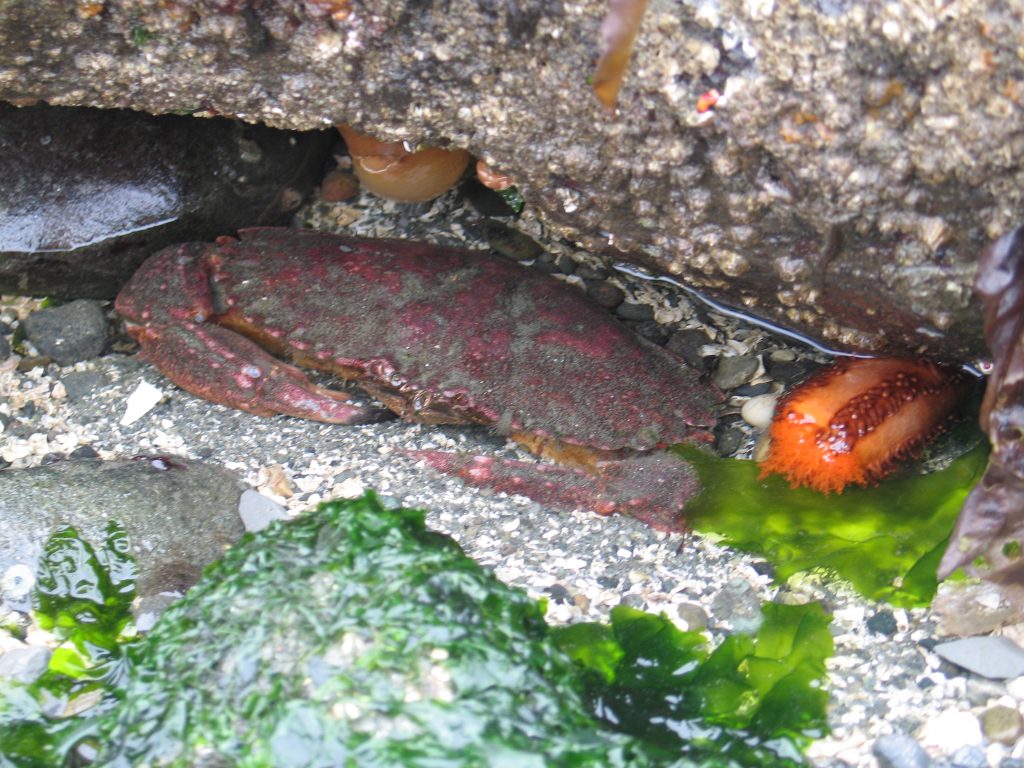
While their bulky claws and surly personalities often give rock crabs a stodgy reputation, juveniles can be incredibly expressive. Rock-turning beach goers are often treated to a circus of patterns and colors of juvenile red rock crabs, ranging from black to white and from solid to zebra striped (Karuse-Nehring et al. 2010). Though as full grown adults, rock crabs don’t fear too much other than giant pacific octopuses, and a few terrestrial predators – our recreational fishery among them – as juveniles, rock crabs may use these outlandish patterns as disruptive camouflage. By adulthood, most rock crabs have settled into a more conformist middle-aged coloration of a brownish red that makes them look something like old bricks partially buried in the sand.
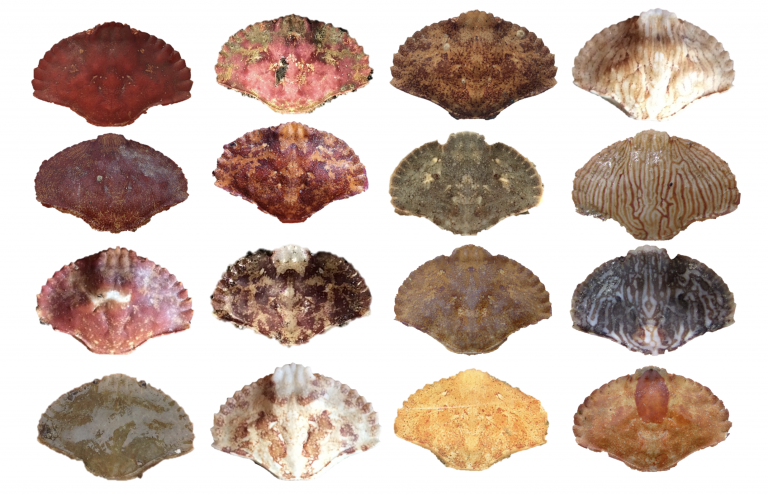
Juvenile rock crabs can have an incredible and festive range of colors and color patterns in their shells, including stripes and spots. Photos: WSG/Jeff Adams
Beyond red rocks, we also have a few other species of rock crab in Washington, including the pygmy rock (Glebocarcinus oregonenesis, GLOR), which is just cute as a button and not a lot bigger than one, and the Pacific rock crab (Romaleon antennarius, ROAN), which is similar to a red rock but with pointier carapace teeth and lots of red spots on its underside. The Pacific rock tends to be on the Pacific coast but can be found in the Strait of Juan de Fuca. A couple other small rock crab species can be found in Pacific coast nooks and crannies but don’t appear to be found in the Salish Sea. Both the pygmy and Pacific have been found in Crab Team molt searches and – very, very rarely – in traps as well. You might note that all these species have black tips on the claws – beware!
The Great Red Hope
It’s fair to ask the question of why, if these beach bruisers are so fearsome, we include a few sites where rock crabs are thriving in the early detection monitoring network. Aren’t these sites likely to be “safe” from green crabs? It’s true that in most places trapped for green crabs across the state right now, finding a red rock crab in your trap is a sure bet you won’t get any green crabs at that location. Historic data in California shows the same pattern (Jensen et al. 2007). However, in some places where green crabs have been abundant for longer, like the west coast of Vancouver Island, scientists report increasing “encroachment” of green crab into habitats once dominated by red rocks. Crab Team sites like Blakely Harbor are interesting because, other than the presence of rock crabs, they actually look like good habitat for green crabs. Observations of whether or not green crab can survive at those sites will help us learn more about how effective rock crabs could be as biotic resistance – reducing the survival or keeping green crab out of certain habitats.
By monitoring a range of sites with different ecological communities of native organisms, Crab Team hopes to learn not only about the invasion of green crabs, but also about the interactions with native species. Time will tell who has the upper claw.
– Jeff Adams & Emily Grason