
Creature Feature: Batillaria
Species Name: Batillaria attramentaria
Common Name: Asian mud snail, Asian horn snail
Species Code: BAAT
Size: up to 45mm
Distinguishing Features: Snail with a long, narrow, conical shell. What you might imagine a unicorn horn to look like. Brown and black, sometimes with lighter stripes that are also visible along the inside of the apertural lip. Operculum circular with concentric rings.
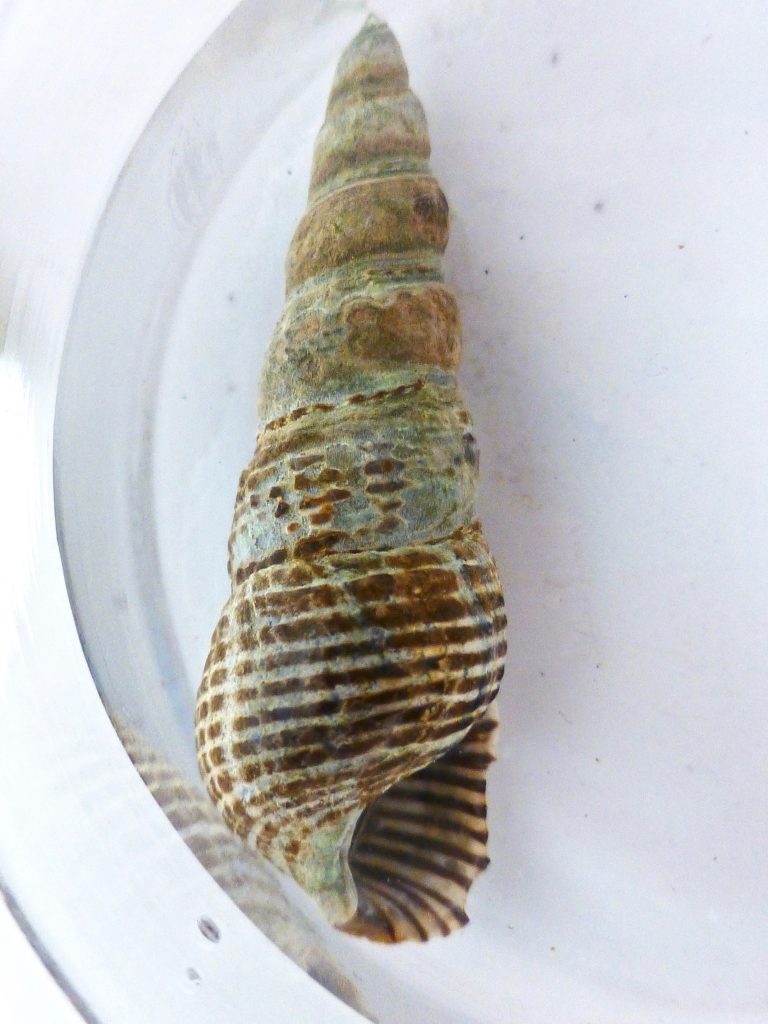
A Snail? Isn’t this CRAB Team?
Goal number one of Crab Team is finding populations of invasive European green crab while they are still very small. Thankfully, however, the traps that volunteers and monitors pull up every month are vastly dominated by native animals: staghorn sculpin, graceful crabs, three-spined stickleback, and, of course, the nearly ubiquitous hairy shore crab. Since 2015, Crab Team traps have captured nearly 225,000 animals, and only 10 of them have ever been European green crab – that’s less than 0.005 percent.
One other invasive critter does make it into Crab Team’s top five, however. The Asian mud snail, Batillaria attramentaria, was the third-most abundant animal in traps during 2018. This might be a surprise, even to some Crab Team volunteers, because, though the top two species, hairy shore crab (91 percent) and staghorn sculpin (5 percent) are present at nearly every single Crab Team site, Batillaria was only detected in traps at 13 of the 54 sites (though, based on observation, we know they are present at at least 17 sites).
Batillaria is what ecologists refer to as “patchily distributed”, that is, it’s not found everywhere, but can be impressively numerous in some locations. As a graduate student, I studied this snail, and the highest density I measured was an average of about 2,550 snails in a square meter at one location in Padilla Bay, near Mt. Vernon. To understand how this snail can have such explosive abundance in some locations but be completely absent in other habitats that look essentially the same, it helps to know a bit of the Batillaria story in the Salish Sea.
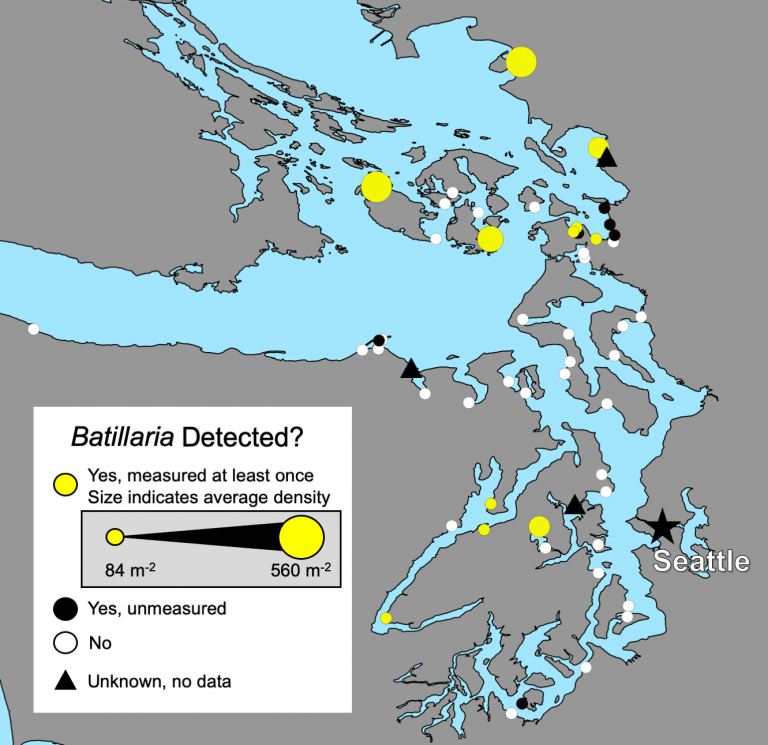
Map of Batillaria observations for all Crab Team sites. Circles indicate the site has been assessed for the presence of Batillaria, and they have either not been detected (black circles), have been detected but not measured (white circles), or have been detected and their density has been measured at least once (yellow circles, the size of which increases with average measured density). Presence of Batillaria has not been assessed formally at two sites (triangles). Click to enlarge.
This snail is one of a handful of invasive species that were accidentally imported as hitchhikers on Pacific oysters (Crassostrea gigas, read the research), which are themselves not native to the eastern Pacific Ocean, but were shipped from Asia to help replace the collapsed Olympia oyster (Ostrea lurida) fishery in the late 1800’s and early 1900’s. Before managers were aware of the dangers posed by non-native species, there weren’t many (or any) measures in place to reduce the chance of accidentally starting an invasion this way. Adult oysters, and all of the tiny things living on, under, and around them, were pulled up from reefs of Japan and Korea, shipped in crates and barrels across the ocean and dumped out into places like Samish Bay, just north of Padilla Bay. The best information we have estimates that Batillaria got to the Salish Sea by the 1920’s, which means we are coming up on the centennial of Batillaria’s addition to the flora of Washington’s inland waters.
Given that the snails can live up to six or so years, and produce thousands of eggs per year, it’s perhaps not surprising that that is enough time to build up extremely large densities in places like Padilla Bay. In fact, maybe the more curious question is:
Why don’t we see them absolutely everywhere?
The answer to this question has (at least) two parts. The first part has to do with the life cycle of the snail. Most marine snails, like our local periwinkles (Littorina spp.), attach their eggs to a stable or semi-stable part of their habitat, and then the young hatch out of their eggs into a free-swimming larva called a veliger. This has the advantage of enabling the young to get washed away from their parents and avoid competing with them for resources. Think of it as sending your kids to school in another state so you can regain control of your pantry. But this strategy has risks – the larvae, which don’t have a lot of control over where they end up, might land in a place that isn’t favorable for their survival. So some snail species take a different tack: they grow through their veliger stages while still inside the egg capsules and hatch out looking very much like tiny versions of their parents. This appears to be the case with Batillaria. The spread of a snail population with no dispersal stage is slower than it would be if the larvae could get washed around, and in the case of Batillaria, spread has been almost entirely human-aided. Batillaria was probably brought from the native range to the West Coast a number of times, but after arrival, the snail also got moved to new sites as humans moved oysters to try to find new places to grow them. This means that any place you see Batillaria, you are almost guaranteed that there is some history of growing oysters, most likely Pacific oysters, in that location. Nowadays, though, growers (and others) work hard to avoid moving anything other than the oysters and other shellfish themselves around as they work across multiple sites, so this type of introduction and spread is rare.
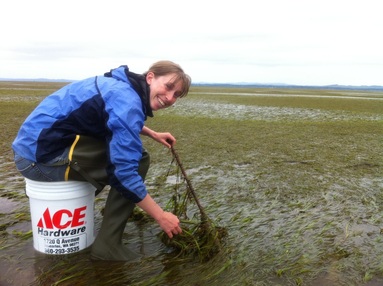
Five gallon buckets make great seats on the tide flats. Crab Team program manager Emily Grason checks on the status of tethered snails in a field experiment to assess how well Batillaria survive at Oysterville, Willapa Bay. (Photo courtesy of Ryan Davis).
The other part of the answer is undoubtedly that not every place is suitable for Batillaria to thrive. One interesting case study of this is Willapa Bay, Washington. This coastal estuary in the very southwest corner of the state is one of the top oyster-producing estuaries in the world, with the majority of the harvest coming from Pacific oysters. Yet, as far as we can tell, Batillaria is only present in that estuary at one location in the entire bay – Oysterville. You can perhaps guess, based on that town’s name, what the history of Oysterville is, and why it might not be a surprise to find Batillaria there. What is a bit of a surprise is that the snail remains present, but only at very low densities compared to places like Padilla Bay.
To investigate why Batillaria do so well in Padilla Bay compared to Willapa Bay, I conducted an experiment to see how well snails survive in each place. How do you track snail survival out there in the big, wide world? You tie them up of course! Along with my advisor, Jennifer Ruesink, and a few extremely patient friends, I used fishing line and super glue to create 600 snail leashes, and tied them to rebar to answer the following questions about snail survival and how it compared between Padilla and Willapa Bay:
- Is anything eating snails at either site? If so, what?
- Do snails die “of natural causes” (such as drying out, or heat stress) at different rates at each site?
- Do snails living at different depths survive at different rates? Does this depend on which site they are living at?
The study clearly showed that snails very rarely died of natural causes at either site, but in Willapa Bay, where the density of Batillaria is atypically low, tethered snails got crunched up by crabs – primarily Dungeness and red rock crabs (read the research). Snails living deeper got hit especially hard, which makes sense because most of the larger crabs eating Batillaria live deeper than the snails do, and come up to eat them on high tides. By contrast, in Padilla Bay, none of these large crabs appear to spend much time at the depths at which Batillaria lives, enabling the snail population to grow much larger. Willapa Bay is known for having very robust populations of Dungeness crab in particular, and so, on a larger scale, this native crab probably has a role to play in keeping Batillaria rare in that estuary.
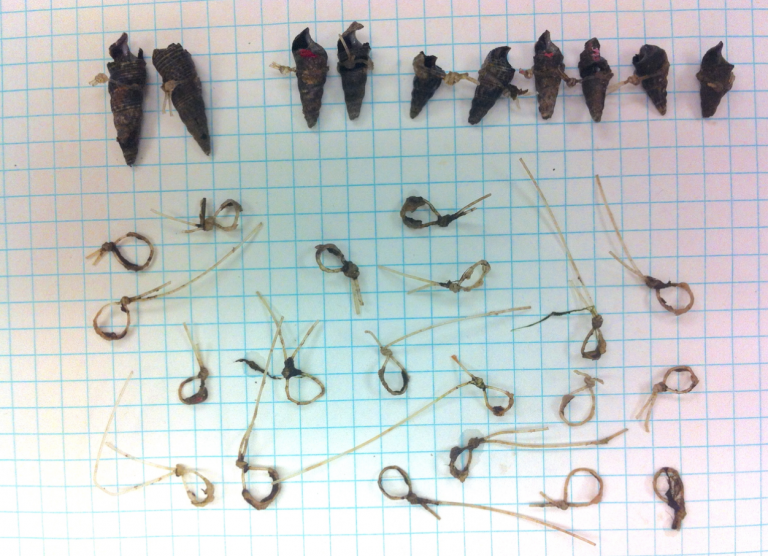
When you tie 30 Batillaria to a piece of rebar in Willapa Bay for 6 weeks, nearly all of them are eaten by crabs, as evidenced by their disappearance from their fishing line tethering loops. Even the remaining snails, top row, had been chipped at their openings by eager crabs. By contrast, no snails were ever consumed by crabs when the same experiment was conducted in Padilla Bay. (Photo: Emily Grason).
Is Batillaria that Bad[illaria]?
Does it matter whether Batillaria are absent or present, or if they are sparse or dense? That is, what impacts, if any, does this snail have – and if it’s so abundant, why aren’t we more concerned about it? Many managers only consider a non-native species to be “invasive” if it has impacts that negatively impact human economies. Batillaria, thankfully, does not appear to cause damaging impacts to oyster culture or native species that we are concerned about with other invasives, such as European green crab. But from the perspective of an ecologist, no matter how many there are, or what the type of impacts are, a non-native species, by virtue of having to eat something, and having to live somewhere, has an impact on the ecosystem it lives in. The snail eats benthic diatoms that grow on the surface of mud particles, not exactly the latest hot commodity in the commercial fisheries market! But how could the snail impact other organisms, and ecosystem processes, in our area? Researchers have observed a number of interactions and impacts with other species for Batillaria:
- In California, where Batillaria is also invasive, it outcompetes a native snail (Cerithidea californica) not found in Washington, to the extent that the native has disappeared at many sites where it used to be found (read the research).
- In Padilla Bay, Batillaria helps native hermit crabs by providing them an abundant sources of shells to live in (read the research).
- Also in Padilla Bay, Batillaria makes it possible for a large population of invasive slipper shell limpets (Crepidula fornicata) to live, because the shells of Batillaria provide a rare (in Padilla Bay) hard surface on which the limpets can live.
- Batillaria encourages the growth of the non native dwarf eelgrass (Zostera japonica) (read the research). The non-native eelgrass can, in turn, make it difficult to grow clams (read the research), but similar to the native eelgrass (Zostera marina), can also provide valuable habitat and resources for birds, fish and other animals (read the research).
Certainly, ecologists have not discovered, or characterized, every impact Batillaria has with the local ecosystems, but even this short list offers an interesting example of how non-native species can be both helpful and harmful to native species, and can even help other non-native species succeed!
This snail is not currently considered a big enough threat to the Salish Sea to warrant any management, or even much study. But that’s not the same as saying it is “beneficial,” net neutral, or even that it poses no threat to native ecosystems. In many cases, non-native species aren’t initially a cause of concern in a new place … until they are. That is, new impacts can pop up even after a species has been found in a new place for quite a while. The changes might be because of a chance event disturbing the native ecosystem, and creating an opportunity for the non-native, or another introduced species that helps the original invader take off (read the research).
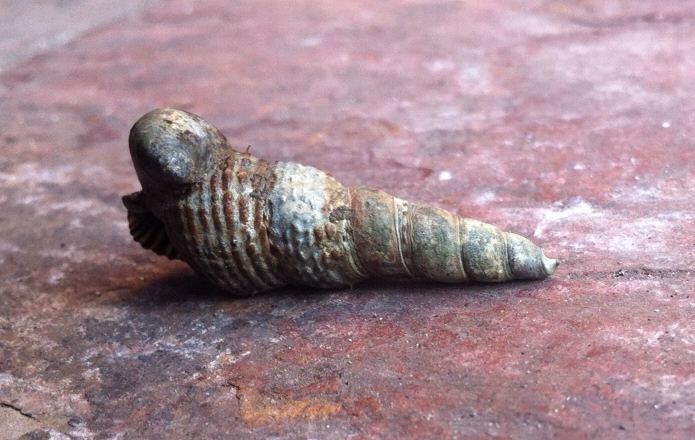
A Batillaria with a Crepidula limpet on its shell.
Though the shape of this snail has been likened (by me, mostly) to a unicorn’s horn, it is nothing of a rarity in our neck of the woods. In fact, I surveyed, modeled and estimated the total number of Batillaria in Padilla Bay alone at 1.2 – 2.8 billion. In addition to Batillaria showing up in traps, extra-dedicated Crab Team volunteers at a few sites are helping to collect additional data on Batillaria (see map above), by counting how many of them they find on the shore at their sites, and seeing how this changes over time. These data could prove useful in trying to understand how invasions change over time or with the arrival of green crab. In the case of Batillaria, we’ve seen that numbers in our region appear to have stayed consistent, but at least one site in California has seen a population collapse for Batillaria – the cause of which is as yet unknown – after decades of abundance.
Cases of extreme abundance, like that of Batillaria, can offer a way to learn about how and why certain invasive species flourish while some never manage to take hold. Hopefully future research will continue to shed light on not only this snail, but on invasive species generally, and help us manage them more effectively.
–Emily Grason
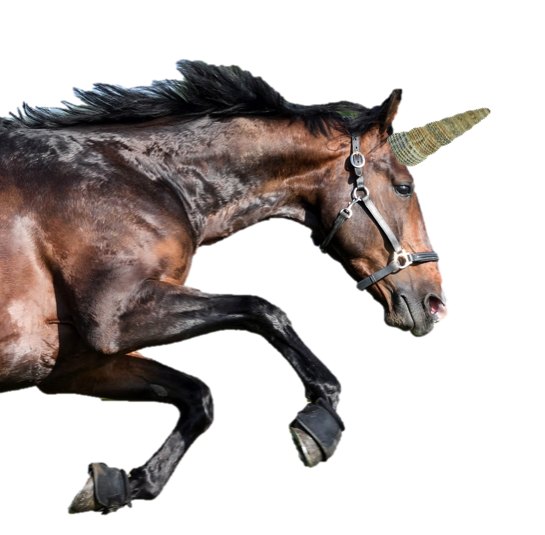
Some (mostly Emily) have likened the shape of this snail to a unicorn’s horn. That basically makes Batillaria magical.