
Creature Feature:
Graceful Crab
Most people have never heard of the graceful crab (Cancer (Metacarcinus) gracilis), despite how common it is. That’s because it looks very similar to a crab people often see on their dinner tables, Dungeness crab. The two species look so similar that many people mistake graceful crabs for young Dungeness crabs at first glance. The similarity between the two species speaks to their relateness; they share a genus name*, and are therefore as closely related as two distinct species can be.
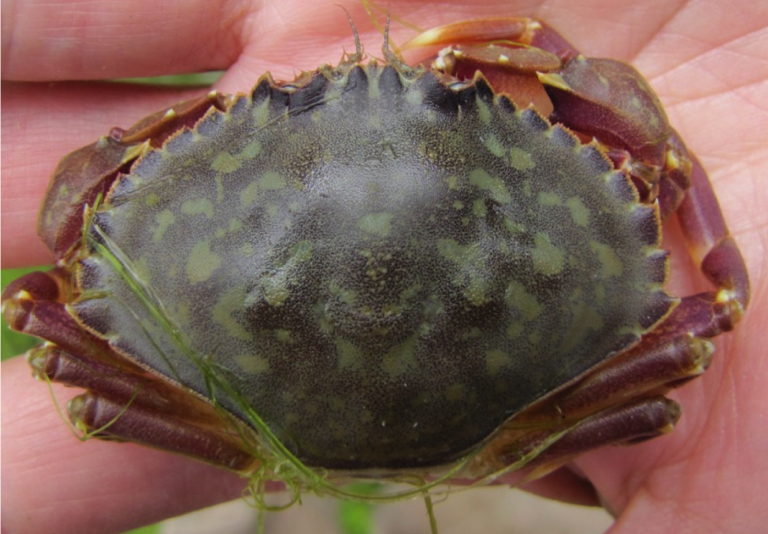
The first clue you can use to tell the two crabs apart is their size. Despite their otherwise similar appearance, you would never accidentally catch and eat graceful crabs. That’s because they never grow as large as Dungies, and max out at about 4 ½ inches – well below the 6 ¼ inch minimum legal size for Dungies. At one time, Washington Department of Fish and Wildlife did promote a small recreational fishery for graceful crabs. But the confusion about which species people were taking made it difficult to regulate the fishery and ensure that young Dungeness crabs weren’t also being taken.
In our monitoring, Crab Team volunteers have to develop keen eyes and learn to distinguish the two species easily, even if they are the same size. Both graceful and Dungeness crabs live in the salt marshes and pocket estuaries where we sample, but Dungeness crabs only use those habitats when they are young, and move to deeper waters as grow large enough to avoid predators. So, when we see young Dungeness crabs in our traps, they are about the same size as graceful crabs.
How to tell the difference, then? It turns out that, similar to many of the other crab species, the key is in the teeth. On the edge of the back shell, the spines that jut out to the outside of either eye are called marginal teeth, and they are one of the best ways to tell different species of crabs apart. Being closely related, both Dungeness and graceful crabs have 10 marginal teeth on either side of their shell, but graceful crabs are widest at the ninth tooth, while Dungeness crabs are widest at the 10th – which is the spine that a recreational crabber uses to set the crab gauge.
Even if you only have a claw, you can figure out which species you are looking at. Dungeness and graceful crabs both have relatively long skinny pinchers, which are often called “pinching claws” for that reason, as opposed to the beefy crushing claws of rock crabs, for instance. But along the top edge of the claw, Dungeness crabs have serrations, while that edge is smooth on the claws of graceful crabs. Now you can impress your friends at beach parties!
It’s more than just looks that separate the two species, though. According to research by Crab Team member Sean McDonald, graceful crabs’ metabolism is more efficient warmer water than Dungness crabs’, even when they are the same size. This might enable graceful crabs to be more successful in pocket estuaries and marshes, where the shallow waters can get quite warm in the summer.
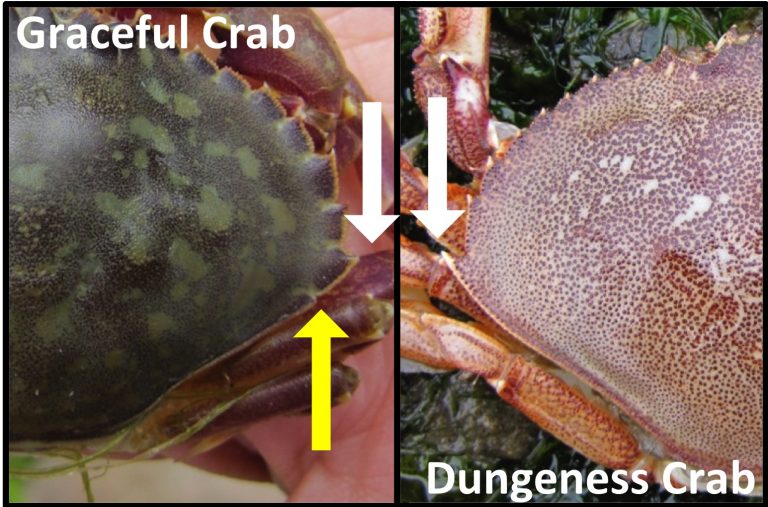
The widest tooth – indicated by the white arrows – is number 9 for graceful crabs, but 10 for Dungeness crabs. The yellow arrow shows the small notch behind the graceful crab’s widest tooth, which is really the 10th tooth. Note the smooth edge of the shell behind the Dungie’s widest tooth. Click to enlarge. (Photos: J. Adams)
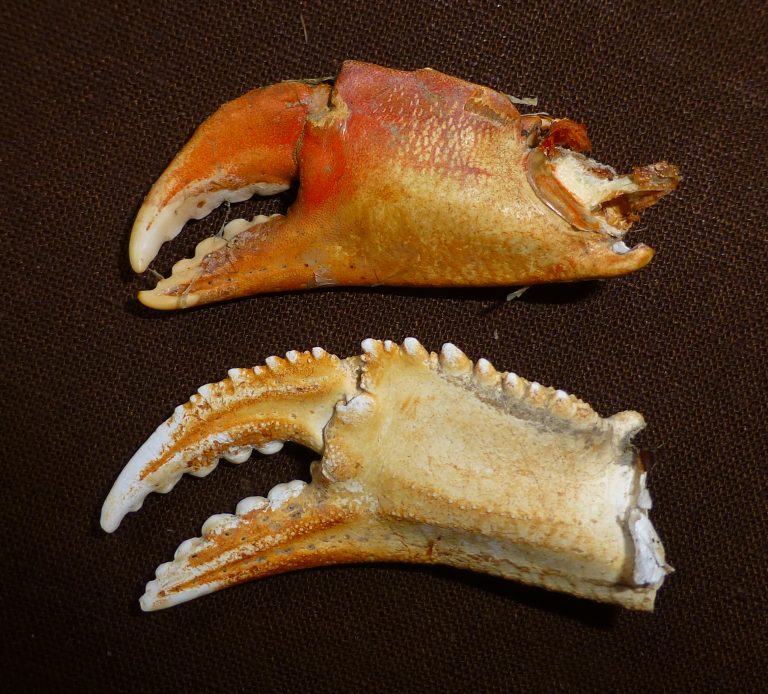
The top edge of the graceful crab claw, shown here on top, is smooth compared with the serrations on the top edge of the Dungeness crab claw, shown on the bottom. (Photo: E. Grason)
One particularly surprising bit of graceful crab natural history is that the young crabs are adventurous travelers, and their preferred transportation is the fried-egg jelly (Phacellophora camtschatica). Most crabs have to settle onto the sea floor as they transition from free-swimming zoeal larvae to megalopae (see last issue of the newsletter for an explanation of the life stages of crabs). Even as megalopae, graceful crabs aren’t ready to come down yet, it seems, and prefer to spend a while longer floating around on the large jellies. A study in Santa Barbara found that during the warmer months, nearly all of the fried-egg jellies they collected had megalopae on them, and some graceful crabs stayed on their jelly-as-hot-air-balloon as they transitioned to juveniles. The researchers even investigated the crabs’ diets, and found that as megalopae, they eat bits of the jelly itself, and so are partially parasitic. However, as they grow into juvenile crabs, they switch to eating other parasites also found on the jelly, such as amphipods. In addition to a great view and amphipod buffet, graceful crabs in this commensal relationship benefit from a warm, protective relationship with the jellies. That is, the jellies often swim up near the surface, and the warmer surface water allows crabs to speed up development, and stay safe from predators, all without having to lift a claw. Maybe cruise ship is a better analogy than hot air balloon! Read the full research article..
Next time you find a small crab you at first take for a Dungie, take a closer look. You never know, you might very well have one of the Salish Sea’s graceful crabs.
*The name of the genus is contested, though the relatedness of the two crabs is not. After being known as Cancer for years and years, a recent change was adopted to Metacarcinus. However, there are still many who strongly contend that the crabs should remain in the genus Cancer, and only time will tell which taxonomist wins the day. For now we choose to acknowledge both names and call the crabs Cancer (Metacarcinus).