
Green Crab: Ontogeny and Phenology
Here at Crab Team, we get asked a lot of questions about green crab. One of the most common is simply, “Where am I likely to find a green crab?” To answer that simple question, we have to provide a relatively unsatisfying answer: it depends. It depends on a number of factors but ontogeny and phenology are among the most important. Ontogeny refers to the changes that an organism undergoes as it develops over its lifespan, while phenology involves cyclic or seasonal patterns of natural phenomena changing throughout the year. These concepts interact in interesting ways to influence the real estate landscape for green crab. Indeed, ontogeny and phenology are critically important in considering where one might find green crab because … timing is everything.
You see, much like your kids heading to college and then striking out on their own, the place a green crab calls home changes over its lifetime (ontogeny). It all starts in the plankton.
They Grow Up So Fast…
Larval green crab slosh around on ocean currents and rarely touch the bottom. This strategy keeps them as close as possible to their planktonic food sources and allows the species to spread to new locations. The open ocean is their first habitat, albeit a short-lived one, and they spend only a few months adrift. That’s because, like all arthropods, the developing larvae undergo a series of important metamorphoses, shedding their exoskeleton (molting) and changing the arrangement of their body features. With those changes, they shift what habitats they use. The current-loving larval stages (zoeae) give way to megalopae (the single of which is “megalops,” which is a pretty fun word to say). The megalopal stages are “thigmotactic.” Now, there’s a word to impress your friends with at cocktail parties! It means that they seek contact with another surface. The sole purpose of this stage is to find a suitable place to settle and make a living for the remainder of their crabby lives. Megalopae are better swimmers than their predecessors and have strong preferences for habitats that promote survival. During high tides they settle onto the upper shore of estuaries into marsh grasses, oyster or mussel beds, and other spots where they can hide from predators. Once they find a safe home, megalopae metamorphose again into baby crabs.
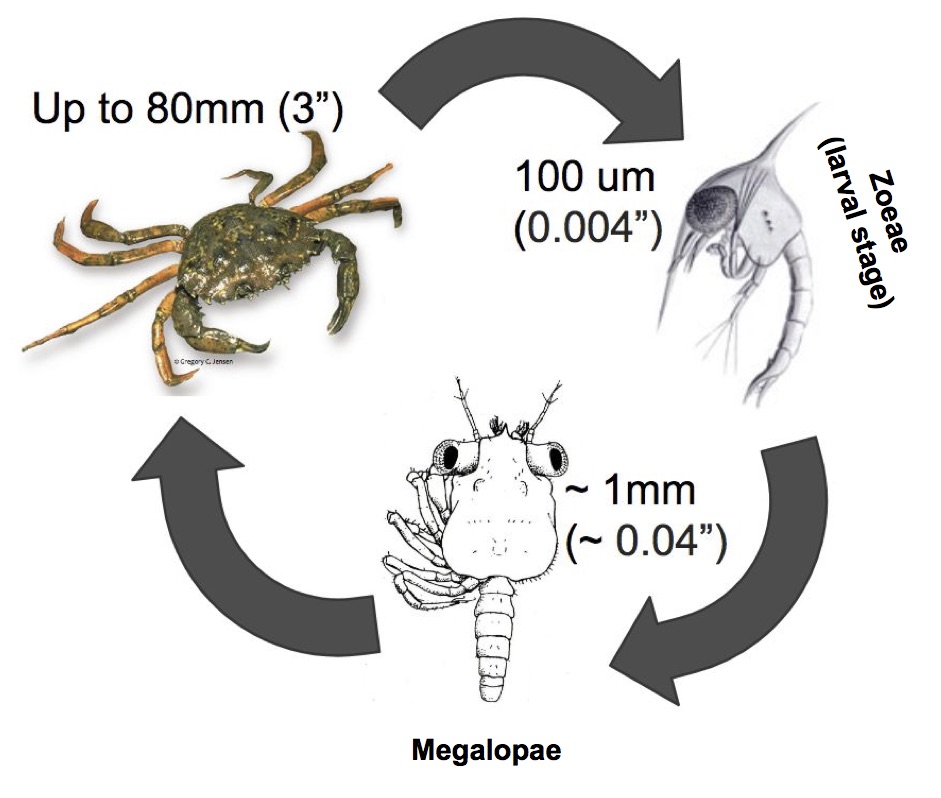
Life stages of European green crab. With adapted images from Greg Jensen (adult), Rice and Ingle (megalops), and Haeckel (zoea).
Over the next few months of life on the bottom, the baby green crab grow rapidly, taking advantage of fertile growing conditions in the relatively warm, very shallow water. At this vulnerable size, they live among the marsh plants, hunker down in shallow burrows, or hide in seagrass or shellfish beds. As the crabs grow, their increased size gives them a bit of protection from some predators, so they can move into slightly deeper water where there are better feeding opportunities. In some cases, these young green crab occupy saltmarsh channels or shallow lagoons, and as they grow even larger, they might move into shallow subtidal regions of estuaries.
Green Crab Maternity Homes
For female crabs, major life events lead them to choose a different habitat yet again. The process of extruding eggs onto the abdomen is a tricky one, and requires just the right conditions. Female green crab seek out sandy areas under rocks and other debris, then dig a shallow depression and use it much like a Jell-O mold to form the newly laid eggs against their body. A “berried” female carrying thousands of bright orange eggs is an easy target for many predators so brooding moms tend to stay buried and relatively sedentary as their eggs develop. Females prefer sand over gravel or mud during this time, likely because it’s easier to keep the eggs clean and well aerated. Note: scientists actually know relatively little about brooding female green crab because they’re so cryptic and difficult to find.
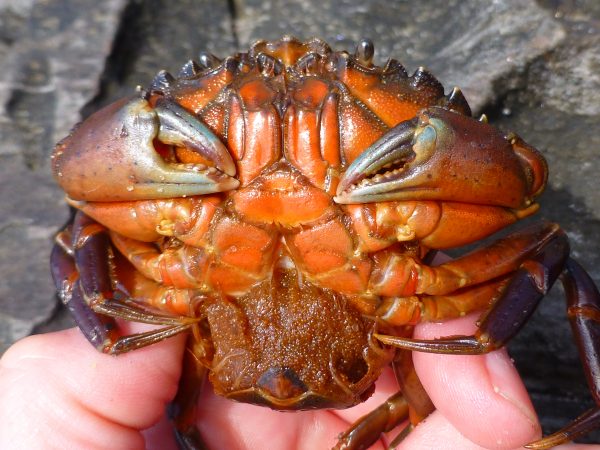
A green crab baby bump. This, female found in Maine, has turned quite orange with age, and is brooding her eggs under her abdominal flap. (Photo: E. Grason).
The Golden Years
The final ontogenetic shift in habitat occurs as green crab start to senesce. Most crabs reach what is referred to as a “terminal molt.” That is, they only molt a set number of times in their life. When they reach this stage, their last shell, which they will live in for the remainder of their lives, turns from green, to orange, and finally to red. These color changes are accompanied by changes in physiology and aggression. The older crab become less tolerant of fluctuations in temperature or variability in salinity. Consequently, old crabs tend to be found in slightly deeper areas and farther away from freshwater inputs like streams and rivers. You can read more about this in a previous newsletter article.
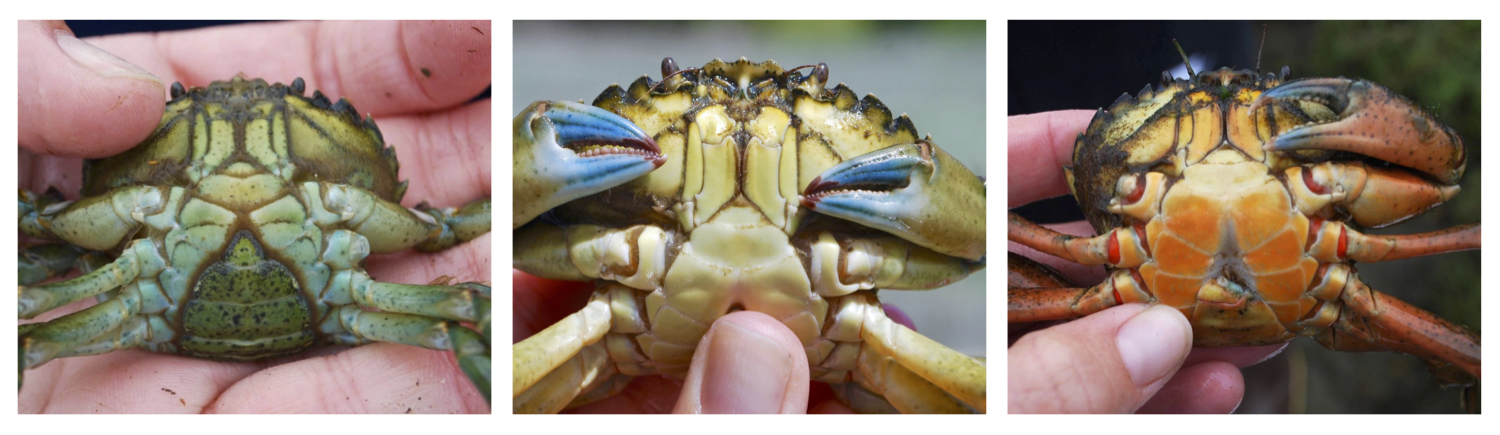
The various color phases of European green crab. Photos: Kelly Martin
For Every Season…
These ontogenetic changes don’t occur in a vacuum. They’re timed to coincide with other natural phenomena so that crabs are “dialed in” to their surroundings as they change throughout the year. Thus, we observe phenological patterns – seasonal changes – in how crabs grow and where they are found. While not all of the triggers are known, seasonal changes in temperature and light level are important, as are the cyclic patterns of the tide. For instance, there’s evidence from some regions that female green crab time the release of their larvae with nighttime flushing tides in early spring. This timing gives their offspring a better chance of being carried out to sea when there is abundant planktonic food, like copepods, and currents are favorable for dispersal.
It’s not an accident that Crab Team monitoring corresponds with these seasonal and cyclical patterns, because seasons affect where and whether we are likely to find green crab. In the Pacific Northwest, green crab tend to be most active during the warmer spring and summer months (April – September). Crabs don’t keep a warm body temperature like we do, so their activity rates are strongly influenced by external temperatures, because warmer temperatures speed up biochemical reactions. Crabs have to take advantage of the warm parts of the year and cram in as much feeding, growing and mating as possible. That makes green crab “more catchable” at these times of the year, more eager to enter traps in search of food, and that gives us a better chance of finding them even if they are extremely rare.
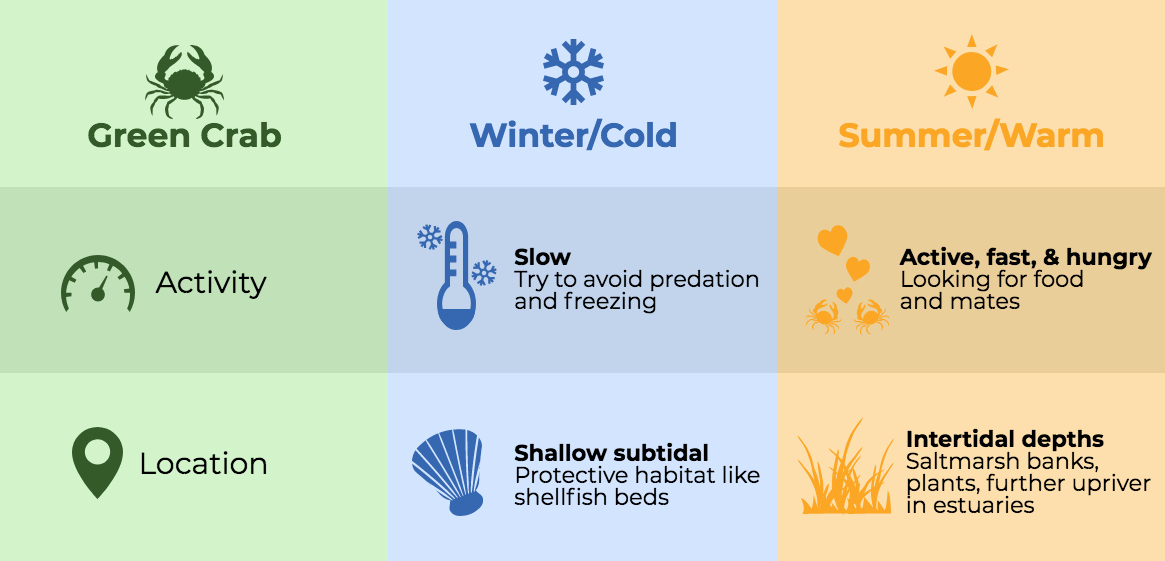
It’s not only activity level that changes with the season, but also the places where crabs are found. In the winter, air temperatures can get dangerously cold for green crab. In addition to slowing them down, making it difficult for them to get food and escape from predators, if crabs were to be out of the water when temperatures drop near or below freezing, ice crystals could form and damage their tissue. To avoid this, they spend more time in slightly deeper water during colder parts of the year. Green crab often migrate out of the intertidal zones and deeper into the shallow subtidal. They seem to take shelter in shellfish beds at these depths and are sometimes found by shellfish growers during this time of the year. We have also observed that as the spring rains abate, and the salty portion of river estuaries extends further and further upstream, green crab can also be found further upriver in the later summer than in the earlier summer.
At sites like Makah Bay, on the outer coast, and Graveyard Spit in Dungeness Bay, where many green crab have been captured, we have had seen clear seasonal patterns of growth. We also see clear peaks in molting during early July and late August. The crabs are growing quickly and shedding their shells as they do during these months. Not surprisingly, we see some similar patterns in native species, too. Tracking seasonal patterns is useful for understanding the dynamics of these populations. And just like tracking the flowering date of the cherry trees here on the University of Washington campus, or sighting of the first migrating snow geese in the Skagit Valley, observations of green crab phenology can provide scientists with insights into how climate change could affect local ecosystems and the invasions that threaten them.
– Sean McDonald