
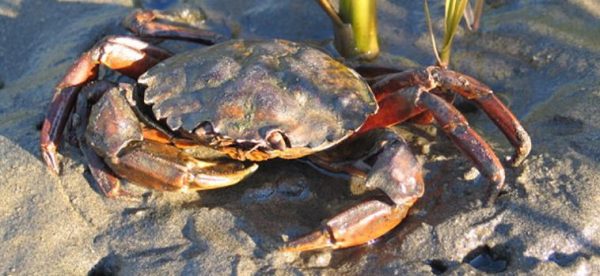
Photo: Sean McDonald.
“Green” Crab: Just How Green is “Green”?
If you have participated in any Crab Team training workshops, then you know full well that we don’t put much stock in color as a diagnostic characteristic for identifying crabs. Our ‘don’t use color’ mantra is repeated in our meetings and outreach materials – to the point of near obsession. Can you blame us though? When you look at as many crabs as we do, it doesn’t take long to see there are no hard, fast rules when it comes to color. We often see young ‘red’ rock crab with black and white stripes, ‘purple’ shore crab with an olive hue, and ‘yellow’ shore crab that would be more accurately described as violet. Indeed, color is variable in a wide variety of crabs native to the Pacific Northwest. But what about the invasive ones? Are European green crab really green? As it turns out, the answer is a resounding, “sometimes.”
As juveniles, green crab (let’s just call them Carcinus to avoid confusion) come in an array of colors and patterns. Tiny Carcinus — dime- to quarter-sized — can even change color, or at least brightness*, to match their surroundings. Juvenile crab achieve this feat by manipulating red, white, and black pigment cells, called chromatophores, beneath their thin shells. While not quite as dramatic as a chameleon (or octopus, to use a marine reference), these changes in color and brightness could mean the difference between life and death. Often times, camouflage is the only thing keeping a little crab from becoming a little snack for a hungry fish or bird, and there’s a distinct advantage to blending in with the seaweeds, shells, and cobbles that are common habitats for young crab in both their native and introduced range. (Read about how video games are used to learn about the effects of green crab patterns on survival.)
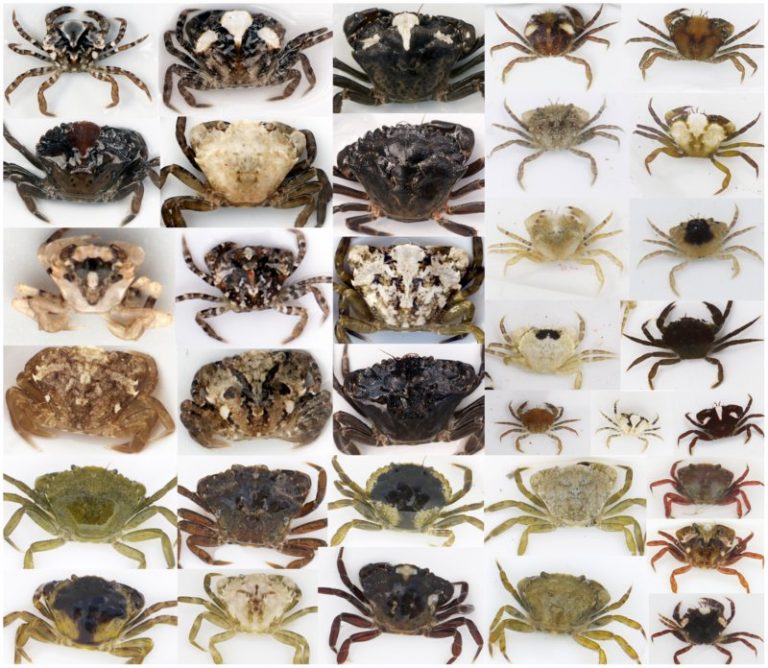
Juvenile European green crab come in a variety of colors and patterns of camouflage. The patterns are considered disruptive coloration, similar to zebras, and could be linked to their survival. Image from Stevens et al. 2014. Click to enlarge
Adult green crab are not able to change color at will. Their thicker, heavily-armored shells are more opaque, which makes the chromatophores less visible. Nevertheless, adult green crab still range in color from green through yellow and orange to red. Color in adults results from pigment, astaxanthin, bound up within the shell itself and is linked to the duration of the intermolt period, which is the length of time between molts. Newly molted crab tend to appear bright green but individuals become redder the longer they go without molting. This process may be initiated by photo-denaturation of astaxanthin, which is known to turn red when degraded by light (Reid et al. 1997). By the way, this is the same reaction that occurs when a lobster is boiled!
Over the past half century, scientists have slowly unraveled the mystery of color change in Carcinus, and it turns out these differences are more than just skin, or rather shell, deep. There are distinct biochemical, physiological, and behavioral differences among color variants. Scientists interested in these differences tend to differentiate adult Carcinus into two categories: green morph and red morph.
Green morph Carcinus tend to be younger, smaller, and have thinner shells than their red counterparts. They’re also more tolerant of fluctuations in salinity, oxygen and temperature, and more resilient when exposed to pollutants. Conversely, red morph Carcinus are more aggressive and mate more successfully. These differences translate into substantial disparities in behavior and habitat preference in the field.
In the Atlantic, adult Carcinus occupy deeper water habitats than they do here, and exhibit daily patterns of activity. In particular, green morph Carcinus tend to forage with the tide and make intertidal migrations to shallow water. Older red morph Carcinus migrate less frequently or discontinue migrations altogether and remain in deeper water. Michel Kaiser and his colleagues suggested that “green morph” Carcinus might be forced to migrate in part to decrease aggressive encounters with larger red morph crab. (For more on this: McGaw and Naylor 1992; Reid et al. 1997, Wolf 1998…there’s even more, just ask us!).
Whether these ecological differences persist in populations along the West Coast remains to be seen. To date, there is little evidence of intertidal migrations and Carcinus, both green and red morphs, occur most often in shallow water.
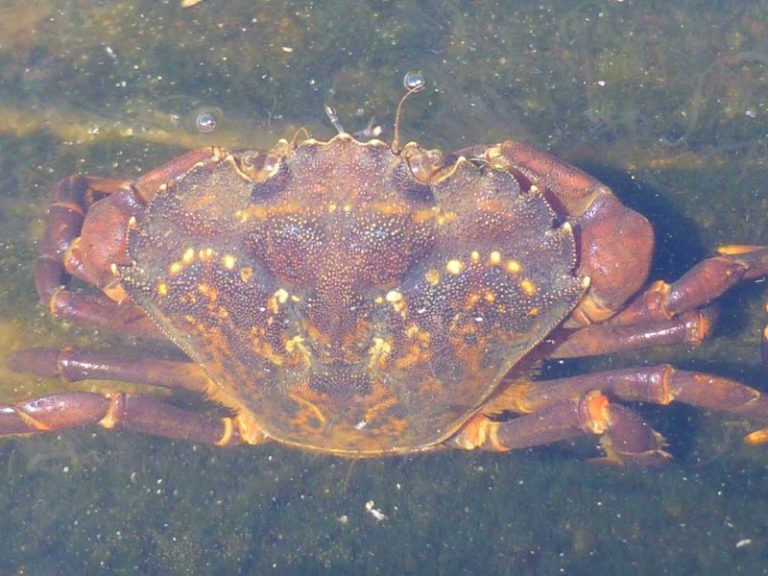
A red morph Carcinus maenas found in Maine. Photo: Emily Grason.
For what it’s worth, the Carcinus captured in Westcott and Padilla bays in August and September of 2016 were all green morphs. These individuals were relatively small and likely only 1-2 years old. Time (and lots of monitoring!) will tell if there are more Carcinus in Puget Sound, but as we enter a new sampling season, it’s important for everyone to keep an eye out for the European green crab, which is only ‘sometimes’ green.
-P. Sean McDonald, Ph.D.
*We try to connect you with the research our information is based on. We apologize, however, that some articles require a subscription to access.
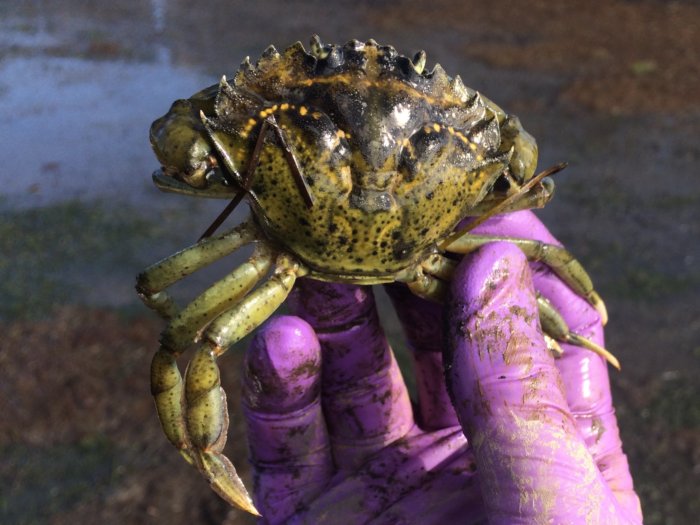
Green morph male Carcinus maenas from Padilla Bay. Photo: Jeff Adams.