
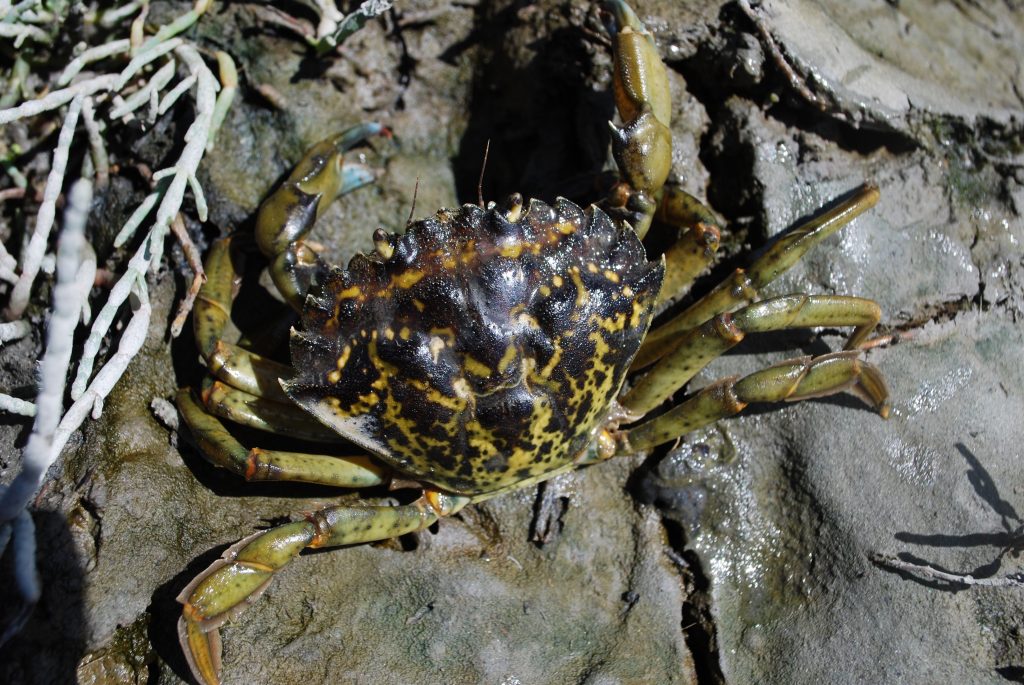
European green crab. Photo credit: Kelly Martin/WSG
Fast Food: Some green crab are bigger, stronger, and hungrier than others
Guest columnist Brett Howard received her doctorate from Simon Fraser University, completing her dissertation research on the impacts of European green crab in British Columbia. You can read the published research underlying this article online for free.
The classic dramatic predation sequence in any nature documentary, where the predator is first shown stalking its prey, followed by a chase and attack, demonstrates the universal steps that all predators, from the largest charismatic megafauna to the smallest invertebrates, use to acquire food. In addition to being a spectacular visual, this familiar sequence also offers important ecological insight into predatory behavior.
In the late 1950s, a Canadian entomologist named Buzz Holling developed a mathematical model for predicting the success of a predator by breaking down every predation event into two components: the attack rate and the handling time. The attack rate measures how quickly a predator can find and attack its prey while handling time describes the time needed to capture and consume prey. A fast handling time prevents bigger, more aggressive animals from stealing prey, and also allows a predator to begin searching for its next meal sooner. By breaking the predation process down into these two measurable steps, it is possible to compare the efficiency of predators among individuals, populations or species.
This comparative approach is especially interesting when applied to invasion ecology, because knowing how effective an invasive predator is can offer insight into their long-term impacts on native prey populations. There have been a number of such studies that have demonstrated that invasive predators can outperform native predators. For example, the highly invasive largemouth bass (Micropterus salmoides) in South Africa can eat more prey, faster than a similar native fish, the Cape kurper (Sandelia capensis), which is consistent with its impacts on South African freshwater ecosystems (read the research in Alexander et al. 2014).
If functional responses can help explain behavioral differences between native and invasive predators, what could they tell us about differences in the predatory behavior of a single invasive species with multiple invaded regions? To test this hypothesis, my collaborators and I ran functional response experiments on European green crab (Carcinus maenas), because it is an invasive predator found in multiple invaded regions worldwide (Figure 1), and because these regions have all experienced very different occupancy histories and impacts of green crab. In North America, green crabs are known for having strong negative impacts on shellfish populations. Meanwhile, invasive green crabs in South Africa and parts of Australia have not had significant or detectable impacts. Why the impacts of green crab (and many other invaders) vary among invaded regions is not well understood, but is certainly affected by how an invasive species interacts with each region’s unique biotic and abiotic characteristics. In this study, we focused on how those differences manifest in the predatory behavior of green crab.
Between myself and my collaborators, who were working out of Queen’s University Belfast, in Northern Island, and Stellenbosch University in South Africa, we collected green crab from both the native range (Europe) and from three invasive ranges – in this case British Columbia, Nova Scotia and South Africa (Figure 1) – and performed functional response experiments by letting our crabs forage on different densities of mussels (Mytilus spp.) inside experimental chambers (i.e., Rubbermaid storage bins). Based on how many mussels each crab consumed (Figure 2 in the paper), we were able to estimate how effective green crabs from around the world were at detecting and attacking prey (attack rate) and how quickly they consumed that prey (handling time) (Read the research in: Howard et al. 2018).
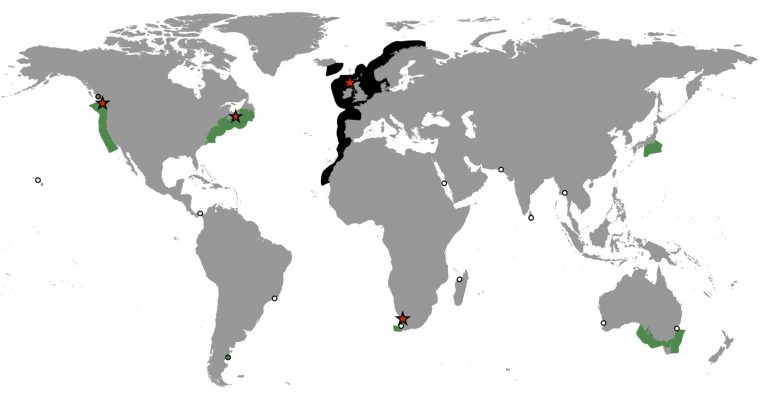
Figure 1: the native (black) and invasive (green) ranges of European green crab, and green crab collection sites for the study (star). Click to enlarge.
Although our crabs were foraging for a sessile (attached) prey species in a relatively small area, we nonetheless detected differences in attack rate, which mean that some populations of green crab were faster at finding mussels than others. Green crabs from British Columbia were the fastest, possibly because they were more active in the experimental chamber and consequently came across more mussels (Figure 3).
However, the most dramatic result was in the crabs’ handling times. North American invasive green crab, from both British Columbia and Nova Scotia, had much faster handling times than either the native green crab from Europe or the invasive crab from South Africa (Figure 3 in the paper). Rather than transporting live, non-native mussels internationally, we opted to use different, locally abundant mussel species in each of our four regions (e.g., M. trossulus in British Columbia). Despite the variation this may have introduced to the experiment, we consistently found the fastest handling times in North American green crab. Like other crabs, handling time for green crab includes the time it takes to break the shell and excavate the meat within. The ability to do this is dictated by how big (and therefore strong) the crab’s claws are compared to the prey’s shell thickness. An excellent example of this is our native red rock crab (Cancer productus), which is an important predator in mussel beds and has impressively large, powerful claws for this purpose. Green crab fall into both camps because they are heterochelous, meaning their claws are always different sizes – a smaller one for cutting apart soft tissues and a larger one for crushing shells (read the previous newsletter article on green crab claws). Being equipped with two different tools helps make green crab a successful invasive species, because they can adapt their diet to whatever prey happens to be available. It appears that green crab in British Columbia and Nova Scotia have improved on that advantage, as we found their crusher claws were significantly bigger than those of South African invasive green crab. Why North American green crab have such big claws is open to speculation, but it is well-documented that individual crabs can grow proportionally bigger claws over their life span in response to environmental cues (e.g., thick shelled prey or large-clawed competitors like red rock crab). Regardless of the reason, with bigger claws, green crab in North America can break into mussels quicker, giving them faster handling times.

The lab setting for Howard’s experiment in British Columbia.
There are two important take-aways from this study. The first is that there is still much to be learned about the predatory behaviors of invasive species by looking at their functional responses. The second take-away, specific to green crab, is that our findings qualitatively line up with observed predatory impacts for this species in the field. North American invasions of green crab can be quite detrimental, unlike in South Africa, and this could be attributable, in part, to the higher attack rates and faster handling times of North American green crab. From a management perspective, this study is further evidence that the shellfish populations in British Columbia, and probably throughout their North American range, are at risk of being over-exploited by these highly efficient invasive predators.
– Brett Howard