
Featured Creatures:
Group Name: Majoidea (a superfamily, rather than a single species)
Common Name: Spider crabs
Species Code: SPID
Geographic Range: Southwest Alaska to southern California
Size: up to about 110mm (4.3″) for Northern kelp crab (Pugettia producta)
Trapped at Home: Crab Team’s Spider Crabs
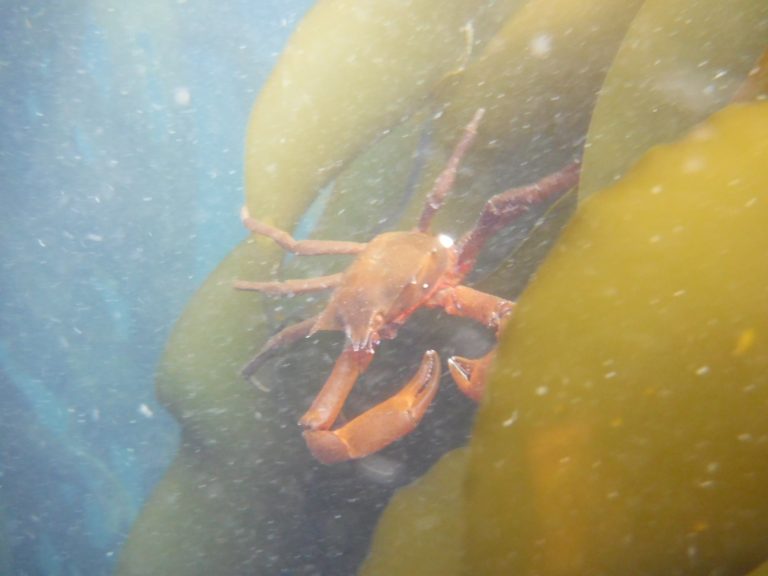
While Majoids aren’t a major player in Crab Team trapping, this colorful crab clan rocks both style and personality. Of the spider crab species, we’re pretty sure that the Northern kelp crab (Pugettia producta) is the only species that has shown up in Crab Team traps so far, irregularly and only at a handful of impoundment-/lagoon-type sites. Interestingly, it’s mostly during the early part of the season when spider crabs show up in traps, then there seem to be fewer later in the season (Figure 1). Crab Team members may still find a molt or washed up carcass of one of the handful of other spider crab species in our region, and heck, let’s explore this group for a bit so we can all have fun keeping an eye out for them as we explore the beach or swim, snorkel or dive the Salish Sea.
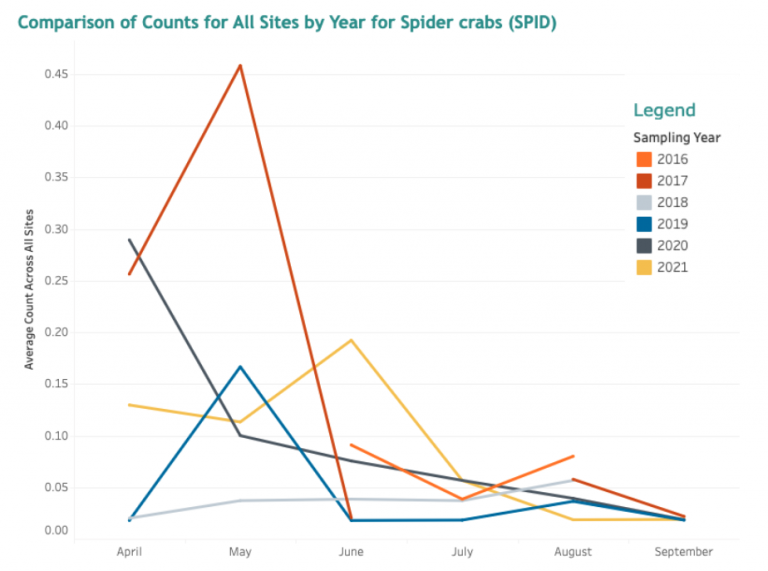
Figure 1: Spider crab counts across all sites and by year for each month. Explore more data at Crab Team’s Tableau site. Click to enlarge.
Spider crabs (SPID in Crab Team lingo) are all in the superfamily Majoidea and are one of a few groups of species that Crab Team lumps into a taxonomic pot rather than always identifying down to species. They can be tricky under the best of conditions, but then they go and glom other plants and animals onto themselves, sometimes making diagnostic characteristics tough to see. So, like flat fish (FLAT) and eel-like fishes (ELFS), we figured it’s in the interest of accuracy and sanity to not try to “overidentify” spider crabs. That said, Crab Team members, staff and colleagues have enjoyed looking at many a picture of animals from those groups to see if we can confidently add species identifications to the footnotes.
For starters, spider crabs do look spidery. They tend to have long and spindly walking legs and claws that are reminiscent of the spiders who defend the corners and crannies of our homes from all manner of bugs. [Note: While decapods have spider crabs, arachnids have crab spiders… I just find that funny.] Along with their skinny legs, their carapace is a different shape than most of our other crabs, being narrower than it is long for most species and having more of a shield or pear-shaped appearance. In fact, the outline of their carapace – the points, the curves, the rostrum – is often enough to identify one species from another… that is if you can see the carapace through the menagerie they are growing on themselves. If the carapace is difficult to see, often the colors and patterns of claws can help in identifying species. Speaking of claws, spider crabs are certainly notable in that their final molt also aligns with sexual maturity, and while that means females invest their energy into egg making, the males invest in CLAW SUPERSIZING, often resulting in seemingly ridiculously large, long claws.
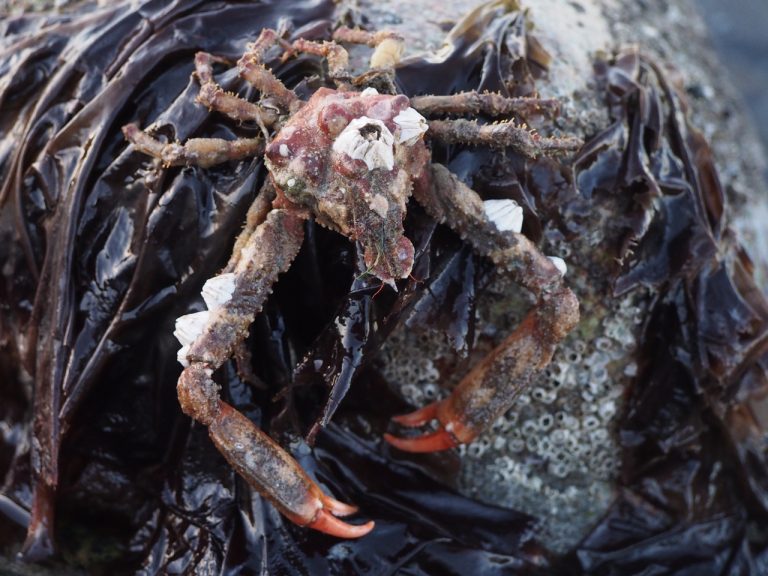
Male sharpnose crab (Scyra acutifrons), with its aging terminal molt and ridiculously impressively large/long claws Photo: Wendy Feltham
Majoids are pretty diverse in the eastern Pacific. On Washington’s shoreline and shallow subtidal areas, we could probably find a handful of species. In Greg Jensen’s Crabs and Shrimps of the Pacific Coast, ten species from two families (listed below) are described as being in Washington waters. We’ll focus on one from each family that tide poolers, beach explorers and Crab Teamers are probably most likely to come across.
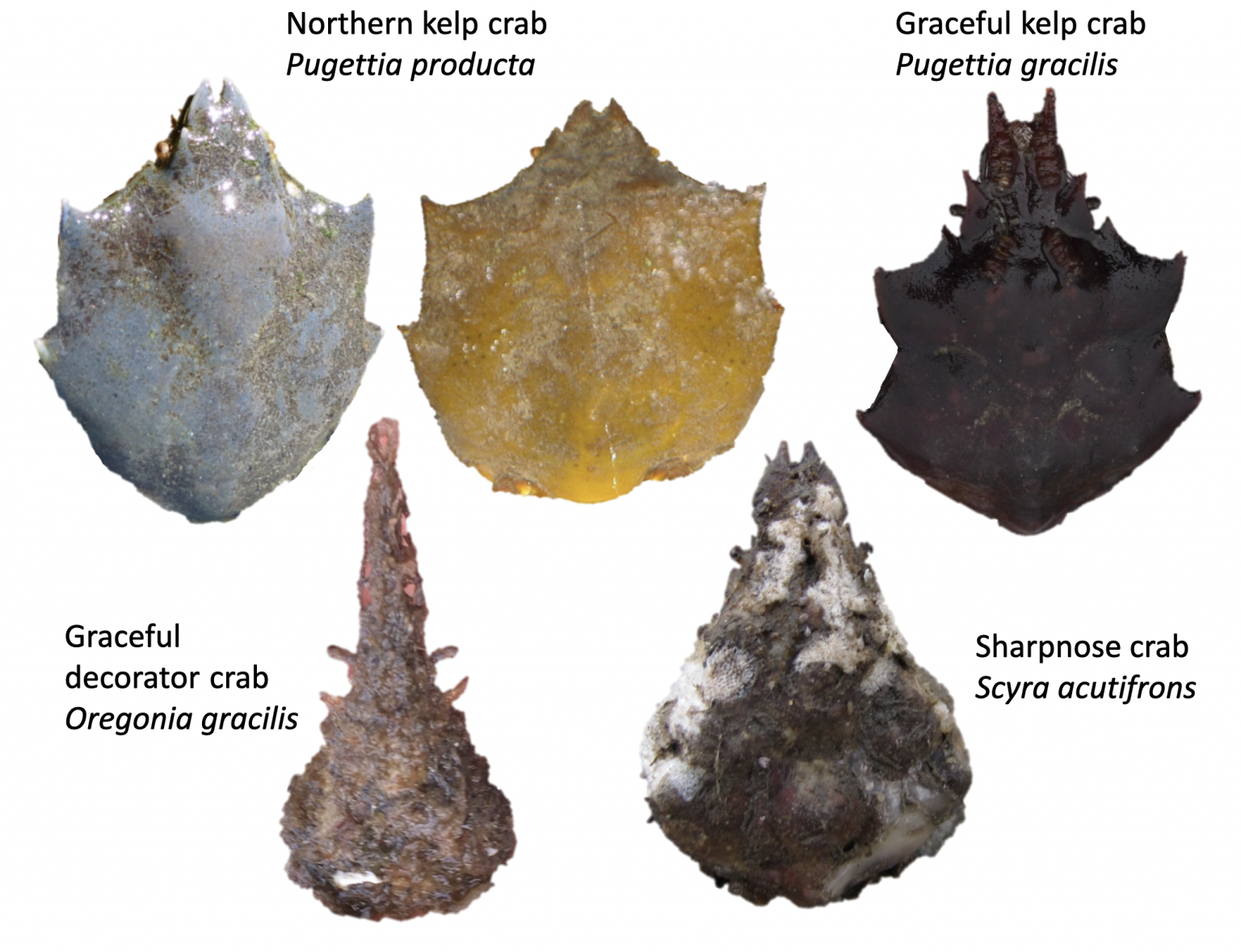
Comparison of four relatively common Washington nearshore spider crab species’ carapaces. Photos: Wendy Feltham and Jeff Adams.
Washington spider crabs (* = more detail below)
Family: Oregoniidae
- *Graceful decorator crab (Oregonia gracilis – up to 39mm)
- Pacific lyre crab (Hyas lyratus – males to 80mm, females to 55mm)
Often with graceful decorator; with much shorter rostrum - Southern Tanner/snow crab (Chionoecetes bairdi – males to >200mm)
(yes, tasty snow crab!) On open mud/sand; rarely shallow
Family: Epialtidae
- *Northern kelp crab (Pugettia producta – males to 110mm, females to 90 mm)
- Graceful kelp crab (Pugettia gracilis – to 45mm)
Common among rocks, algae and eelgrass - Sharpnose crab (Scyra acutifrons – to 45mm)
On rocks or other structure and fast currents; more with inverts than algae - Longhorn decorator crab (Chorilia longipes – to 45mm)
Usually in deeper (>30’) water - Cryptic kelp crab (Pugettia richii – males to 42mm, females to 33mm)
Mostly Pacific coast in kelp forests - Foliate kelp crab (Pugettia foliata – males to 42mm, females to 33mm
Mostly Pacific coast in kelp or rocks - Moss crab (Loxorhynchus crispatus – males to 123mm, females to 79mm)
More likely on Pacific coast and south of Washington
Graceful decorator crab
The graceful decorator crab (Oregonia gracilis), Oregoniidae’s master of disguise, is the most commonly encountered member of the family along Washington shorelines. Spider crabs run the gamut of decoration, and, using little curved hairs on their bodies, most will do a bit of decorating, even if it’s just a piece of algae on their nose when young (because why not?!). The graceful decorator has loads of these hairs that they can use to stash all manner of plant and animal material. Thorough decoration is especially common in young and female decorators who have abundant hairs to use for attachment. Older males generally have fewer hairs and may be more minimalistic in their ornamentation.
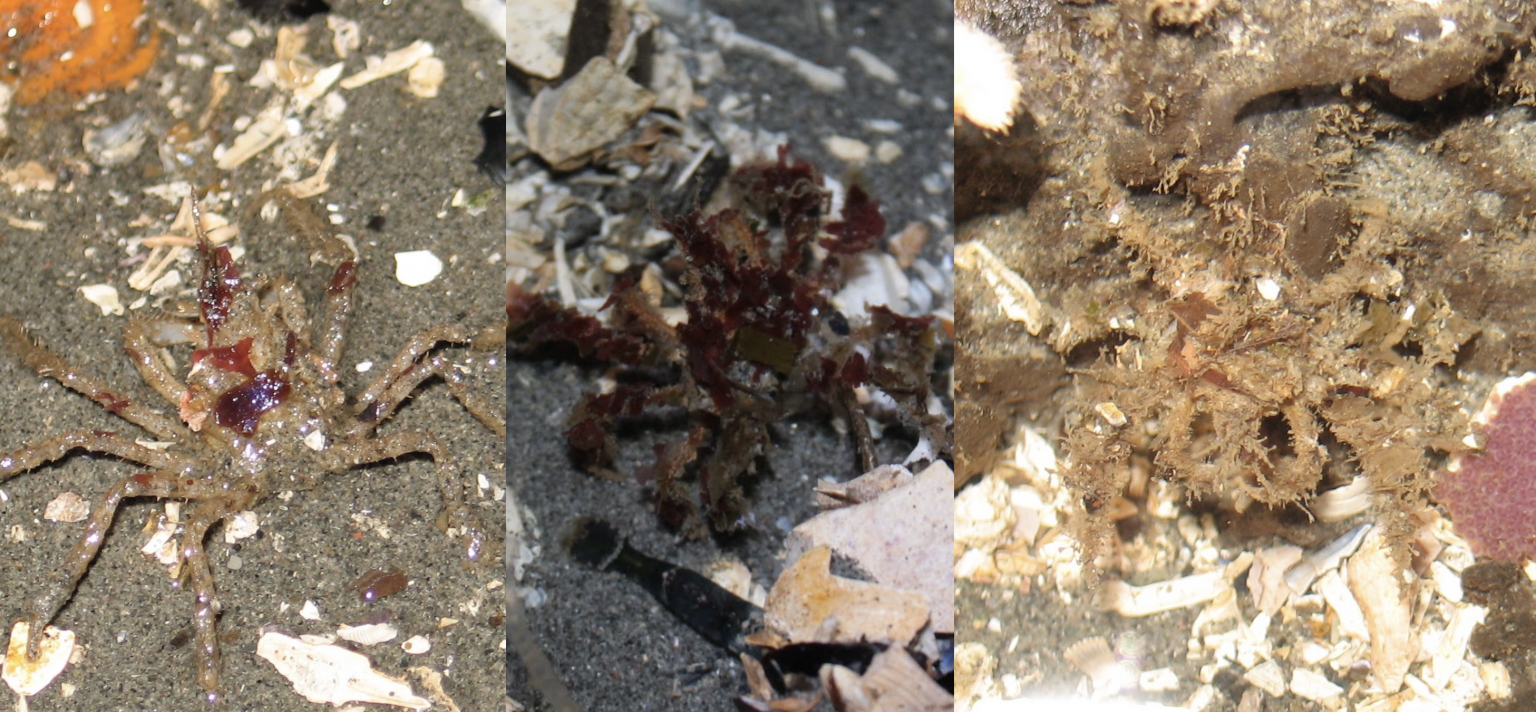
Now, for ID, just look for the spine next to the eye… Juvenile graceful decorators can be easily overlooked and hard to be sure of identification because of their thorough decoration. Photos: Jeff Adams (Click to enlarge)
Assuming you can see enough of their body at all through their bio-camo… You can look for their long rostral horns that stick out parallel from their head. Also very helpful is a long, thin, prominent spine behind each long eye stalk. Otherwise, their body shape pretty much looks like a pear with eyes. When you can see through to their color, they tend not to be very bright, and while they have small hairs, they also don’t have a lot of spikes on their carapace.
Researchers at the UW and Miami University ran experiments with graceful decorators to see how they used decorating materials in different life stages (Hein and Jacobs, 2016). They found that decoration started after megalope morphed into juveniles. It’s fun to imagine these super tiny crabs (3mm long!) already sticking things to itty bitty carapaces and legs. Interestingly, the researchers found that juveniles used mostly free floating organic debris to decorate, while it’s not until they mature further that their decorations focus more on algae and other animals. Juveniles molt so frequently, that it seems sensible to not invest too much into your personal zoo and botanical garden. As they use more flora and fauna to decorate, they will often transfer their pets from their molted shell to their new, hardening body before fully abandoning their molt.
Northern kelp crab
And let’s wrap up with the crab that we do see in Crab Team traps. The northern kelp crab (Pugettia producta) is a big, aggressive, omnivorous, abundant beastie that will shred everything from its favorite bull or giant kelp to snails, seagrass seeds, sea slugs, jellyfish and occasionally a passing diver. Interestingly, along with helmet crabs and hairy shore crabs, this species frequently fools beachgoers into thinking it might be a European green crab.
Maybe it’s the color? While the shape is quite different from a green crab, Northern kelp crabs are striking for their often bright olive coloring, and, especially when more mature, their bright red undersides. Their frequently undecorated carapace is relatively smooth and very shield-like with just a couple prominent spines and short, rounded rostral horns. Another species, the graceful kelp crab (Pugettia gracilis) is also pretty common and looks very similar to the northern kelp crab. The graceful’s rostral spines are a bit longer and carapace has an extra spine and more prominent indentation in the middle. Perhaps most helpful if present are the claw tips, which are usually grayish or blue, tipped with orange in graceful and more reddish or olive in northern.
Adults can be very abundant in kelp canopies. That’s garnered them more recent attention, particularly in the Salish Sea, as bull kelp has recently declined or disappeared in many locations. A couple of studies out of the UW’s Friday Harbor Labs showed that northern kelp crabs can play a strong role in reducing the growth and survival of bull kelp (Dobkowski, 2017) and that Salish Sea northern kelp crabs have an affinity toward fresh bull kelp (Dobkowski et al, 2017). On the upside, when the invasive kelp Undaria showed up in California, researchers found that northern kelp crabs mowed down one of their study cohorts (a particularly abundant cohort), preventing the plants from reaching maturity (Thornber et al, 2004). When kelp is not abundant, and particularly during winter after algae largely senesces, northern kelp crabs are happy to scurry off and scavenge barnacles, anemones, other invertebrates … and maybe mackerel? The pattern of when we see them in Crab Team traps may reflect the seasonality of when they’re foraging broadly and when they’re hunting kelp.
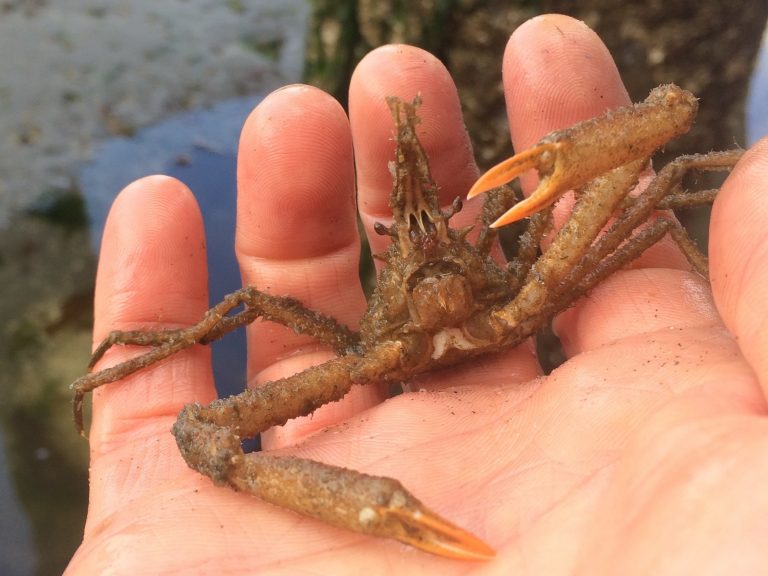
Male graceful decorator crab with mature claws and without much decoration. Larger males tend to have fewer of the hairs to which to attach things. Also note the narrow spine below each eyestalk that is helpful for identifying the species. Photo: Jeff Adams (Click to enlarge)

Female and male northern kelp crab abdomens (and ready to pinch claws!). Photos: Katie Dobkowski (Click to enlarge)
So, keep your eyes on the beach (and face in the water if you’re so inclined) to enjoy this cool critter collection, and please share any interesting finds. In fact, one great place to do so is the Crabs of the World iNaturalist project, created by one of Crab Team’s very own super volunteers, Wendy Feltham.
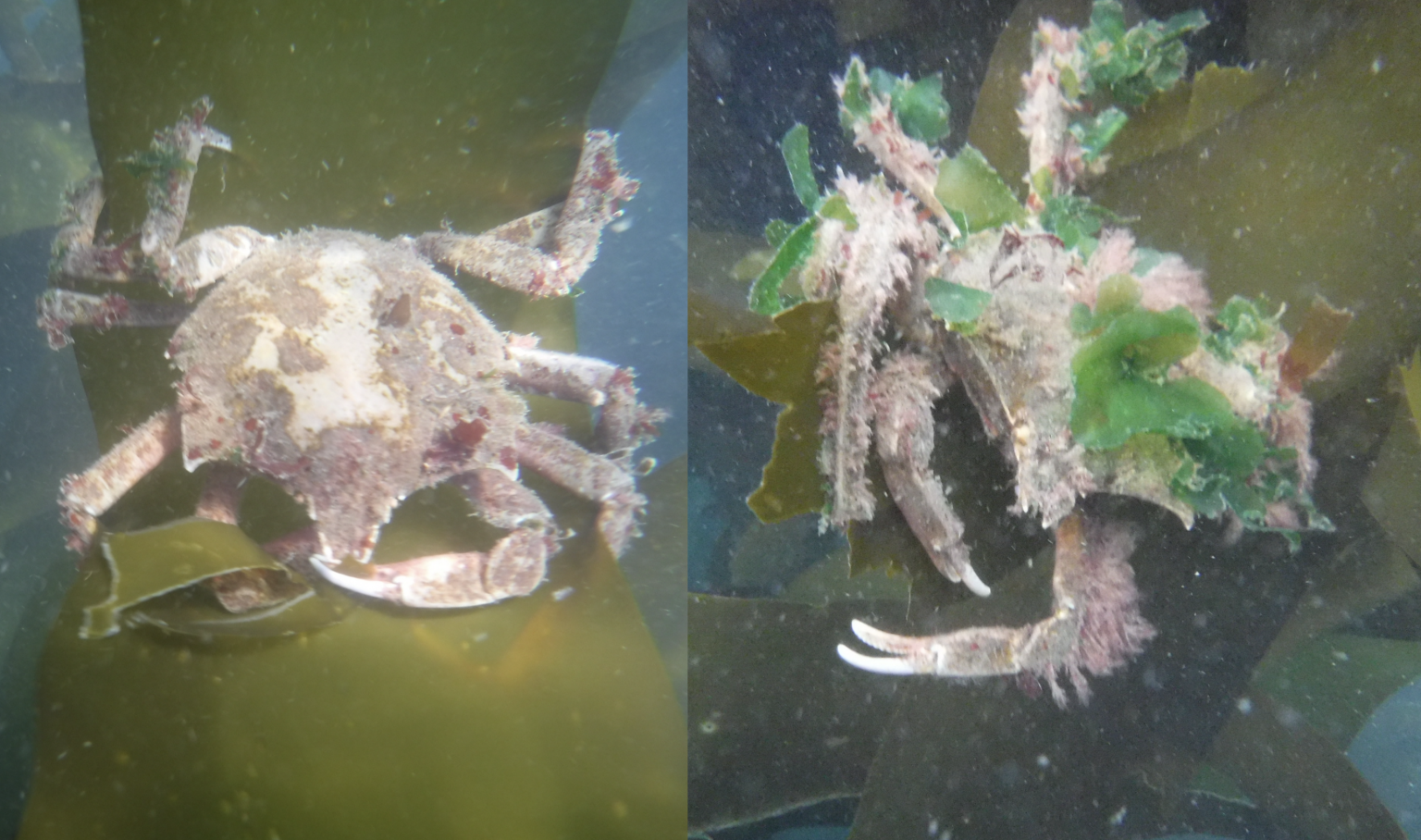
Nom, nom, nom… Surprisingly well dressed Northern kelp crabs feeding on bull kelp blades. Photos: Aina Lei Hori (Click to enlarge)
– Jeff Adams