
Creature Feature:
Purple Shore Crab
Species Name: Hemigrapsus nudus
Common Name: Purple shore crab
Species Code: HENU
Geographic Range: Southern Alaska, USA to Baja Peninsula, Mexico
Size: Females up to 56mm (2.2”), males up to 58mm (2.3”)
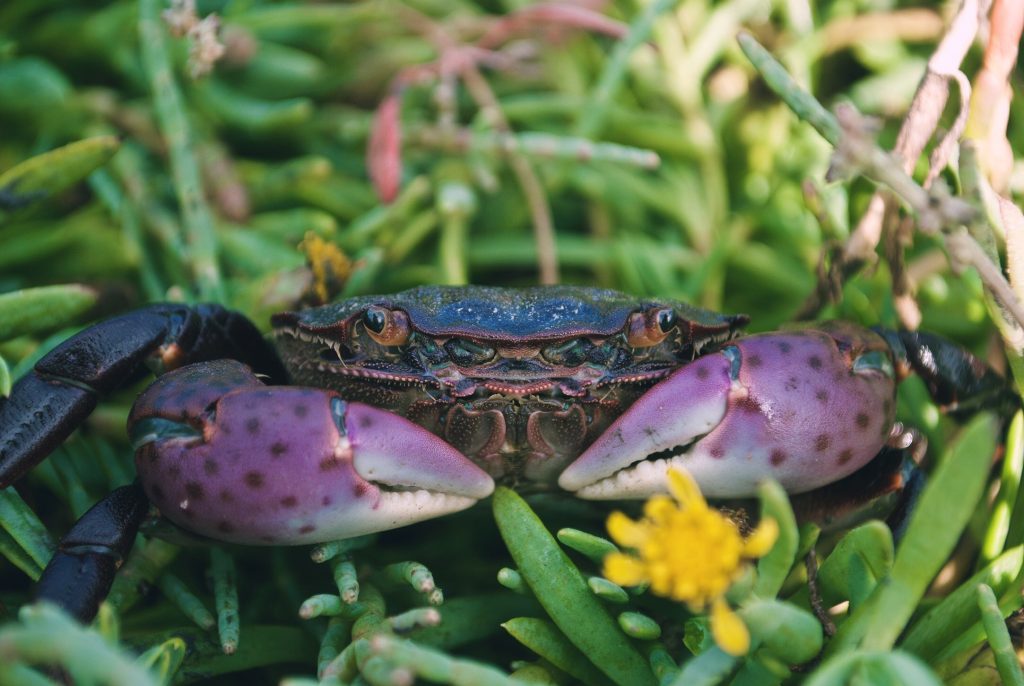
The mud can be sticky, the crabs can be pinchy, and the tides don’t always align with sunny weather. But if you ask Crab Team volunteers, many of them will say that the most challenging part of Crab Team sampling is distinguishing between our two native shore crab species of the genus Hemigrapsus. Of these two close cousins, we often talk most about H. oregonensis, HEOR, the hairy shore crab, because it is by far more abundant and ubiquitous in our sampling than any other animal, comprising more than 90% of all organisms captured in Crab Team traps.
As crabs go, the purple shore crab, H. nudus, comes in a distant second to the hairy across the Crab Team monitoring network, even though it is probably as abundant and widespread in the Salish Sea. Why is that?
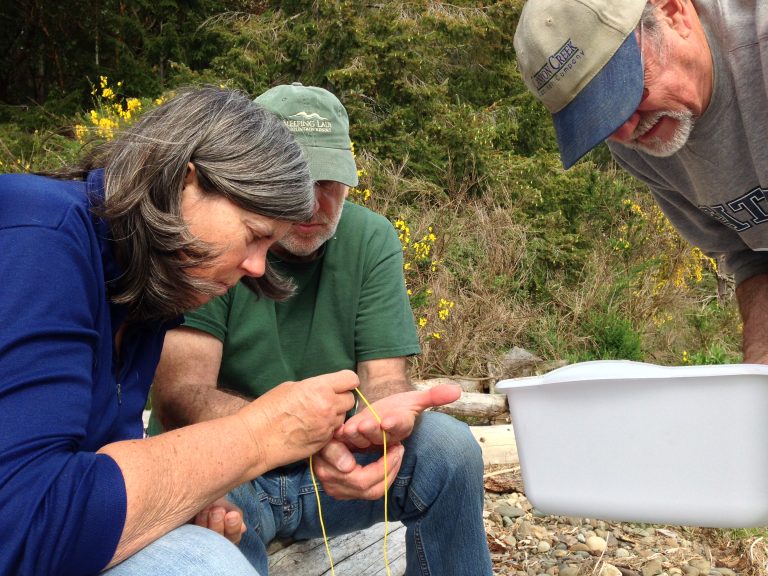
Volunteers taking a close look at shore crabs to tell the two species apart. Photo: Emily Grason
Not Quite Identical Cousins
The two species are indeed visually very similar, and sometimes it takes a well-trained eye to distinguish them. Both have squarish carapaces, rounded claws and measure a maximum of a few inches across the back shell. Similar to many crabs, color can be widely variable: we have found green “purple” shore crabs and hairy shore crabs that are purple in color. As the scientific species name “nudus” suggests, one feature that can help tell the two crabs apart is that the purple shore crab lacks the abundant hairs the hairy shore crab has on its walking legs. But when looking at a molted crab shell, the color can be bleached out and the hairs on the legs can go missing, making these features unreliable diagnostics. Crab Team monitors are trained to look across multiple features, and pick out subtle differences — sometimes needing a magnifying lens — including how far the bumps between the eyes of the crab project, and the direction of the marginal teeth on the edge of the shell. (Learn more here)
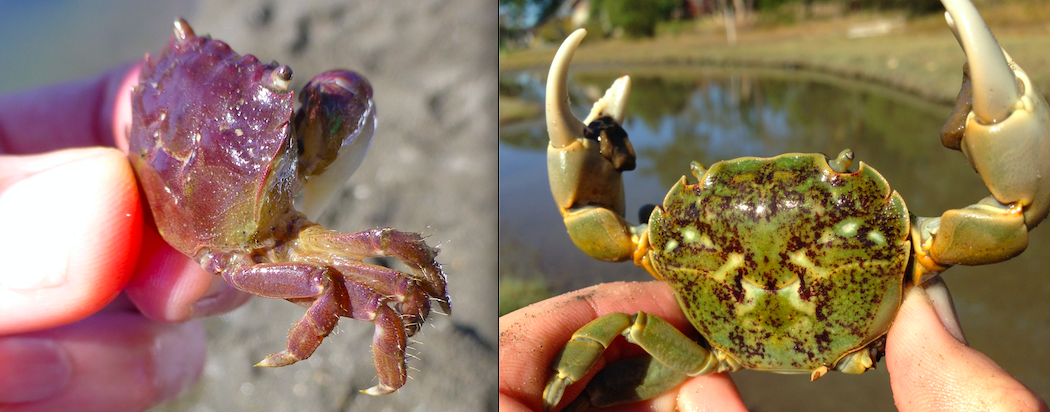
A purple hairy shore crab (left) and a green purple shore crab (right). A great example of why you shouldn’t use color to tell species apart!
If the crabs appear so similar, why do we find so many more hairy shore crabs in our traps? Well if one were to look even more closely at the two species, say, inside their gill chambers, you’d notice another species difference: hairy shore crab have finer setae (hair-like structures) protecting their gills, and more of them than purple shore crabs. The stouter, sparser setae of the purples aren’t as effective at straining tiny silt particles out of the water, so in muddy habitats, their gills can get clogged (Hiatt 1948**). The same research also showed that purple shore crabs can’t take the heat as well as hairy shore crabs. These factors together mean that most purple shore crabs steer clear of the shallow, warm, muddy pocket estuaries and salt marshes that we sample. Purple shore crabs are relatively more abundant on the cobble beaches that line much of the more exposed shores of Washington’s portion of the Salish Sea, and they are a favorite of beach walkers on a low tide.
The Mystery of Many Molts
Crab Team tracks crustaceans across a network of 56 sites both by setting traps and by hunting for the shells crabs shed as they grow (molts). A number of monitors at different sites have keenly observed they might find a lot of purple shore crab molts, but see few live individuals, or none at all, in their traps. Crab Team uses both of these survey techniques because they could be different ways we might detect European green crab if they were present, but they also give us slightly different information about the crabs living at a site. To be captured in a trap, a crab has to be attracted to bait in the first place. Meaning, if a crab isn’t hungry, or eats only seaweed, it’s not likely to come to our traps. Crabs also have to be close enough to actually smell the bait for traps to be effective, but molted shells can get washed in from other locations depending on the winds, tides and shoreline shapes. Molt surveys sample more species from the crustacean community than our traps, including species that might not be interested in coming to the bait (the vegetarians), and those that live too far to find it. We think this might be at least part of the explanation for why, in 2018, purple shore crabs were captured in traps at only 29 of the 54 sites Crab Team had that year, but were found as molts at 48 of those sites. Species like purple shore crabs probably live relatively close by, maybe just outside the lagoon being sampled, but don’t venture in to find the traps.
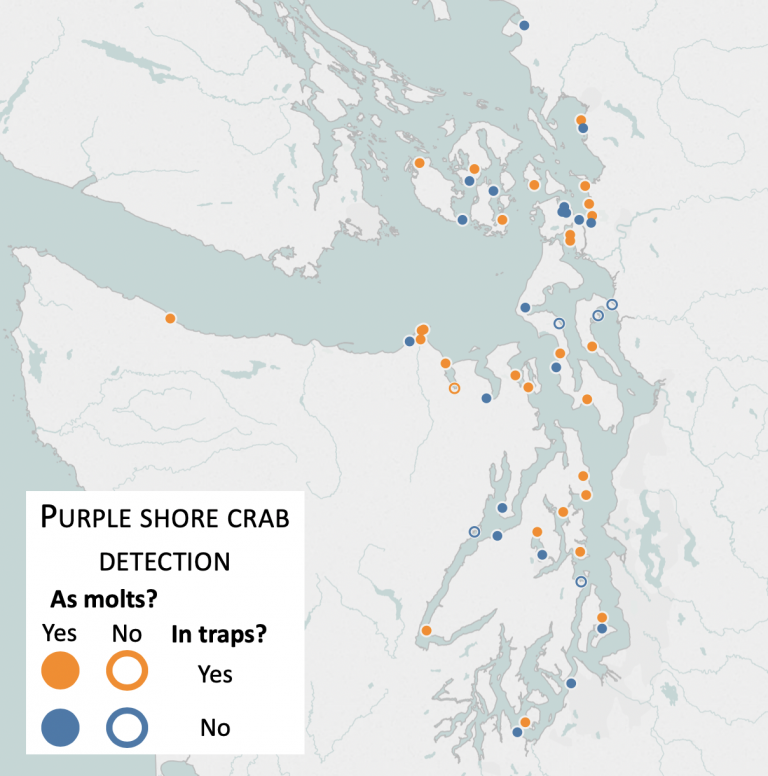
Map of Crab Team sites and whether or not purple shore crabs are found there in traps or as molts. Click to enlarge.
Size might also matter. The purple shore crab grows larger than the hairy, which is typically under 30 millimeters (1.2 inches) across the back shell. Just as trapping surveys make it more likely we will detect certain species of crabs (those attracted to bait), molt surveys make it more likely we will detect certain sizes of crabs —larger ones. This is what scientists call sampling “bias,” and the detection bias in our molt survey for larger crab shells probably happens for two reasons. First off, it’s just easier to find larger things. In fact, it can take practice and patience to develop a search image for the smaller molts. Some as small as beach hoppers show up in our surveys. Second, because they are typically thinner than large shells, smaller shells break down faster in the waves and weather. Taken together, these two factors probably cause larger crab species to be overrepresented in our molt surveys relative to their true abundance in the habitat, and certainly overrepresented relative to the traps.
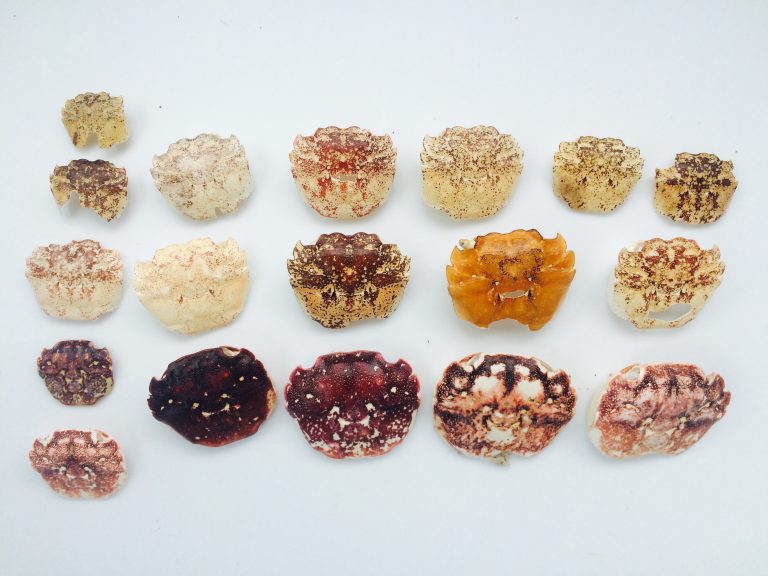
A sampling of hairy and purple shore crab molts. Can you tell them apart?
While it’s critical for us to recognize how sampling techniques could favor some species, sizes or types of organism over others, it’s also important to acknowledge that no sampling technique is perfectly unbiased (the closest anyone has ever come is the fictional “tricorder” from Star Trek). Our job is to try to understand these biases, and make sure we take them into account when interpreting the data.
While, to many people, purple shore crabs might be indistinguishable from hairy shore crabs, the data Crab Team monitors are gathering shows how even apparently small differences between related species can result in substantial differences in distributions. This can occur by a process ecologists call “niche partitioning.” The basic idea is that a single species can evolutionarily diverge into two separate species if they adapt to survive in slightly different habitats, environmental conditions or ecological communities. By using different parts of the environment, they minimize the need to compete with each other. Within the Salish Sea, a diversity of shoreline habitats is one factor that enables a high diversity of local crabs as well.
–Emily Grason
**While we try to use open access sources as often as possible, some of the studies cited in this article are not open access. If you have any questions about any of the research cited here, please feel free to reach out to crabteam@uw.edu.
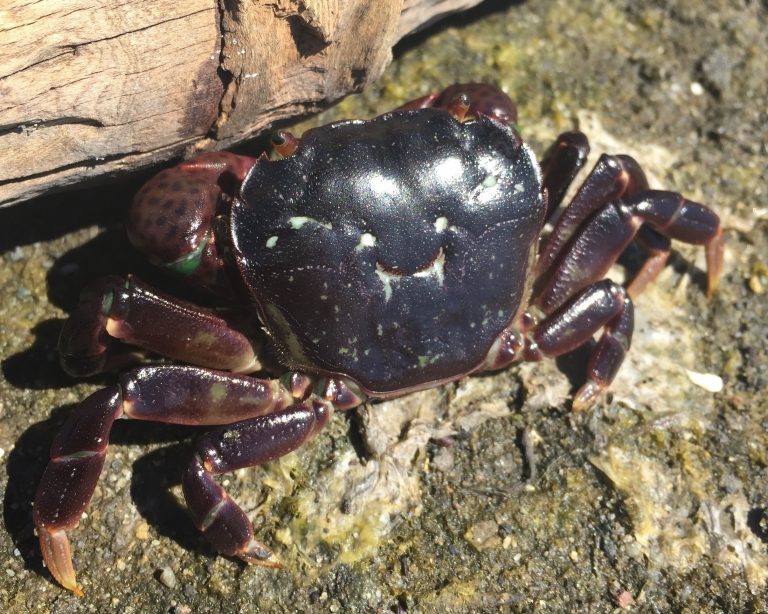
The purple shore crab, Hemigrapsus nudus. Photo: Kelly Martin