
Creature Feature: Pickleweed and its Parasitic Partner
Species Name: good question… maybe Sarcocornia perennis
Size: Up to 30 cm tall
Distinguishing Features: Mat of dead-looking brown stems in winter; succulent, fleshy, green, oppositely branched plant with scales rather than leaves through the growing season; club-like and often colorful flower spikes at the end of stems have super tiny flowers arranged in groups of three.
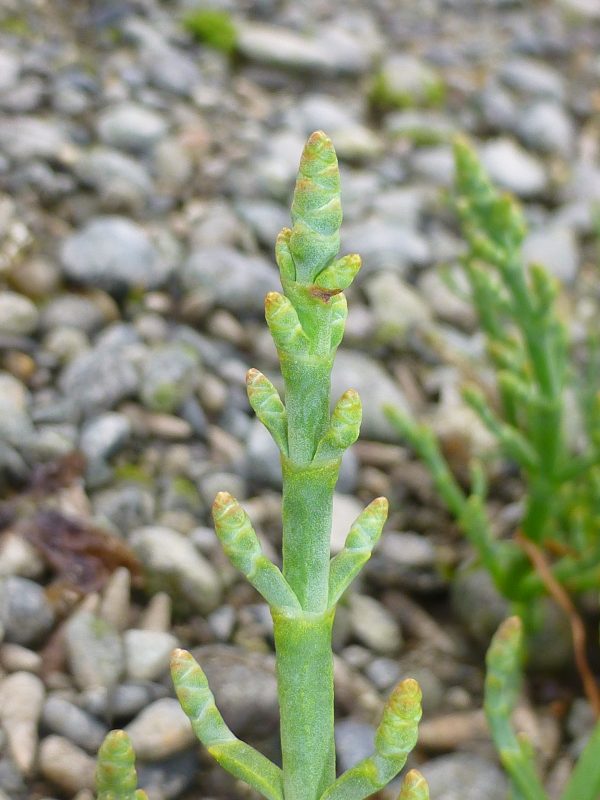
The Name Game
We’re going to be flexible with our definition of “creature.” Since one-third of our protocol has very little to do with animals, we figured the plants deserve some love too! And what better flowerphile to start with than pickleweed (Sarcocornia/Salicornia).
There doesn’t appear to be any certainty around what scientific name/s to ascribe to our local species. The Burke Museum calls the perennial pickleweed (which dies back to a mat of brown stems every winter) Sarcocornia perennis, and the annual pickleweed (which dies back completely and returns from seed or taproot) Salicornia depressa. The perennial pickleweed seems to be called pacifica in British Columbia and California or maritima sometimes because, well, why not. Of course, Salicornia virginica is widely used in seashore guides and plant texts for our region to describe pickleweed. Even the family name is not free from scientific uncertainty. To avoid this “taxonomic nightmare,” as it has been called by scientists, we’ll call it all … pickleweed.
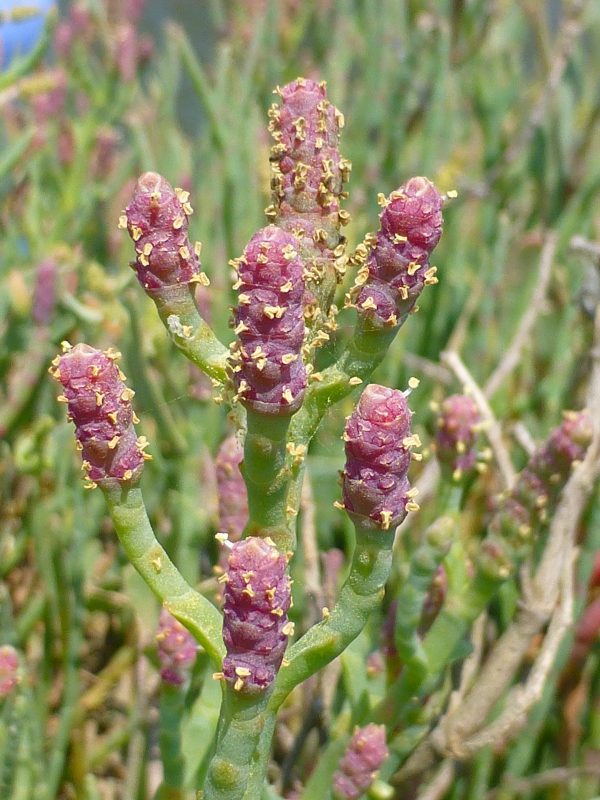
Pickleweed “in bloom”. Photo: Emily Grason
Of course, settling on a common name hasn’t gone much better. Pickleweed, sea beans, sea asparagus, samphire (evolved from “Saint Pierre,” patron saint of fishermen), glasswort and saltwort seem to all be contenders for describing pickleweed species. There’s also chicken claws and crow’s feet, which are my new favorite names, as they’re pretty descriptive of pickleweed. The first three names in the list reflect the fact that pickleweed is edible and consumed around the world. To do so yourself, harvest the fresh green parts of the plant from unpolluted areas, blanch them for a minute in boiling water (no salt), shock them with ice water, then eat them or use them in some awesome dish you found by searching “sea bean recipe” online. Nibble them raw too. I find them succulent and salty with just a bit of bitter.
The name glasswort started about 500 years ago. Pickleweed was burned to ash so the sodium carbonate within could be used as one of the three main ingredients in a new glass-making process that would dominate production for centuries to come. Now pickleweed is being used or considered for use in bioremediation of pollution, biodiesel, animal feed, paper production and as a treatment for a number of health issues.
Sea Shore Superstar
Since it is an abundant, rooted, halophyte (salt-loving plant) that lives lower in the intertidal than most other shoreline plants, pickleweed plays a really important ecological role. Its roots provide some stability and structure, while its stems further dampen waves during high tide in the already low energy environments in which they like to grow. Maybe most importantly, they provide a cool, damp, shaded hideout for beach creatures. It’s not unusual to find shore crabs, beach hoppers, barnacles, three kinds of snails and more under and on pickleweed.
Pickleweed species can grow in salty soils inland as well. Their adaptation to dealing with so much salt, which would be otherwise toxic, is pretty cool. Some salt is filtered out at the roots, but salt that gets into the plant is dealt with by pumps within each cell that gather salt and send it to a storage area in the cell called a vacuole. When the vacuole has reached its limit, the cell dies and a new cell takes over. Thank the vacuoles for the saltiness of this succulent.
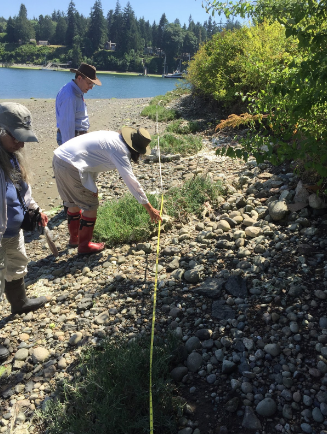
Shoreline monitoring volunteers (serendipitously also members of Crab Team!) Niki Quester, Bob Webb, and Marge Widmeyer helping collect data on pickleweed planting experiment at a large private shoreline restoration site on Bainbridge Island. Photo: J. Adams
Even though it’s a halophyte (“salt-lover”), apparently pickleweed can be grown indoors or take root in your garden, though it might lose the salty flavor. Sounds like a gardening project for next winter or spring! That also reminds me of an experiment Jim Brennan, then with Washington Sea Grant and now with Marine Ecological Consulting Services, undertook at a large scale private shoreline restoration. He dug a shallow trench at a tidal elevation a couple feet below mean higher high water. Then, he alternated stretches of trench with chopped up pickleweed placed along the bottom with bare stretches, then backfilled the trench. Monitoring continues, but six years later, the pickleweed has grown up nicely where planted, though it remains patchy. While pickleweed is a fairly effective colonizer on its own, the same approach could be used at other locations as an inexpensive way to jumpstart pickleweed where it had been lost or reduced as a result of shoreline modification.
Several lovely little plants, including jaumea, saltgrass, seaside plantain and spurrey, are also part of the community pickleweed dominates.
- Marsh jaumea (Jaumea carnosa) is fleshy with leaves and relatively large, bright yellow flowers. It’s hard to miss when it’s in bloom.
- Saltgrass (Distichlis spicata) is a short, stiff grass whose blades are largely on a single plane. Instead of storing salt like pickleweed, saltgrass secretes the salt through glands to the surface of the leaves. You can often see salt crystals on the blades if you look closely.
- Seaside plantain’s (Plantago maritima) flowering stem looks like those of the plantain species that may live in your yard, but the leaves of seaside plantain are narrow and fleshy, almost like long, skinny aloe leaves.
- Spurrey (Spergularia salina) is usually not very obvious, but it’s adorable enough to get a mention.
… Oh, and then there’s salt marsh dodder.
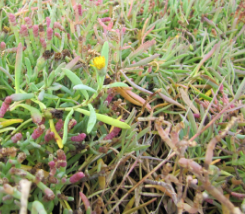
The pickleweed community, including jaumea (with the yellow flower) and saltgrass (grass on the lower right). Photo: J. Adams
Orange Spaghetti Vampire
Since we’re talking about pickleweed, the favorite host for parasitic salt marsh dodder, it seems fair to give this awesome parasite a nod. There are a bunch of different dodders in Washington, but the main one entangled in the pickleweed community appears to be salt marsh dodder (Cuscuta pacifica… or salina… bah).
Dodder is a parasitic member of the Convolvulaceae, which includes morning glory and sweet potato. It is unable to perform photosynthesis or obtain any of its own water or nutrients. The dodder grows from seed each year, rooting briefly in the ground until it has attached to a host. At which point, the root is rendered unnecessary and dies back. The dodder then wraps around and up and all over the host and its neighbors, piercing stems with structures called haustoria that anchor the dodder while providing the conduit through which they siphon off goodies.
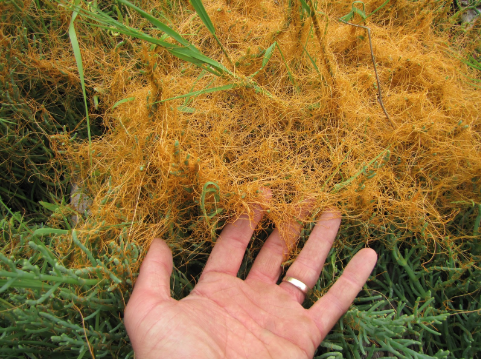
Orange dodder creates a spidery web across the top of pickleweed. Photo: J. Adams
But I’ll be darned if this brilliant string doesn’t produce the cutest and most abundant little flowers! Especially when compared to pickleweed’s invisibly tiny flowers. Then again, pickleweed did do all the work to provide the energy for dodder to make the flowers. Shouldn’t it be able to claim the flowers as an attractive product of its own labors? Maybe, but the bling isn’t necessarily worth it to the pickleweed.
The salt marsh community as a whole, on the other hand, may be celebrating their rootless hero. Dodder doesn’t seem to cause mass mortality of pickleweed, but the effects can be strong enough to create opportunities for less abundant species to occupy more habitat. That means the presence of dodder can increase the diversity of the salt marsh, playing a role not unlike the purple sea star’s keystone predation, which can create more diverse rocky intertidal communities. Way to go little orange thread! Power to the parasite.
–Jeff Adams
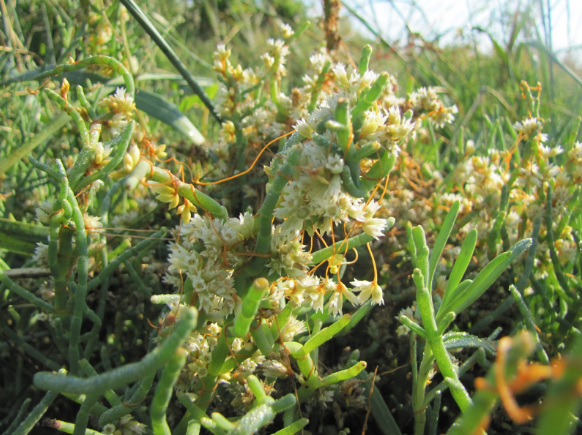
Dodder in bloom. (Photo: J. Adams)