Site Spotlight:
Ocean Shores
Number: 603
Region: Grays Harbor
Launched: 2020
Site Captain: Bruce Rittenhouse and Barbara Hayford
In this edition of Site Spotlight, we are excited to feature one of the WSG Crab Team network’s coastal sites for the first time ever! The growth, in 2020, of the Crab Team network to include sites in estuaries on Washington’s Pacific coast has increased the scope of what we can learn from monitoring. So, let us transport you to Ocean Shores in Grays Harbor, where you can find this Crab Team monitoring site sandwiched between a backdrop of shellfish beds and… a municipal airport?!
A Maze of Muddy Sloughs
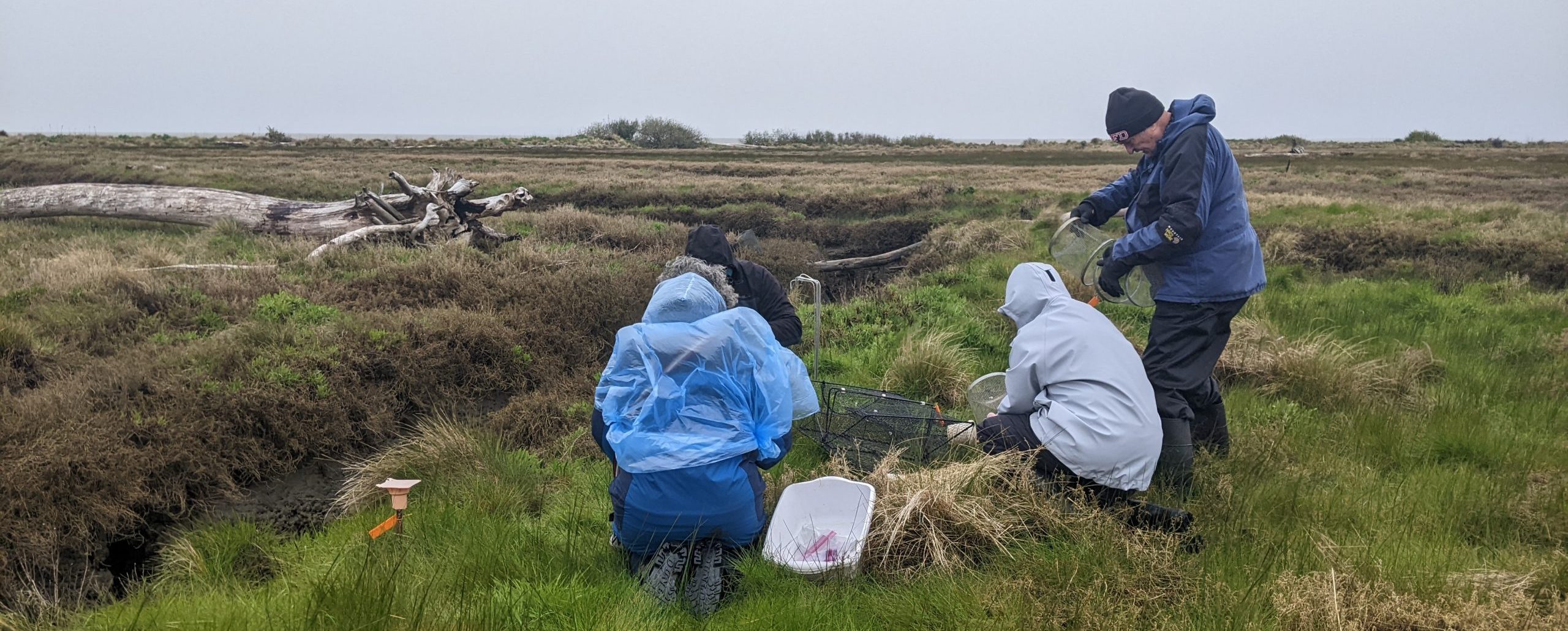
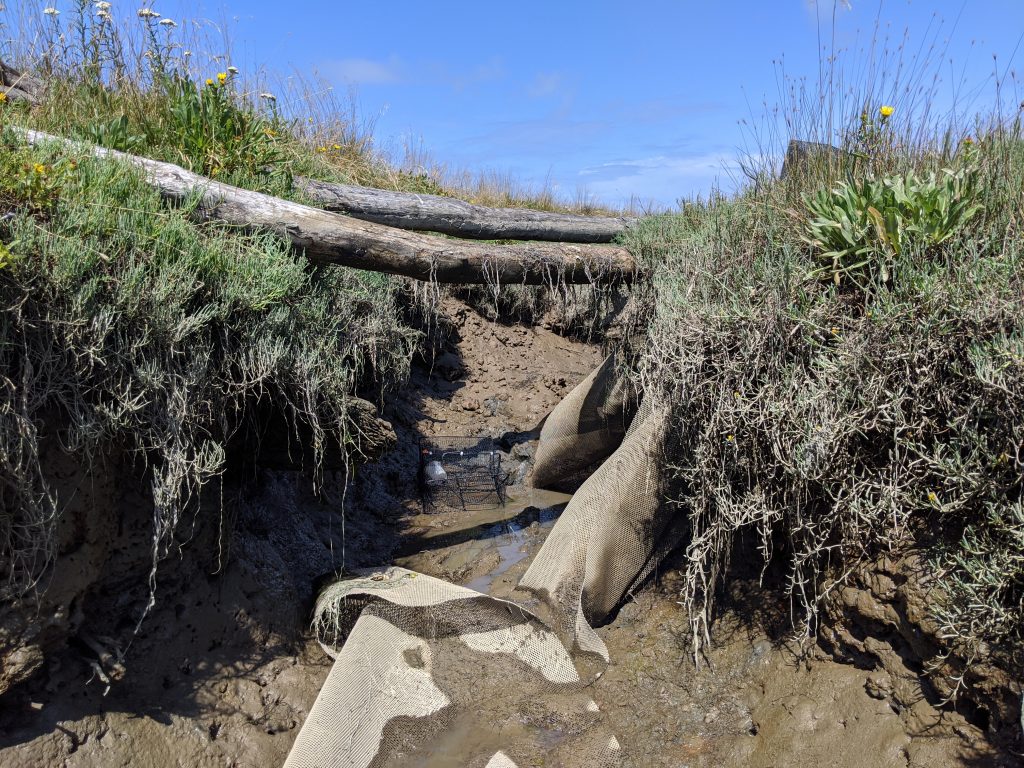
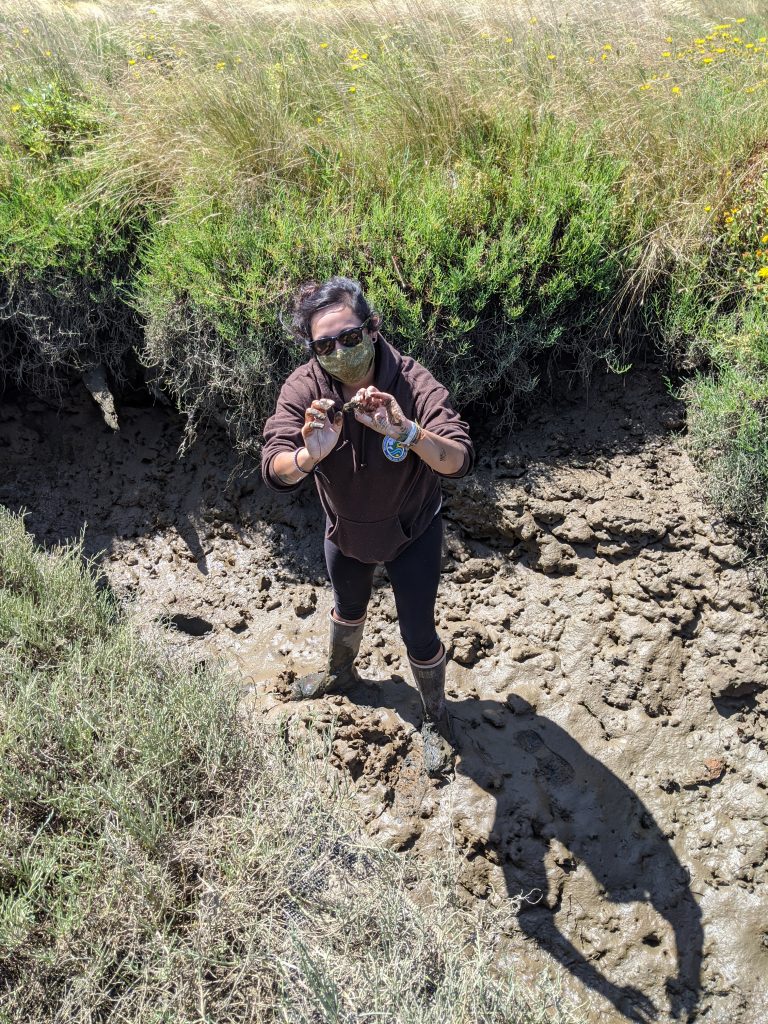
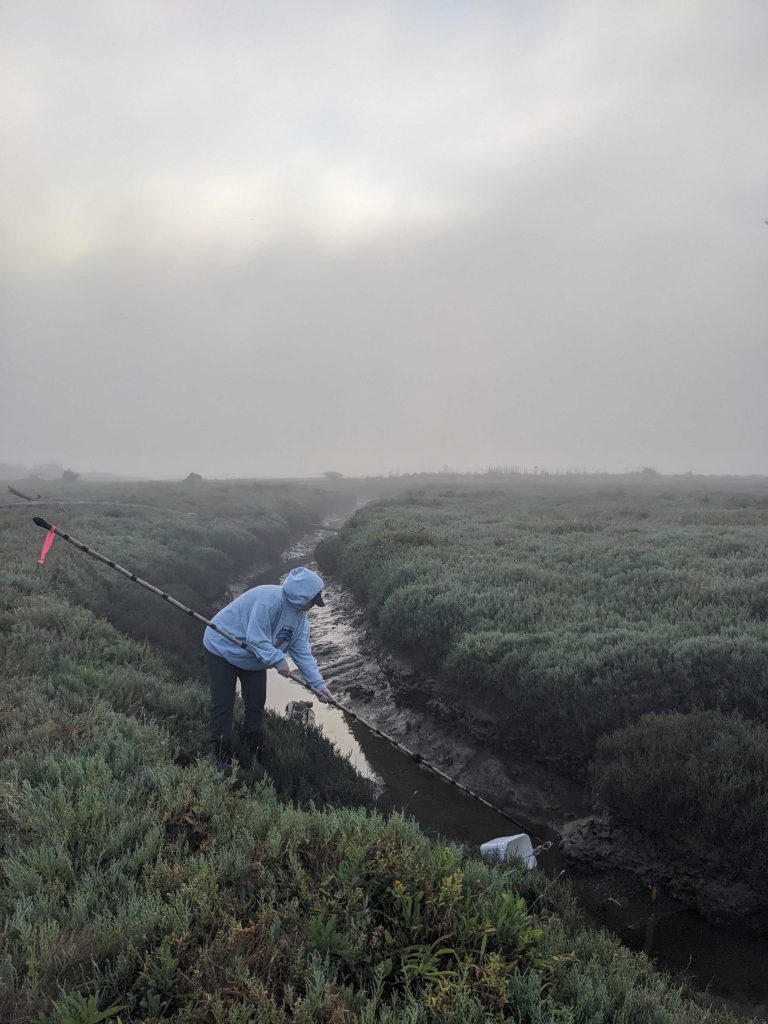
The view from the Ocean Shores Municipal Airport parking lot looks out past the 3000-foot public airstrip and towards the wide open bay of Grays Harbor. From the ground, it’s hard to see just how extensive this channelized marsh habitat truly is. But those flying into the airport to take advantage of amazing clam digging and Washington’s ocean beaches get an excellent view of the branching sloughs carved between banks dressed in pickleweed. Driftwood is abundant and scattered throughout the habitat, with large resident logs often serving as bridges over narrow, steep-sided, channels that drop more than six feet to the mud below. Getting to the site marker involves some creativity in crossing, climbing, and sometimes even crawling over and around various gaps between solid ground. The channels themselves boast the kind of thick, gooey mud that makes sucking and squelching noises with each boot step sinking into and pulling out of the mucky bottom. And there’s evidence that we are not the only ones using this site, either. Coyotes have frequently been seen at dawn, and monitors observe scattered bones and skulls from deer. Scat from bears and perhaps other scavengers is not very difficult to find. All in all, despite being relatively close to town, this site is wild, a quality shared by many of the Crab Team coastal sites.
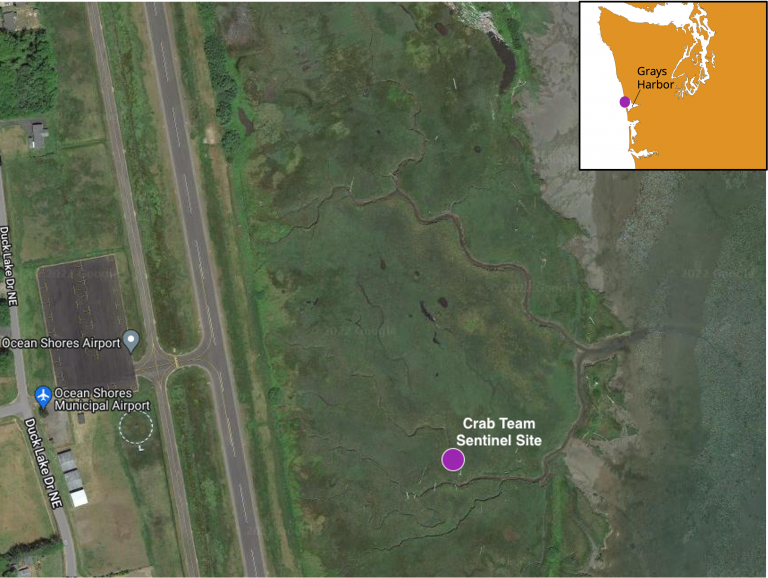
Aerial imagery of the Crab Team monitoring site at Ocean Shores in Grays Harbor. Click to enlarge.
An Historic Location
In the early days of the European green crab invasion in Washington, Ocean Shores was one of the first trapping locations in the state. Trapping for green crab first occurred in Ocean Shores in 1998, when the Washington Department of Fish and Wildlife (WDFW) conducted an initial green crab population assessment survey in coastal estuaries. That year, though only 14% of the trapping effort in Grays Harbor took place in Ocean Shores, more than 90% of green crabs from the estuary were captured at this site (Figlar-Barnes et al. 2002)*. As the trapping continued through 2001, however, the green crab catch rates continually dropped pointing to a decline in green crab numbers in the area. These trends were consistent with WDFW trapping results from Willapa Bay during that same time – at both locations, green crabs would sometimes be so scarce as to be undetectible. This trend suggested that green crabs were not successfully established in Washington’s southwest estuaries at the time, and so green crab trapping was discontinued after 2001.
In 2020, when WDFW and Washington Sea Grant renewed trapping efforts on the coast, Ocean Shores was flagged as an area of interest based on the historic trap data and the prevalence of ideal habitat for green crab. A scouting trip with the Quinault Indian Nation in July of that year turned up several green crab molts and even a hand capture of a live green crab within just a few minutes of arriving at the site. This location immediately became a high priority for one of the very first coastal sites in the Crab Team network.
Partnering in Stewardship
Shortly thereafter, the Quinault Indian Nation adopted the site during the pilot year of the sentinel site program, Crab Team’s expansion of monitoring trapping to sites in coastal estuaries. Quinault biologists Joe Schumacker and Alan Sarich led the charge during the most challenging year of sampling, ensuring that all protocols, Crab Team and COVID-related, were closely followed. Despite the strain on human resources in the year that followed, the Quinault site captains also ensured that Ocean Shores was fully sampled for the first full season, from April through September, in 2021. The team often quipped that the mosquitos at their site were worse than those of the Alaskan bush in the height of summer, but even that didn’t deter them from getting out there every month!
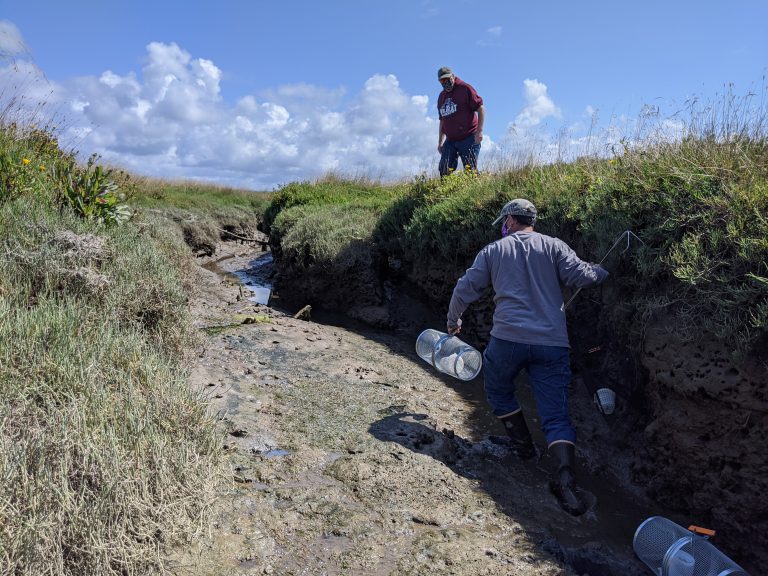
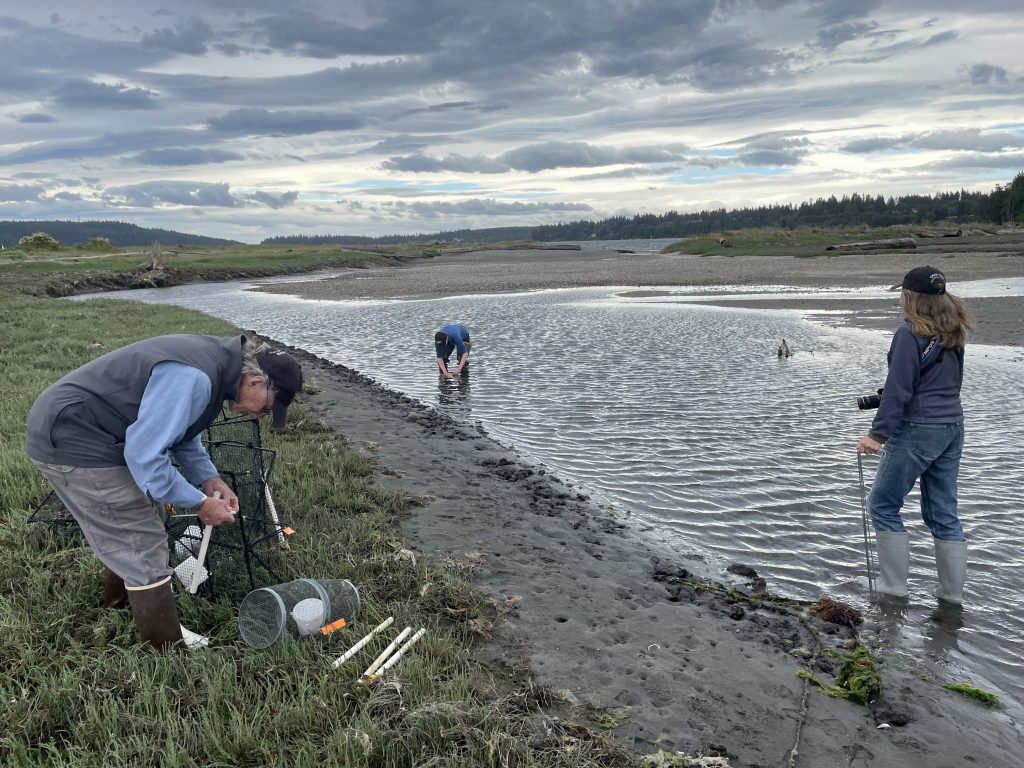
Quinault Indian Nation biologists, Joe Schumacker (on bank) and Alan Sarich (in channel) brave mosquitos and mud to accomplish their sampling in 2020.
Having helped launch the site, the Quinault biologists were ready to pass the baton to other eager monitors during the following year and recommended the Coastal Interpretive Center as a partner. This seemed particularly fitting given the Center’s early beginnings as a WSG program called “Ocean Adventures” in 1977. Re-establishing this partnership in Ocean Shores felt like coming full circle. Dr. Barbara Hayford, the Center’s Director, was enthusiastic to assume monitoring responsibilities alongside committed board members and volunteers from the Center. Over the past two years, Bruce Rittenhouse has captained the team with members Bob Krueger, Cathey Peterson, Ann and Dick Bower, and Rachel Davey. Many of the monitors have had a career focused in environmental sciences, and have found this site a rewarding way to stay involved locally in scientific monitoring and outreach. “I enjoy working outdoors and on monitoring projects because I feel that I am contributing to science and conservation…. I really enjoyed learning about the different crabs and fish in our samples,” Dr. Hayford reflected after her first season. Thanks to these two extraordinarily dedicated teams, site #603 has not missed a month of sampling since its launch, now four years ago.
A Green Crab Hotspot
On resuming green crab trapping at Ocean Shores in 2020, the site again emerged as a “hotspot” given its high population density, consistent with observations from two decades before. Over the past three years, both Crab Team site surveys and larger scale removal efforts have shown that, compared to other locations in Grays Harbor, Ocean Shores has one of the highest relative abundances of green crabs in the estuary. The site has captured green crabs during every month of monitoring, for a grand total of 136 green crabs captured in 120 trap sets over four monitoring seasons (Figure 1). Size data from the crabs captured reveals that multiple age classes, from young-of-the-year to adults, are present at the site, pointing to the establishment of a local population that had been living at this site for several years prior to 2020 (see Protocol in Focus for more information on how we determine this). Noticeably, catch rates were lower during this past 2023 season than in previous years of sampling, which is something we are interested in exploring more in the data.
One possible explanation for Ocean Shores’ relatively higher densities of green crabs is likely proximity to the mouth of Grays Harbor. This location might make it more susceptible to larval input from sources outside of the bay, such as larger populations of green crabs to the south, as far as Oregon and California. After entering the estuary, the planktonic larvae are swept along with the tides and currents that eddy north around Damon Point and settle within the protected, channelized sloughs of Ocean Shores, which are perfect protective habitat for juveniles.
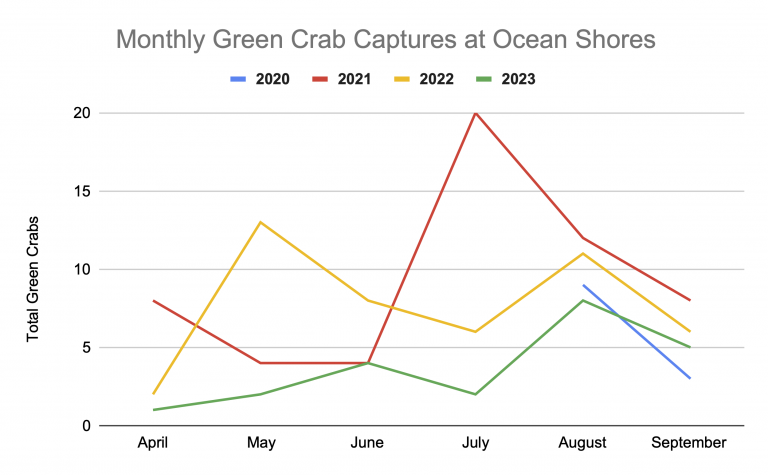
Figure 1. Total number of European green crabs (CAMA) captured each sampling month at site 603 since the site launched in August 2020. Click to enlarge
…and the Usual Suspects
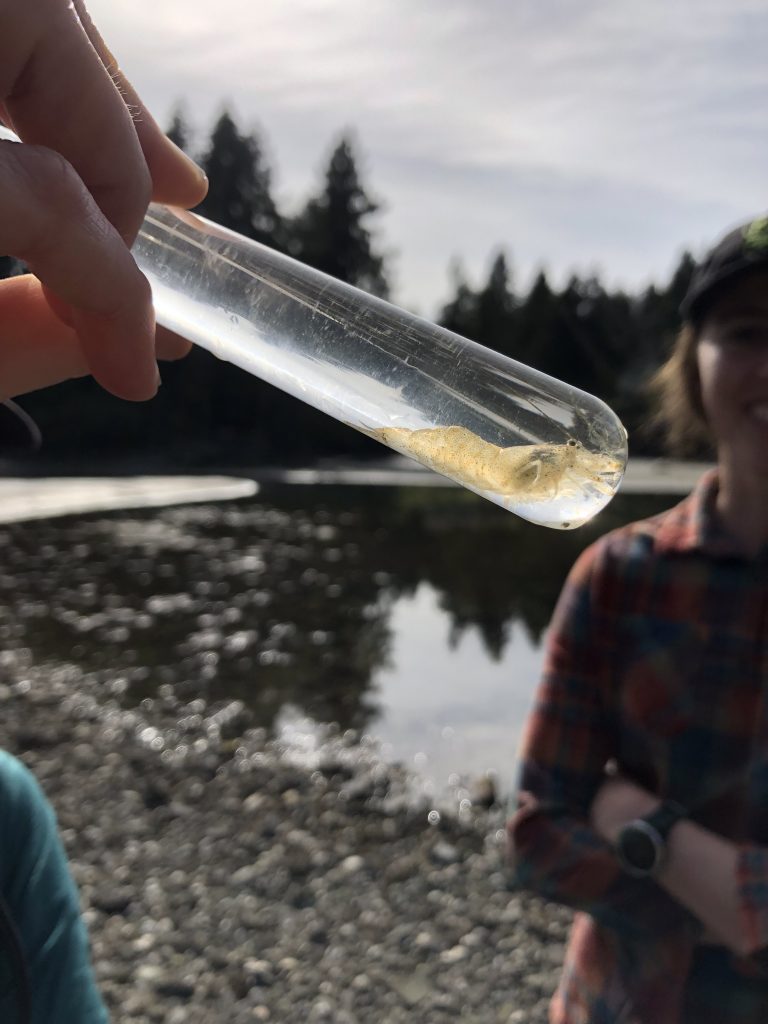
Meanwhile, when it comes to native species, this site has many similarities to the others in our network. Hairy shore crabs, staghorn sculpins, three-spined sticklebacks, are common captures, and the occasional prickly sculpin and sand shrimps will also sneak into traps. Monitoring a site like Ocean Shores, where green crabs are present alongside native species that we detect elsewhere in our network, might provide insight into what we could see in other places in the state as the European green crab invasion unfolds. Data from this location, and most of the coastal sentinel sites, are therefore valuable in multiple ways: They can tell us what’s happening at this site specifically, and they can also guide our mental model when thinking about sites that don’t yet have green crabs, but might in the future.
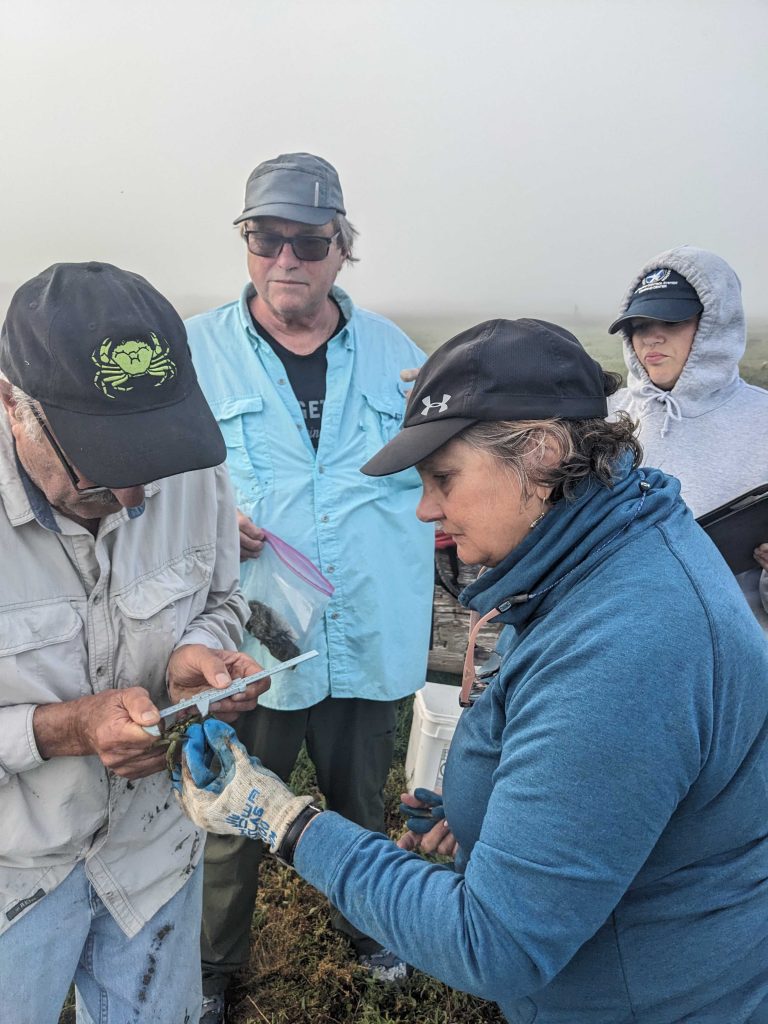
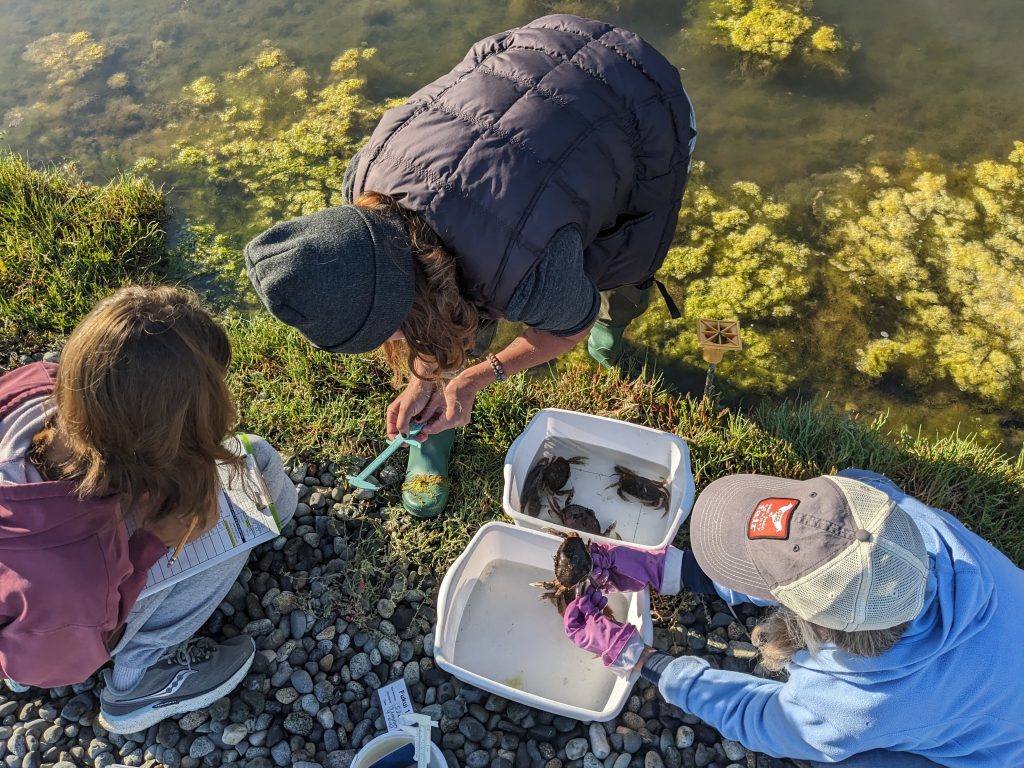
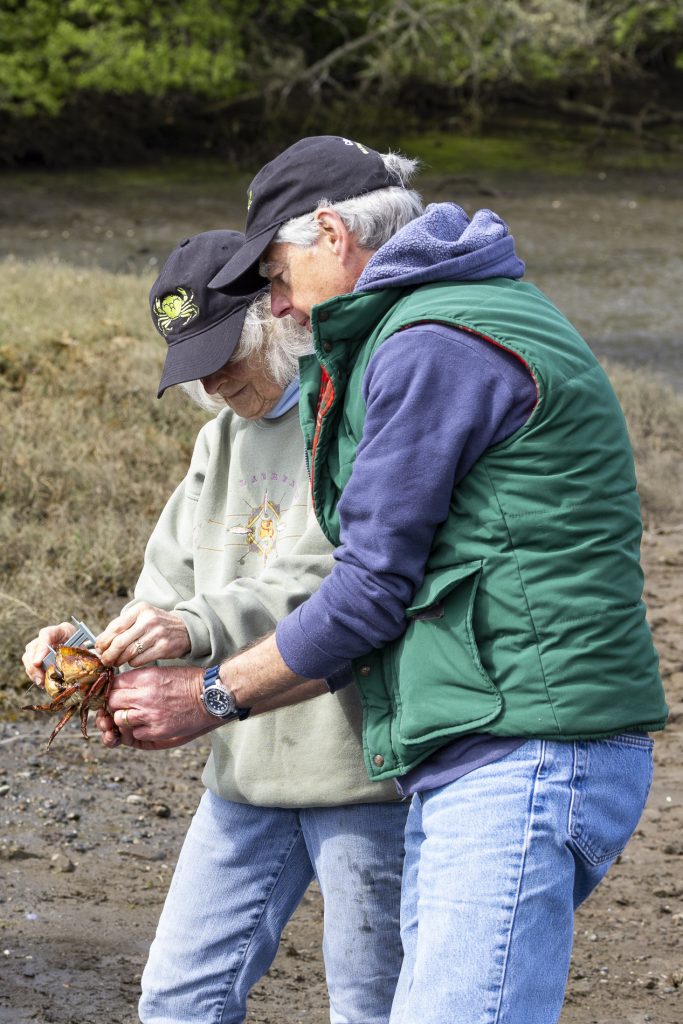
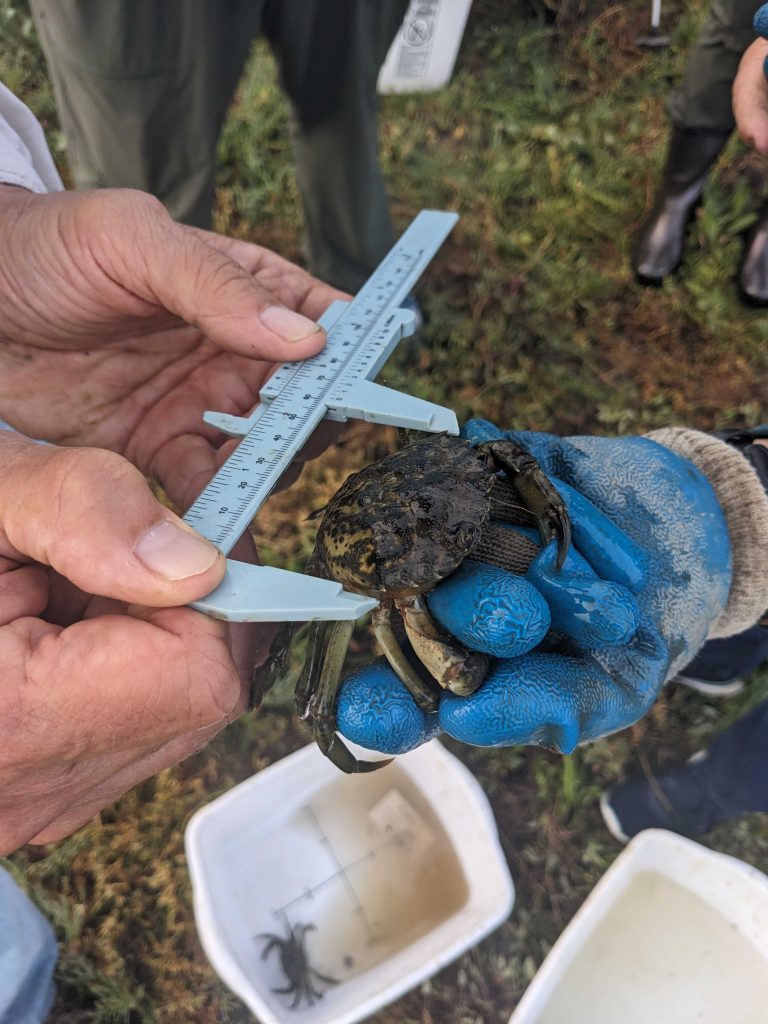
The Ocean Shores team measures one of the green crabs captured in August of 2023. Photo: WSG/Lisa Watkins
At the same time, sustaining the monitoring long term allows us to track the relative abundance of native species and green crabs over time, and gain insight into potential interactions between them. For obvious reasons, there is a strong sense of urgency to understand the impacts that green crabs could have (or are having) on native ecosystems and resources. In that regard, collectively, we still have some work ahead – measuring impacts is often challenging at the early stages of invasions. One reason is there simply hasn’t been much time for impacts to have accumulated. Green crab numbers, even in coastal estuaries, have only boomed in the last several years, and are likely still climbing. So it might take time for green crabs to rack up multiple years and generations of predation impacts on, for instance, hairy shore crabs, in order that we would be able to detect changes in those populations of native species. In addition, in Grays Harbor we face an additional challenge: because there was a long gap in trapping for green crabs in coastal estuaries, the baseline data needed to be able to compare coastal sites pre- and post-invasion don’t exist. It’s just not possible to measure changes without a starting point, so we have to use other data sources to infer what the changes might have been and which changes might have been caused by green crabs. In this case, it takes more sites, and a bit longer to get a confident understanding of how green crabs might be changing the local ecology.
But with the Crab Team network of monitors we are headed in the right direction. Thanks to the dedication of Crab Team network monitors like the Quinault biologists and volunteers with the Coastal Interpretive Center, we are collectively building the first dataset of its kind to help unveil what’s happening in our estuaries as they are facing an increasing threat from green crabs.
–Alex Stote
*Figlar-Barnes, Ronald A., B.R. Dumbauld, A. Randall, and B.E. Kauffman. 2002. Monitoring and Control of European Green Crab (Carcinus maenas) Populations In Coastal Estuaries of Washington State. Report to Washington State Department of Fish and Wildlife. 45 pp. This report is not publicly available online. Please contact Crab Team (crabteam@uw.edu) to request a copy.
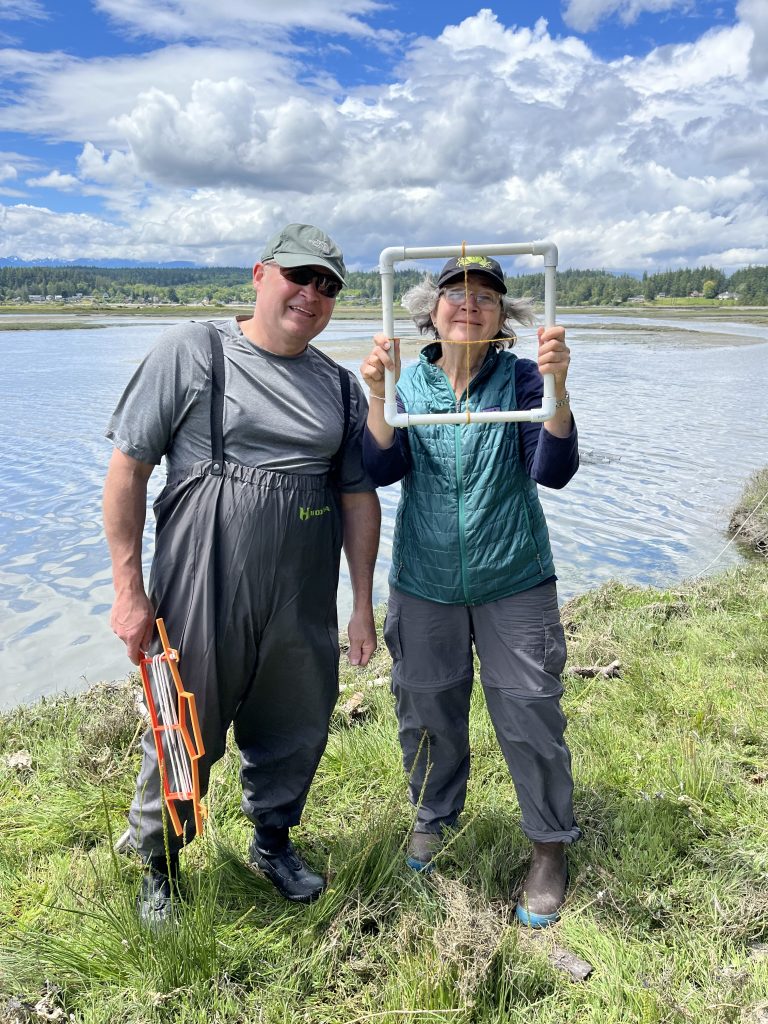
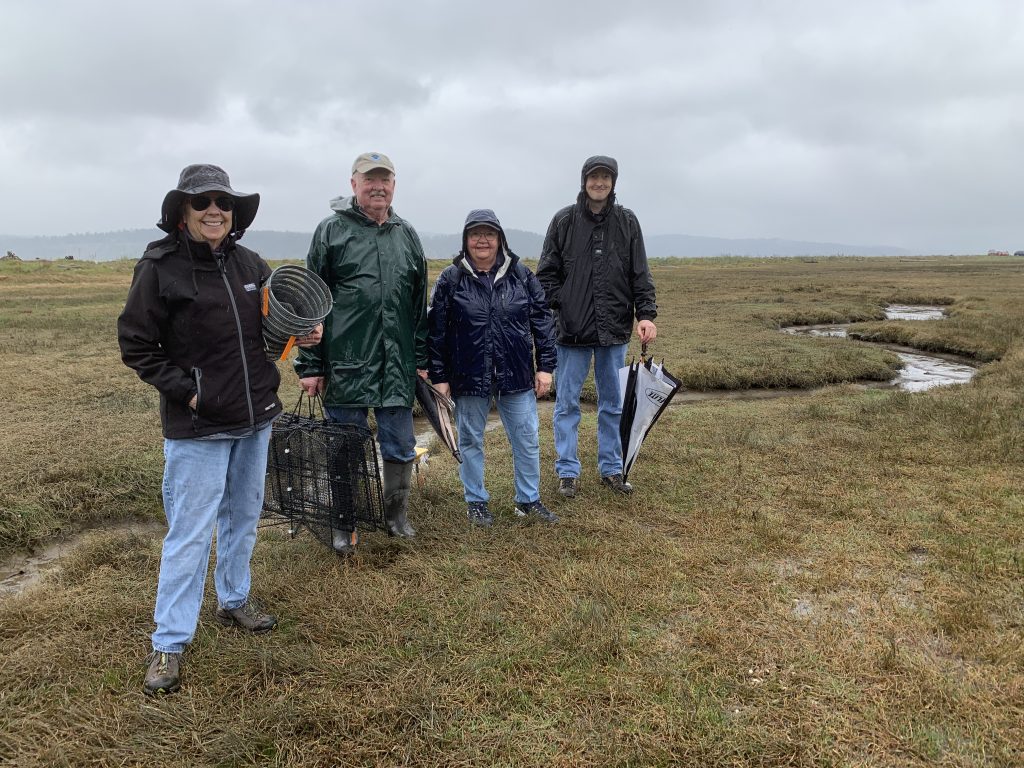
Header image caption: The Coastal Interpretive Center took on this site in 2021, launching in April despite the wind and rain! From left to right: Dr. Barbara Hayford, Cathey Peterson, Bob Krueger, and Bruce Rittenhouse. Photo: WSG/Alex Stote
Photo Gallery
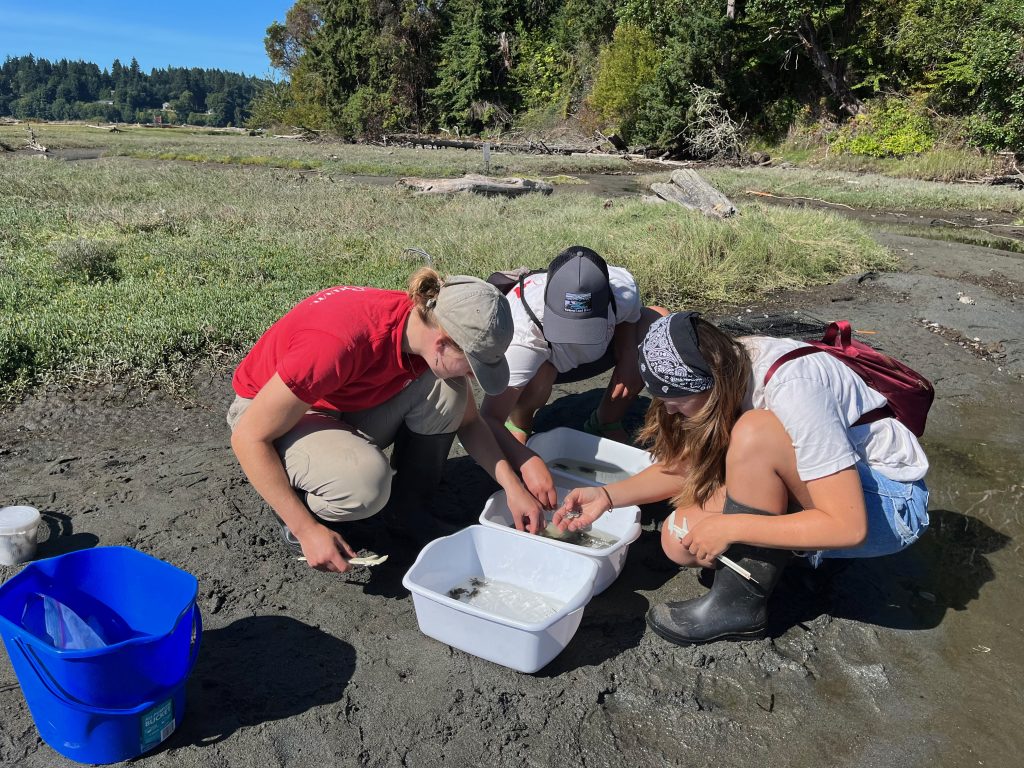
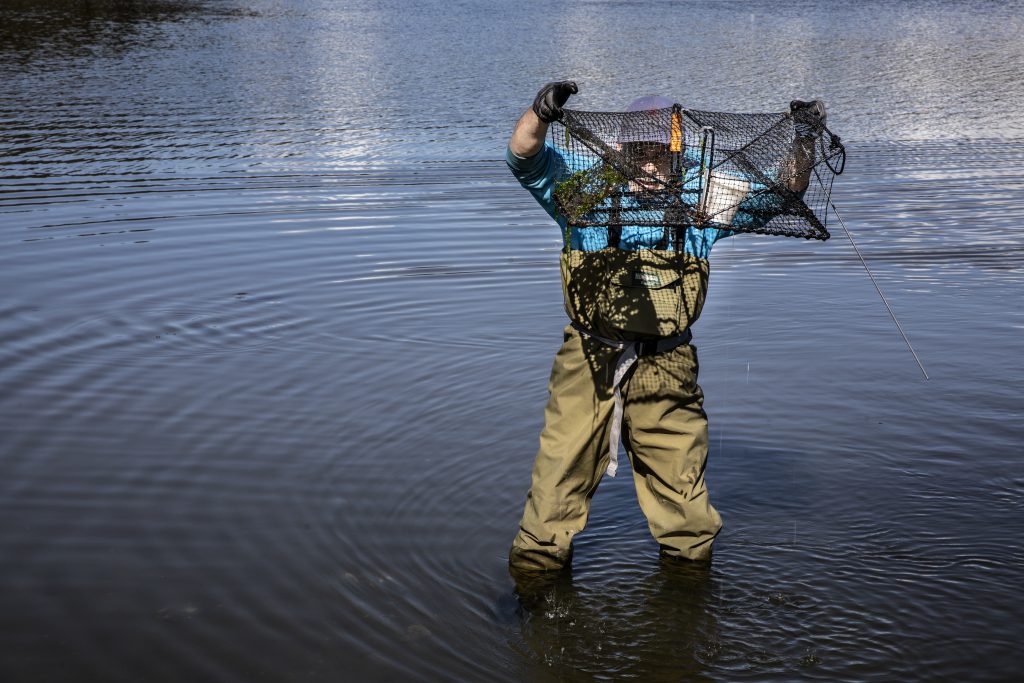
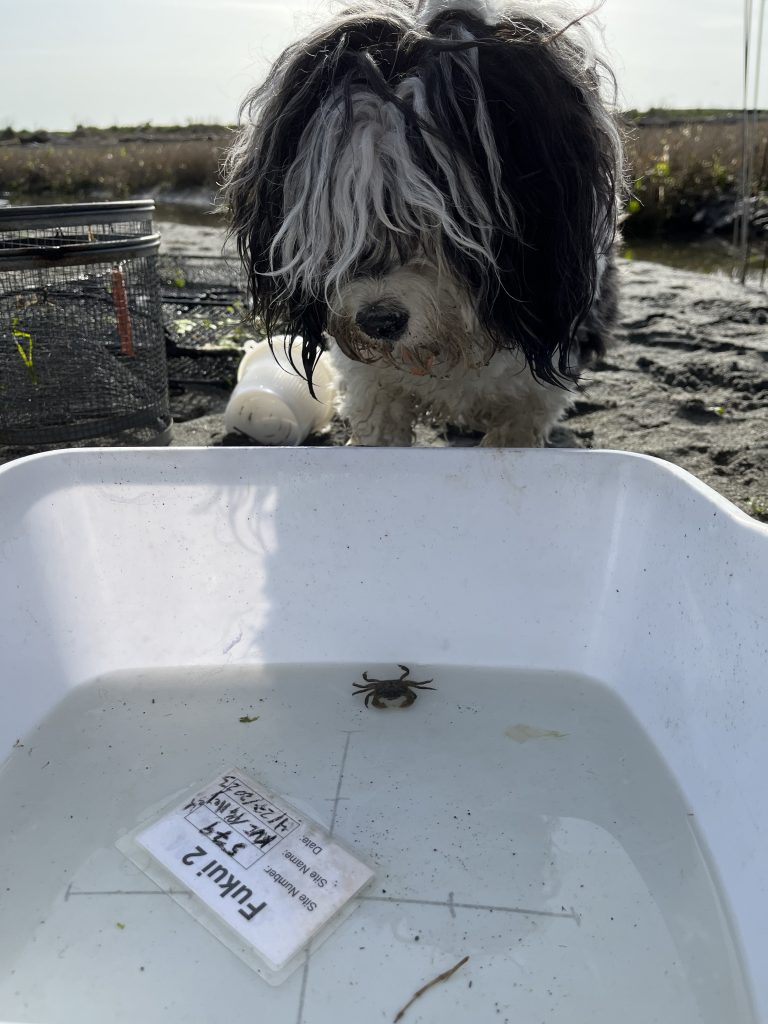
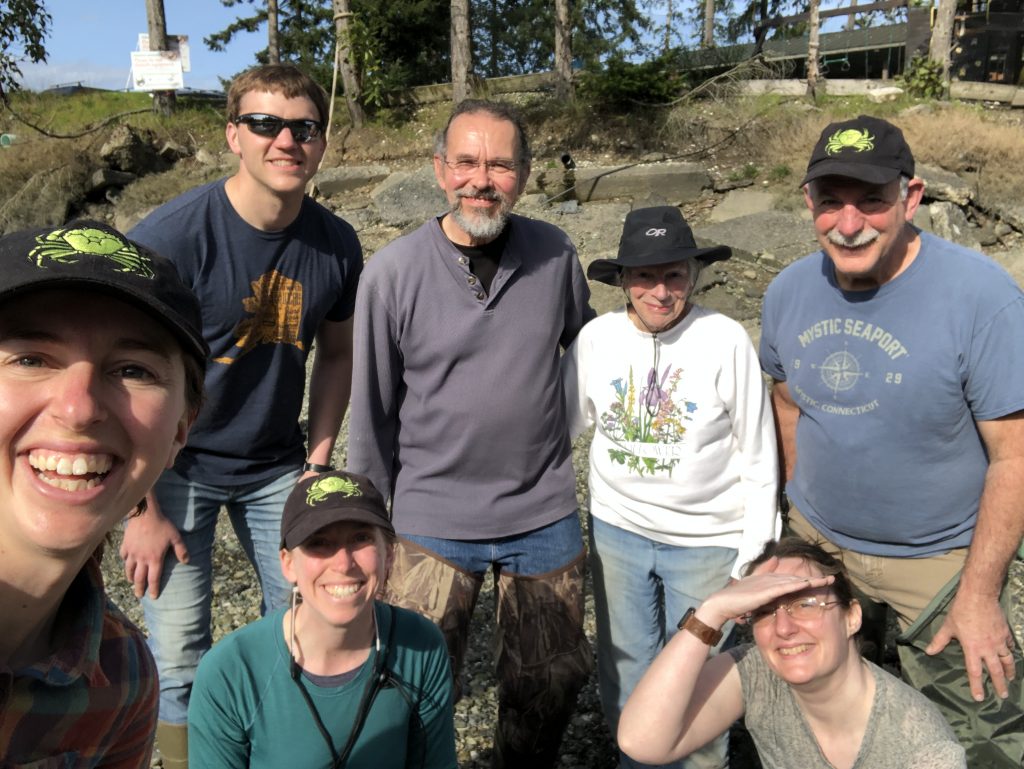
We love to get the virtual experience of monitoring with all of the Crab Team volunteers. Do you have a photo to share? Send it to crabteam@uw.edu. (Click on arrows to scroll, and photos to enlarge for more detail.)