
Crab Team Deep Dive: Documenting a new shrimp in Washington’s Salish Sea
WSG Crab Team recently shared news of a relatively new unwanted arrival to Washington’s Salish Sea shorelines, and it wasn’t the one you’re probably thinking of. In fact, it wasn’t even a crab at all! Though Crab Team was launched to conduct early detection for the invasion of European green crab into the Salish Sea portion of Washington, monitors across all of Washington’s shorelines faithfully record data on every individual animal in the traps, including fish, snails, native crabs, and even the occasional nudibranch or sand dollar! Because of this data-rich protocol, Crab Team not only detected, but tracked the range expansion of a non-native shrimp that was not much on the radar of researchers or managers in the state – Palaemon macrodactylus. (Etymology note: Palaemon is from the ancient Greek and is likely a reference to mythological sea gods, while “macrodactylus” roughly translates to “big finger” for their claws).
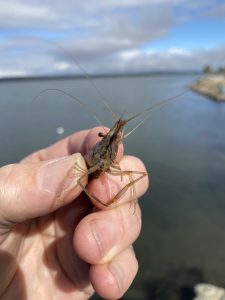
A close photo of Palaemon macrodactylus featuring their namesake giant chelipeds. Photo credit: Sean McDonald
In the summer of 2020, we asked crustacean guru Greg Jensen to provide a species-level identification for an unusual-looking shrimp that we had lumped with the broken-back shrimps (for their humped profile). Dr. Jensen responded that our photo showed Palaemon macrodactylus, a species that he had recorded in Willapa Bay a few decades ago, but wasn’t really considered to be part of the “shrimp scene” in Washington. We cracked open some books, searched the databases, and found that, indeed, the only record of this shrimp in the Salish Sea came from a popular species guide on marine life of the northwest. Lamb and Hanby mention only one occurrence of this shrimp in Boundary Bay. Perhaps, then, it was not a coincidence that the Crab Team shrimp photo we were passing around had come from Drayton Harbor, a stone’s throw away.
It isn’t surprising that Crab team monitors and staff had initially lumped Palaemon macrodactylus with other common species. It turns out “cryptic” invasions, in which non-native species go unnoticed due to misidentification as a native species, are quite common in marine and estuarine environments, especially in organisms like plants and invertebrates, that can be difficult to tell apart with the naked eye. While it’s impossible to know how many of these invasions occur, experts agree they likely have a significant impact on global biodiversity.
In our case, the revelation of a new shrimp started a 4-year project leveraging the Crab Team dataset, monitoring network, and partnerships to dig into everything we could find out about Palaemon macrodactylus, which we like to shorten to the moniker – PAMA (the code we take from the first two letters of the genus and species names).
- Crab Team Time Machine: Because Crab Team monitors take photos of every single trap catch, we were able to go back in time, and look at the photo record of every shrimp caught in all previous trapping surveys. We found that about a third of the 152 records of shrimp had in fact been PAMA, going back as early as 2016.
-
Start Spreading the News: We not only started training all Crab Team monitors on ID of this species, we also connected with other trapping partners. Colleagues with WDFW and NWSC working in Whatcom and Skagit Counties then started collecting PAMA records in their own datasets as well.
- Gotta get ‘em all: To learn as much as possible about these shrimp, we asked Crab Team monitors and partners if they would collect and share any specimens with us. A UW capstone student, Jessica Pineda, completed a project verifying the identification of these shrimp specimens and documenting population demographics, including sex, various size measurements, and ovigery (whether or not they were brooding eggs), on more than 750 specimens!
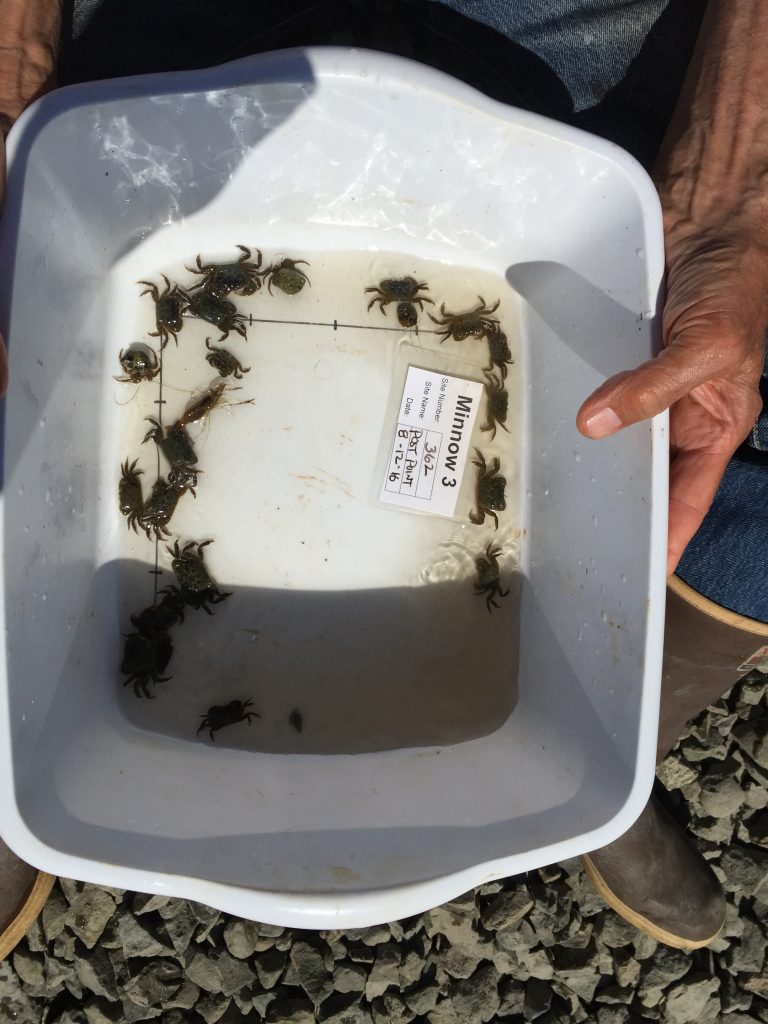
This trap photo was part of the time capsule that enabled Crab Team go back and verify that PAMA had been present in traps as early as 2016. See if you can spot the shrimp with the giant claws!
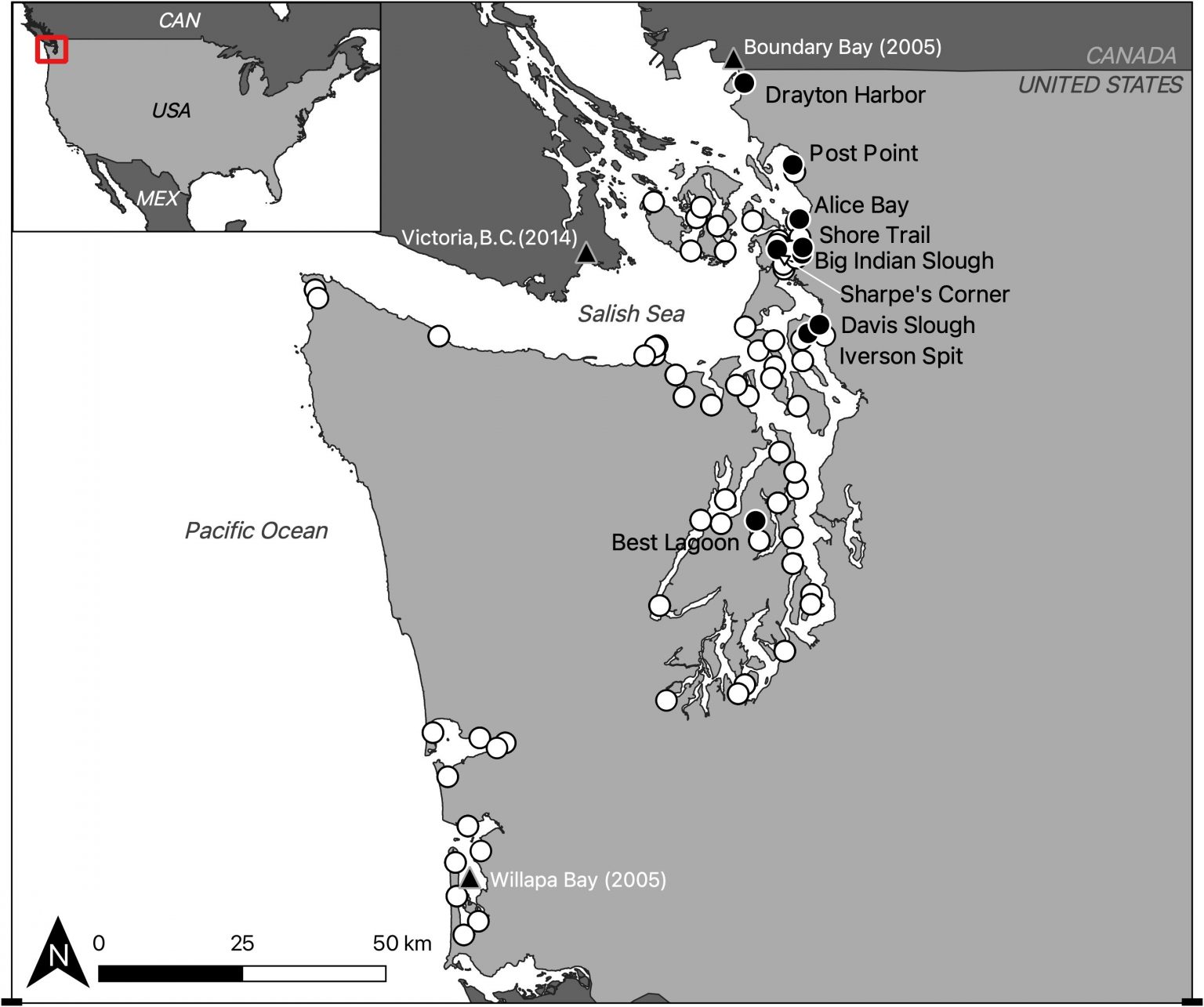
Map of Crab Team network sites, circles, and other notable detection sites, triangles, for Palaemon macrodactylus. Filled symbols show where this shrimp has been confirmed. Open symbols are sites that have failed to turn up evidence of this shrimp to date. Click to enlarge. Figure from Grason et al. 2025.
Figure from Grason et al. 2025.
PAMA probably arrived in the Washington portion of the Salish Sea at least a few years before we first recorded them in 2016. This is at least true for the northernmost sites where we have documented them (Post Point and Drayton Harbor). It’s not possible to tell exactly when because these shrimp have a relatively short life-span.
The spread and increase of PAMA over the decade of monitoring demonstrates the species is an ongoing invasion. Year-over-year, PAMA has been found at increasingly southern sites. Additionally at sites where it is consistently found, generally the shrimp has increased in abundance over time. The current-most southern extent is Best Lagoon, in Dyes Inlet.
Trapping probably only detects certain portions of the total population. We tried several different sampling techniques for this shrimp, and found that traps, even minnow traps, only catch the largest individuals, which are most often female. This means that trapping alone doesn’t give us a full picture of the population.
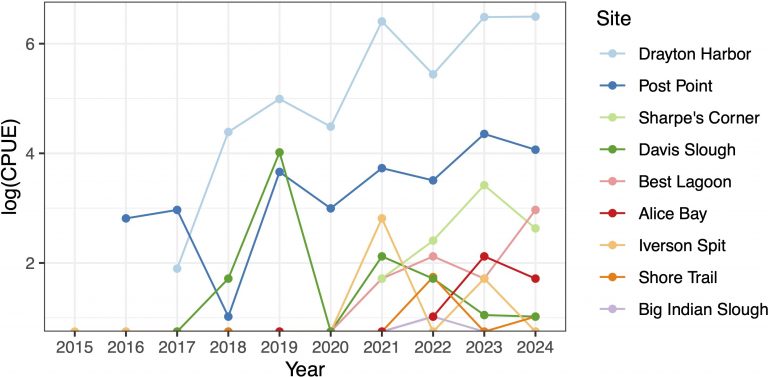
Annual Palaemon macrodactylus abundance at Crab Team sites.
Figure from Grason et al. 2025.
All of this was only possible because of the robust participatory science model of Crab Team. The Crab Team network operates at a scale that wouldn’t be possible without the time and talents of more than 700 individuals over the last decade. Built into the monitoring protocols, both the emphasis on consistency and the verifiable, archivable data enabled the retrospective portion of this study. Crab Team monitors capture photographs of their trap catch, which not only enables the program to verify species identity in real time, but also “back in time” to answer questions we didn’t even know we were going to have when we launched the network. That’s why taking great photos is so important!
While uncovering an invasion that wasn’t even on the radar can feel a bit defeating at times, perhaps it’s helpful to keep in mind that PAMA isn’t known to have large ecological impacts like the invasive species Crab Team is primarily concerned with – European green crab. Researchers have hypothesized that there could be some dietary overlap with crangonid shrimp species, but it’s not clear whether there is much habitat overlap with native crangonids. Nevertheless, one of the lessons that we have to keep learning from biological invasions is that surprises are common. Predictions are difficult, and we’re wrong more often than we’d like to be! Moreover, any species that becomes abundant in a new place has to eat something, and it has to live somewhere. In that way, it is likely that if PAMA becomes abundant, the ecology of certain places will change – even if in subtle ways.
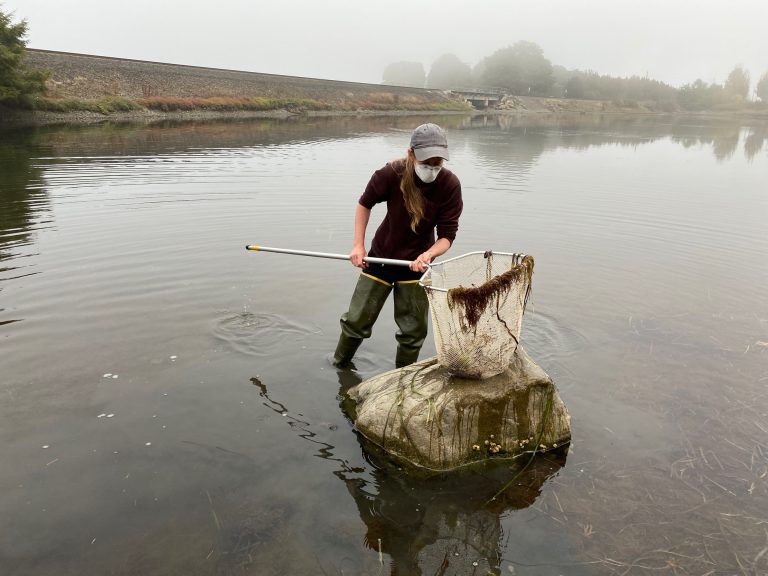
Emily Grason sampling for PAMA at Post Point in 2020 as part of a snapshot effort to investigate their distribution. Photo credit: Sean McDonald
For these reasons, it’s important to be able to detect and track even the invasions that aren’t expected to have substantial impacts. But it’s rare to be able to accomplish this, since limited funding is understandably prioritized for species of highest concern. All too often these species aren’t detected until their abundance is extremely high; thus Crab Team has accomplished a rare feat! The network of Crab Team monitors has provided a very powerful example of how participatory science can meet this need by “Tracking two invasions for the cost of one.”
—Emily Grason
Read the full manuscript here: Grason, EW: J Pineda, PS McDonald (2025) Tracking two invasions for the cost of one: opportunistically tracking the range expansion of non-native Palaemon macrodactylus in the Salish Sea through participatory science. Frontiers in Marine Science. Vol. 12. DOI: 10.3389/fmars.2025.1553583