
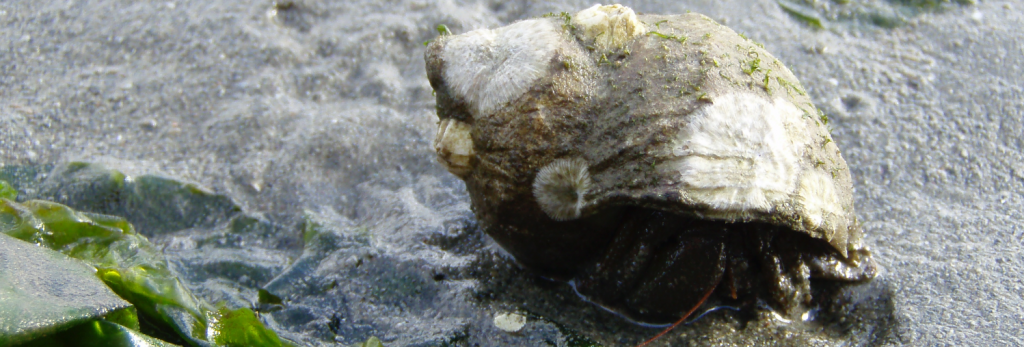
Grainy hermit cautiously moving across the beach at low tide. Photo courtesy of Jeff Adams
Featured Creatures:
Species Name: Pagurus granosimanus
Common Name: Grainyhand or grainy hermit crab
Species Code: PAGR
Geographic Range: Unalaska, Alaska to Ensenada, Baja California, Mexico
Size: Carapace length up to 3/4″ (19mm)
Species Name: Pagurus hirsutiusculus
Common Name: Hairy hermit crabs
Species Code: PAHI
Geographic Range: Pribilof Islands, Alaska to Monterey, California
Size: Carapace length up to 1.25″ (32mm), but usually smaller
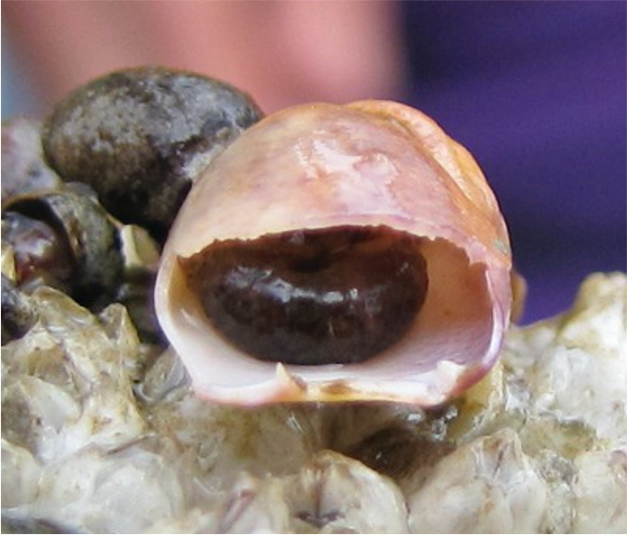
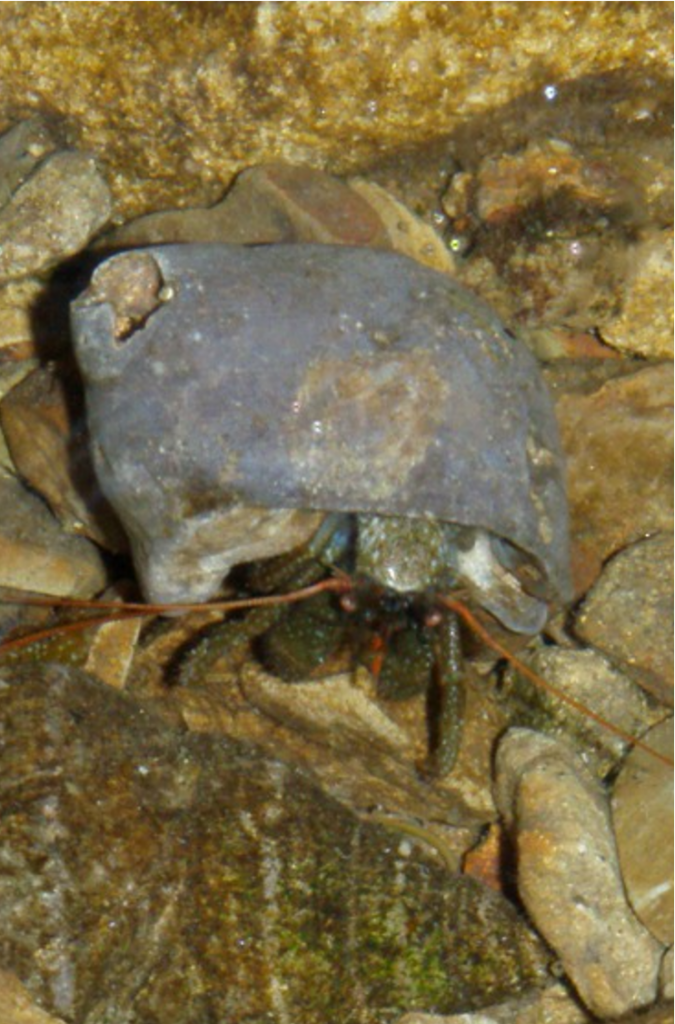
Been feeling a bit hermit-ish this last year? Since leaving our houses could threaten our well-being, we settled into our homes for several seasons. For better and worse, it gave us a chance to closely connect with how good of a fit our living spaces are for us (size, layout, location, etc.), leading to more than a few remodeling projects and some moves. After nearly a year and a half, we may at last be approaching a time when we can leave our homes at will and explore the world with a reasonable expectation of safety. Meanwhile, after about 150,000,000 years, our 10-legged hermit friends seem perfectly content seeking the best fit home for their needs and holing up in their “hermitage” for their own safety.
With more than two dozen species of hermit crab in or near the Salish Sea, we have a pretty rich array to appreciate. That said, only particularly attentive divers get to experience the greatest breadth of Salish Sea species. For those of us exploring the beach at low tide or meticulously sorting the contents of a Crab Team trap, hermit crab encounters typically involve one or both of two common species, the grainy or grainyhand hermit (Pagurus granosimanus, PAGR) and the hairy hermit (Pagurus hirsutiusculus, PAHI).
Being a Hermit
Hermits are in the group of decapod (ten-legged) crabs called Anomurans that only have eight obvious pods. The group also has a pair of antennae on the outside of their eyes, rather than having all their antennae between their eyes just as the “true crabs,” Brachyurans like our iconic Dungies, do. Legs nine and ten are highly modified and small and tucked away to be used mostly for cleaning. But unlike their porcelain or king crab Anomuran cousins, evolution left the hermits with an unarmored abdomen and a need to adjust to life protecting a squishy backside with some kind of shell. Lugging their house around doesn’t always slow them down though. Our hairy and grainy hermits were among the species in a study looking at scavenging behavior that showed hermits were perfectly capable of kicking it into high gear when the smell of mashed mollusks was drifting in the water (Greggor et al. 2016). Not only are they likely to be first on the scene, they are also likely to gather in large numbers and even gain competitive advantages over other small organisms that are after the same food.
Of course, there’s the issue of reproduction when your reproductive bits are tucked deep in the coils of an inflexible shell. Like other species of crabs, hermits will protect a female with whom they intend to mate. However, instead of the intimate embrace of a red rock or a Dungeness, male hermits just grab the shell of the future mother of their children and drag her around for hours or days until the time is right. Not romantic or even that graceful, but they’ve made it work. They do check in with each other by tapping legs periodically to see if all is ready. When the time comes, mating can’t happen in the shell, so they must leave or mostly leave their shells for a brief time (a few minutes or less usually) to mate, after which, they return to the safety of their shells and the males may continue to protect their mate for a little while.
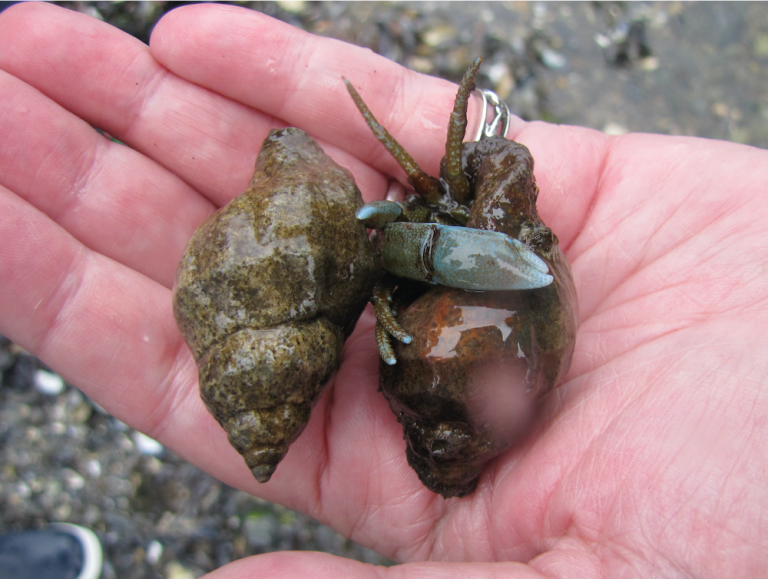
Grainy hermits in a pre-copulatory hold. These are large and similar in size. Sometimes one of either sex may be smaller as research suggests they are more focused on readiness to mate than a size match. Photo courtesy of Jeff Adams
Grainyhand Hermit Crab: “The Tank”
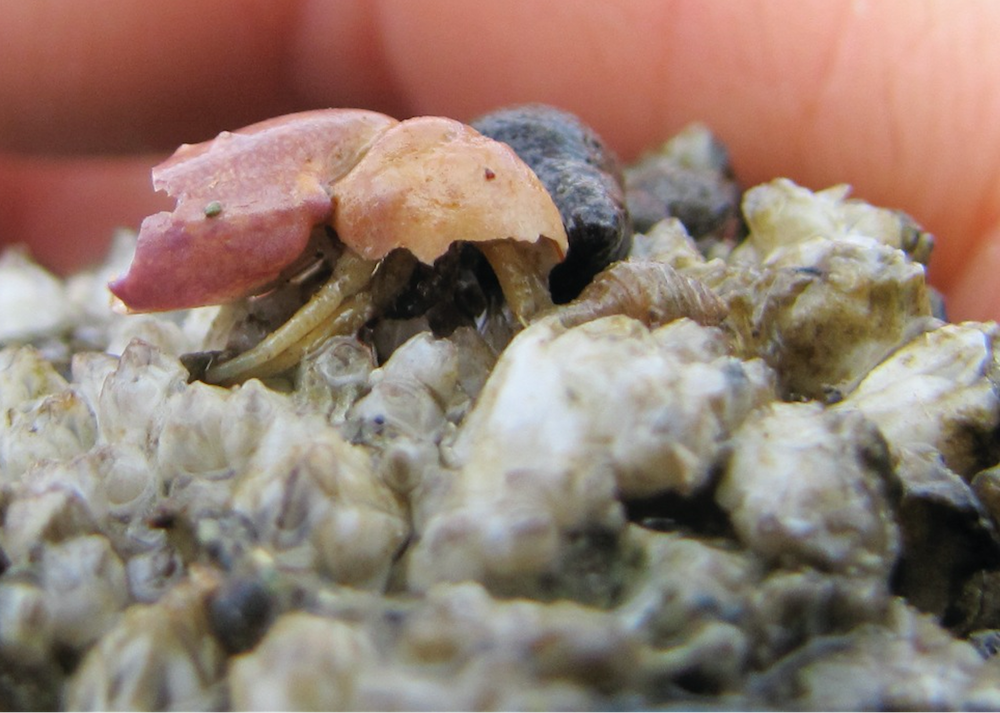
The grainyhand hermit is known for choosing large homes (sometimes ridiculously so) into which it can fully retreat if threatened. Their strategy for survival is to choose the brick house and wait until the wolf gets tired of huffing and puffing. Still, the housing market can be difficult at times. It’s not unusual to find grainy hermits in a shell that you can imagine wasn’t their first choice. A loose barnacle or a piece of a molted crab leg might be the best they can get. If the crab isn’t fully in the shell or if you can convince it to peek out, the bright orange antennae are a quick clue to a grainy hermit’s identity. When you take a look at the legs, you will see they are evenly covered with light to blue bumps that give them their graininess. As they wear their skin for a while, it can erode, showing a lovely shade of blue.
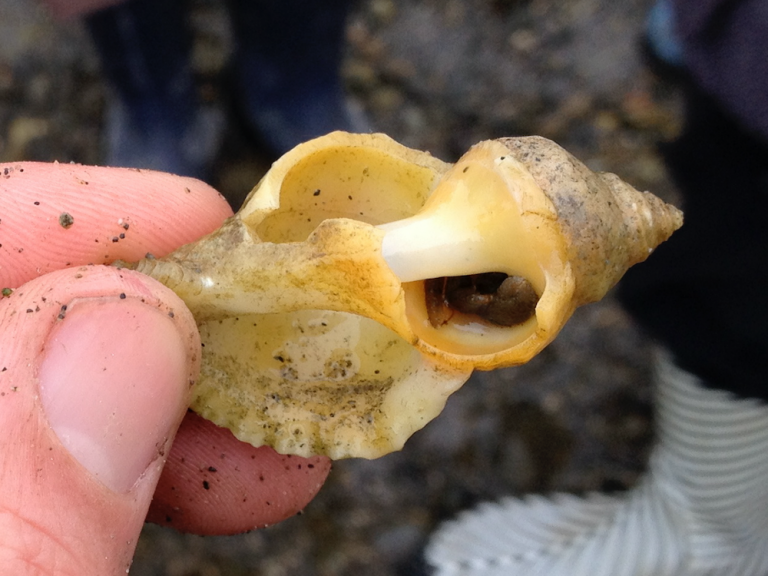
Can you really carry that thing? Tiny grainy hermit in a large frilled dogwinkle shell. Photo courtesy of Jeff Adams
Hairy Hermit Crab: “The Speedster”
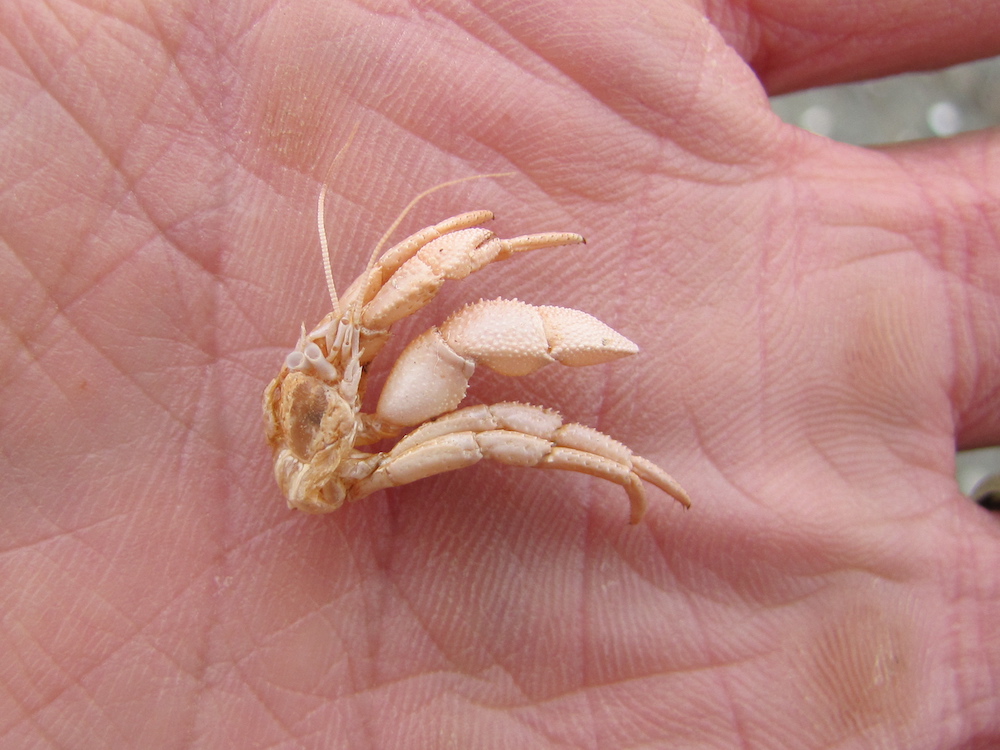
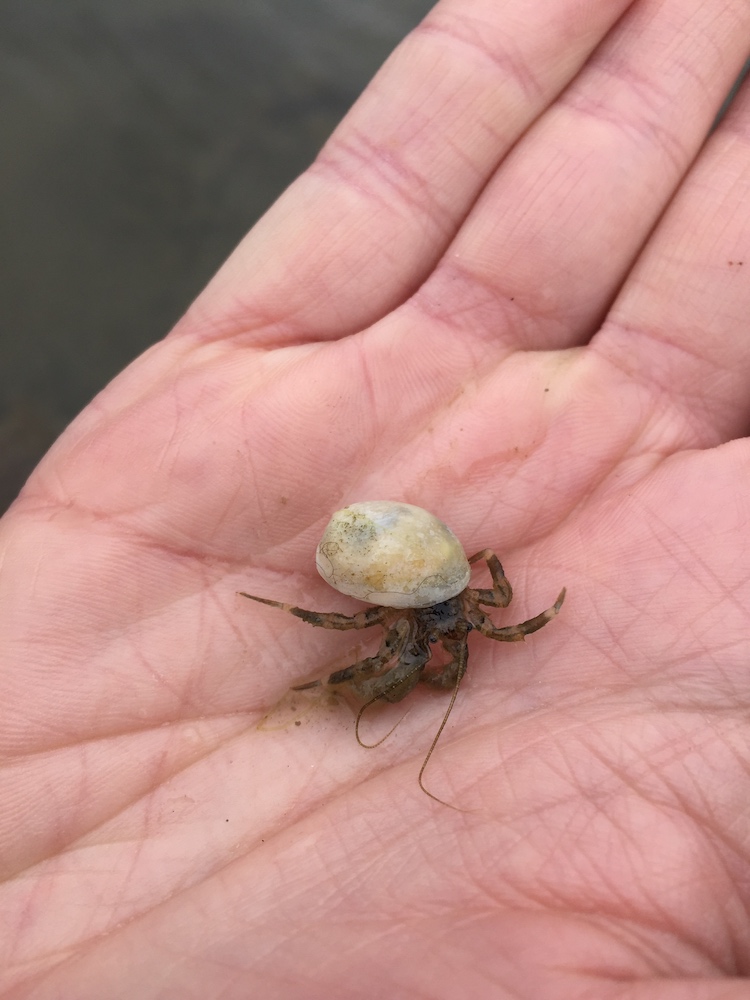
Hairy hermits’ shells are typically pretty small (sometimes ridiculously so), not even entirely covering their abdomen and leaving you asking, “Why bother?” When disturbed, they may even ditch the shell so they can flee unencumbered. Sometimes they will take advantage of a larger shell, particularly egg-bearing females who may be wanting a little peace and privacy. Small shell or not, focusing in on legs with light bands and blue bits, and also on stripy (but not orange) antennae, can help you nail down the identification. Still, the hairy hermit is one of those species that can be quite variable in appearance. In fact, their namesake trait is particularly variable, especially as they age. While they share the “hairy” with other crabs in our region (hairy shore crab, hairy helmet crab), the taxonomists went a step further and put “hirsut” right into the species name for these hermits.
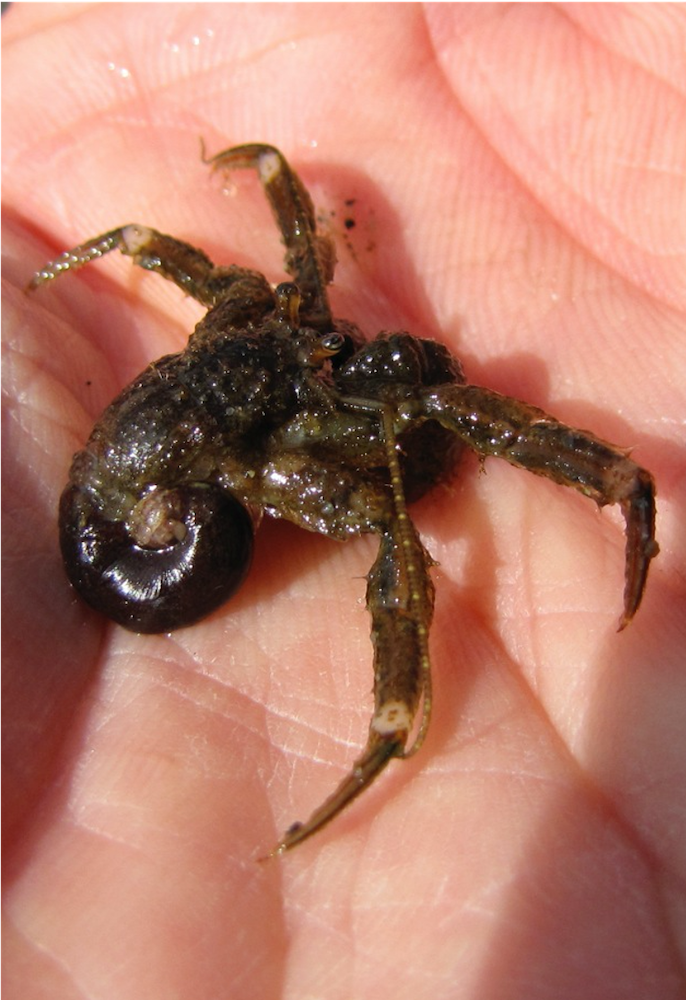
This hairy hermit abandoned its shell, opting for a speedy getaway while exposing its soft abdomen. You can also see the white bands on the legs, and banding on the brown antennae. Photo courtesy of Jeff Adams
Many hairy hermits don’t seem too far outside of the norm of hairs, but once in a while you stumble across one (often larger) that is quite the furball. Hairy hermits are incredibly common, particularly in the intertidal, where they tend to be found a bit higher on the beach than grainyhanded hermits. Some cool research on hairy hermits showed they prefer darker shells and hanging out on darker substrates. They have also been known to make use of shells from nonnative snails like Batillaria attramentaria here in Washington (Wonham et al. 2005*), and even to such an extent that they were able to use the new snails’s shells to expand their range in the San Francisco Bay area (Wicksten 1977*).
So, maybe this has been a bit more of a grainy hermit kind of year, staying tucked safely at home as much as possible. The second half of 2021 may feel more like hairy hermit time, when we still keep our protection close but free ourselves for more exploration. Maybe for 2022 we will molt all our hermit ways and will emerge as red rocks again – top of the crabby food chain and free to roam.
– Jeff Adams
*While we try to link you directly to the research we reference, some of the studies cited in this article are not open access. If you have any questions about any of the works cited here, please feel free to reach out to crabteam@uw.edu.