
Green Crab: Setae Save the Day
Members of the Crab Team spend a lot of time talking about how to identify crabs based on physical characteristics. When it comes to our most ubiquitous shore crabs, hairiness is a go-to feature. We unapologetically harp on the fact that hairy shore crabs (Hemigrapsus oregonensis) have hairy legs, while purple shore crabs (Hemigrapsus nudus) have ‘nude’ legs. However, upon close inspection of any crab, including European green crab, you’d see that hairiness isn’t restricted to the legs; depending on the species, patches occur in various clusters and constellations all over the body. So what’s the function of all this ‘hair’? To answer this question, one really must walk a mile in a crab’s shoes (or at least picture what it’s like to spend some time in a crab’s shell).
Imagine living within a rigid suit of armor. Sure it would be great protection but it might be a bit desensitizing. You wouldn’t really be able to feel anything that came into contact with your ‘suit’ – and forget about enjoying a gentle breeze. Or how about smelling an appetizing aroma or even hearing an alarming sound? This might be the situation for European green crab (and all other crabs) too, if it weren’t for setae.
Setae are the hairs or other fine projections emanating from a crab’s shell. Carcinologists (crab scientists) define setae as articulated cuticular extensions of virtually any shape or size, from microscopic to visible to the naked eye (such as the hairy legs of shore crabs). Setae are made of the same material as the shell and each one is connected to the body with a flexible membrane that allows it to move. Nerves nestled within this membrane connect to the crab’s nervous system. Within the decapoda (crabs, shrimps and lobsters), there are at least fifteen different types of setae. Though we often refer to them as hairs, they are far more complex and varied. Let’s explore a couple of things setae can do.
Tuning in
With the exception of sight, most sensory functions in crabs are carried out by setae. Sensory setae are adapted to detect stimuli. Essentially, they act like satellite dishes picking up signals from the environment. Some are quite sophisticated and others more rudimentary.
Mechanoreceptors serve the function of touch or, like a seismograph, detect low-frequency vibrations. Setae that detect water movements have been shown to help European green crab to help European green crab orient to tidal currents that they use to travel distances during nighttime feeding excursions. Tactile setae are also important for sorting and handling food. In green crab, the mouthparts alone are covered with thousands of setae of four distinct types. If you’ve ever flipped a crab on its back and seen it quickly right itself, then you’ve seen another type of tactile setae in action. In this case, clusters of specialized setae in a tiny organ near the crab’s eye cradle a small rock that tickles the setae as it rolls around, helping the crab recognize which end is up. In many ways this organ is analogous to the inner ear in most mammals.
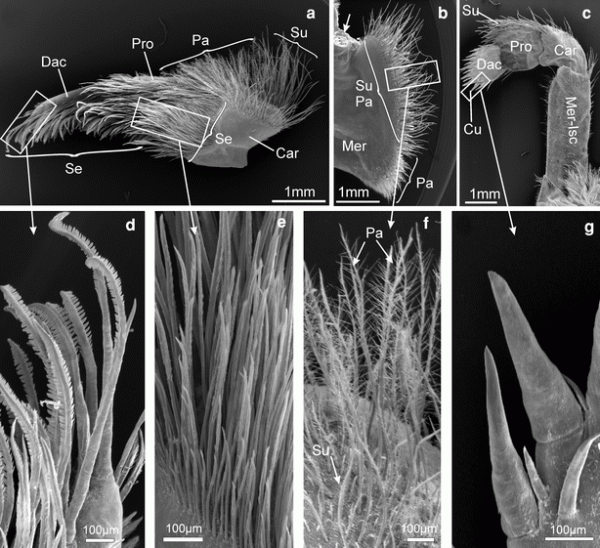
Scanning electron micrograph of the mouthparts of green crab showing setae (image: A. Garm). Source: Garm, A. 2005. Mechanosensory properties of the mouthpart setae of the European shore crab Carcinus maenas. Click photo to enlarge.
Chemoreceptive setae, as the name implies, detect chemical signals and can be further divided into olfactory (smelling) or gustatory (“tasting”) receptors. Long, narrow setae on the antennules, which are positioned between the eyes and above the mouth, are responsible for crabs’ sense of smell. These setae are tightly packed to maximize their sensitivity to specific signals like food, mates or predators. The characteristic antennular ‘flicking’ behavior observed in many crabs has evolved as a method to enhance their sense of smell. Several studies of green crab have shown that ‘flicking’ increases dramatically once crabs begin actively looking for food or mates, and this seems to help in narrowing the search.
But, when you’re underwater, the line between smelling something and tasting it is somewhat blurred. Specialized setae responsible for the senses of smell and taste are differentiated primarily based on their sensitivity. Whereas setae on the antennules may be stimulated at low concentrations by a distant source, coarser types associated with the mouthparts and claws may only respond to chemical concentrations that are 100 times greater. For these less sensitive setae, physical contact is required for tasting to occur. Many species, including green crab, actually do most of their tasting with the tips of their legs, which is pretty handy as they probe the sand or mud looking for their next meal. In fact, a green crab’s shell contains more than 4,000 ‘funnel-canals’ replete with these gustatory receptors, and most of these are situated at the leg tips.
Keeping it clean
According to my 7-year-old, crabs are possibly the most vain of all shellfish (she hass seen Moana exactly a gazillion times and can’t get over Tamatoa). Even non-CGI crabs spend considerable time grooming and preening. In fairness, though, without these efforts, microbes and other fouling organisms would quickly coat most body surfaces.
Significant fouling can develop on sensory setae, gills, and incubating eggs within days without proper maintenance. To combat this, most appendages have tufts of brush setae adapted to keep things spick and span. Cleaning setae are typically specialized to the task; some are coarse for scrubbing tough areas, while others, including those used to clean delicate developing eggs, are soft and supple.
Speaking of vain crabs, some species like the decorator crabs (Oregonia gracilis is one local example), take setae to the extreme to adorn themselves. These crabs cultivate or place materials on their carapace to blend in with the surrounding flora and fauna and dense growths of hooked setae provide points of attachment for this camouflage. Similarly, it has been suggested that setae covering the body of our local hairy helmet crab serve primarily to accumulate silt and debris that help it to blend with its surroundings.
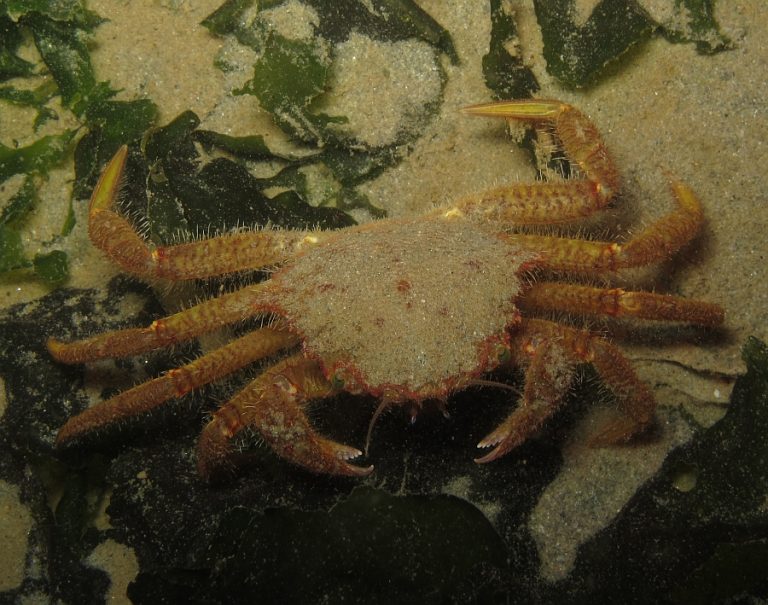
The hairy helmet crab, Telmessus cheiragonus, has coarse setae covering most of its body, which gives it a ‘hairy’ appearance. Silt and detritus clinging to the setae may afford the crab a certain degree of camouflage. (photo: G. Jensen).
Setae do it all
Specialized setae aid in pretty much all aspects of a crab’s lifecycle. Setae are used to transfer sperm between mating crabs, females deposit their eggs onto the setae of their abdomens to carry and incubate them, and even crab larvae ride ocean currents by flapping and fanning plumes of setae through the water. Some of the more rudimentary types are also among the most important, including the bristles that act as a physical filter to screen water passing over the gills, or setae within the stomach that help with digestion.
This is not meant as a comprehensive guide to setae. Carcinologists are still working to understand all that setae do. Advances in electron microscopy and other techniques have facilitated closer examination of setae over the past 25 years, and this work continues to elucidate their functions. Detailed behavioral and physiological studies will undoubtedly shed more light on how crustaceans have adapted setae to meet the challenges of life under water.
– Sean McDonald
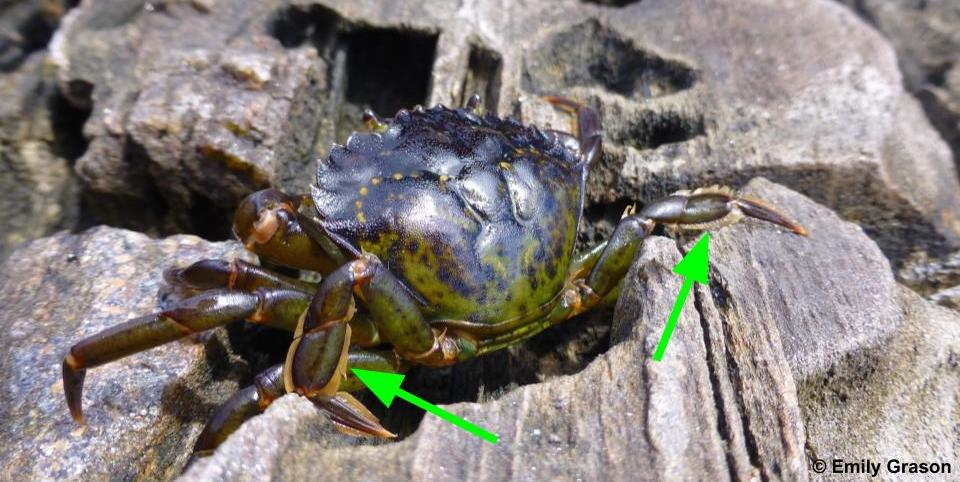
Feature Photo: European green crab with setae on its walking legs. Click photo to enlarge.