
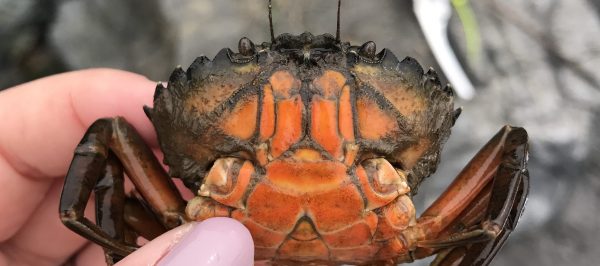
Green Crab: Declawed
It sounds like a koan, one of those paradoxical riddles meant to clear your mind: What is a crab without claws? It turns out a crab without claws is probably…pretty hungry.
Crabs use their claws (termed “chelipeds” by crab biologists) much as we use our hands – to interact with the world around us. Whether that’s catching food, crushing a mussel shell, fending off would be predators or competitors, claws are multipurpose tools. But what happens when crabs lose their tools?
Costing an Arm and a Leg
Crabs, similar to sea stars, have the ability to autotomize (meaning “self cut”) their claws and walking legs. Autotomy enables a crab to drop a claw in a safe way – on purpose – to avoid getting seriously injured or eaten. For instance, if a gull is carrying a crab by a leg up the beach to eat it, the crab can drop the leg, and use the other seven walking legs to make a speedy getaway, leaving the gull with only a morsel to snack on.
If crabs were built like humans, dropping an arm or a leg would mean certain death, but crabs have a special system built into their anatomy that enables them to do this safely. A special muscle contracts when the crab decides to ditch a leg or a claw, causing the leg to snap off in a predesigned location within just a couple of seconds. The wound is quickly closed with a protective barrier to keep the crab from bleeding to death (more information on Snail’s Odyssey). This is a little like how our bodies form clots to stop blood loss, but the difference is that this can only occur in a particular spot at the base of each leg of the crab.
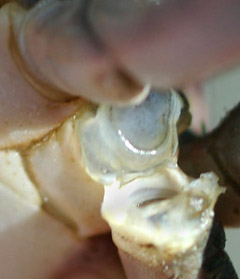
Autotomy membrane protecting crab from blood loss after shedding a limb in Hemigrapsus nudus, purple shore crab. Photo from A Snails Odyssey.
While it seems like a shame to lose a leg or a claw, crabs do have the ability to grow a limb back – eventually. Crabs can only grow when they molt, and they cannot produce a full sized claw in a single molt. It takes crabs about three molt cycles to get their regrown limb back up to snuff. For young crabs, regrowth is quicker than for large crabs, because small crabs can regrow proportionally more claw with each molt and because they molt more frequently. Adults sometimes molt only once per year, however, so losing a limb is a serious problem. In addition, all crabs reach a terminal molt, a final stage of life when they will never again shed their shell for growth. If a crab that has reached its terminal molt loses a limb, that limb will never regrow.
This is why “claw poaching” is illegal in our area. Poachers take the claws of crabs like red rock crab, which are known for their big meaty muscular pinchers, but toss the crab back to circumvent catch limits. Perhaps poachers assume they are not doing any harm, because the crabs can regrow their claws. But not only is regrowth unlikely for a large crab, but it can also prevent the crab from mating, and, even worse, it can directly kill the crabs. When the claw is ripped off faster than the crab can autotomize, the limb is often pulled out of the body cavity, taking with it the particular part of the leg designed to stop the bleeding. Crabs that are roughly handled to remove claws can therefore bleed to death.
Regrowing limbs is no easy task either, because growth depends on the crab being able to eat, and eating depends on the crab…having claws. If the crab has lost both claws, this is very tricky indeed. Retaining at least one claw seems like a huge asset, but it turns out it depends on which claw.
Your content goes here. Edit or remove this text inline or in the module Content settings. You can also style every aspect of this content in the module Design settings and even apply custom CSS to this text in the module Advanced settings.
Compensating for Claw Loss
Not all claws are created equal, even for an individual crab. This is because many crabs have some level of differentiation between their two claws. While you might be familiar with the dimorphism in the claws of lobsters, or fiddler crabs, European green crabs also have two types of claw: a cutter and a crusher. The crusher is, as you might expect, the more muscular claw, and like your biceps, the claw that is stronger is often bigger top to bottom. The more slender claw is the cutter, used to help in manipulating food and in tearing flesh. You might also notice a difference in the bumps on the inside of the claw, what crab scientists call dentition. Those bumps concentrate the force of the crabs pinch to small area, and help them cut (sharp bumps) or crush (rounded bumps) their prey. The green crab crusher has wide dentition that looks a lot like our grinding molars. The cutter has smaller bumps that look more like the scissoring teeth of a dog.

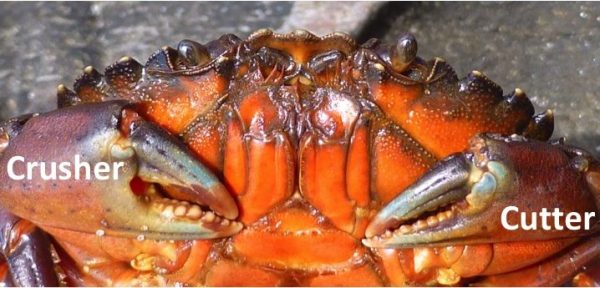
A female European green crab from Maine, showing off her “dimorphic claws”. Her right claw is taller top to bottom, giving greater mechanical advantage for crushing. The more slender left claw is her cutter. Photo: E. Grason
Even though these differences seem fairly subtle to us, they can make a big difference to a European green crab. It turns out, if you have to lose a claw, you really don’t want to have to do without your crusher claw. A recent study tested how well European green crabs missing either a cutter or a crusher claw were able to feed themselves compared to crabs with both claws intact. For some types of prey, losing the crusher claw meant the crab was nearly helpless, unable to break open any of the oysters offered. On the other hand (or “claw”, groan), if the crab lost the cutter claw, it barely missed a beat, needing only the remaining crusher to crack open just as many oysters as a crab with both claws (you can read the research). Loss of a crusher claw, could make life harder for a green crab, but perhaps not impossible. Green crabs are known for being flexible eaters, so a crab down a crusher might switch to something easier to subdue, such as worms or even seaweed.
Also like humans, European green crab populations are biased when it comes to right-left asymmetry; nearly all crabs are “right-clawed” – meaning the crusher claw is on the crab’s right. However, this can switch over the course of the crabs life if the crab loses the right/crusher at some point, i.e., the cutter becomes the crusher throughout several molts as the crab regrows the other claw.
Clawless Carcinus
Losing a crusher is bad news for a crab, but could it be good news for an invasion? At Crab Team, we keep an eye on how much limb damage European green crab have when we find them. This crab was found at Dungeness Spit, missing a crusher claw and first walking leg on the right side. The crab in the header image was captured at Padilla Bay this April, a rather poor specimen missing both claws, and both of the first set of walking legs. We prefer to see crabs like this because it means this crab has encountered something trying to eat it or fight with it. It also means that it’s less of a threat to native crabs and clams!
In previous research in California, Crab Team member Sean McDonald and his colleagues observed that European green crabs living near larger species of rock crabs (multiple species of the genus Cancer) frequently had damaged or missing claws and legs, while crabs living in marshy areas where rock crabs don’t go were more likely to be unharmed.
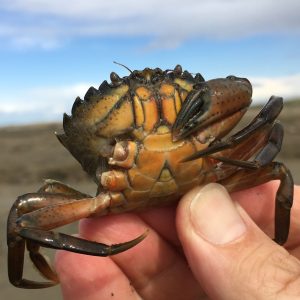
Male European green crab captured at Dungeness Spit this summer, showing loss of right/crusher claw and first right walking leg. Photo: Allen Pleus/WDFW
Of the European green crab captured on Washington’s Salish Sea shorelines so far (slightly more than 100 to date), roughly one out of every five crabs had some type of limb damage, either to walking legs or claws. Half of those had damage to one of the claws, and at least half of that group involved the right/crusher claw, meaning that at least 5% of European green crabs in our area are likely not very good at feeding themselves. How does this compare to other populations of green crab around the world? The frequency of clawless crabs here is similar to field surveys conducted in the Gulf of St Lawrence, on the eastern seaboard of Canada, but substantially lower than has been observed in other parts of the world, including California (greater than 50% according to research).
Lost claws matter not just to the individual crab, but also to the population of crabs, and to the impacts of that population on native critters. Figuring out why there is variability in limb damage might help predict how claw loss could impact our own shorelines.
– Emily Grason