
Photo courtesy of Jackson Blalock
Green Crab: Elephants in the Eelgrass
Guest contributor Brett Howard completed her Ph.D. research at Simon Fraser University focused on the impacts of European green crab on ecosystems in British Columbia. She currently works for Fisheries and Oceans Canada, the federal governmental department that manages fisheries.
Some species can change landscapes so substantially that they become symbols for ecosystem health and conservation. The classic example is the beaver, a species that can create diverse wetlands by the simple act of industrious dam construction. Destruction and disturbance are often equally effective forms of landscape transformation. Large herbivores may break, tear, or stomp over vegetation, dig massive pits in search of water, and leave behind concentrated deposits of nutrients in their dung. A herd of elephants is not subtle. Whether constructive or destructive, these species are considered allogenic ecosystem engineers, meaning the origin of change is a consequence of an animal’s behavior. This is in contrast to autogenic ecosystem engineers, where the species themselves are the habitat. Many plants, algae, and sessile invertebrate species, like oysters, fall into this category. For example, the iconic large brown seaweeds of kelp forests are the foundation for an ecosystem that supports everything from the smallest invertebrates to sea otters.
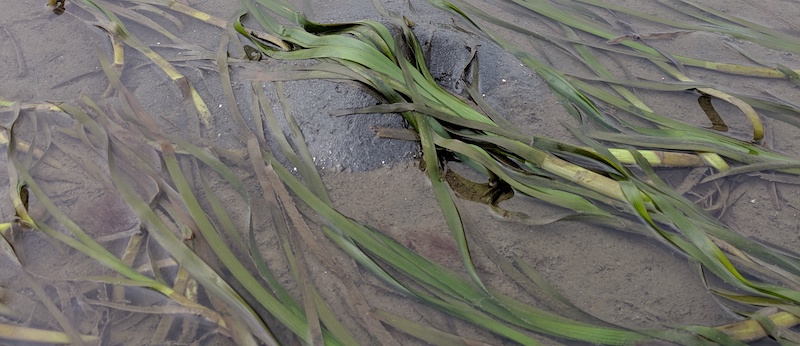
Oysters and kelps are not the only autogenic ecosystem engineers along the West Coast. The native eelgrass Zostera marina is a critical nearshore habitat that turns structureless mudflats into three-dimensional habitat. Anyone who has kayaked over an eelgrass bed at high tide has likely seen the comings and goings of a diverse range of species, like the giant, white Lewis’ moon snail (Neverita lewisii) or the bright green bay pipefish (Syngnathus leptorhynchus). There are numerous transient species that move into eelgrass beds to forage or to evade predators. Juvenile rockfish (Sebastes spp.) and Dungeness crab (Cancer (Metacarcinus) magister) are common in eelgrass beds as well as out-migrating juvenile salmon.
The ecological importance of eelgrass has incentivized federal, state, and provincial governments in both the USA and Canada to put regulations in place to protect these habitats. This protection is necessary, as eelgrass beds have been declining globally due to environmental stressors like rising water temperatures, excess nutrients, and alteration and construction along shorelines (e.g., armoring, docks, boardwalks, marinas, etc.).
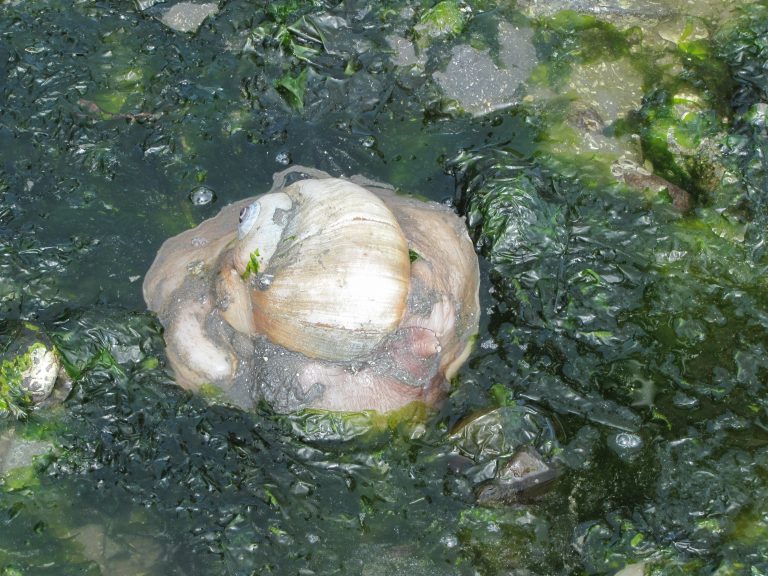
Lewis’ moon snail (Neverita lewisii) making headway in the intertidal zone. Photo courtesy of Jeff Adams
The ecological importance of eelgrass has incentivized federal, state, and provincial governments in both the USA and Canada to put regulations in place to protect these habitats. This protection is necessary, as eelgrass beds have been declining globally due to environmental stressors like rising water temperatures, excess nutrients, and alteration and construction along shorelines (e.g., armoring, docks, boardwalks, marinas, etc.).
In the early 2000s a new threat to eelgrass was identified on the east coast of North America where researchers took notice of massive, sudden declines in eelgrass beds that coincided with large populations of invasive European green crab. After 75 percent of the plants in Benoit Cove, Nova Scotia were lost over a single summer, researchers tested the hypothesis that green crabs were allogenic ecosystem engineers in this system by studying the effects of green crabs caged in an eelgrass bed (Garbary et al. 2014).The use of cages in field studies is meant to keep one aspect of the environment constant (in this case the presence or absence of green crabs) while allowing all other experimental conditions to be dictated by real-world conditions. These types of experiments may use enclosures, where the cages keep crabs in, so there is a “known density,” or exclosures, where the cages keep crabs out. The enclosure experiment in Nova Scotia showed that plants inside the cages were shredded or uprooted by green crabs while they foraged in the soft sediment. The negative correlation between green crab presence and eelgrass (i.e. the more green crab, the less eelgrass), especially at high crab densities, was further supported by similar studies in Newfoundland, Prince Edward Island, Canada and Maine, USA (Malyshev & Quijón 2011; Neckles 2015; Matheson et al. 2016). It seemed that in large numbers, green crabs could have profound impacts on this critical habitat. The change in habitat from eelgrass bed to mudflat by green crabs exemplifies allogenic ecosystem engineering.
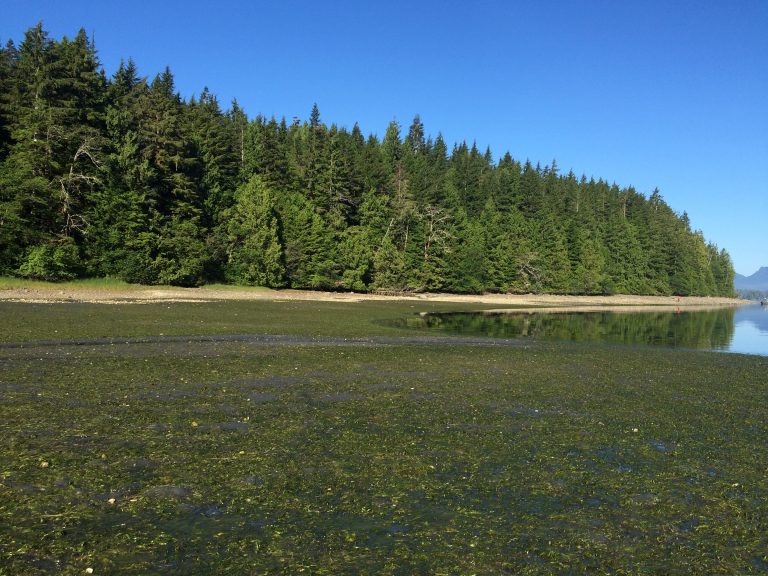
Eelgrass bed at low tide in Mayne Bay, British Columbia. Photo courtesy of Brett Howard
When considering the issue of invasive green crabs on Vancouver Island, BC these studies caught my attention. After all, the species of eelgrass affected on the east coast was the same as that found on the west coast, Z. marina. Would green crabs have the same impact on our eelgrass beds?
My colleagues, Drs. Fiona Francis, Isabelle Côté, and Thomas Therriault, and I tested the interaction between green crabs and eelgrass on the West Coast by placing green crabs in enclosures at high and low densities (5.6 and 1.4 crabs per square meter, respectively) in an eelgrass bed on the southwest side of Vancouver Island.
From surveys done by the Department of Fisheries and Oceans Canada, we know this range approximates the densities of green crabs at moderate and very high-density sites elsewhere in the region. Over the course of one month, we measured the change in both eelgrass blades (leaves of the plant) and rhizomes (similar to roots) inside and outside the enclosures. How green crabs impact these two parts of the plant affects plant regeneration and overall bed persistence. If green crabs were just removing the blades, like a lawnmower or a grazing herbivore in a grassland, the root structure of the grass would remain intact, likely allowing the plant to regrow quickly. By comparison, if green crabs are more like elephants, pulling out plants, roots and all, it could mean a larger or more permanent impact to eelgrass beds. All this talk of herbivory might suggest that green crabs are eating eelgrass. To determine if there was herbivory going on, or if the damage to the eelgrass was simply incidental, we dissected the stomachs of enclosed crabs and had the contents analyzed for eelgrass DNA.
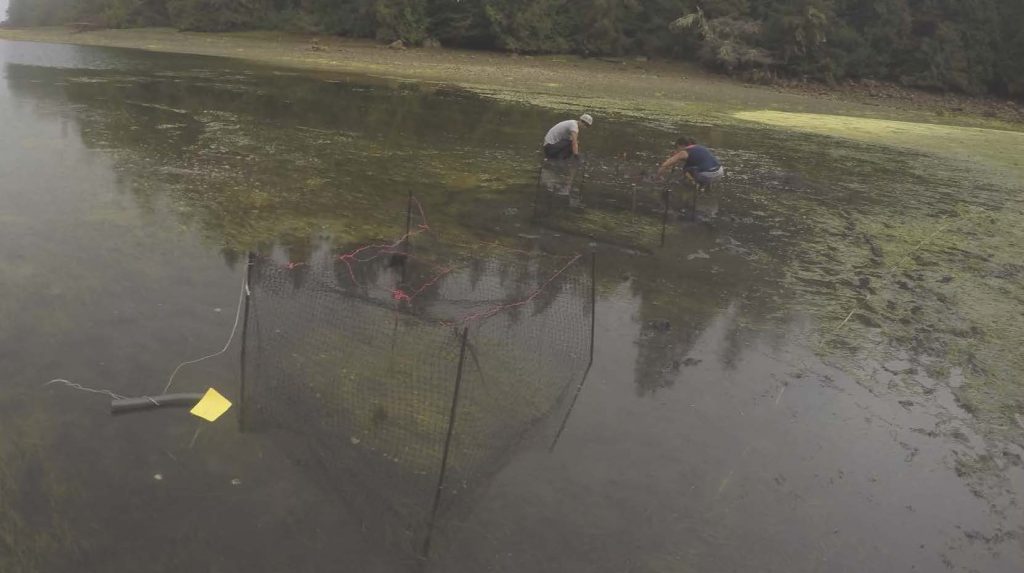
Dickson Wong and Fiona Francis building the last of the enclosures. Photo courtesy of Brett Howard.
As with the experiments on the East Coast, we observed a significant decline in eelgrass blades in our highest density crab treatment. These enclosures lost 73 – 81 percent more blades than the low-density ones. On average, the number of blades in the high-density enclosures decreased by almost 2 percent every day, due to green crab activities.
This is an extraordinary rate of loss, up to three times faster than the natural loss of blades over the same time during this experiment. Yet, is also important to keep in mind that these numbers reflect the effect of green crabs in an unnatural setting: an enclosure. In nature, green crabs will move around a bed and with the tide, so their effect is unlikely to be as concentrated as it was in our experiment. Regardless of the specific numbers, what this experiment reveals is that green crabs will damage eelgrass plants as a consequence of their behaviors, and this damage scales with crab density. This raises concerns about the long-term stability of eelgrass beds on the West Coast with high densities of green crabs (i.e., greater than ~5 crabs per square meter). When we looked at the high-density enclosures in closer detail, we found the rhizomes did largely remain intact under the sediment, suggesting the eelgrass might be able to regrow quickly in the absence of green crabs. Our experiment ended before we could track this, however, so future study would be needed to confirm that recovery does take place.
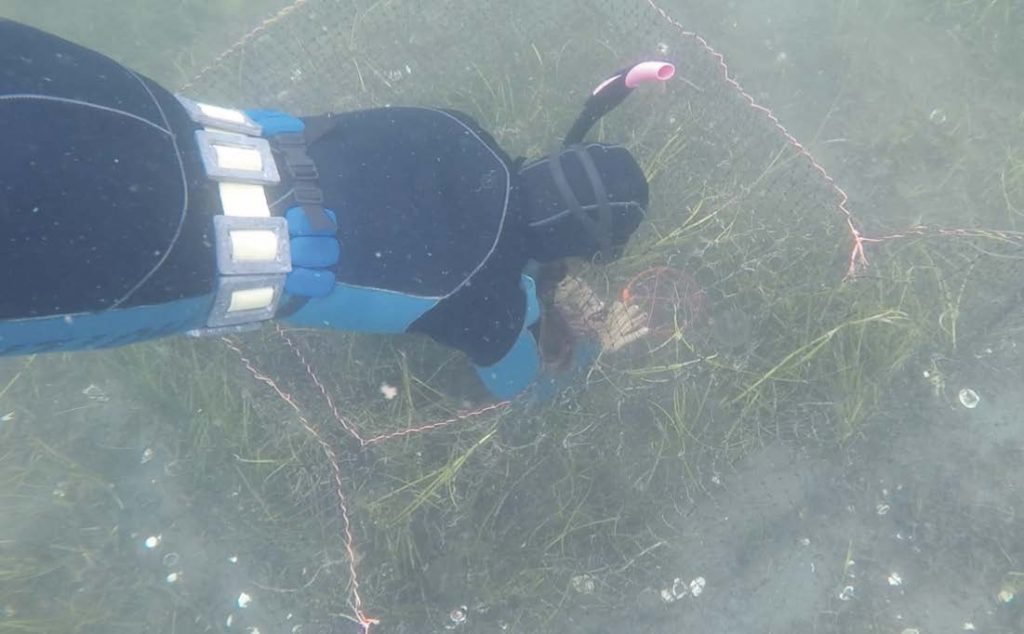
Fiona Francis counting eelgrass blades in an enclosure. Photo courtesy of Brett Howard
Stomach contents revealed herbivory by green crabs on eelgrass was common, especially in the high-density enclosures where 88 percent of crabs tested had eelgrass in their stomachs. This suggests that when green crabs are in high density environments with increased competition for prey, eelgrass can supplement their diet. Previously, there had been evidence of green crabs foraging on eelgrass on the East Coast, but this was limited to juvenile crabs (Malyshev & Quijón 2011). This ability to adapt their diets to different conditions is one of the ways this species manages to thrive on coastlines around the world. Here on the West Coast, it would appear we have an ongoing struggle between two persistent ecosystem engineers, one autogenic native species (eelgrass) and one allogenic invasive species (green crab). On one hand, like many terrestrial grasses, eelgrass can be quite resilient to disturbance like blade herbivory, so long as it is in a habitat conducive to growth. On the other hand, we know green crabs can be voracious, eating everything including eelgrass, and can live in very high densities on the West Coast. Could high densities of green crab overwhelm eelgrass’ regenerative ability? More than anything, this study demonstrates how important it is that we protect our eelgrass beds from stressors within our control, such as habitat disturbance, excess nutrients, and shading from shoreline structures, so that they are more likely to recover from the effects of grazing green crabs.
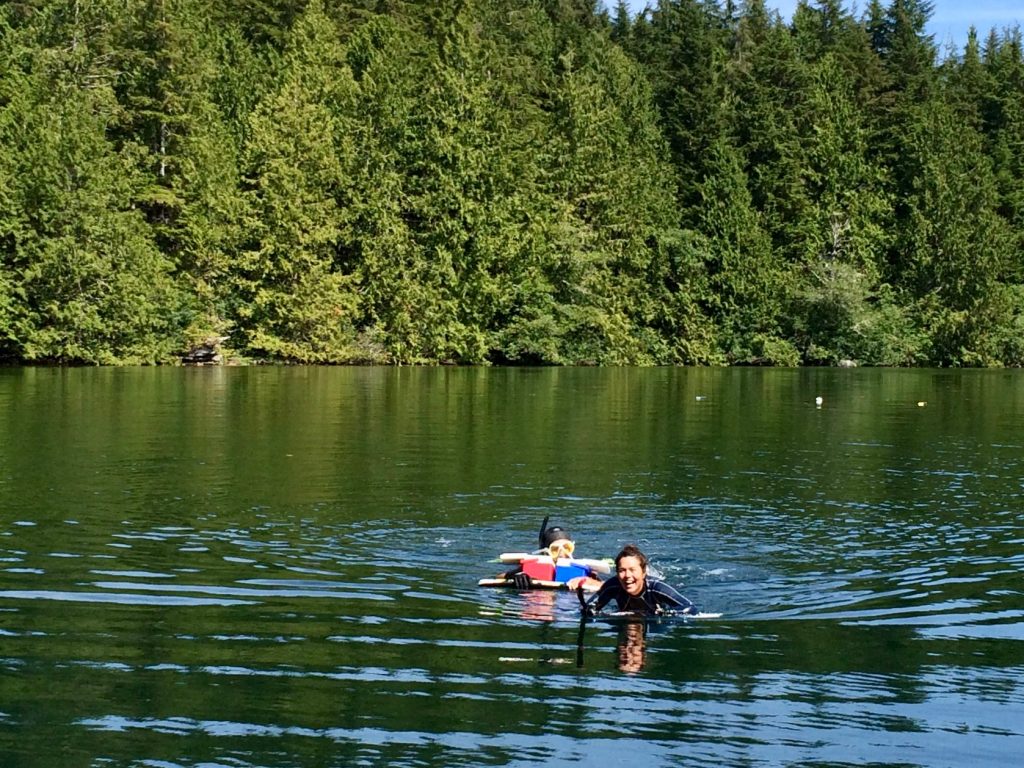
Fiona Francis and Dickson Wong swim back to the boat after data collection. Photo courtesy of Brett Howard
–Brett Howard, Ph.D.
Citation: Howard BR, Francis FT, Côté IM, et al. (2019) Habitat alteration by invasive European green crab (Carcinus maenas) causes eelgrass loss in British Columbia, Canada. Biol. Invasions. Vol 21:3607–3618. DOI