
What is the Hydra Effect: Could Trapping Green Crabs Increase Their Numbers?
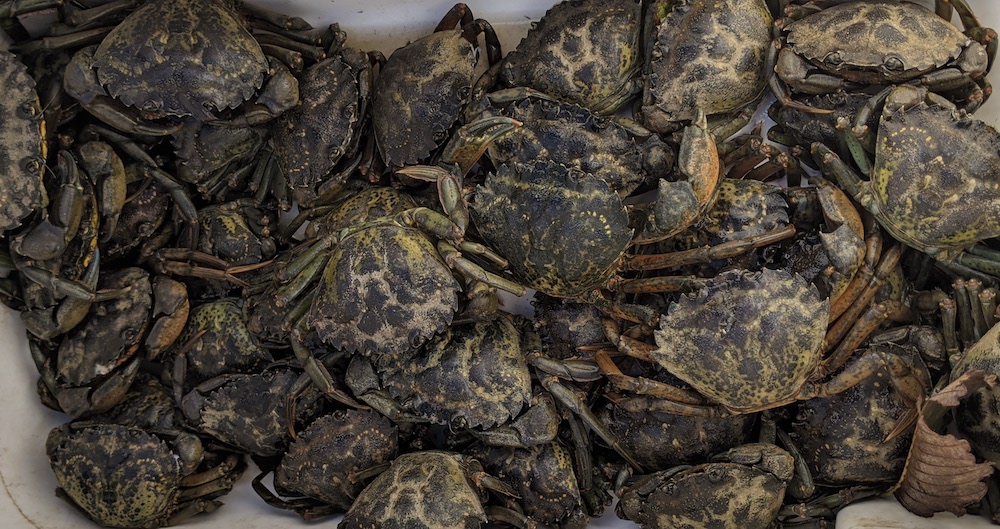
Unwelcome and Tough to Evict, When “Eradicated” Species Bounce Back With a Vengeance, and Green Crab Study: Scientists Learn ‘Eradication’ May Not Achieve Desired Solution… These were just a few of the provocative headlines that appeared last year following publication of a study by Dr. Ted Grosholz and colleagues in the Proceedings of the National Academy of Sciences. And while the study in question focused on invasive European green crab in California, Washingtonians were rightly alarmed by these headlines streaming across their newsfeeds. After all, Washington State is experiencing its own burgeoning green crab invasion (see What Does the Invasion at Lummi Mean for the Salish Sea? and Coastal Green Crab Captures Increased in 2021 on the Crab Team blog).
The paper, Stage-specific overcompensation, the hydra effect, and the failure to eradicate an invasive predator, describes a case study in Stinson Beach, California, involving attempts to eradicate the prolific invasive crab from Seadrift Lagoon, a 40 acre manmade seawater pond sandwiched between Bolinas Lagoon and Bolinas Bay. Beginning in 2009, Grosholz and colleagues trapped Seadrift Lagoon extensively and repeatedly in an effort to extirpate the crabs. By 2013, the researchers estimated the population had declined from more than 125,000 to fewer than 10,000 crabs. However, by just the next year, the population had rebounded to more than 300,000 young crabs – nearly three times the pre-eradication population size. Because similar population booms weren’t observed in nearby embayments, the researchers concluded that their own management efforts were to blame for the increase. But why?
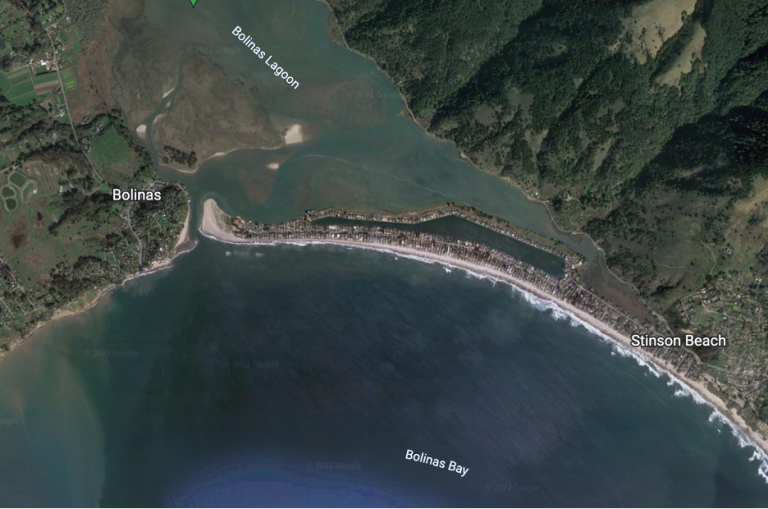
Seadrift Lagoon is a manmade seawater pond sandwiched between Bolinas Lagoon and Bolinas Bay. A little over a mile in length and 500 feet across at its widest point, the lagoon was built in the 1950s to support a gated vacation community. Green crab arrived in Seadrift lagoon in the early 1990s and quickly became abundant. (Click to Enlarge)
The response of green crab populations in this situation has been attributed to what’s called “the hydra effect” (note: scientists get a bad rap for being boring, but we do have a knack for naming things). The hydra effect (Thanks, Abrams and Matsuda!) occurs when a species increases in number despite a higher death rate. This counter-intuitive result is named for the Greek legend of the Lernaean Hydra, a monster known for growing two heads for each one a would-be hero might cut off. Hydra effects can occur for a variety of reasons but most commonly because a population is released from competition or predation. In Seadrift Lagoon, there are nearly no other species present capable of preying on green crabs. Therefore, large adult green crabs are the most abundant predator and competitor of other green crabs. Because of this dynamic, the eradication effort had the unintended consequence of decreasing cannibalism and competition within the species. Without many large, hungry green crabs gobbling up little green crabs, the new generation of little crabs survived better and “overcompensated” for the loss of the older generation. Obviously, this was not what Grosholz and colleagues had anticipated.
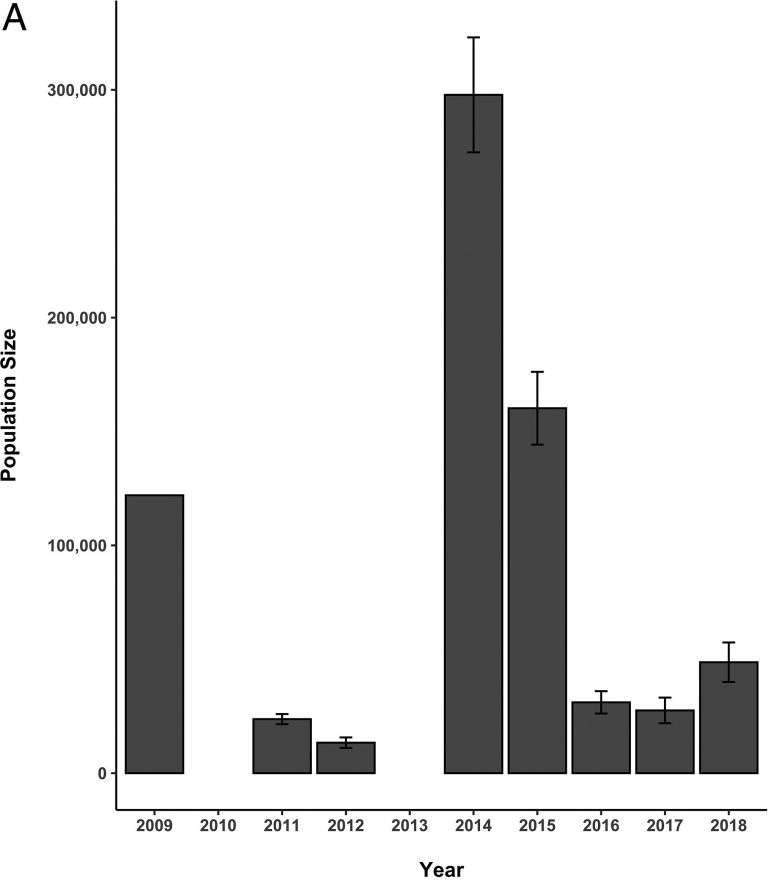
Figure 1A reproduced from Grosholz et al. 2021 showing the estimated population size of green crabs within Seadrift Lagoon from 2009-2018, as partial evidence of overcompensation occurring with the dramatic increase in 2014. Note that population estimates were not available for 2010 or 2013.
Making Sense of Overcompensation
The case of Seadrift Lagoon led to a lot of scientific soul-searching by the study authors and possibly the most provocative headline of them all… Are We Managing Invasive Species Wrong? This loaded question has had many folks involved with green crab wringing their hands. Before we chalk up the situation to the mythological power of the hydra or simply throw in the towel on controlling green crab altogether, there are a couple of important points to consider, particularly when drawing lessons to apply to Washington State and elsewhere – first, compensatory processes that contribute to the hydra effect aren’t the boogeyman, and second, context matters.
While overcompensation of the green crab population in Seadrift Lagoon was a surprise, it isn’t without precedent. Overcompensation has been observed in animals ranging from mosquitos to voles and smallmouth bass to Soay sheep. Moreover, compensatory processes in general are well-studied and important features of sustainable management of fished or hunted species. An underlying principle of sustainable management is that reproduction and survival are dependent on the size of a population. There are also limits on the size of a population based on available resources. Put simply, harvest (removal) is thought to pressure on and competition for limited resources, so that remaining individuals reproduce more and survive better than they would have if no harvest occurred. Bottom line: whether managers are trying to sustain or eradicate a population, understanding how compensatory processes operate is critical to success and achieving desired outcomes.
Will Washington Face a Hydra, Too?
Another point highlighted by the Seadrift Lagoon example – context matters. Unlike natural bays and estuaries along the Pacific coast that teem with predatory fish and crabs, Seadrift Lagoon is an isolated, artificial pond, where cannibalism and competition with other green crab likely have an outsized impact on dynamics of the green crab population. Added to this, limited exchange of water with the coastal ocean means that green crab larvae hatched within Seadrift Lagoon are likely retained and settle there. In this way, the lagoon is very close to a very large isolated experimental fish tank. In this unique situation, removing adult green crabs as part of the eradication effort had the unintended consequence of making life easier for their progeny. While this is certainly an interesting ecological phenomenon, we wouldn’t necessarily expect it to occur in other areas with more abundant and diverse native predators and competitors. We also wouldn’t expect it to occur (at least not so dramatically) if many or most of the larvae were expelled from the lagoon and dispersed more broadly along the coast. In fact, it may be reassuring that, here in Washington, in most locations where we have been working for several years to reduce green crab populations through trapping, like Dungeness Spit and Drayton Harbor, we have not encountered any evidence of overcompensation.
What Do We Learn from Seadrift?
So, perhaps, the most important lesson of the study by Grosholz and colleagues is the need for careful development of management plans that specifically consider green crab biology, ecosystem properties, and oceanographic processes. As study co-author and marine biologist with the Smithsonian Environmental Research Center, Greg Ruiz said, “instead of a one-size-fits-all approach, this study highlights the need to evaluate possible unintended consequences in selecting management strategies and tailoring these to the particular context and expected outcome.” Important factors, like native predator abundance and larval retention, which can set the stage for overcompensation, vary across Washington’s shorelines, and already we can see signs that these might be influencing whether or how quickly populations are growing at different sites. This likely means it will be necessary to develop separate management plans for Washington’s coast and inland waters, carefully honing the objectives of any management action based on characteristics of individual sites and water bodies. Management might even include consideration of alternative approaches, such as functional eradication, in places where green crabs cannot be completely eliminated. Moreover, special cases like the Lummi Sea Pond, which more closely resemble conditions in Seadrift Lagoon, might require a tailored approach with strategies and goals that are not as well suited to other locations. Far from being the catastrophe of mythological proportions portended by the hydra, the case study from Seadrift provides valuable insight into an edge case, understanding of which, though it may not be widespread, will undoubtedly enhance efforts to manage green crab in Washington waters and elsewhere.
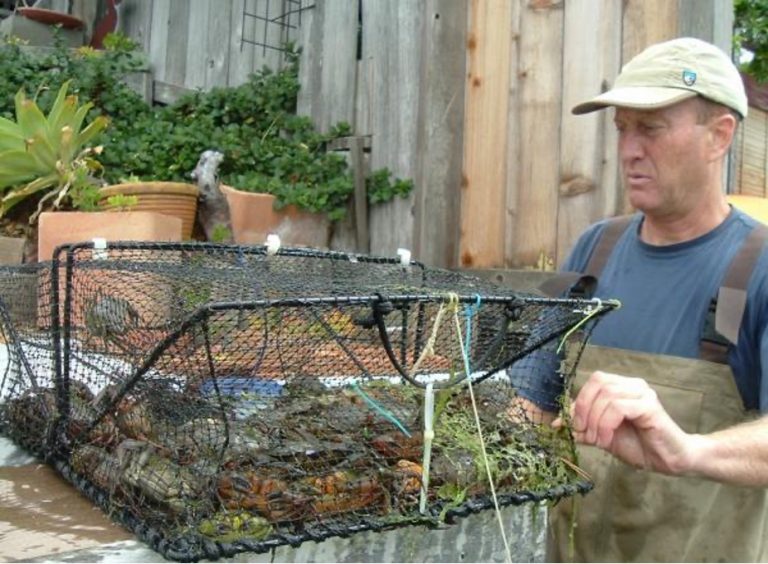
Ted Grosholz and colleagues tried to eliminate invasive green crab from Seadrift Lagoon, near Stinson Beach, California. Their study, published in the Proceedings of the National Academies of Science, describes how these efforts failed because of overcompensation of the population. Copyright UC Davis
-P. Sean McDonald
*While we try to link you directly to the research we reference, some of the studies cited in this article are not open access. If you have any questions about any of the works cited here, please feel free to reach out to crabteam@uw.edu.