
Diet DNA: What Are Green Crabs Eating?
It’s a beautiful, blue-sky day in Willapa Bay. The sunlight dances on Stackpole slough as a light breeze ruffles the surface of the water. We can still hear some birdsong from the woods along the shoreline. And I’m stuck in thick, gloopy mud up to my waist, trying not to sink any further as I helplessly wait for Crab Team program lead, Emily Grason, to dig me out.
I’ve worked in some of the muckiest reaches of the Chesapeake Bay, and nearly lost several boots to the mudflats of Puget Sound. But I have never become so stuck in the mud that I needed someone else to pull me out. Putting aside the embarrassment of doing so in front of Emily Grason, expert navigator of Crab Team’s muddiest trapping sites, I did feel like I had finally experienced a right of passage for any coastal scientist.
And, thankfully, my muddy misstep proved to be a small hiccup in an otherwise successful trip. The 178 European green crabs we trapped on that September day would join 186 others, collected earlier that summer, to help us answer the question: What are green crabs eating in Willapa Bay?
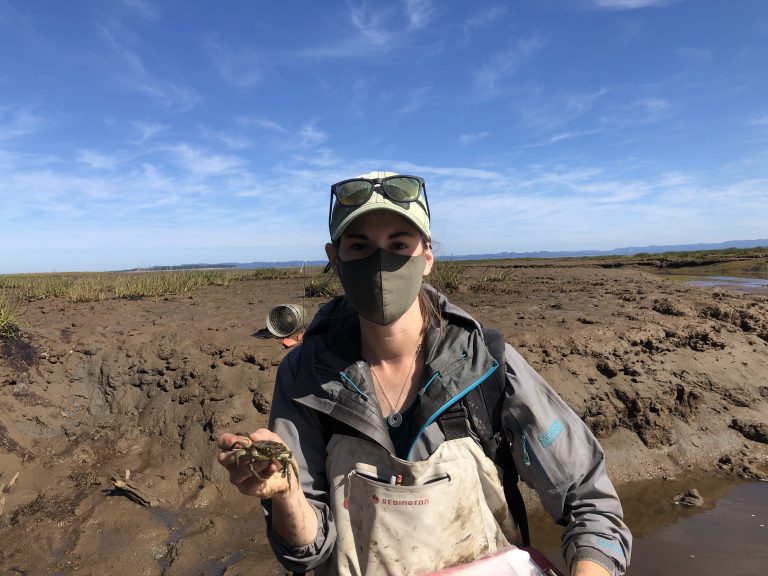
Mary Fisher with one of the study crabs at Stackpole slough, recovered from being stuck in the mud. (Photo: WSG/E. Grason)
The Hypothesis
Broad and adaptable eating habits help species like European green crab thrive outside of their native range. Studying the diets of green crabs where they are invasive can help us predict their impact on local ecosystems – including impacts to species that we eat, and which provide water filtration, and other benefits and services. Green crab populations in Willapa Bay have risen dramatically in recent years, with large numbers of green crabs observed on local shellfish beds. As a result, shellfish growers and resource managers are concerned that green crab predation on Manila clam (Ruditapes philippinarum) may be causing reductions in local harvest.
These observations led us to make the following predictions: (1) European green crabs trapped on actively farmed Manila clam beds will frequently have Manila clam in their stomachs; and (2) more green crabs trapped on clam beds will have Manila clam in their stomach contents than green crabs trapped on clam beds, at slough sites without aquaculture.
The Investigation: Using DNA to Find Out What Crabs Eat
A common method for studying the diet of aquatic species is to remove their stomach contents and visually identify food items. Depending on how recently a fish has eaten, their last meal can be pretty easy to figure out (you can even do it yourself using these stomach photos taken by NOAA Fisheries researchers!).
But as Crab Team co-lead Sean McDonald puts it, crabs are “self-contained blenders.” In addition to shredding their prey with their formidable claws, and mouthparts, crabs have a unique structure in their stomach, known as a gastric mill or ‘stomach teeth,’ that further grinds down whatever they just ate. If stomach-teeth sound like something out of a horror movie, they can be a nightmare — for scientists. When we open up a crab stomach, it looks a lot like a grainy smoothie. This makes it extremely difficult to identify food items, especially if we want to know that a shell fragment came from a Manila clam instead of a Pacific oyster, or any other bivalve.
Advances in genetic technology have made it possible to identify stomach contents without actually seeing intact food items. DNA-based diet analysis simultaneously identifies a range of food items in a crab’s stomach using the genetic material (DNA) that those items have left behind. This process, known as DNA metabarcoding, uses a short DNA sequence (a “barcode”) in much the same way a grocery store uses barcodes on cereal boxes; by “scanning” the DNA barcode with a DNA sequencing machine, and matching that barcode to an online database, we can match the DNA to the species that left it behind.
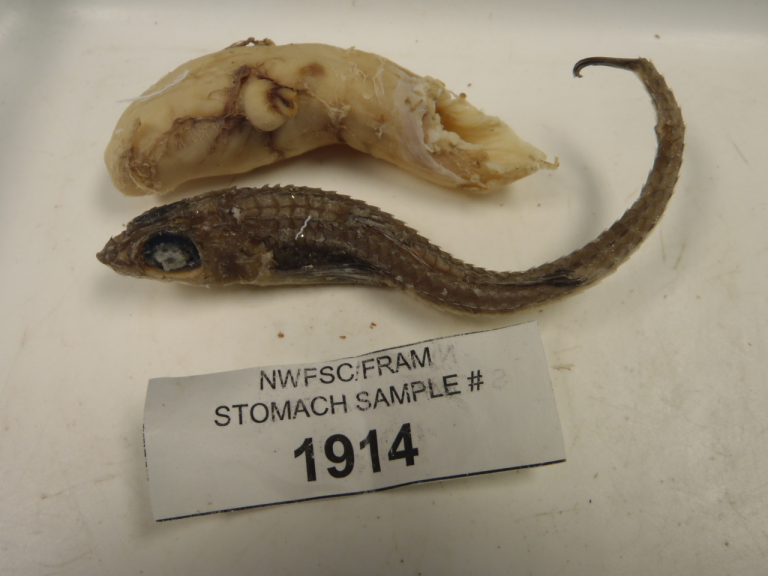
The contents of a Yelloweye rockfish stomach (a Bigeye Poacher fish). Photo: NOAA Fisheries
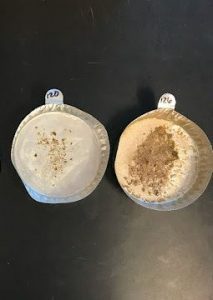
The dried contents of a European green crab stomach make it easy to see how hard identifying diets can be. Photo: Mary Fisher
Sounds pretty straightforward, right? Here’s the catch — the stomach is a very difficult place to get DNA from. It’s full of acids and digestive enzymes, which interfere with the chemical reactions we need to prepare DNA for the sequencing machine. And the physical and chemical breakdown of food items during digestion also breaks down DNA in the stomach, leaving behind low quality, too-short DNA fragments that we can’t analyze. Add in the fact that this technique has been applied to European green crab only once before*, under slightly different conditions, and we had to get a little creative.
To preserve the DNA in each crab’s stomach, Crab Team and partners hauled heavy packs of dry ice onto the Willapa Bay mudflats, freezing the trapped green crabs as quickly as possible. We carefully drew each crab’s stomach contents out through its mouth with a pipette – essentially, pumping the crab’s stomach – to avoid contaminating crab stomach samples with outside DNA. Finally, we used specialized lab protocols, which we optimized for our samples, to isolate food item DNA from interfering stomach acids and enzymes. Each of these methods were developed with the help of Argentinian and Canadian green crab researchers, and members of the UW-based Kelly Lab.
This all yielded small amounts of DNA, invisible to the naked eye, in a tube smaller than a pinkie finger. At this point, there still isn’t enough DNA for the sequencing machine; we need to make more of it using a “copy-and-paste” process called PCR, or polymerase chain reaction (yes, the same PCR for diagnosing COVID-19). After we’ve made enough copies of DNA, we can scan it with the sequencing machine and match the resulting data to an online database, which tells us which food items that DNA came from.
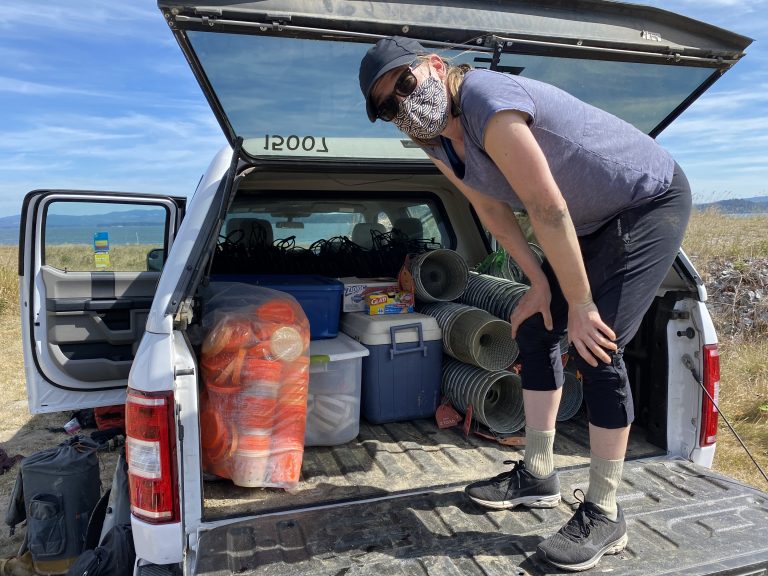
Emily Grason of Crab Team with the coolers of dry ice and other trapping gear. Photo: P. Sean McDonald
The Reveal: What Are Green Crabs Eating in Willapa Bay?
Getting results from DNA research can feel like turning the last page of a really good mystery novel, or being a kid on Christmas morning. It’s hard to capture the excitement and awe of opening that data file and finally finding out what was in each crab stomach, each tiny sample of invisible DNA. Especially after all of the delays and challenges associated with conducting this research in the middle of a global pandemic, including supply chain disruptions that left us scrambling for lab materials.
Another reason getting DNA data is like finishing a mystery novel – there is always a surprise reveal at the end. The big surprise in our data was that only one of the green crabs we studied showed evidence of consuming Manila clam, despite the fact that more than half of the crabs we analyzed were trapped directly on clam beds. This finding means it is unlikely that larger, male crabs consume a lot of Manila clams during the summer months, which was not what we had hypothesized. However, it does not rule out the possibility that green crabs rely more on Manila clam as food at other times of the year, or that smaller sized green crabs may consume smaller Manila clams.
Somewhat less of a surprise – green crabs had a wide diet, and we documented more than 50 unique items in the stomach contents of green crabs analyzed. What was at the top of the menu? Many of the green crabs we trapped had recently been munching on the native hairy shore crab Hemigrapsus oregonensis (12 crabs, or 18%), and the eastern soft-shell clam Mya arenaria (7 crabs). Negative impacts to these two species have been observed in other areas where green crabs are abundant (including California and Maine, respectively). Based on Crab Team trapping, we know that the native hairy shore crab is frequently found in the same places as green crabs, as is the sand shrimp Crangon franciscorum – which we found in the stomachs of 10 green crabs – and the Pacific staghorn sculpin, Leptocottus armatus – which we found in 7 green crabs. Interestingly, we also found that green crabs had recently consumed a variety of non-native species, including the invasive mud snail Batillaria attramentaria and several species of non-native amphipods.
For a more detailed accounting of these crabs’ stomach contents, check out the project summary or, if you’re a number cruncher, you can download the data table from our peer-reviewed paper.
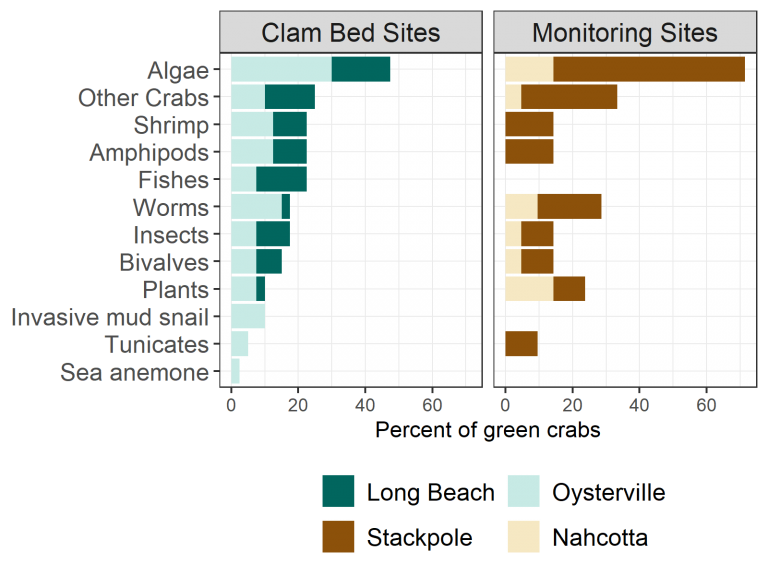
The top items on green crab menus depended on what site the crabs were trapped from. Algae was the top type of food overall, followed by other crabs – mostly native shore crabs. Click to enlarge.
Where Do We Go From Here?
Although our observations did not support our predictions, we did observe green crabs eating other ecologically important native species. For example, the sand shrimp C. franciscorum is an important food resource for Dungeness crab, sturgeon, and other fishes. Washington Sea Grant Crab Team and partners continue working hard to trap and remove green crabs throughout Willapa Bay. Crab Team researchers are also following up on the observations of hairy shore crab in quite a few of the crab stomachs. Former Crab Team postdoctoral fellow, Ben Rubinoff, conducted a field experiment and data explorations to see there is evidence that this predation could be leading to measurable impacts on the local populations of our hairy heroes (more to come!).
And for other researchers who want to keep exploring the possibility that green crabs are preying on Manila clams, we’ve extensively documented all of our methods and made our lab and analysis protocols publicly available online.
Green crab is particularly concerning as an invasive species due to its role as a flexible predator along marine shorelines. However, predicting the specific impacts of this predator in a new location can be really difficult at the early stages of invasion. It often takes time for populations of invasive predators to grow large enough to even cause a measurable impact in the populations of their prey species – much longer than we would want to wait to do something about it! These new methods offer managers a sensitive tool to get timely information on green crab diets, and enable us to be more forward looking at what changes might be coming to our shorelines if green crab populations continue to grow as they have over the last several years.
–Mary C. Fisher
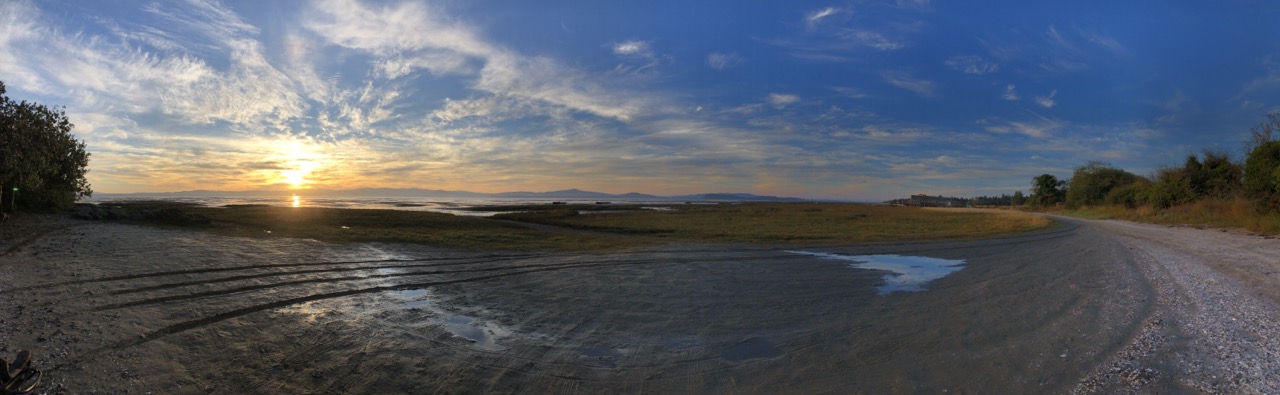
Header image: Sunrise in Oysterville, WA Photo: Emily Grason
*While we try to link you directly to the research we reference, some of the studies cited in this article are not open access. If you have any questions about any of the works cited here, please feel free to reach out to crabteam@uw.edu.