
Site Spotlight: Crandall Spit
Site: Crandall Spit (341)
Region: Fidalgo Bay
Launched: 2016
Site Captain: Sue Russell
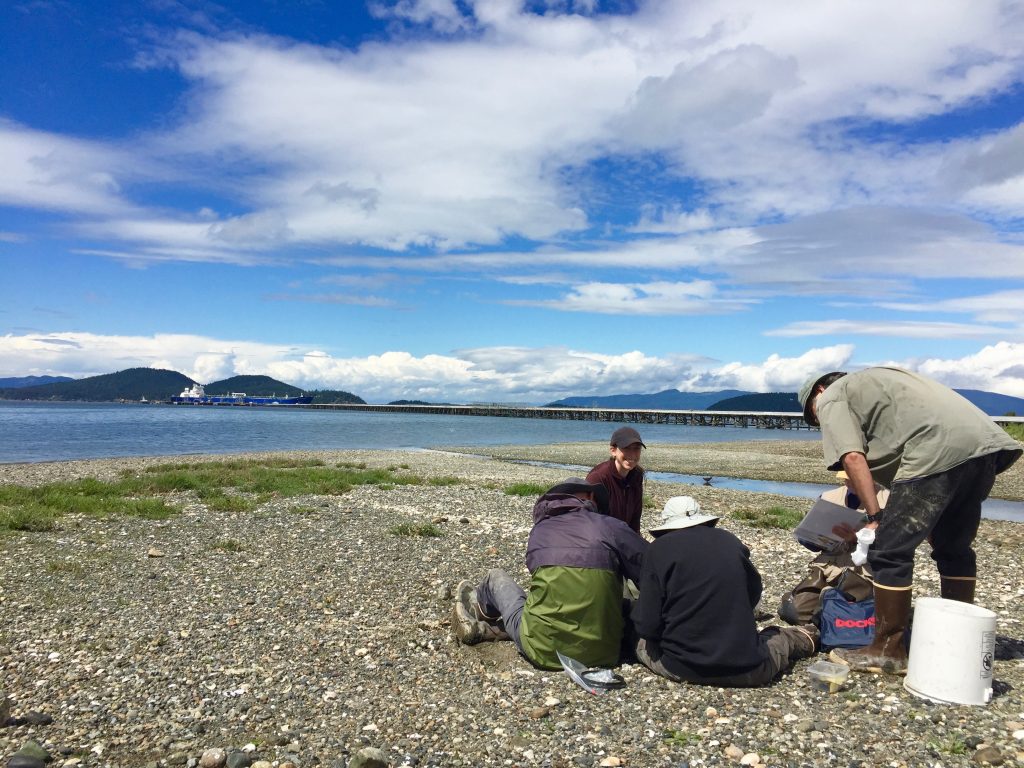
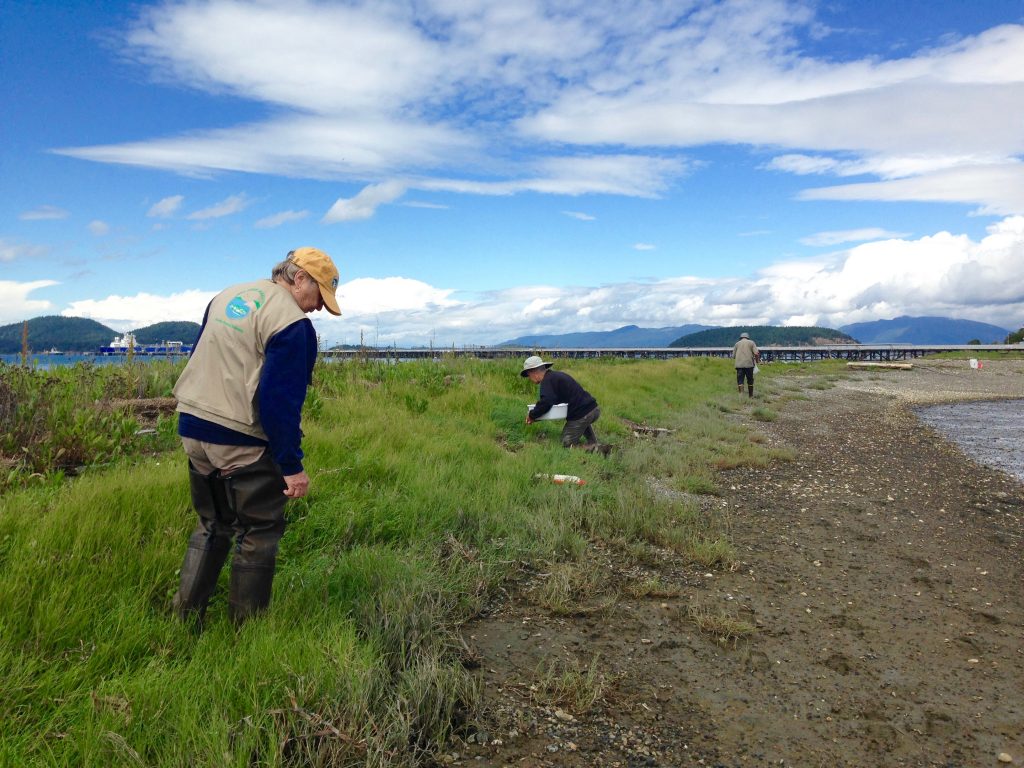
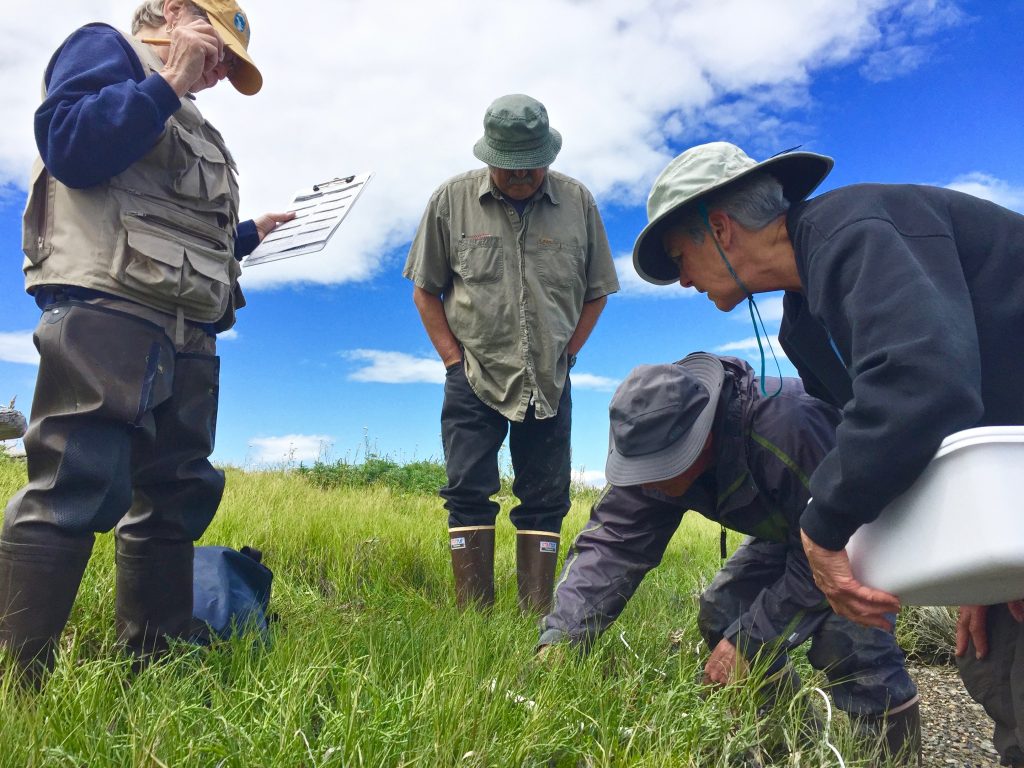
“I am certain that there’s a joke in here somewhere about getting ‘goose eggs’ during our molt hunt!” I had a chance to visit Crandall Spit in May to help the team of volunteers look for European green crab, but we got sidetracked by some decidedly non-crabby natural history – a couple of huge, white empty eggshells in the wrack line. I was up in Fidalgo Bay, near Anacortes, along with Crab Team program assistant, Kelly Martin, to work alongside Crab Team volunteers and keep abreast with the latest developments in the field. Getting us out of the office and into the mud on a gorgeous day didn’t hurt either!
According to the Crandall Crabbers, the eggshells we found that day might have come from a nesting pair of Canada geese that have been known to set up shop on the spit. Last year, the geese were a bit of an obstacle to sampling. Evidently one time, the path to the site led the team right up to their nest, and they were all chased off by the pair. “With water on one side and hip-deep mud on the other, we had no option but to try to sneak by while the geese were off their nest. We were just starting to congratulate ourselves on our success when the attack happened. With a lot of arm waving, coupled with a mad dash, we made it through the battle zone without any bloodshed. Needless to say we found an alternative route for next time,” recounts Pattie Hutchins.
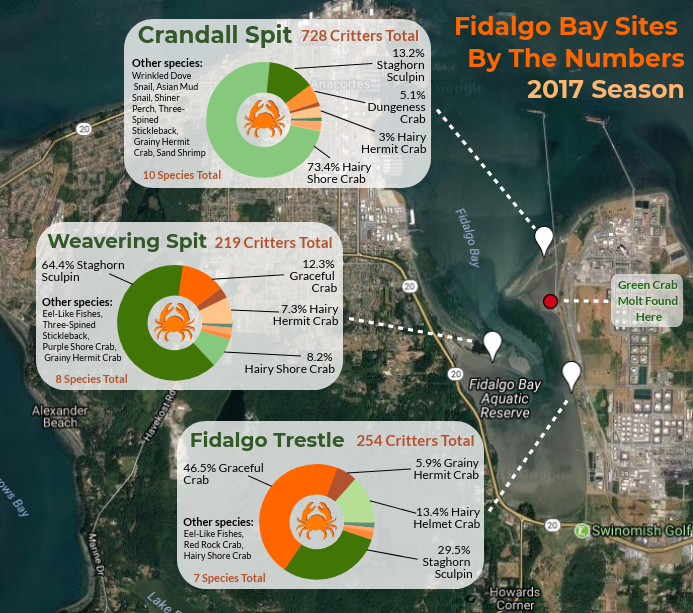
Map of Crab Team sites in Fidalgo Bay and the critters found in traps in 2017 at each site. Graphic: Kelly Martin. Click to enlarge.
Encounters like these also remind us that the salt marshes and pocket estuaries monitored for European green crab are not only important for marine critters like crabs and fish, but also for other wildlife, particularly migratory shorebirds (we also saw Caspian terns and oystercatchers that day, thankfully not protecting their nests).
Crandall Spit is one of three Crab Team monitoring sites in Fidalgo Bay (see map). You might have heard about Fidalgo Bay recently because a molt from a European green crab was found just south of Crandall Spit, leading to increased trapping activity in the area. Up to that point, no evidence of green crab had been detected in Fidalgo Bay, even though there are several sites in the area. Thankfully, additional exploratory trapping by Washington Department of Fish & Wildlife has failed to yield any further evidence of green crab in Fidalgo Bay.
It’s relatively uncommon to have multiple sites so close together in the Crab Team network of early detection sites. But the high site density in Skagit County occurs largely because of the intense concern focused on European green crab in Skagit County, following the detection of four crabs in adjacent Padilla Bay in 2016. Crandall Spit was launched as a Crab Team site in 2016, but the other two sites, Weavering Spit and Fidalgo Trestle, were launched in 2017. That year, the Skagit County Marine Resources Committee obtained a grant from the Northwest Straits Foundation to purchase monitoring equipment for participation in Crab Team early detection, enabling Crab Team to grow from 2 to 11 sites in Skagit County, and support monitoring in other MRC counties as well.
Even though the three monitoring sites in Fidalgo Bay are relatively close together, they are surprisingly different in what they catch in traps. Crandall Spit traps are dominated by hairy shore crab, while Weavering Spit catches more staghorn sculpin than anything else, and the Fidalgo Trestle site gets primarily graceful crab. These differences in the ecological communities among the three sites show us that even sites close to each other can be different because of small details about the habitat. Crandall Spit is more enclosed and protected than the other two sites, which might at least partly explain the relative success of hairy shore crab there.
We are fortunate to be able to include Crandall Spit in our network, not only because it is such a great monitoring site for early detection of green crab, but also because it is owned by Shell Oil, one of the two companies that own refineries on March’s Point, the peninsula that separates Fidalgo and Padilla Bays. Tom Flanagan, a volunteer Crandall Crabber, comments on how special the place is, “You just can’t wander out there if you feel like it. Access is tightly controlled, so in many ways it has a pristine character.” Shell has supported green crab monitoring in the area over the past several years, not only by helping volunteers access Crandall Spit, and other sites, but also helping fund green crab monitoring work in the region. “Although I have personal concerns about our society’s reliance on oil and the carbon footprint, I am grateful to Shell for participating in citizen science in this way. It reminded me that no issue is just black and white,” says Sue.
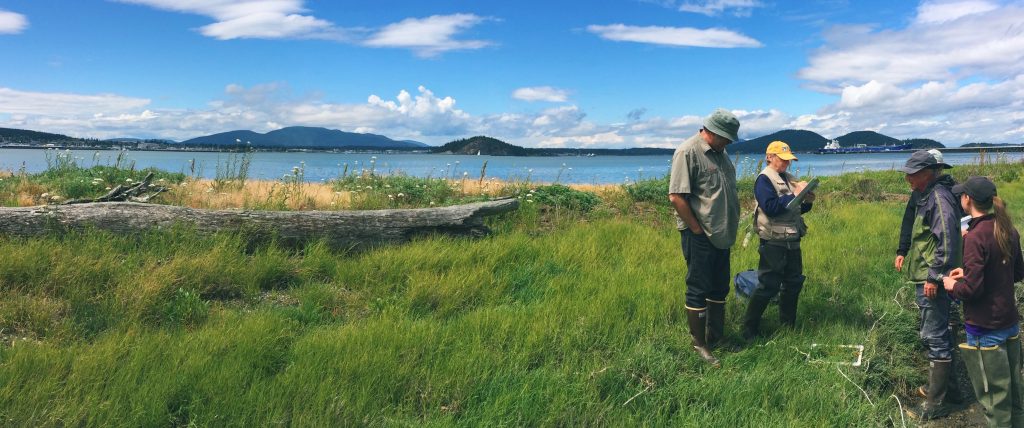
Crandall Spit volunteers L to R: Pattie Hutchins, Gordon Sjogren, Tom Flanagan, and Sue Russell. Photo: Kelly Martin
What are the Crandall Crabbers’ secrets to successful sampling? Sue says that it can work particularly well to balance variety with specialization. While everyone on the team has particular strengths, aptitudes, and interests, it can also keep things fresh to take turns at each of the tasks, rotating through each part of the protocols to experience the big picture.
Leadership and decisiveness are also assets to a fun experience. Team member Tom Flanagan says that Captain Sue, “is good at making sure that we all have a chance to do all the tasks that are required and that nobody gets put in a position that they find untenable. It makes the job both challenging and interesting.” One member of the team has turned out to be adept at adjudication of estimates for the transect survey. At each quadrat, says Sue, “he listens to the others banter back and forth about percent cover of this and that, then takes in the ‘big picture’ of the quadrat contents. If the rest of us don’t come to consensus on a certain observation, we look to him and he weighs in on the final decision.”
True to form, on the day that we visited Crandall Spit along with volunteers, Gordon, the adjudicator was able to keep us all on track – even when we were distracted by bird eggs or the beautiful views of Lummi and Guemes Islands to the north. As a closing thought, Sue wanted us to share how great it is to be a Crandall Crabber, “I love our team. Everyone is enthusiastic, responsible, and fun to be with. We joke and have some good laughs while we are doing our work.” Even though Crab Team sampling is mostly focused on crabs (and maybe sometimes fishes, shrimps, or even snails), it’s people that make it work.
-Emily Grason
Feature Photo: The Crandall Spit team working through the transect survey with Crab Team program manager, Emily Grason. Photo: Kelly Martin