


A male Dungeness crab (Metacarcinus magister) mid-molt. The shell of the crab can be seen splitting apart across the molt line on either side of the face. Photo Credit: H. Brown/WSG
April Showers Bring May… Molts?
While it might seem ages away right now, spring in Washington brings an increase in outdoor recreation, daylight, flowers, and … crab molts? Molts are the shells that crabs shed as they grow, and, when found on a beach, provide evidence that a crab was living nearby. In addition to trapping, documenting crab molts is another way to learn about the crab communities living in nearby marine waters. Molt Search is a Crab Team program Co-managed with partners at WSU Extension that surveys beaches for these cast-off carapaces. Molt Search was created to support early detection of invasive European green crab (Carcinus maenas). But did you know surveys could also contribute to management of native Dungeness crab (Metacarcinus magister)?
Molts are Data, Too!
How do crab shells become data? Like other crustaceans, crabs shed their shell each and every time they grow larger. The discarded shell is light, and gets carried by water up onto the beach. Molts can often be found piled up at the high water mark – the wrack line – and they are sometimes mistaken for dead crabs; but their presence provides evidence that a healthy population of growing crabs is, or was recently, living nearby. To take advantage of this record in the wrack, Crab Team launched Molt Search in 2023 as a complement to Crab Team’s flagship participatory science program, the monitoring network. In fact, the Molt Search protocol is nearly identical to the molt hunt survey conducted as part of monitoring network sampling. The added benefit of Molt Search is that surveys can be done by any trained person, at any time, and on any Washington shoreline to which they have safe, legal access. In this way, we are collectively able to gather data at a scale that would be an impossible feat for professional and monitoring trappers alone.
Molt Search has been growing as a community and as a dataset, with an increasing number of “super-searchers” and program trainers at partner groups, such as Friends of the San Juans, and Harbor WildWatch. In this way, Molt Search helps round out both ends of a trade-off in early detection of green crabs; as a way of searching, trapping is more “sensitive” for green crabs, but is labor-intensive. Though less sensitive, the wide accessibility of looking for shells on beaches means that Molt Search can cover more geography, and involve more participants, and through more surveys, can help fill gaps in our knowledge of how green crabs are spreading.
Already, Molt Search participants have helped identify new detection sites for green crab managers by finding the first evidence of green crab presence in several new locations, including Orcas Island and Skagit Bay. Any Molt Search survey that includes a suspected European green crab is flagged for immediate review and, if verified, reported to Washington Department of Fish and Wildlife (WDFW). Finding a green crab molt in an area without any previous live captures of the invasive crab alerts partners to a need for more trapping to determine whether live green crabs are present. Finding green crabs when they remain at low densities gives managers the best opportunity to effectively control their numbers, so this is especially important in Puget Sound, where European green crabs are continuing to expand their range.

An invasive European green crab (Carcinus maenas) found during a Molt Search in Bellingham in the summer of 2026. The carapace (back) and body of the green crab are circled. Photo Credit: E. Grason/WSG
Dungeness Crabs and Their Elusive Juvenile Stage
Crab Team focuses on invasive European green crab as part of the core mission, but also tries to learn as much as possible from the search efforts of all participants. For this reason, Molt Search protocols not only ask specifically about green crabs, but also document observations of native Dungeness crabs, which searchers are far more likely to encounter at this stage of the green crab invasion. This data isn’t just for kicks, it actually has the potential to help managers better protect the population as a whole by filling a key data-gap in tracking Dungeness populations.
Despite the importance of Dungeness crabs to the culture and economy in Washington, there is surprisingly little known about the population at the juvenile and subadult stages – what geographies and habitats they frequent, and how their survival changes over time. Because the Washington Dungeness crab fishery is co-managed by Treaty Tribes and WDFW, researchers and managers from both groups have been able to take complementary as well as collaborative approaches to understanding populations. Both groups collect data on the larval and adult life stages, but the “gap years” that pass between have remained a “black box”. On the early side of the life of a Dungeness crab, The Pacific Northwest Crab Research Group (PCRG) uses light traps to document the abundance and distribution of Dungeness crab larvae at their megalopal stage. Adult populations of Dungeness crabs are assessed from recreational, commercial, and Tribal trapping information as well as fishery-independent survey efforts by co-managers. Neither of these methods captures juvenile or subadult crabs, leaving a hole in the current population tracking.
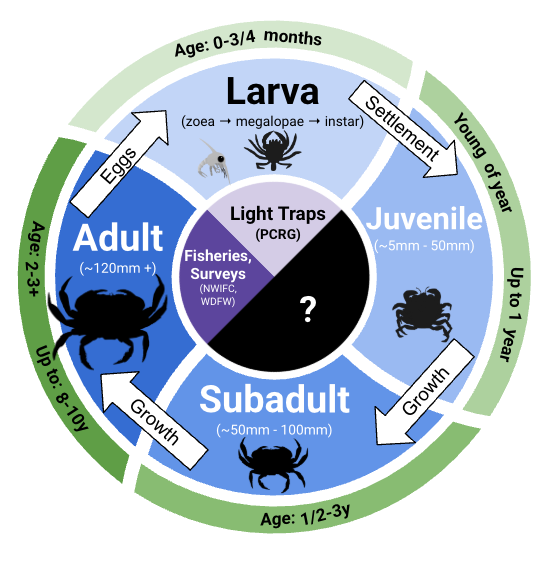
Life cycle and data sources of the Dungeness crab populations. The blue circle shows the life stages and size, the green circle indicates how long each phase lasts, and the purple circle shows the observation methods and sources of data at each life stage.
Recording Dungeness crabs in Molt Search surveys was built into the protocols from the start, but inspired by research efforts of the Swinomish Indian Tribal Community. To track teenage crabs, biologists with Swinomish borrowed the molt hunt protocol from the Crab Team monitoring network surveys, and added a component to measure any Dungeness crab shells that are found as a part of the search. This adapted protocol made its way back to Crab Team a couple years later when the Molt Search program was launching, and now Molt Searchers help managers learn about Dungeness crabs as well as green crabs. Currently, Molt Search is one of the only methods by which data on the juvenile years are gathered regionally, starting to complete the “missing link” of the Dungeness crab life cycle in Washington. Understanding how these stages are connected and the use of habitats for each stage is useful for management of this important fishery. If we learn what geographies and habitats juveniles are using, as well as when they are making use of them, managers might ensure those areas are protected. Supporting Dungeness crabs through all life stages could increase the number of crabs that reach harvestable size.

Management regions defined by Hannah Brown’s investigation into Dungeness crab patterns observed in Molt Search, adapted from the WDFW Puget Sound crab management regions.
First, however, researchers want to understand how observing molts might or might not provide a lens to track populations of the live crabs themselves. While light traps and crab pots capture live individuals, molts are one observational step removed. Because they can be carried away from the crabs that shed them, and degrade over time, molts are slightly offset, in space and time, from the crabs themselves. Hannah Brown explored this question in her recent thesis at the University of Washington School of Marine and Environmental Affairs in partnership with Crab Team. Brown created a mathematical model that compared the relative abundance of larvae (from the light trapping data) with relative abundance of molts (from the Molt Search data), observing their relationships across space and time. Results showed that, within Puget Sound, abundance of both Dungeness crab molts and larvae is variable between different regions (see below).
Overall, both larvae and molts were scarce in South Sound and southern Hood Canal. In addition, regions that observed more Dungeness crab larvae, also generally found more molts on their shorelines, which is one indication that molts could be a good proxy for populations of crabs. However, the correlation between larvae and molts wasn’t a straight line, but a saturating curve, meaning that even as greater numbers of larvae are found within a region, the number of molts for that same region gets closer to maxing out. This match wasn’t perfect, either. One region in which the larvae and molt abundance showed more of a mismatch than other regions was in northern Hood Canal (5-N). Based on the mathematical model, there were fewer molts than expected based on the abundance of larvae. Brown has a few ideas of what might have caused this region to be an outlier, including a potential lack of suitable habitat in the region for juveniles and/or the recent increase in larvae in this region that hasn’t yet shown up as molts on the beach (stay tuned!).

Correlation between Dungeness crab larvae (April 2022 - September 2025) and molt abundance (April 2023 - April 2026) for each Puget Sound Crab Management Region.
While connecting larvae and molts of juvenile and adult Dungeness crab is a great first step to fill in the missing link of the life cycle, an additional step is needed to understand how the abundance and distribution of molts reflects the abundance and distribution of the live crabs themselves. The Crab Team monitoring network, which uses different trapping gear than commercial or test fisheries, captures a wide range of sizes of Dungeness crabs – from 17 to 162mm. These two datasets could work well in tandem to both validate molts as a window into the missing link the data life cycle, and to answer questions about timing and distribution of this species.

A Dungeness crab molt among algae-covered rocks in the intertidal zone. Photo Credit: J. Adams/WSG
Get Searching!
There are a few months to go before we expect the spring rains of molts, but searches provide information all year round. Most Molt Searches occur during spring and summer months when the weather is most conducive to searching. Many crab species molt during warmer weather, and so searchers are more likely to find green crabs, and observe Dungeness crabs. Crabs do still molt during winter, however, and surveys during this time of year can help shed light on molting seasonality for multiple native species and potential molting variation due to El Niño. For those who don’t mind the rain, a winter Molt Search could be just the thing to beat the winter blues. While surveys can be conducted on any beach you have access to, they can be particularly helpful in remote areas that are less commonly frequented by beachgoers, such as the Strait of Juan de Fuca. For early detection of green crabs, parts of the Salish Sea where green crabs remain rare or undetected are most helpful to guiding management activity, such as central and south Puget Sound and Hood Canal. You can scan shorelines for where surveys have been done on the MyCoast website.
All ages, all backgrounds, and all experience levels are welcome to join in gathering data on crab molts in Washington state. Anyone interested in contributing to this effort just needs to attend free training (most are in late spring), grab a timer, and head out for some productive beachcombing. For more detail, check out the Molt Search program page and For current Crab Team network monitors, a kick start guide is now available. Happy searching!
–Hannah Brown