
Vectors and Pathways
Before an invasive species becomes invasive, it first starts out minding its own business in the homeland, gets shuffled by humans to a new part of the world, catches its breath, meets others of its species who were shuffled along with it and realizes, “This is the promised land!” A few generations later… and, voila! You have a burgeoning invasion. This might be a simplification, but one of the key steps where we can create roadblocks or even prevent invasions is the vector (transportation mechanism) by which we as humans move species – intentionally or accidentally.
Around the World in Many Ways
Each species, based on its habitat, life cycle, and biology, has different vectors that are the most important to its transports, and green crab is no exception. A good summary of the different ways European green crab could be moved around the planet by humans can be found in Australia’s national Rapid Response plan for the species.
While there are a number of ways green crabs could spread, by far, the most important vector for moving marine species around the world has been ship ballast. When ships are carrying a much lighter load than they are designed for, they typically need to take on some kind of “dead weight” to remain stable for open ocean voyages. The ballast gets offloaded at the destination port, when the ship takes on the goods or payload it needs to move that can be loaded to balance the ship. Different ballast techniques have been important through history, and they continue to pose a potential threat to moving green crab, even in Washington.
Solid Ballast: For as long as humans have sailed long open water voyages, we have used the materials closest to hand when embarking on a voyage – rocks and sand from the shoreline. These had to be manually loaded into and unloaded from holds. Depending on their source and storage, natural solid ballast could come pre-outfitted with anything else living on the shoreline, seaweeds, barnacles, bivalves, worms, and anything living on these organisms. Often the ballast on a ship was stored at the lowest part of the ship, often wet and dark, enabling critters in the ballast to survive long voyages wet and cool. Thus, solid ballast, when off loaded at a distant destination port, could easily release all of these organisms into a new port of call.
Ballast Water: By the 1880s most ships were using tanks pumped full of seawater at the departure port as ballast, because it was much easier to load and unload than solid ballast. Ballast water tanks are not a luxury way to cross an ocean, but many very small organisms can make the journey, getting picked up as plankton in the home port and surviving the trans-ocean voyage to arrive at a destination unknown when the water is again pumped out at the next port.
Pathways: Solid ballast was the most likely vector for moving green crabs to the east coast of North America, where they were documented by 1817. But green crabs have been moved to multiple geographies across the planet, but what about the species’ other invasion pathways (the geographical journey they took to a new invasive range)? The first detection of green crabs in Australia occurred around 1890, meaning ballast water was a possible vector at that time. From Australia to Argentina, green crabs once again hitched a ride in a ballast tank, arriving on the eastern coast of South America from Australia by 2000 (Trovant et al. in preprint). Interestingly, genetic evidence further suggests that there might have been a second introduction to Argentina directly from the native range. Similarly, in South Africa, green crabs are believed to have been introduced to busy ports like Cape Town harbor multiple times.
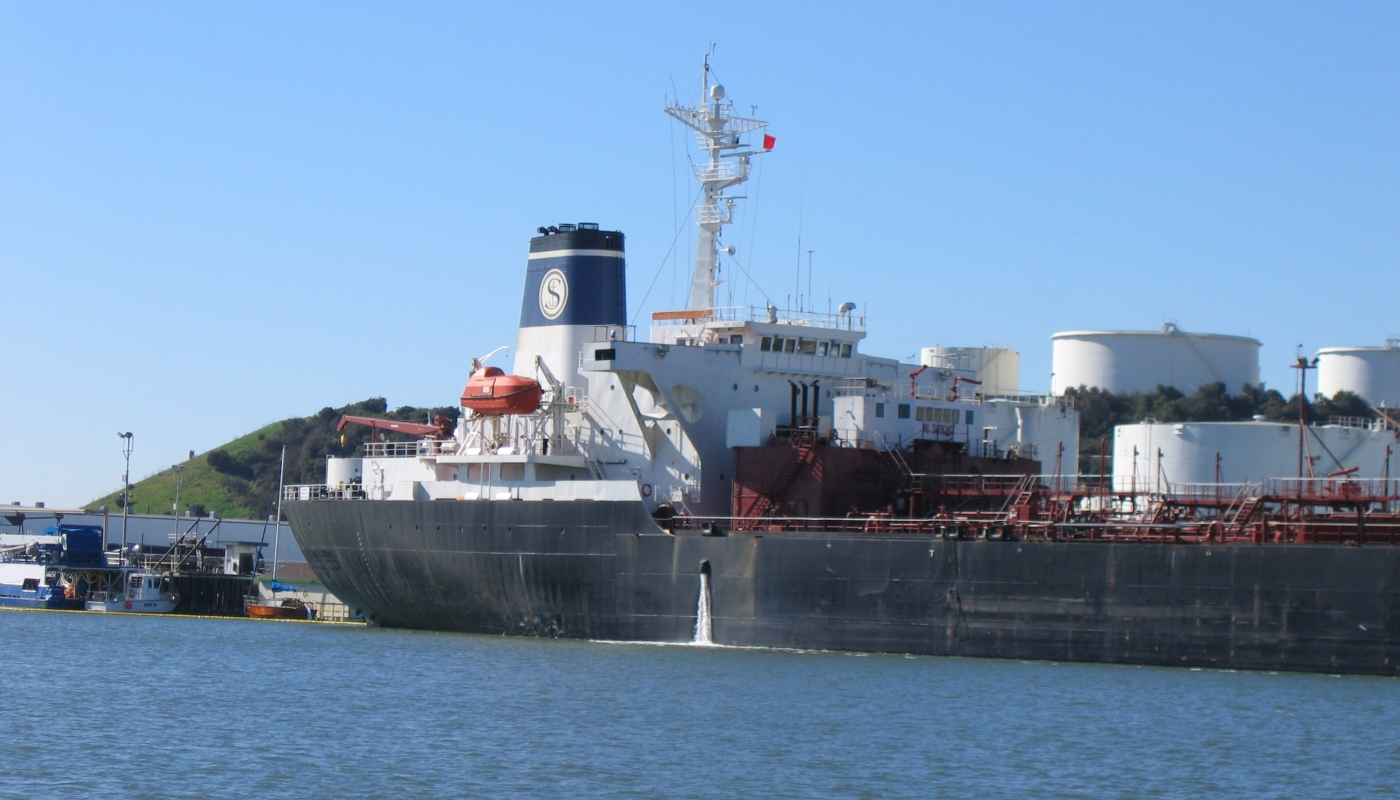
Ballast water discharging from a ship in San Francisco Bay. Photo Credit: M. Noble/Smithsonian Environmental Research Center
What About Washington?
Of course, ballast isn’t the only vector important for the spread of green crab. The species likely first arrived on the U.S. West Coast through repeated shipments of live baitworms and lobsters from New England packed in seaweed, especially Ascophyllum nodosum (Carlton et al. 2003). This seaweed was inexpensive, helped keep shipments alive during transport, and also happened to provide ideal shelter for juvenile crabs. Researchers repeatedly documented young green crabs hitchhiking in these shipments over the years, and genetic evidence later confirmed that the original San Francisco Bay population came from the northwestern Atlantic. Once packing materials were discarded into coastal waterways, green crabs had an opportunity to establish in a new environment.
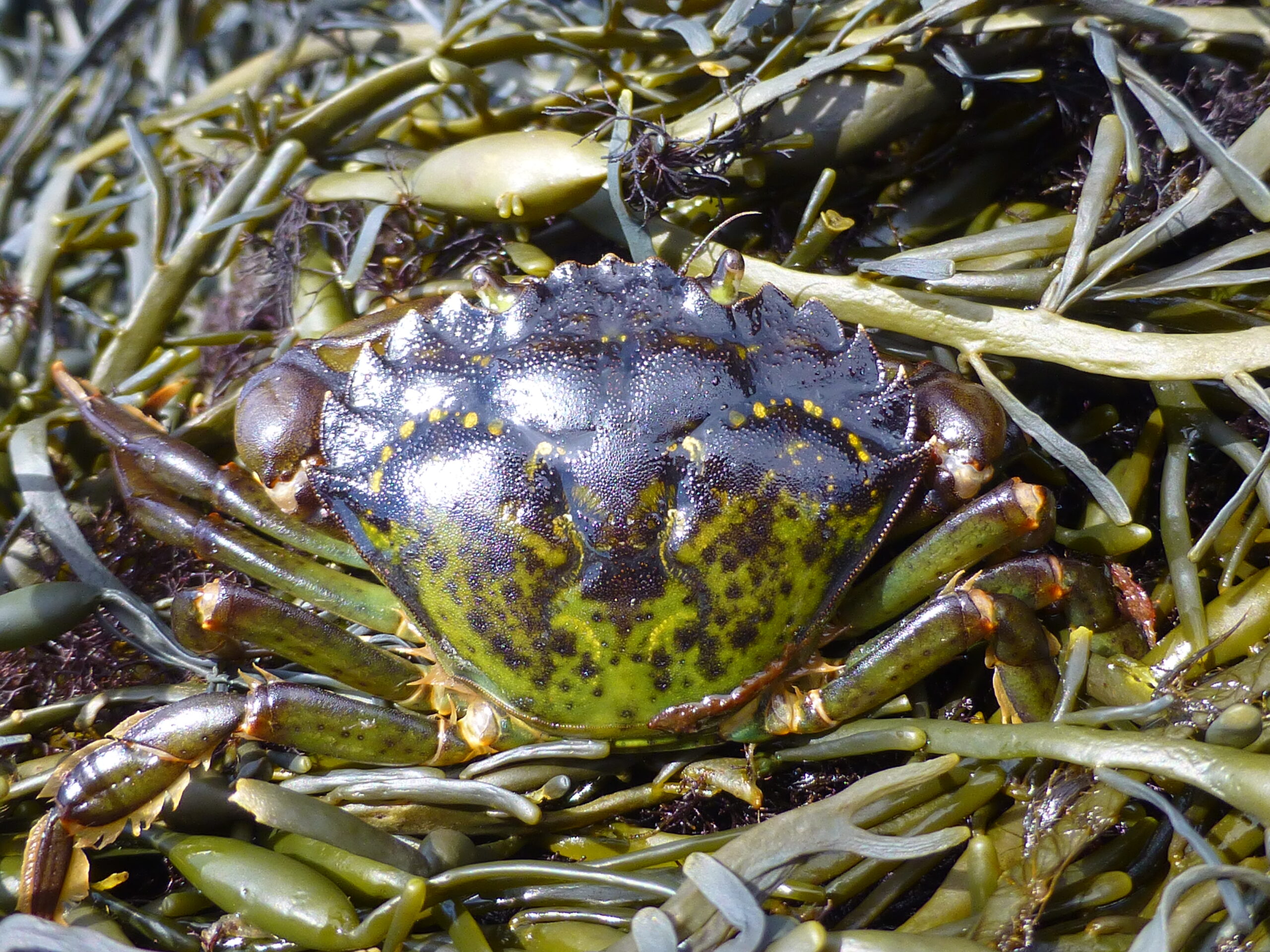
A European green crab resting on the Ascophyllum nodosum seaweed species. Photo Credit: E. Grason/WSG
After establishing in San Francisco Bay in the late 1980s, green crabs spread primarily through natural larval dispersal, with ocean currents carrying larvae northward along the Pacific Coast, and eventually as far as southeast Alaska. Still, natural barriers initially slowed invasion into some regions, including the Salish Sea, where predominant surface flow out of the Strait of Juan de Fuca created an obstacle. Sadly, here again human activity accelerated spread when green crabs were accidentally introduced to Sooke Basin on southern Vancouver Island, likely through shipments of bagged mussels used for biotoxin monitoring. Mussels, like the seaweed Ascophyllum, provide ideal shelter for juvenile crabs. Once those juvenile crabs reached maturity and reproduced, Sooke’s enclosed geography helped retain larvae and rapidly grow a local population, creating a major stepping stone for further spread into the Salish Sea.
Closing the Barn Door, Even if the Horse is Already Loose
Even though green crab is already in Washington, there are two reasons why preventing further introductions of green crabs from outside the West Coast continues to be important. First, there are still areas in Washington to which green crabs have not yet spread. The goal is to protect these locations by reducing the rate at which green crabs expand their range to include these sites and grow their populations to impact them. Currently, managers do this by trying to remove as many green crabs as possible from nearby sites, creating a bit of a “buffer.” An accidental transport of green crabs over this buffer could quickly undo the efforts aimed at slowing the rate of arrival and spread.
The second reason is that further introductions can bring new genetic resources to Washington’s invasive population. Currently, the genetic evidence indicates that all green crabs on the West Coast came from a single introduction event from the US East Coast, meaning that all of the green crabs are descended from a limited number of individuals that arrived in San Francisco Bay. This green crab lineage can be further traced back to the southern portion of the native range. But a cautionary tale from the east coast of North America underscores how additional genetic diversity can exacerbate an invasion. The initial invasion of green crabs on the East Coast ranged from New Jersey to Maine for most of the 20th century and originally was from the southern genetic lineage, and the northward progression seemed to stall out. Green crabs have wide environmental tolerances that enable them to survive conditions that many native species cannot – foundational to their success as a global invader. But it seemed the crab population that was invasive on the East Coast was unable to tolerate colder waters and continue north.
Then, in the 1980s the population in Nova Scotia suddenly experienced dramatic growth and expansion. Several years later, a new population was found in Newfoundland well beyond the northernmost range extent for the species. Genetic research ultimately confirmed that these changes in the invasion were the result of separate, relatively recent, introductions from the northern part of the native range (Roman 2006, Blakeslee 2010). Among other differences, these more recently-introduced genetic lineages are more cold-tolerant than the southern lineage that previously made up the East Coast population. Over subsequent decades, these northern lineage green crabs have spread south from the Canadian Maritimes, and met up and mixed with the crabs from the original invaders (Lehnert et al. 2018). What’s more, in the areas where the genetics of the two lineages are mixing, green crab populations appear to be even more robust and damaging than they were prior to the arrival of the new genes. In this way, we are managing not just invasion by a species, but by genetic resources.
What can we do now?
Regardless of the reason for continued prevention, either of these two scenarios would have the effect of accelerating the invasion, thus spreading limited resources for management thinner and thinner. The more we can slow the progress of the invasion, the more cost-effective management efforts can be both in the short and long term.
For these reasons, managers continue to work to prevent the introduction of green crabs from outside Washington, outside the West Coast, and even from invaded to uninvaded sites within the state. How is that done?
- Regulation of ballast water treatment and discharge.
- Requiring permits to relocate any species or physical structures into or within state waters. This largely affects the work of shellfish growers, but has more recently been considered in terms of dredge spoils.
- Prohibiting the importation and sale of green crabs for consumption – preventing accidental release.
- Requiring careful handling and disposal of any green crabs moved within the state, e.g. for research.
- Outreach and education to homeowners and boat owners, providing guidance on best practices to avoid accidentally moving green crabs with boats or shellfish.
There are even more benefits to preventing further introductions that protect local species. One stroke of good luck/bad luck that the West Coast had when green crab was introduced is that it appears the species did not bring any of its diseases or parasites along for the ride. While this has the unfortunate effect of releasing green crab from a measure of population control that these “natural” enemies would exert, it also reduced the chance that one of these enemies could harm populations of native species. For instance, a species of parasitic barnacle found in the green crab’s native range does a better job of killing native Dungeness and shore crabs than green crabs (read about it in a previous newsletter article). So far, that barnacle is not found in the West Coast, but further introductions of green crabs from regions where the parasite is found could endanger native crab species.
Understanding the risks and pinch points of different vectors helps us best direct resources to effectively reduce the chance of introduction. The benefits can extend beyond a single species, because managing the vectors for one species can also create barriers for other potential introductions. These are wise investments when we consider that the cost of managing an invasion skyrockets once you get past prevention.
-Emily Grason and P. Sean McDonald