
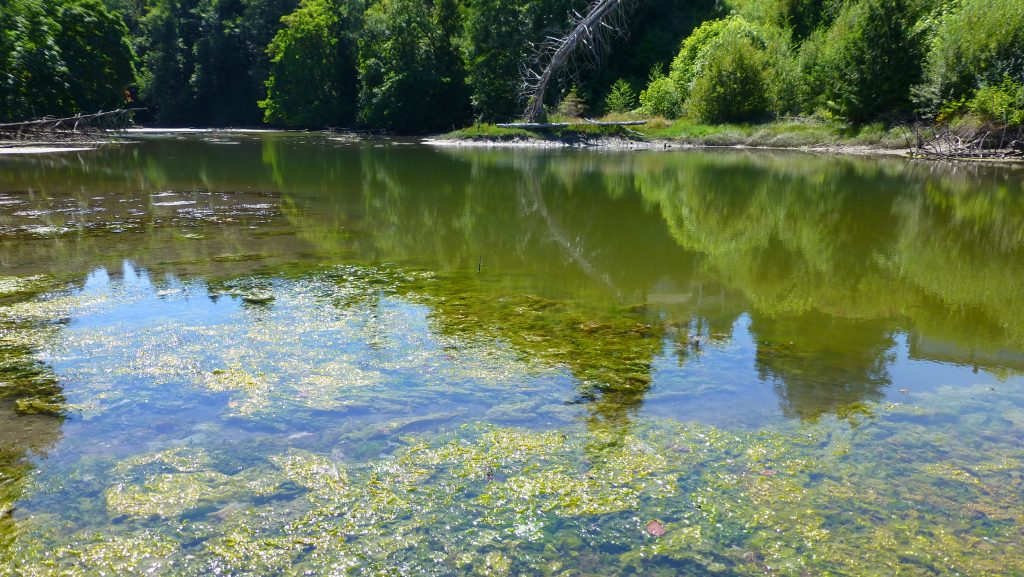
A river-otters eye view of the tranquil, reflective waters of Butterball cove.
With such an adorable site name, it was perhaps no surprise that we got to see a couple of playful river otters scamper across the berm at Butterball Cove on the first day of sampling last year. It was a great way to christen the launch of monitoring at this picturesque and tranquil lagoon deep in South Sound, not too far west of the Nisqually reach. Butterball Cove is a lagoon surrounded on two sides by steep hills, and cut off from the main part of the Nisqually Reach by a high berm, complete with an old hunting shack.
We were introduced to the site by Caitlyn and Wendy, from the South Sound Estuarine Association, and it wasn’t just the picturesque setting that suggested it would be a good monitoring site. As soon as we set foot in the lagoon, dozens of small native hairy shore crabs (Hemigrapsus oregonensis) scattered. Shore crabs are a good indicator that a site could be a good habitat for green crabs. European green crabs are actually also called “shore crabs” in the native range because they live fairly high on the beach, compared to larger types of crabs. Our shore crabs have similar habitat preferences to European green crabs, and are therefore a good indicator that the water is salty and cool enough, and that the area is protected from the larger crab species that would eat green crabs.
We also learned about the site from Anne Mills, who runs the citizen science program survey of Pigeon Guillemot (PG) breeding populations. Anne pointed out PG burrows high in the steep bluffs on the south side of the cove. The otters we saw were no strangers to science in their cove, Butterball has been a key site for PG monitoring as part of the Nisqually Reach Aquatic Reserve, and volunteers watch parents come and go, bringing fish to the burrow to rear their chicks.
Butterball Cove is a great example of how partnering with local organizations has helped us find great monitoring sites. Anne connected us with Gail, who lives at the top of the hill, and who helped us get permission from the neighbors to sample at this property. We always try to work with our site neighbors to make sure we don’t disturb their enjoyment of special places like this. We also hope that they will keep their eyes peeled for green crabs, because while our sampling takes place 6 times per year – they are there all year long, and can be a powerful early detection squad when they know what to look for.
Gail not only helped us communicate with neighbors, but also threw herself into the project as a volunteer! She was joined at Team Butterball by Caitlin from SSEA and Raquel Crosier, who is a specialist in invasive species, formerly coordinating the Washington Invasive Species Council (WISC), which you might be familiar with because it is the central location for reporting invasive species in Washington (check our their app, too!).
Raquel, Gail, and Caitlyn make a great team, currently our southernmost site. You might be wondering why were are interested in a site so far from the potential source population in Sooke Inlet, BC. It’s true that we might not expect Butterball Cove to be the first place that green crabs show up in Puget Sound. The first answer to this is that this project is not only a green crab monitoring project but a pocket estuary project. We don’t know a lot about how these isolated habitats are being affected by all of the changes faced by the marine environment; ocean acidification, shoreline development, pollution, sea level rise, plastics, etc. This project will provide long term data that can help answer that question. In addition, if green crabs do arrive along inland Washington shorelines, we want to use our observations to learn about how green crabs are affecting habitats. The only way to know that is to compare sites with green crabs to sites that have never had green crabs at them, to see if they experience different changes over time that we can attribute to green crabs.
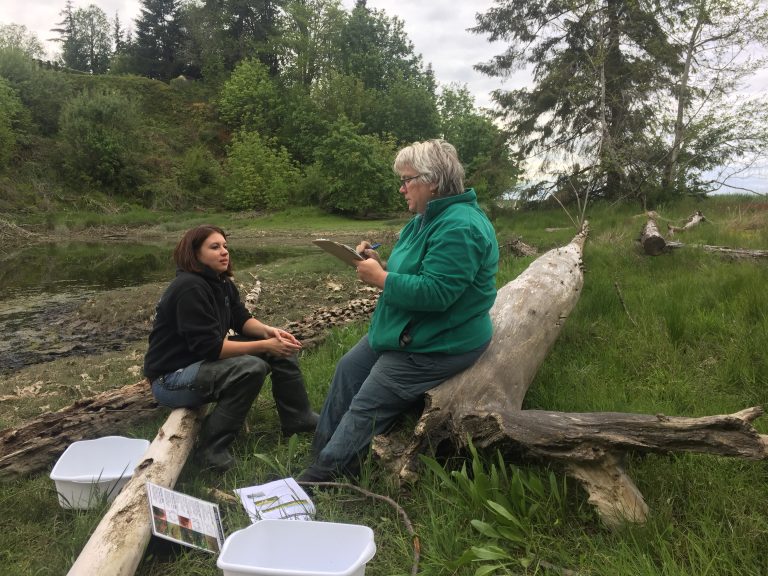
Caitlin and Gail at Butterball Cove
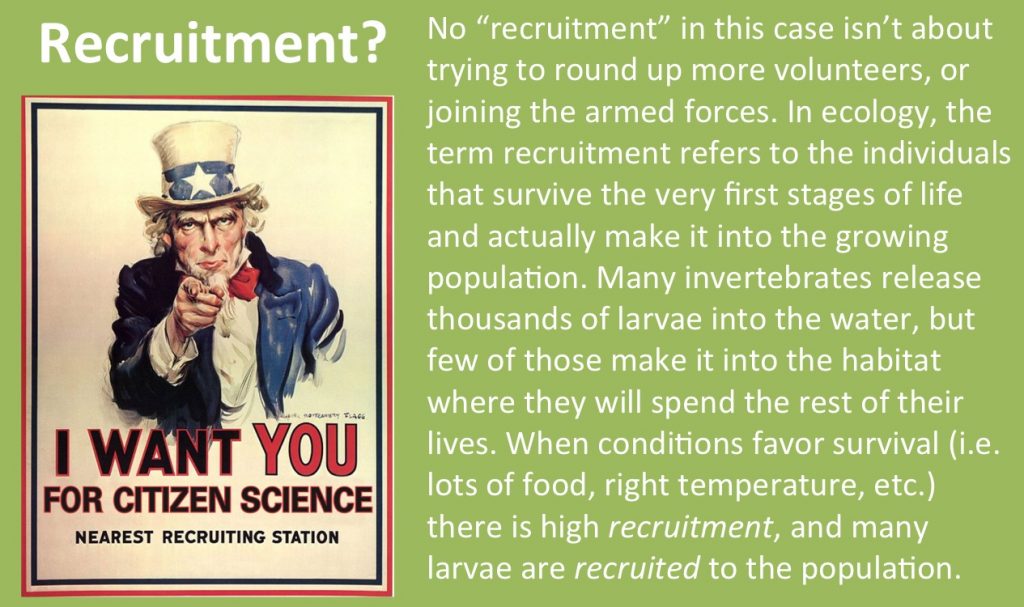
Lastly, though it seems unlikely, it’s entirely possible that green crabs could arrive everywhere in Puget Sound at one time. If green crabs have a very good recruitment year (see inset), we will only be able to tell how far they have gone into Puget Sound if we have sites looking everywhere. South Sound is a key part of that puzzle.
We hope to add more sites in South Sound as we continue to grow the program and for the time being, we are glad to have the team at Butterball as our Southern Sentinels.