
Green crabs: In hot water – and loving it!
When they are young, green crabs, a bit like toddlers, can be very picky about their surroundings and their schedule, and you can just imagine the temper tantrums! Green crabs hatch out of eggs, and emerge into the world looking very different from their final form. When they are part of the plankton, young zoea can swim a bit, but are mostly at the mercy of the tides and currents, so they don’t have much control over their experience. This is also the stage at which they can be moved around the coastlines, and transported to new ranges. Green crabs arrived in the PNW this way in the late 1990’s, swept all they way up from central California.
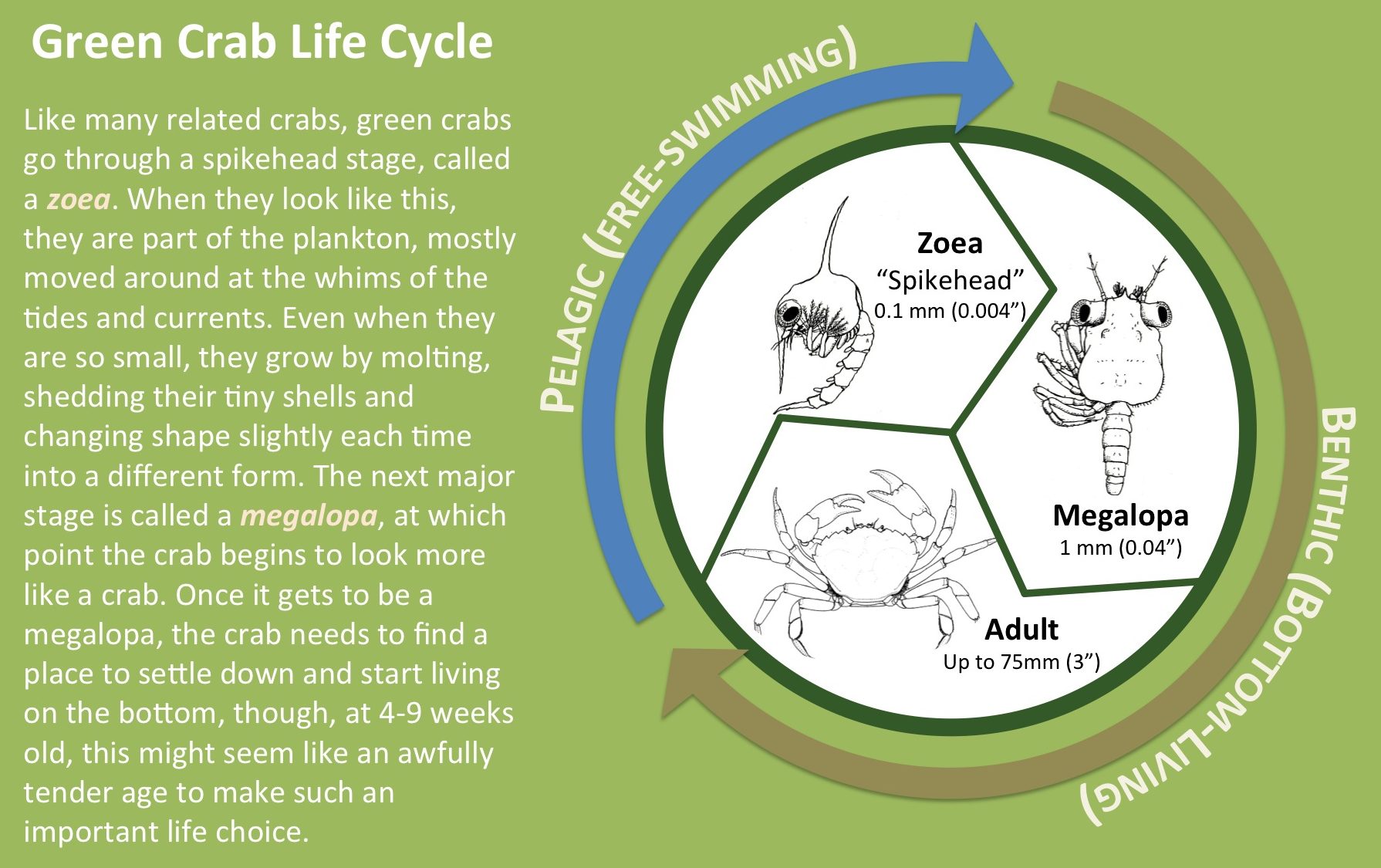
Green crab life cycle. Line drawings of zoea and megalopa by Auguste Le Roux (Own work) after Rice and Ingle 1975.
When they got to the PNW, green crabs survived and grew to maturity in the coastal embayments of Oregon and Washington (Coos Bay, Willapa Bay, etc.), but didn’t seem to be able to reproduce successfully. So, their numbers declined over the next several years. However, every few years since then, there seems to be a bump in recruitment. Researchers have been conducting ongoing tapping, to track the populations of green crab in these embayments, and noticed good years for baby green crabs in 2003, 2005, 2006, and 2010. Why those years? Were those green crab larvae coming from the local population? Or also part of a wave of California crabs swept north?
Recent research by scientists at Oregon State University and NOAA has looked at what is going on in the ocean during those years to try to understand what conditions create the Goldilocks “just right” for green crabs. It turns out the key factors appear to be warm sea surface temperatures, particularly those associated with the El Nino Southern Oscillation – ENSO, and warm trends in the Pacific Decadal Oscillation – PDO). These climate factors change the ocean to make it favorable for green crab larvae to get moved hundreds of miles up the coast, and arrive in time to settle in the coastal embayments that provide them with good habitat. In particular, green crabs like:
- Warm winter sea surface temperatures above 10 C (50 F). Warm water means the larvae can grow and develop more quickly.
- Northward currents that push the larvae toward good habitats.
- Nearshore water circulation that keeps the larvae from being carried out to sea.
On off years, the cold water means green crab grow very slowly or not at all. Even worse – for the green crabs, that is – the circulation pushes green crabs out to sea, where they won’t be able to survive when they have to transition into the bottom-dwelling megalopa stage.
This tells us that the most likely cause of those peaks in recruitment in, for instance, Willapa Bay, is the transport of larvae from California populations, which remain abundant, rather than larvae produced by a small number of crabs surviving in PNW bays.
Something different appears to be going on with established populations of green crab on the outer coast of Vancouver Island. In places like Barkley Sound, green crabs continue to become increasingly abundant, which suggests that those populations are reproducing successfully within the deep fjords. It’s possible that circulation patterns in coastal fjords keep the green crabs from washing out to sea more than those along the Oregon and Washington coastal embayments.
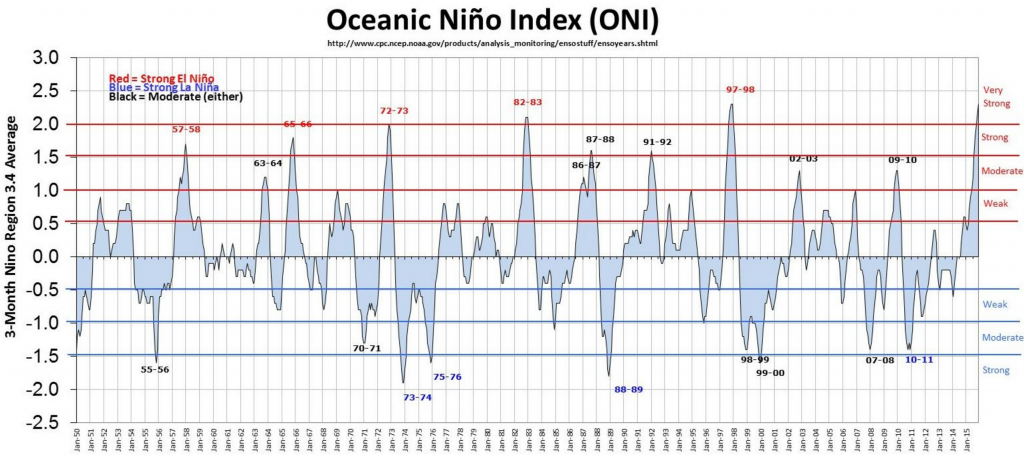
Oceanic Nino Index (ONI) a measure of the strength of ENSO trends. Data from NOAA plotted by Paul Huttner at MPR News.
What does this mean for inland Washington waters? It’s difficult to tell. This year is the strongest ENSO since the 1997-1998 event that originally moved green crabs north, which would predict a bumper crop of larvae. That could mean there is a greater chance of larvae getting further into the Salish Sea, either coming up the coast, or coming from the much closer population established in Sooke Inlet, just west of Victoria. So, if ever there was a time to make sure we have traps in the water, and people combing the shorelines looking for molts – that time is now. Even if green crabs do survive in our inland Washington pocket estuaries, will they be able to successfully reproduce and establish self-sustaining (or even booming) populations? Or will they gradually die off?
We still have a lot to learn about green crabs, and close monitoring of our shorelines is essential to determining what the long term status and effects of green crabs along inland shorelines will be.