
Creature Feature:
Burrowing Shrimps
Species Name: Multiple species of Thalassinidea
Size: Varies by species, but can be up to 6″ (150mm)
Distinguishing Features: “Lobster-like” shrimp – dorso-ventrally flattened with large abdomen and broad tail fan. Hairy walking legs, often a pale white, pink, or gray. More pronounced claws than “true shrimp”, may be uneven in size.
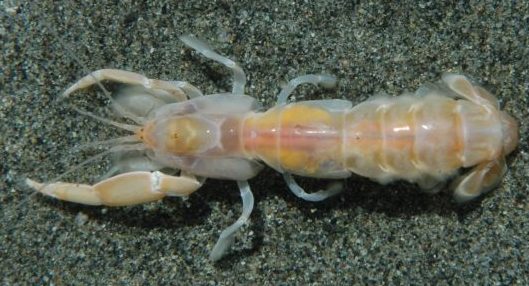
The bay ghost shrimp, Neotrypaea californiensis, has one claw much bigger than the other. Photo: Dave Cowles at Rosario.wallawalla.edu
Kings of the Mud: The Salish Sea’s Burrowing Shrimps
Ever find that weird molt that’s not very crab-like but odd for a shrimp? Have you kicked up a creepy, soft, yellow/orange critter while slogging through the mud? Have you suddenly sunk to your knees in what looked like a relatively firm (albeit holey) beach? You’ve probably seen volcano-like mounds on the beach, or you may have thrown a yabby on a fishhook. Welcome to the Salish Sea underground, home to a trio of unusual, ecologically important, economically complex, otherwise cool crustaceans – the bay ghost shrimp Neotrypaea californiensis, its less common close cousin the giant ghost shrimp N. gigas and the blue mud shrimp Upogebia pugettensis.
Ghost and mud shrimp are collectively called burrowing shrimp because of their remarkable adaptations to living in the relative safety of the seafloor. They can burrow arm’s length into the substrate, rivaling the great geoduck for digging deep. Unlike the geoduck, these busy burrowers are constantly moving mud, water and themselves, creating a very active environment that aerates the substrate, enhances nitrogen fixation and provides habitat for other organisms. If you’re looking to put your weight on the beach surface, however, such Swiss cheesing of the seafloor can definitely change the stability under pressure.
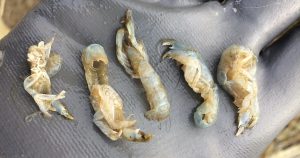
Molts from U. pugettensis, showing how it got its common name – the blue mud shrimp. Unlike N. californiensis, the claws are similar in size and look more like those of a praying mantis than a crab. Photo: J. Adams
Happy Homemakers
At the beach surface, mud shrimp leave little more than holes to hint at their subsurface accommodations, while ghost shrimp at least give us a distinctive volcano to appreciate. The burrows below the surface are different as well, with mud shrimp creating a U or Y shaped tunnel nearly up to a meter long, while ghost shrimp build a bit more of a catacomb about half as deep but up to a meter wide (watch ghost shrimp excavation in action!). In both cases, a pair of holes at the surface help with water movement through the tunnels. They filter detritus, small bits of organic matter, and diatoms – tiny algae in glass houses – as they work their tunnels and move water through. The organics sustain them, though their guts are largely filled with sand.
Only the right substrate will do for burrowing shrimp: too hard makes burrowing difficult and detritus harder to sift from the sediment; too soft and the walls come crumblin’ down. The sweet spot is a little different for ghost and mud shrimp species. Even though they can overlap, ghost shrimp tend to live in sandy substrate with a bit of mud, while mud shrimp like their lair to be a bit more compact and muddy. Consequently, ghost shrimp also tend to live a bit higher on the beach while mud shrimp can enjoy the mudflat.
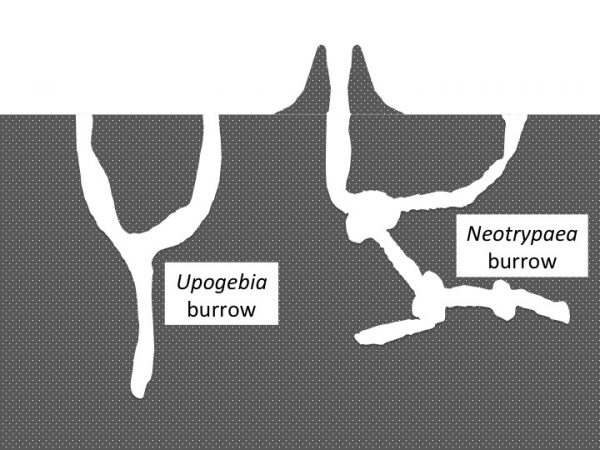
Upogebia typically has a simple Y or U-shaped burrow, while Neotrypaea has a more complex branching shape, extending horizontally, with “turn-around” chambers. Diagram after Swinbanks & Luternauer 1987*
Hotel Californiensis
Burrowing shrimp do all this work for their own benefit, but they also make very good landlords in a crowded market. By engineering livable below-ground space, burrowing shrimp create habitats for critters that otherwise couldn’t survive very well. Tenants from several branches of the tree of life take protection in burrowing shrimp tunnels – a remarkable example of how biology can find creative solutions to surviving in a bug eat bug world. A sort of wormy creature, called a phoronid, incorporates its tubes along the mucus-lined sides of mud shrimp burrow. The mud shrimp can still move easily up and down the burrows while the worm gets a safe seat and a regular supply of soup à la Salish Sea. A small goby fish will use burrowing shrimp burrows, as will a scale worm (a relatively short, armor-plated worm), a pea crab, a close cousin called the hooded shrimp, and a clam species that lives in the mud at the edges of the burrows. The clam (Cryptomya californica) would normally need to have its body near the sediment surface, so its short siphons could reach water, but close proximity to the sediment surface also makes them more readily available to predators. By living on the edge of the burrowing shrimp burrow, the clam can stick its short siphons through the burrow walls and pump water for its nutrition and oxygen needs while the shrimp keeps water moving in the burrow. Others simply uses the burrowing shrimp itself as a substrate…
Hotel Californiensis
Burrowing shrimp do all this work for their own benefit, but they also make very good landlords in a crowded market. By engineering livable below-ground space, burrowing shrimp create habitats for critters that otherwise couldn’t survive very well. Tenants from several branches of the tree of life take protection in burrowing shrimp tunnels – a remarkable example of how biology can find creative solutions to surviving in a bug eat bug world. A sort of wormy creature, called a phoronid, incorporates its tubes along the mucus-lined sides of mud shrimp burrow. The mud shrimp can still move easily up and down the burrows while the worm gets a safe seat and a regular supply of soup à la Salish Sea. A small goby fish will use burrowing shrimp burrows, as will a scale worm (a relatively short, armor-plated worm), a pea crab, a close cousin called the hooded shrimp, and a clam species that lives in the mud at the edges of the burrows. The clam (Cryptomya californica) would normally need to have its body near the sediment surface, so its short siphons could reach water, but close proximity to the sediment surface also makes them more readily available to predators. By living on the edge of the burrowing shrimp burrow, the clam can stick its short siphons through the burrow walls and pump water for its nutrition and oxygen needs while the shrimp keeps water moving in the burrow. Others simply uses the burrowing shrimp itself as a substrate…
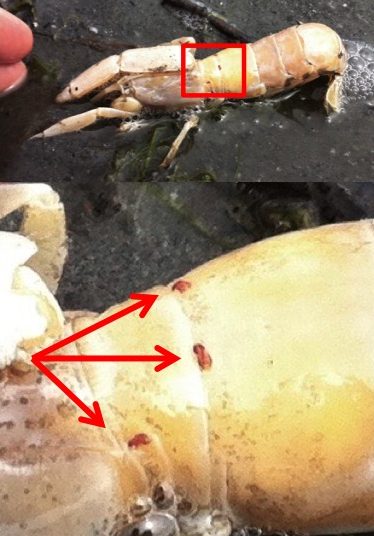
Commensal copepods appear as small red dots on the shell of N. californiensis. Photo: J. Adams
Food for Giants
Even though burrowing shrimp can rule over their tide flat for a decade or more, their burrows don’t ensure safety. Once in awhile, the emperor visits to clean house. Gray whales scoop impressive pits along the shoreline sifting out burrowing shrimp by the millions. In an assessment of gray whale burrowing shrimp harvest, Washington Department of Natural Resources scientists estimated about 10 gray whales consumed about 124,000,000 burrowing shrimp during their 2015 visit to the Whidbey Basin. Whales aren’t their only predator though. Burrowing shrimp made up ⅓ of the diet of staghorn sculpin (Leptocottus armatus, #2 on the all-time Crab Team leaderboard) in a Grays Harbor study. They are an important food source for white and green sturgeon too, with the bellies of young green sturgeon from Willapa Bay containing about 50% ghost shrimp biomass. Cage out these predators and burrowing shrimp can thrive. On top of being eaten, healthy eelgrass beds have been shown to limit the success of burrowing shrimp, making it difficult for them to dig tunnels among the roots.
Controversial Crustaceans
Burrowing shrimp are currently as mired in controversy as they are in the mud. As they riddle and soften the sea floor, heavy clams and oysters sitting on or near the surface may sink or be buried under ghost shrimp’s large mounds. It’s suspected that numbers and local distribution of burrowing shrimp have taken advantage of an ecosystem out of whack and expanded in Washington’s outer coast estuaries, creating significant conflict with shellfish production and a decades-old battle to keep the shrimp ‘at bay’ in aquaculture areas. The controversy has erupted recently as Washington’s shellfish aquaculture industry transitions from an older control measure and seeks another way to keep their clams and oysters from sinking (link). At the same time, burrowing shrimp have been harvested and sold as prized fishing bait. In 2015, approximately 4,000,000 burrowing shrimp were harvested by commercial and tribal operations in the Whidbey Basin. Love ‘em, hate ‘em or a little of both, burrowing shrimp are as interesting and influential as they are unusual.
–Jeff Adams
*We try to connect you with the research our information is based on. We apologize, however, that some articles require a subscription to access.