
Site Spotlight: Deer Lagoon
Site: Deer Lagoon (306)
Region: Whidbey Island
Captain: Tom Vos
Launched: August 2015
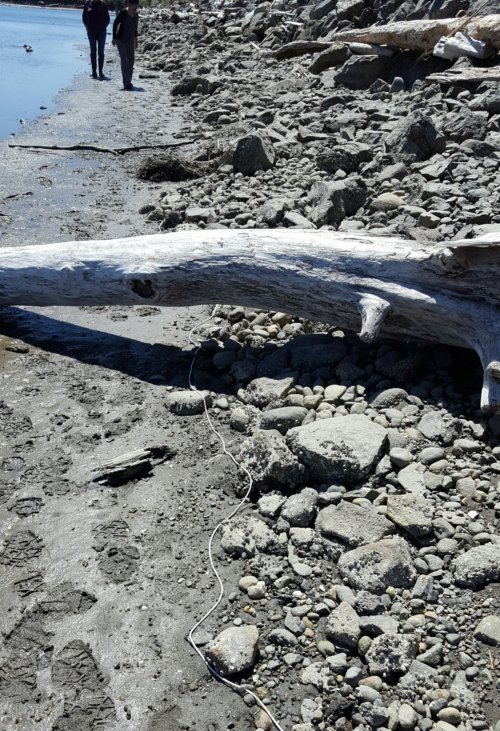
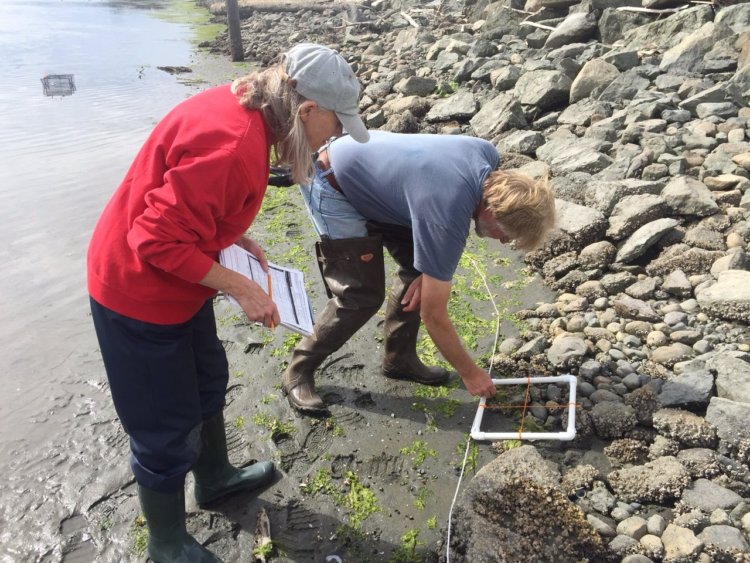
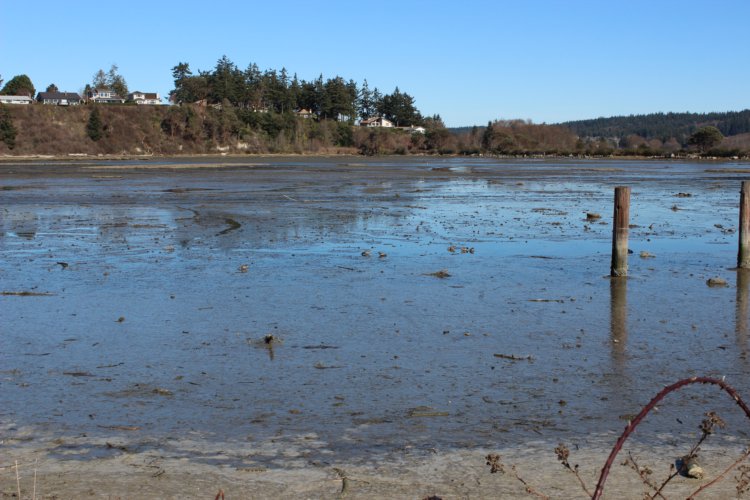
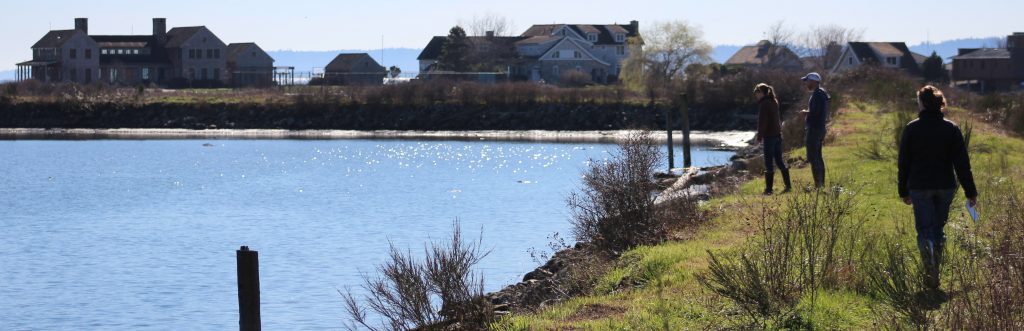
Crab Team was excited to scout Deer Lagoon, one of the first habitats we found that was a promising sampling site. Photo: Jeff Adams.
Nimble fingers are important tools on any Crab Team sampling crew, especially useful for outmaneuvering feisty shore crabs, but at sites like Deer Lagoon, they are essential. Wendy Visconty recounts the dilemma of how to best handle these deceptively strong pinchers: “Wow can those little crabby Hemigrapsus oregonensis and Hemigrapsus nudus bite! Some say – ‘Wear gloves to protect your hands!’ Some say ‘No, gloves just give them something to hang onto.’ What to do?”
On the north end of Useless Bay, on southern Whidbey Island, Deer Lagoon is among the top three Crab Team sites for the total number of critters captured in each trap. Unsurprisingly, the majority is hairy shore crabs (H. oregonensis, HEOR); an average trap (minnow or Fukui) from Deer Lagoon captures more than 125 of that species alone! Captain Tom Vos, who joined Crab Team in 2015 as part of a group of our anchor volunteers from Sound Water Stewards, says that division of labor and specialization can help the work go smoothly: “We have worked out a well-oiled machine when it comes to handling and counting the hundreds of crabs we pull in every time. Everyone seems to have a task in the process that they prefer and we huddle around the tubs in the mud…measuring, counting, recording, dumping….”
The size of Deer Lagoon, at roughly 85 acres, might offer part of the reason it’s such a great spot for pocket estuary critters, but at one time, it was much larger. The current extent of the lagoon is skirted by diking and rip rap revetments on the east and west. At low tide, nearly the entire lagoon becomes tideflat, with water remaining in only a few channels, all of which makes for extremely good shorebird foraging. The area offers one of the best birding spots on the island, with a dense assemblage of good habitats for feeding, nesting, and hiding. The birds are a draw for the Crab Team volunteers as well, who can sharpen their birding-by-ear skills while counting crabs: “Several of the team are also Audubon members and as we are hunched over our tubs/tasks, some bird would chirp, tweet, or whatever and without looking up they would say, ‘Oh, a Wilson’s Warbler’,” says Tom. The group also spotted some rare visitors this summer. In the words of Melissa Lebo, “While counting tiny crabs and searching for hair on legs or not, we were treated to a large number of white pelicans, unusual in this lagoon, and magnificent in their numbers. “
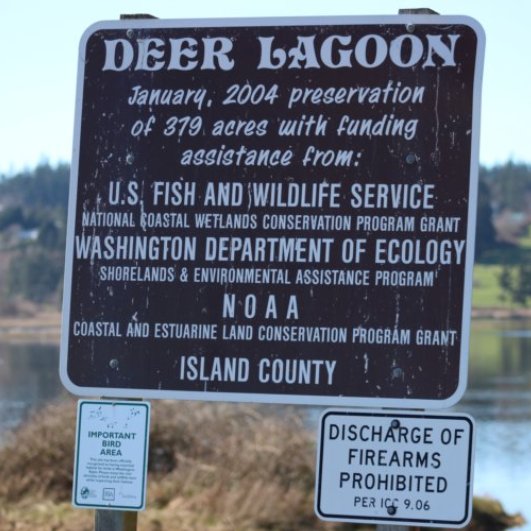
Deer Lagoon is a great site for birding as well as Crab Team sampling. If you don’t believe the words on the sign, the coating of bird droppings should convince you! Photo: Jeff Adams.
Deer Lagoon is a habitat that is both dramatically altered and influenced by humans, and rich with wildlife, which makes it an excellent place to look for European green crab. Among the list of Crab Team sites, it is somewhat distinct in that the main upper-intertidal habitat is riprap rather than marsh vegetation. While green crab, similar to the abundant native hairy shore crab, burrow into muddy banks, they can also hide among stacks of boulders shoring up the dykes. The riprap and armoring at Deer Lagoon also offers a firm place to cling for many marine invertebrates, such as barnacles and limpets, which aren’t otherwise able to survive in low-energy, muddy places. That makes the habitat transect survey at Deer Lagoon a bit different, in that the substrate can be covered with animals rather than plants. In fact, Deer Lagoon was the site that first convinced us to track a category in these surveys to estimate how much space is taken up by these “live epifauna” (read why on our blog).
Many teams, depending on the site at which they sample, also find that another essential tool of the trade is at least one pair of hip waders. Even if the water isn’t very deep, the mud adds a few inches of sink, and sucks knee boots off easier than waders. Tom’s waders give him the ability to venture out from shore more comfortably than knee boots would, and make him de facto trap setter and retriever. Tom is also known on the team as ‘Mountain Goat Tom,’ for his skill at traversing rip rap. According to Melissa, “We were challenged by crawling down rip rap (except Tom, who glided down at full height). I landed one day in the mud as a result of a sunken boot, but no injury. There were surprise sinkholes at the edge of the rip rap. Tom utilized the bucket on every walk out to set the traps. We laughed at a potential rescue with all of us in the mud.” It never hurts to have a good sense of humor when facing the mud at a Crab Team site.
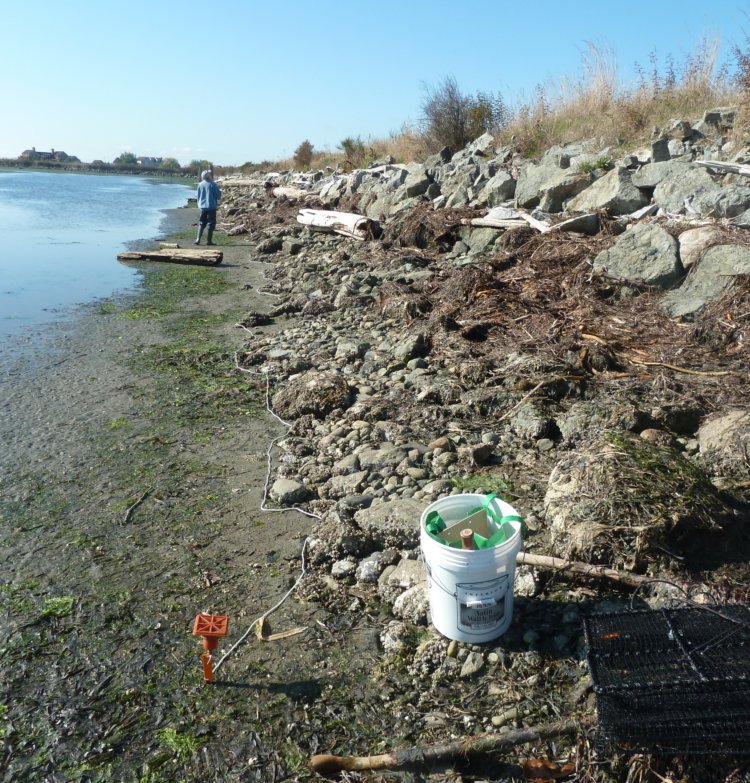
The riprap and cobble shoreline of Deer Lagoon provides more hard substrate than is typically found in muddy habitats, giving barnacles a place to attach. Photo: Tom Vos
The crew at Deer Lagoon clearly enjoys spending time with each other in a beautiful spot. Says Wendy, “I was glad to generally need my sunscreen and sunglasses…. And I was grateful to be part of a dedicated and very fun group. I’m sure looking forward to beginning our surveys again in just a few months!” Sandy Shipley also joined to help learn about and protect local shorelines, “I hope as we gather evidence over time, whether we find green crabs or not, that this information will help scientists as they study environmental changes in our waters.” Indeed all of the data collected from sites like Deer Lagoon will help us gain a better understanding of pocket estuary communities in the Salish Sea, including how they might be impacted by human activity.
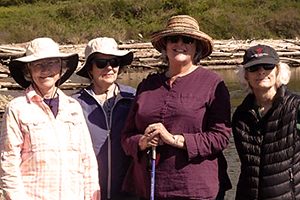
Deer Lagoon team on a sunny day. L-R: Wendy Visconty, Karen Brooks, Melissa Lebo, Sandy Shipley. Photo: Tom Vos