
Creature Feature:
Three-spined stickleback
Species Name: Gasterosteus aculeatus
Size: Typically up to 1.5″ (4 cm), but can be up to 3″ (8 cm)
Distinguishing Features: “Cigar-shaped” fish with three dorsal spines and one pelvic spine. Defensive spines held erect when agitated. Color can be silver, to green and red.
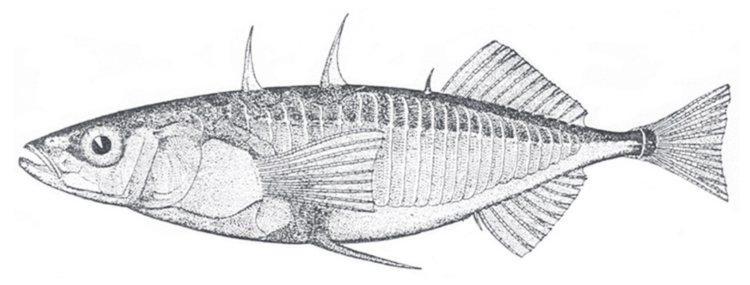
The Crab Team’s pokey pescado pequeño is one of our 10 most commonly trapped critters and the second most common fish, behind the ubiquitously trapped staghorn sculpin (see Summer 2016 Creature Feature). Three-spined stickleback live in cool and cold waters across the Northern hemisphere, with a very similar range to the potential range of European green crab. Their salinity tolerance is even broader than green crab; stickleback can live in coastal marine waters as well as rivers, streams and lakes that are entirely fresh. Stickleback migrate to mate, are fabulous dancers and are the recent darlings of evolutionary biology.
A trophy three-spined stickleback (Gasterosteus aculeatus or GAAC in Crab Team shorthand) would be a little bigger than an angler’s index finger (about 8 cm or 3 inches), but a typical adult is about half to two-thirds as big. Aptly named, this fish has three spines on its back, in front of the dorsal fin. To make it even more challenging to swallow whole, each pelvic fin is a large spine, and a small spine precedes the anal fin. When agitated, all its spines can be locked into an upright position, making them a potentially unpleasant meal.
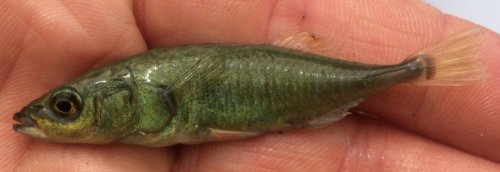
A laid back stickleback, with spines in relaxed position, found in Raab’s Lagoon. You can still see the vertical lines of the protective bony plates on its side between the pectoral fins and the tail.
Despite their hedgehog defense, stickleback can be important prey for some fish and many fish-eating birds. Watch gulls and herons long enough and you can appreciate birds’ knack for choking down uncooperative prey. Loons, terns, mergansers, kingfishers, ducks and even eagles have also been known to dine on stickleback, though not always successfully, as dead birds have been found with a stuck stickleback in their throat.
While many of us learn about anadromy (reproducing in freshwater, migrating to saltwater to grow) through the salmon lens, stickleback are among the many other species adapted to that lifestyle. However, their freshwater spawning is much more elaborate than a salmon. First, the male builds a bower-like nest. He then hangs out nearby, either fighting off anything without stickleback eggs in its belly or performing a zigzag dance for gravid (egg-bearing) females to entice them to enter his nest and lay eggs. Once a female has deposited eggs, the male fertilizes them, chases their mama away and protects and cares for the eggs until they hatch in a little over a week.
As a side note… is it just a coincidence that the Crab Team code for three-spined stickleback (GAAC) is a homophone of “gack”, a sticky or messy substance, and that the male stickleback uses a sticky substance produced from its kidneys as glue to hold together his little domed love shack? Well, yes. It is a coincidence because Crab Team codes are based on the first two letters of the genus and species, and the sticky stickleback substance is called spiggin, from spigg, the Swedish name for the stickleback.
Like steelhead/rainbow trout or sockeye/kokanee salmon, some stickleback can be anadromous, while others remain in fresh water. For the latter, some even further differentiate by being open water predators of plankton and tiny fish, while others stay near the bottom, feeding on insects and small crustaceans. Stickleback that adopt different lifestyles might even avoid each other during the breeding season. Ultimately, reproductive isolation could potentially lead to the evolution of new, distinct species. Also, over a relatively shorter period of time, the freshwater stickleback tend to become physically different from their marine counterparts, having fewer or different sized spines, less armor plating and different colors. The variation in stickleback, and the repeated, rapid changes they show, have made them very popular subjects in evolutionary research, helping us to better understand the features of their genetic makeup and environment that facilitate these changes as natural selection works its magic.
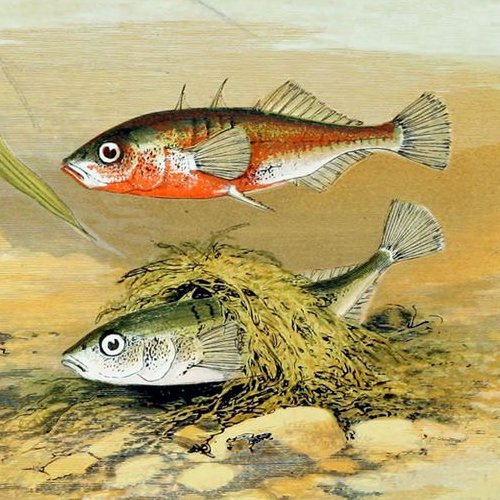
Three-spined stickleback in breeding coloration and an example of the elaborate nest the male constructs from sand and plant material. Artwork from Alexander Francis Lydon, British Freshwater Fishes.
This flexible fish is already showing behavioral changes in response to climate change. Recent research in the UW School of Aquatic and Fishery Sciences showed that, in Alaska, the earlier break-up of ice covering lakes each year allows this fish to have multiple mating cycles in a single year. Because this fish is a dominant part of Alaskan lake ecosystem, this could have “ripple effects” in those places.
When one of these impressive little fish shows up in a Crab Team trap or should you just encounter it on your daily waterside wanderings, you can wish it well as it tries to avoid avian gullets, build the perfect nursery and dance like its future depends on it.
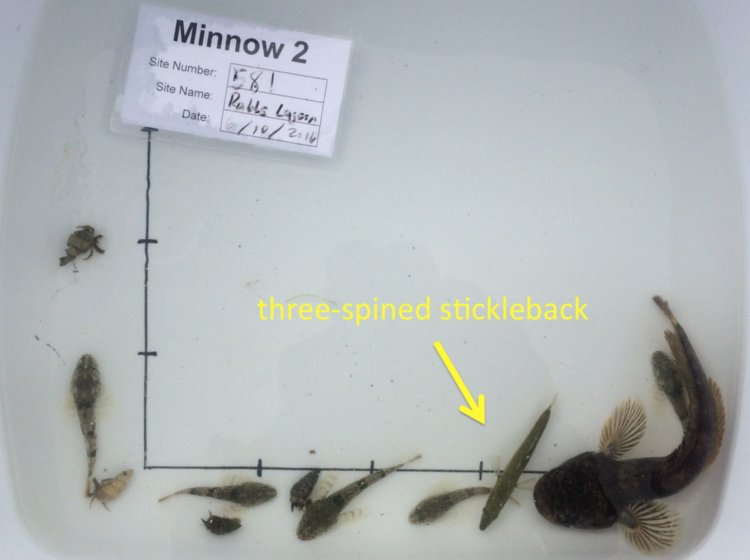
Three-spined stickleback in a minnow trap catch with staghorn sculpin, grainy-handed hermit crab, and a plainfin midshipman. Photo: Jeff Adams.