
Site Spotlight:
Carpenter Creek
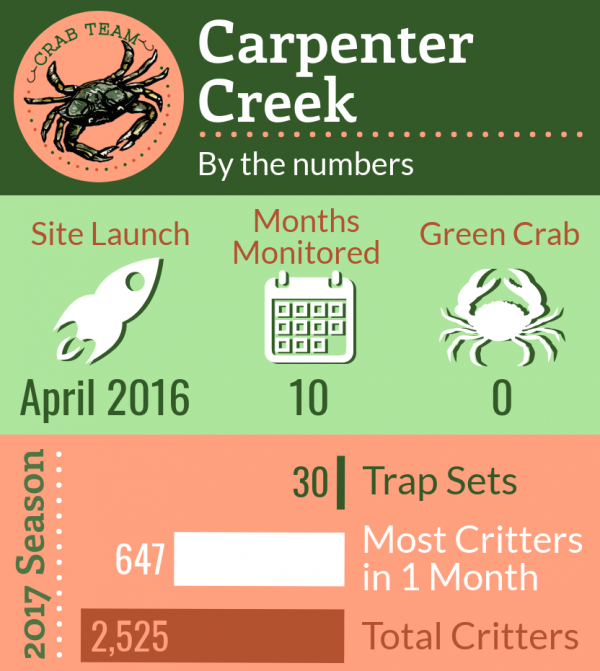
Site: Carpenter Creek (177)
Region: North Kitsap
Launched: April 2016
Site Captain: Joleen Palmer
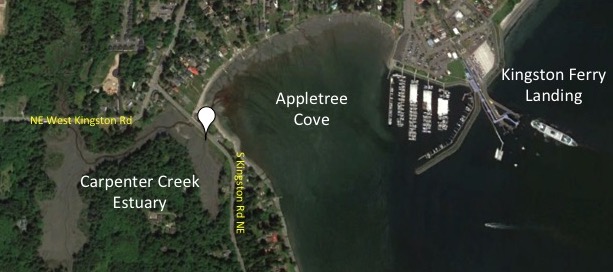
If you are planning a drive out to the Olympic Peninsula from the “Seattle side,” then the Edmonds/Kingston ferry is one way to travel. Look off to the left as the ferry approaches Kingston. That’s Appletree Cove. The bridge you see along its shore marks the entry to Carpenter Creek Estuary, the last pocket estuary available to out-migrating salmonids traveling toward the Strait of Juan de Fuca along the Kitsap Pensinsula’s shoreline. Its quiet waters include a salt marsh—just the sort of place a young fish might choose to feed and rest.
The estuary is still some distance from known populations of invasive European green crab, but if the green crabs ever do arrive at Carpenter Creek they will find exactly the kind of space they love—salt marsh channels, marsh vegetation, and quiet lagoon-like waters. Why do we think they’ll love it? Because hairy shore crabs (Hemigrapsus oregonensis) do!
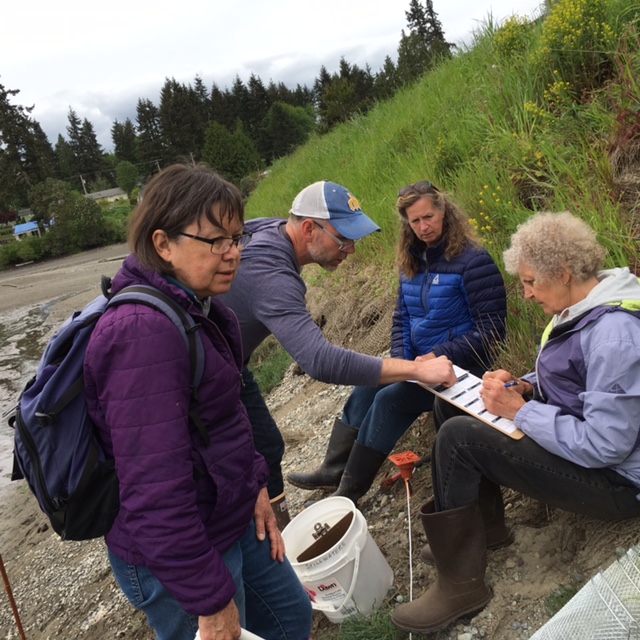
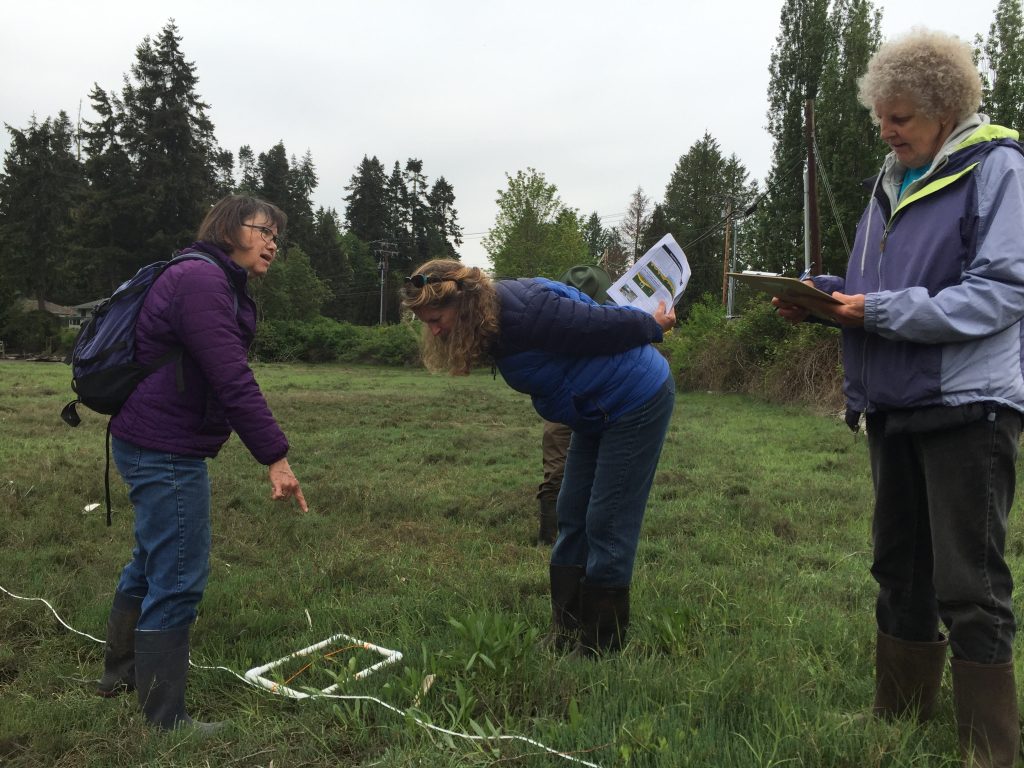
Stillwaters Environmental Center, located just above the Carpenter Creek Salt Marsh, added Crab Team sampling to its other monitoring tasks two years ago. The Crab Team’s captain, Joleen Palmer, already had a working relationship with Sean McDonald as a field site mentor for University of Washington Program on the Environment Capstone students. Joleen and Crab Team member Cindi Nevins welcomed the chance to help with another project Sean was involved in. On his first site visit, Sean’s delight in his “natural habitat”—in the mud with crabs—was apparent and fun to watch.
Click photo to enlarge.
The Carpenter Creek site presents some special challenges. It is one of the few Crab Team sites that does not hold standing salt water at low tide. In order to be sure that the traps are never out of the water, we typically set them on an evening rising tide, and then retrieve them on the falling tide the next morning – sometimes very early. Finding dates with tides that meet the monitoring protocol requirements… and team members willing to get up that early can be a challenge. Fortunately, we have just enough of both to make it work.
Coordinating people and tides for sampling is the first step in sampling. Using the Puget Sound Tidelog book and the TideGraph app, we build a short list of dates that will work. We need sufficient light in the evening and morning to see during setting and pulling traps, and we also need enough water to cover the traps during the overnight low tide. Once we’ve settled on two or three dates for a month, the next step is coordinating around other Stillwaters monitoring work and the availability of Crab Team volunteers. We make sure to get to the site early these days. As Crab Team member Tom Nevins likes to say: “The tide waits for no one.” Arriving late to an incoming tide creates undue stress as he learned the first season racing to place traps before the water overtopped his boots.
What we still never seem to get exactly right is the time when the tide arrives inside the bridge and the delay in the water leaving the estuary after high tide. The bridge restricts the tidal flow, so even if the tide predictions are perfect outside the estuary, the actual timing in the marsh is offset. However our miscalculations have a benefit—while waiting for the right conditions we watch dawn’s golden light shifts or the sun slipping below the trees at dusk. We hear the lap of water, the plop of fish, and the calls of eagles, herons and gulls gliding overhead. One time a deer picked its way along the shore.
“I’m a retired teacher,” says Cindi Nevins. “My whole career involved creating classroom environments where children could thrive. I think of Stillwaters’s volunteer work as an extension of what I’ve always done—we help assure that young fish have a healthy protected nursery space in which to grow into strong adults that can return home to spawn somewhere in Puget Sound. The green crab threatens nurseries like the Carpenter Creek Estuary and Salt Marsh and Crab Teams’ vigilance protects them for a while longer.”
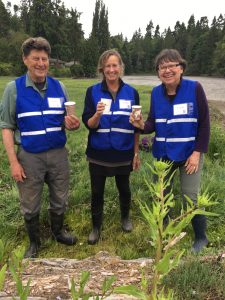
Coffee cups can be convenient for collecting carapaces (molts) – as long as you remember not to drink from them. Treasure hunters from Carpenter Creek, Tom Nevins, Nancy Karle, and Cindi Nevins “toast” a successful molt hunt. (Photo courtesy of Cindi Nevins)
The Carpenter Creek watershed is fed only by rain. It receives no summer snowmelt. Without a high upland source, Carpenter Creek itself is a characteristic Puget Sound lowland stream with a shallow gradient of 1-3 percent over much of its length. Cutthroat trout, steelhead trout, and coho salmon have been observed along its full length. Chinook, chum and pink salmon have been sighted in the estuary and salt marsh along with various forage fish.
Back in the late 1990s Joleen Palmer and Naomi Maasberg were instrumental in founding a community group called the Cutthroats of Carpenter Creek to protect and restore this urbanizing watershed. They built on community networking and grant-writing skills honed during long Seattle careers in community organizing for Lutheran Social Services. Stillwaters Environmental Center, a 501-c(3) non-profit organization, grew out of Cutthroats. When Chinook salmon were federally listed as an endangered species Stillwaters partnered with Kitsap County to secure a federal EPA grant for an Army Corps of Engineers assessment of the estuary. The Army Corps recommendations have guided Stillwaters’ work ever since. Since its founding, Stillwaters’ staff have worked closely with local, state, and federal elected officials, the Suquamish Tribe, Kitsap County and Washington State public agencies, Great Peninsula Conservancy, and watershed property owners to implement the Army Corps’ recommendations. Today two bridges stand as testament to their efforts: the South Kingston bridge replaced a 10-foot box culvert in 2012, funded by the WA state legislature; in March 2018 the West Kingston bridge will replace a 6-foot culvert, opening unrestricted tidal flow into the Salt Marsh.
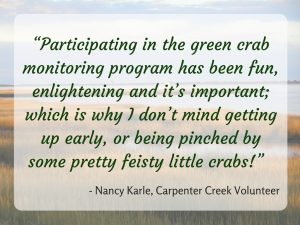
Stillwaters’s local citizen science volunteers, along with interns from the University of Washington and Western Washington University on the Peninsulas, make it possible to monitor the changes to the Carpenter Creek Estuary as more natural tidal flow is restored. We all have the privilege of watching how the creatures in the system help maintain it; especially those busy little native shore crab as they churn through the detritus generated throughout the year.
–Cindi Nevins (Stillwaters Team member)
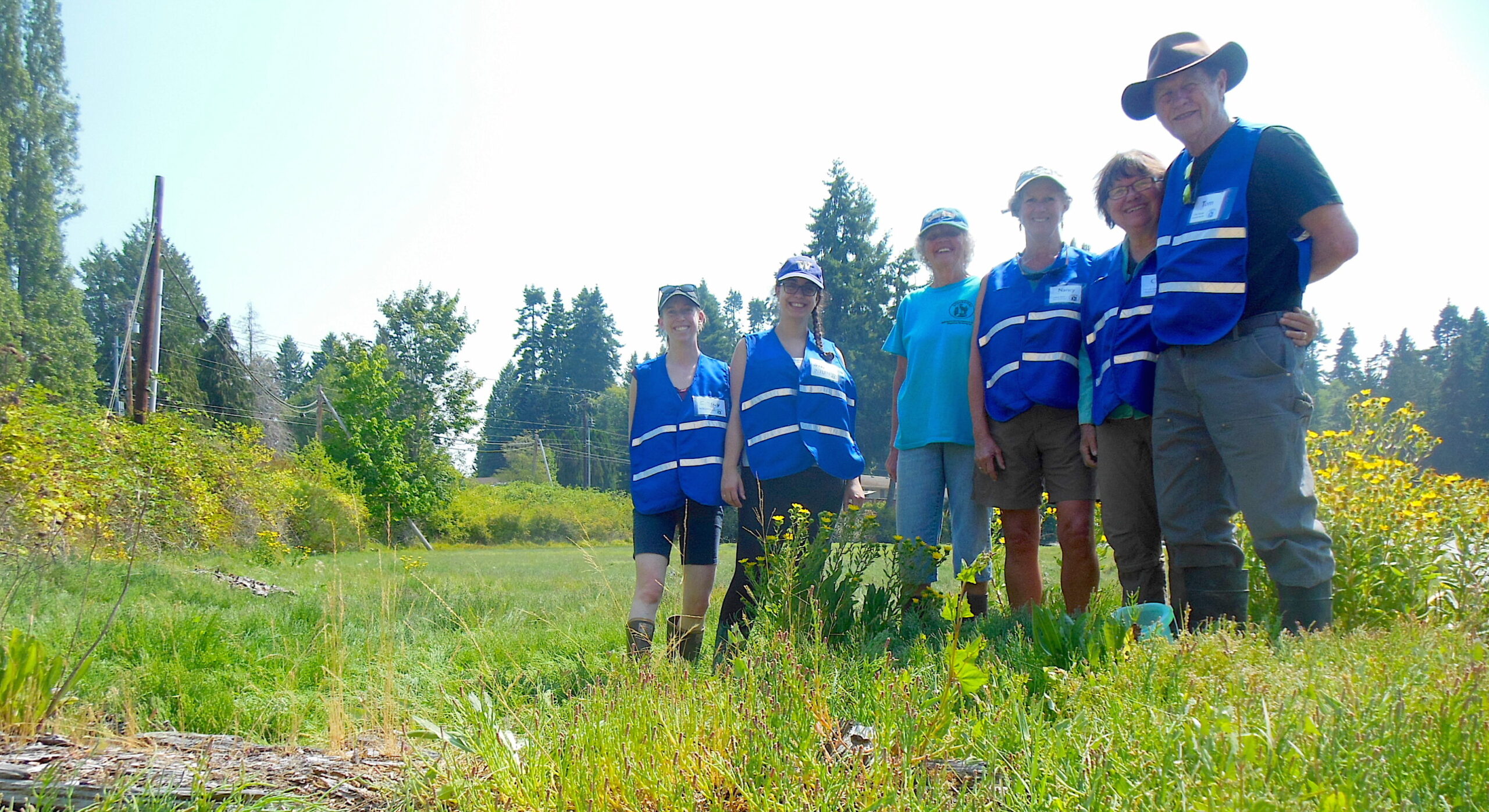
Feature Photo: Program Coordinator Emily Grason and Intern Staci McMahon got to join the Stillwaters team at Carpenter Creek on one of the hottest days last summer. L-R: Emily, Staci, Joleen Palmer, Nancy Karle, Cindi and Tom Nevins. (Photo: Joleen Palmer). Click photo to enlarge.