
Creature Feature:
Hairy Helmet Crab
Species Name: Telmessus cheiragonus
Size: Up to 100 mm (4”) carapace width
Distinguishing Features: Body and legs are hairy. Has a diamond-shaped carapace with 6 large marginal teeth, widest at the 4th tooth from the eye. Walking legs are relatively long while the claws are relatively small. Usually olive or yellow with some red/orange coloring.
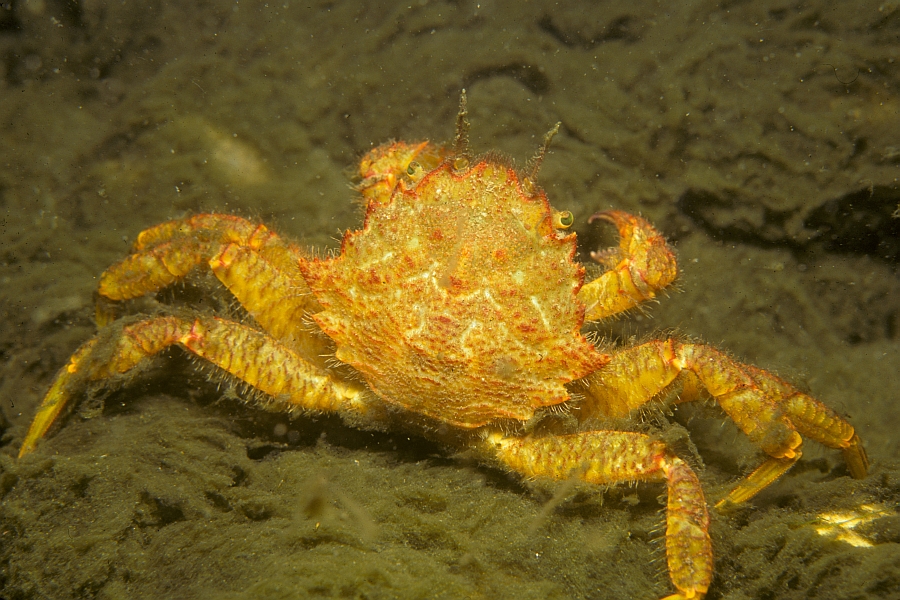
The hairy helmet crab. Photo: Greg Jensen
Water Wuxia
(wuxia [wuu-shiaa]: genre of Chinese fiction typified by pseudo-historical martial artists whose dedication allowed them to achieve superhuman skill)
Like fictional martial arts masters defying Newton through cinematic magic, the hairy helmet crab can confidently cling to eelgrass and lithely leap across the broad blades of native eelgrass in a hasty retreat, all the while brandishing their weapon of choice as a warning to any who may wish them ill. As intertidal explorers, most of us don’t get a lot of experience with living hairy helmet crab (Telmessus cheiragonus, Crab Team’s TECH) because they tend to stay deeper than the tide line or bury in their sandy or muddy habitats. However, if you swim, snorkel or dive over dense eelgrass beds, you too might see one of these clever crab appear to conquer gravity, just as the heroes and villains of Crouching Tiger, Hidden Dragon or House of Flying Daggers during bamboo forest fight scenes.
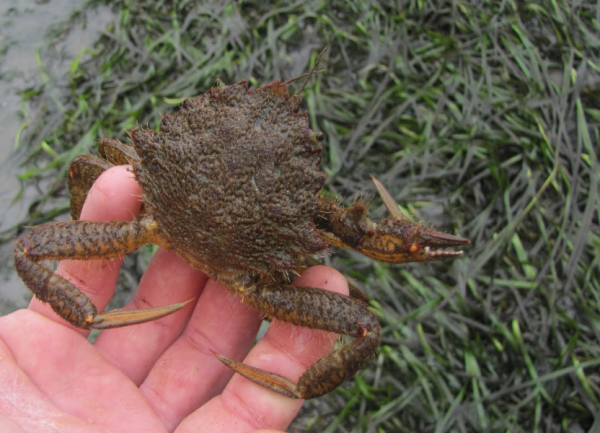
Olive-colored hairy helmet crab and its eelgrass meadow home. Photo: Jeff Adams.
Hi, TECH!
We capture a few hairy helmets in Crab Team traps, and find them even more frequently in molt surveys. So, we thought it would be worth breathing a bit of life into those ghostly shells. They also come closer than any other crab to breaking the green crab identification rule of five large marginal teeth between the eye and widest part of the carapace. Helmet crab have six large marginal teeth, widest at the fourth with a relatively small sixth. When alive, their color can also be greenish or yellowish, while the molts are typically yellow before they bleach out to white.
Unlike green crab, though, they have very long legs for their body and possess wimpy-looking claws that are completely covered in short bristles or hairs. Despite being cute and fuzzy (at least fuzzy…ish) and having relatively small claws, the hairy helmet crab is an omnivore, and has been described as a “wrecking ball” when placed in an aquarium.
TECH’s crabby family (Cheiragonidae) is one of the smallest, with only three members. Of those, our hairy helmet crab has the broadest distribution, from South Korea to California. Its larger cousin, the horsehair crab (Erimacrus isenbeckii), ranges from South Korea to Alaska and takes the prize for most likely to wind up on a dinner plate. Telmessus acutidens, TECH’s more closely related cousin, has the most limited range, living only around the Korean Peninsula and Japan.
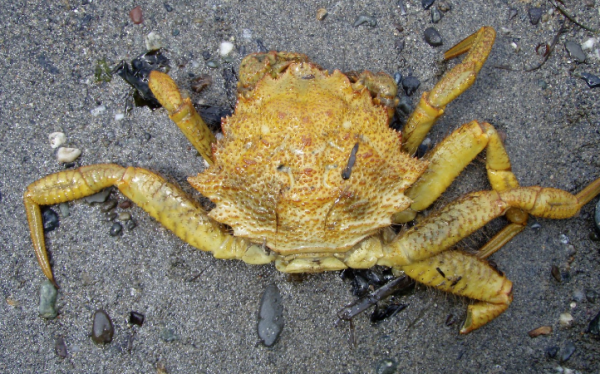
TECH molt with a good view of marginal teeth and long legs. Photo: Jeff Adams.
Hugging Hairy Helmets
There’s not a lot of research on helmet crab, and most of what’s available focuses on their sex life. Did you know that you can make a male helmet crab hug a sponge by dipping the sponge in a bit of urine from a female who is about to molt or just molted. Cool, right?! Apparently, helmet crab don’t exhibit the searching behaviors or courtship displays that some other crabs do, so researchers wondered how they know it’s time to grab their dancing partners. Turns out that a chemical cue in the female’s urine that tells males she’s getting close to molting or ready to mate. After a receptor on the male’s antennae detects the pheromone, he grabs the girl, fumbles her around, then embraces and guards her for about a week and a half until she molts. About half an hour after she molts, they mate for a couple hours. Then the male guards for several more hours before they part ways (see video from Lagoon Point). (Note: The researchers used the word “fumbles” in their paper – descriptive enough to suggest helmet crab may be less graceful in love than in their eelgrass antics.)
Once mated, females can apparently remain fertile for a very long time. Researchers in Japan set up an experiment with a mating group (males and females together) and an isolated group (females alone). Viable clutches of eggs were produced at about the same rate whether boys were around or not, suggesting the females were able to store sperm from mating the previous season. Greg Jensen (UW School of Aquatic and Fishery Sciences and author of Crabs and Shrimps of the Pacific Coast) had an even better anecdote: A female hairy helmet crab had been collected for a class and was being held in a tank, where she had an unfortunate encounter with a red rock crab. Left limbless on one side of her body, she was kept in an aquarium for about three years while she regrew her missing legs and claw. She was housed by herself during that time, but managed to produce a viable clutch of eggs each year. That’s one seriously committed mother, and apparently one seriously virile father!
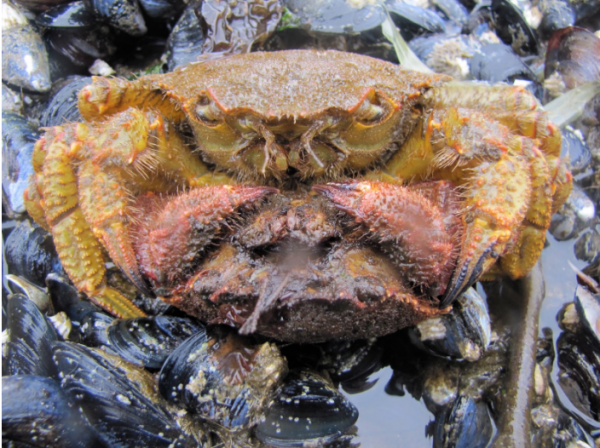
Male hairy helmet crab guarding a female in a precopulatory embrace. Photo: Jeff Adams. Click photo to enlarge.
International Crab of Mystery
The hairy helmet crab is an example of how Crab Team data can contribute to our understanding of the life histories of relatively understudied organisms. Though not nearly as abundant in our samples as it’s similarly named relative the hairy shore crab (Hemigrapsus oregonensis), we are starting to capture a fair number of TECH, enabling us to learn more about their habits. Out of the eight species of crabs in our traps, hairy helmets ranked sixth in 2017, just ahead of spider crabs, but in molts is fifth out of 16 species. For instance, data from 2017 show that TECH was most abundant in traps in the first half of the season, April through June, but nearly absent after July. This could mean that they leave the pocket estuaries we sample as the water gets too warm, or food or habitat becomes more available elsewhere. We can also see from molt surveys that hairy helmet crabs shed their shells mostly in early spring and fall, which is quite different from the summer molting of most of the other species we track (see graph below). The hairy helmet crab molting pattern also seems to be similar to, but may reflect some regional differences from, molting patterns observed in captivity for this species. Finding seasonal patterns like these lifts the veil on species like TECH, which, because they don’t have commercial value, are not studied as in depth as Dungeness crabs.
Unfortunately, there is currently not a lot more to be said about our hairy helmet crab, but maybe it will be Crab Team who contributes the next chapter to understanding this very cool critter!
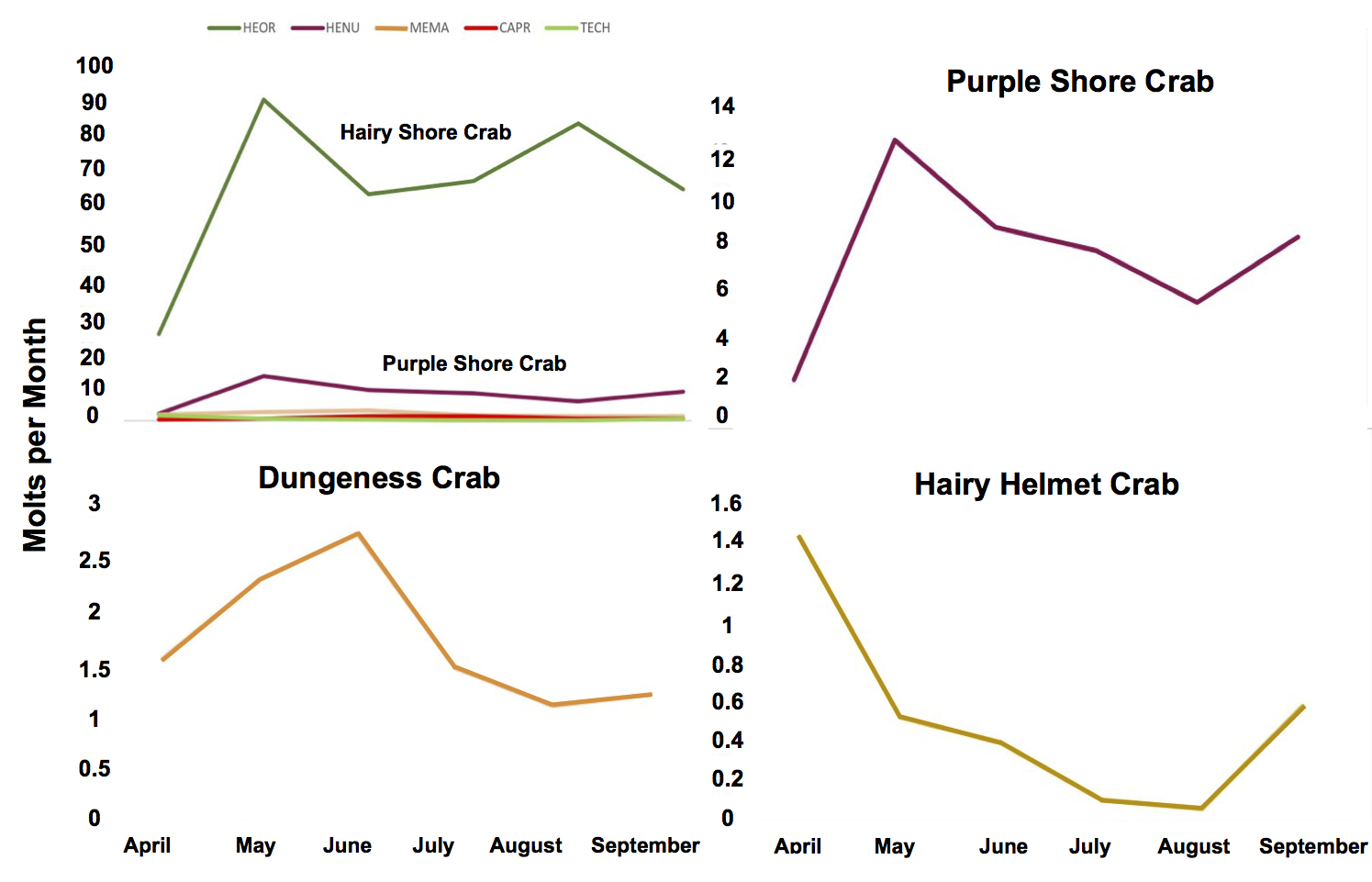
Graphs of 2017 Crab Team molt data, drafted for 2018 returning volunteer trainings. The patterns hint that helmet crab may begin molting earlier in the year than some of our other common crab species. Click photo to enlarge.
–Jeff Adams