
Green Crab: Can They Smell?
Chances are you’ve never heard of pheromones. Yet these chemical compounds are profoundly important. They’re even the basis for what we think of as attraction — after all, how many times have you heard about couples who have “great chemistry”? But pheromones do much more than kindle romance, and they are quite common throughout the animal kingdom. In fact, pheromones are any chemical substance released into the environment by an animal that affect the behavior or physiology of others of its kind. While best known for their impact on animal mating, pheromones are also responsible for communication among colony-forming insects, influencing feeding behaviors and delineating territories, and even bonding between mothers and infants.
The Birds and the Bees, and the Crabs
The ancient Greeks were among the first to recognize that animals secrete substances to attract mates, and by the 19th century, entomologists were familiar with the ways in which bees, moths and ants seemed to communicate using odors. By contrast, it wasn’t until the mid-1960’s that pheromones were identified in crabs (Ryan 1966**), and the chemical nature of these substances has only recently been explored and synthesized, owing in part to difficulties in purifying pheromones from seawater (Hardege et al. 2011). Over the past two decades, research on crab pheromones has focused on their role in mating, and much of this research has been conducted on European green crab, Carcinus maenas. Because mating in green crabs is synchronized with female molting, sex pheromones are critical for ensuring that receptive partners find each other at the right time.
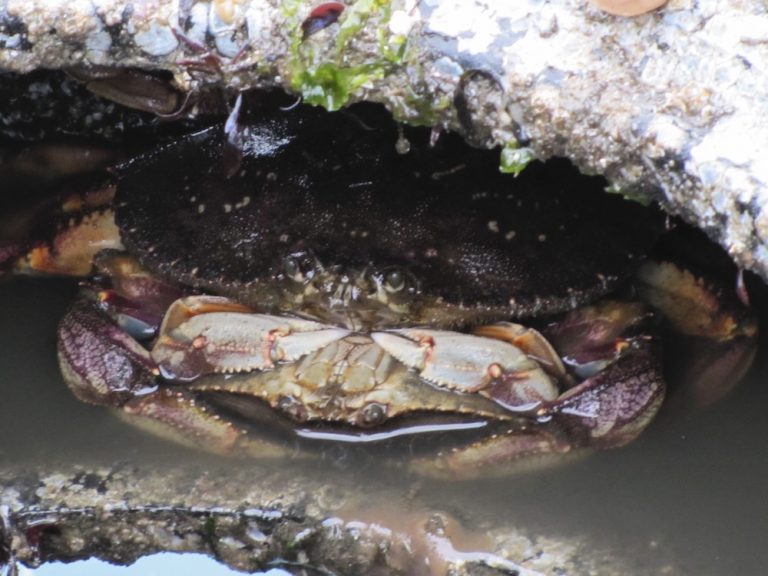
These two Dungeness crabs (Cancer (Metacarcinus) magister) are showing the mating posture, with the male clasping the female underneath him. The crabs will mate face to face, but he may carry the female around right side up prior to and following mating. Photo: Jeff Adams
Timing is everything when it comes to green crab reproduction. That’s because female reproductive organs are only accessible to males immediately following the molt and before the new shell hardens. When a male detects a receptive female, he grasps and positions her beneath his abdomen, placing her in a cradle position, thereby guarding her from other suitors. The male will continue to cradle the female throughout mating, only releasing her once the new shell hardens and she is no longer vulnerable to predators or receptive to the advances of other males in the area (Berrill & Arsenault 1982). Pheromones allow male crabs to sense and select pre-molt females as they approach their critical reproductive period.
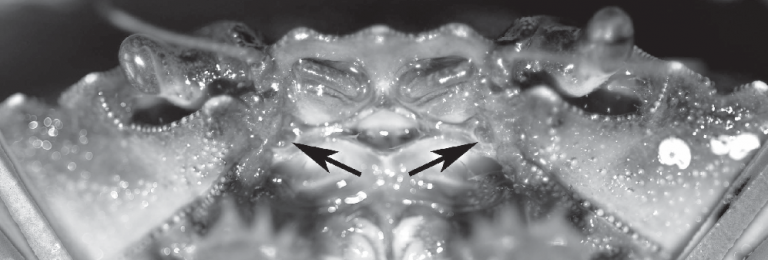
Magnified view of the face of a green crab, the arrows point to the nephropores, the paired openings where urine is released. Photo from Ekerholm et al. 2005.
Female crabs nearing their molt release sex pheromone in their urine, which emanates from the antennal gland between the eyes (Eales 1973). While this design might seem maladaptive, peeing out of one’s own face has advantages, in that urine is carried away from the body in respiratory currents and flow can be directed for maximum effect during face-to-face encounters. The pheromone, which is known by the chemical name, uridine diphosphate, is detected by the males’ antennules and induces a suite of behaviors in male crabs, including increased antennule flicking, searching, pre- and post-mating guarding of the female, and initiation of mating (Bamber & Naylor 1996; Hardege et al. 2011).
In addition to making females more attractive to male crabs, the sex pheromone makes males more aggressive toward one another. Researchers at the University of Glasgow in Scotland found that male green crabs fight each other more intensely and for longer duration when exposed to female sex pheromones. Moreover, these altercations often result in physical injuries (Sneddon et al. 2003) with long-term consequences. For instance, the loser of a fight subsequently shows a delayed and muted response when exposed to female sex pheromones (Fletcher & Hardege 2009).
While female sex pheromone is arguably the most important pheromone for mating, it’s not the only one involved in reproduction. Researchers from Cardiff University in Wales demonstrated that the hormone crustecdysone, which is produced by the female crab during molting, also acts as an appetite suppressant for male crabs in laboratory experiments. This signaling hormone would seem to act as an insurance policy for the soft-bodied and extremely vulnerable female by reducing the risk of cannibalism (Hayden et al. 2007). Interestingly, this action is sex-specific; feeding by non-molting females is not suppressed and these crabs are just as likely to engage in cannibalism with or without crustecdysone.
What Can Pheromones Do For Us?
Fascinating stuff! But can we capitalize on chemical communication to control green crab populations in the Salish Sea? As it turns out, pheromones have been used widely in agricultural settings for pest management, as well as to control invasive insects. A team of international researchers is investigating using this approach for green crab. Joerg Hardege of the University of Hull, England, and Sylvia Yamada of Oregon State University have conducted tests using a synthetic sex pheromone formulation. Unfortunately, results to date have been mixed; the pheromones don’t seem to be any more effective than traditional (fish) bait and they’re harder to use. “I don’t see pheromones being a magic bullet,” Yamada explains, and efficacy is, “limited to high pH and water temperatures above 15 degrees Celsius.” The practicality of using female sex hormone as a bait might also be limited by its range and what might be termed the “detection sensitivity” of male crabs. Mattias Ekerholm and Eric Hallberg of Lund University in Sweden found that, at low concentrations, the pheromone can be effective over a short distance at eliciting increased search and mating-specific behaviors. However, male crabs aren’t necessarily able to detect and follow a concentration gradient of the pheromone, suggesting males cannot follow the pheromone to its source – presumably a female crab (Ekerholm & Hallberg 2005). It’s akin to hearing a high-pitch sound yet being unable to discern where it’s coming from. Thus, even if a male crab detects a signal emanating from a pheromone-baited trap, it might not be any more likely to enter the trap and be caught.
Despite setbacks using female sex pheromone for control, Yamada isn’t giving up. She and her colleagues are exploring alternative pheromones that may act as deterrents. Yamada can imagine opportunities to combine chemical attractants and deterrents for green crab in the same way these stimuli are combined in push-pull integrated pest management for agriculture. In these approaches, deterrents “push” pests away from protected areas and attractants lure or “pull” them to traps (Cook et al. 2007). Such a combination could conceivably make control programs more effective.
– Sean McDonald
**While we try to use open access sources as often as possible, some of the studies cited in this article are not open access. If you have any questions about any of the research cited here, please feel free to reach out to crabteam@uw.edu.