
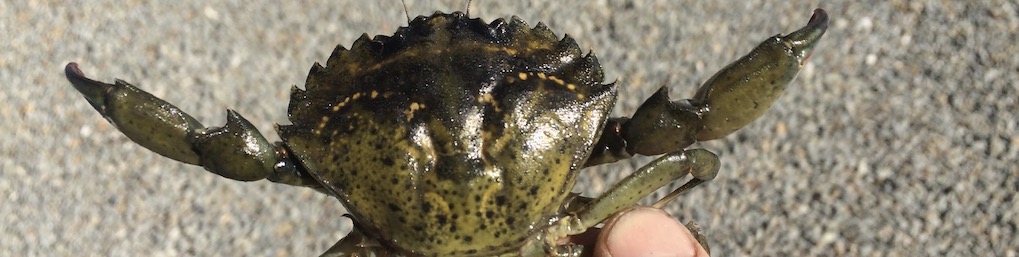
Green Crab: Larvae on the move
Guest contributor Elizabeth Brasseale is currently a postdoctoral fellow at Scripps Institution of Oceanography. As part of her Ph.D. research at the UW School of Oceanography, she worked on a project with Crab Team to help us learn about how green crab larvae may be moving into and around the Salish Sea. In this feature, she describes the results of that research.
In 2016, the first European green crab sighting was confirmed in the eastern Salish Sea, in Westcott Bay in the San Juan Islands. However, at that time, green crabs were not entirely new to the Pacific Northwest. Green crabs had been sighted in bays on the outer coast of Oregon, Washington and British Columbia as early as 1997. So why didn’t green crabs reach the Salish Sea earlier?
Green crab can spread to new places by releasing their young (larvae) into the ocean currents, where they can travel hundreds of miles over the weeks they spend as plankton. By and large, plankton are obliged to go wherever the ocean takes them, so they can only reach new places if there is a pathway in the ocean currents carrying them there. Ocean currents are highly changeable, so these pathways appear and disappear with the tides, weather, seasons, and large ocean trends like El Niño. To find out how green crab larvae are (and aren’t) getting into the eastern Salish Sea, we need to know where and when these pathways are open. To do this, Crab Team joined up with the Coastal Modeling Group at the University of Washington School of Oceanography, where researchers operate a computer model of the Salish Sea and the neighboring areas of the Pacific Ocean. The plan was to use the computer model to see where the pathways were in 2014, 2015 and 2016, the years leading up to the first Westcott Bay sighting.
Well, How Did They Get Here?
There were two hypotheses for how green crabs arrived in the eastern Salish Sea. One possibility is that they came from infested bays on the coast of Washington, Oregon or Vancouver Island. Green crabs have occupied these bays for the last few decades, but it appears their spread into the eastern Salish Sea may have initially been avoided because the Strait of Juan de Fuca forms a natural barrier. The Strait of Juan de Fuca is usually a one-way street carrying a huge amount of freshwater from the Puget Sound watershed and the Frasier River out to the Pacific Ocean, and preventing crab larvae, poor swimmers that they are, from getting washed in. That “barrier” can be removed, however, when the wind is strong enough to reverse the direction of flow in the Strait of Juan de Fuca. But this phenomenon most often occurs in winter so, in general, there is a mismatch between the times when green crab reproduce (spring and summer) and the times when flow reverses in the Strait of Juan de Fuca (fall and winter). Therefore, the hypothesis is that the green crab populations in the region have always posed a threat to the eastern Salish Sea, but it was so unlikely for the timing of green crab larval release to align with a flow reversal in the Strait of Juan de Fuca that it took twenty years before such a coincidence occurred.
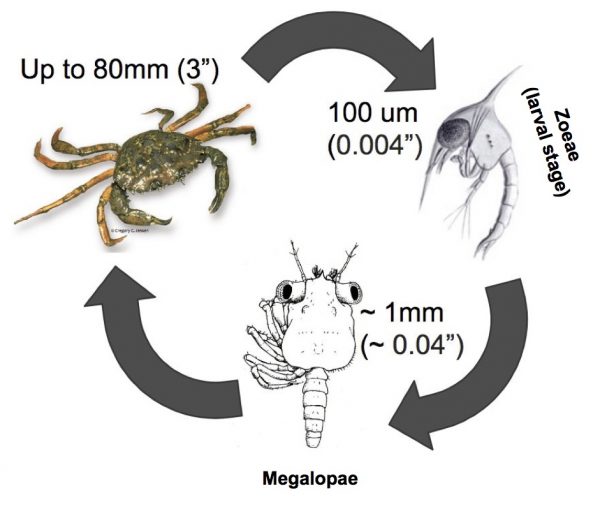
Life stages of European green crab. With adapted images from Greg Jensen (adult), Rice and Ingle (megalopa), and Haeckel (zoea).
The second hypothesis is that green crab invasion in the eastern Salish Sea was inevitable after humans accidentally introduced green crabs to Sooke Basin sometime before 2012. Small green crabs hitched a ride in bags of mussels brought for biotoxin monitoring to Sooke from Clayoquot Sound, a bay with an established green crab population on the west coast of Vancouver Island. For its size, Sooke Basin has a very small opening to the Strait of Juan de Fuca, so water in the basin tends to recirculate rather than empty into the Strait. This allows Sooke to retain a lot of the green crab larvae released by crabs living there, which meant that a large, isolated population grew quickly from the initial introduction. By potentially enabling larvae to bypass the barrier posed by the Strait of Juan de Fuca and accelerating spread in the Salish Sea, the green crab population at Sooke has been of particular concern to managers.
Was Sooke “pouring” green crab larvae into the eastern Salish Sea, or did it mostly keep all its green crab larvae to itself? Was green crab in the eastern Salish Sea an unlucky coincidence, or inevitable?
Experiments “in Silico”
To answer these questions, we conducted experiments using the UW Coastal Modeling Group’s computer model, LiveOcean. We started by recreating the ocean conditions in the Pacific Northwest during 2014–2016, the period when the larvae of the crabs detected in the eastern Salish Sea starting in 2016 would have actually arrived at those sites. For our test sites, we chose Sooke Basin and three other bays where green crabs have been found since the late 1990s that would represent a range of possible geographic origins: Coos Bay (OR), Willapa Bay (WA), and Barkley Sound (BC).
Then we simulated green crab larval releases on several dates during their observed spawning season and used the model to track where they would have ended up. This was done by assigning 10,000 virtual larvae a starting place in the ocean near the mouth of each of the test sites. The simulations checked the direction and speed of the ocean currents at each larva’s location every hour, and moved the larva to a new location accordingly, imitating the way green crab larvae drift as plankton, going wherever the ocean takes them.
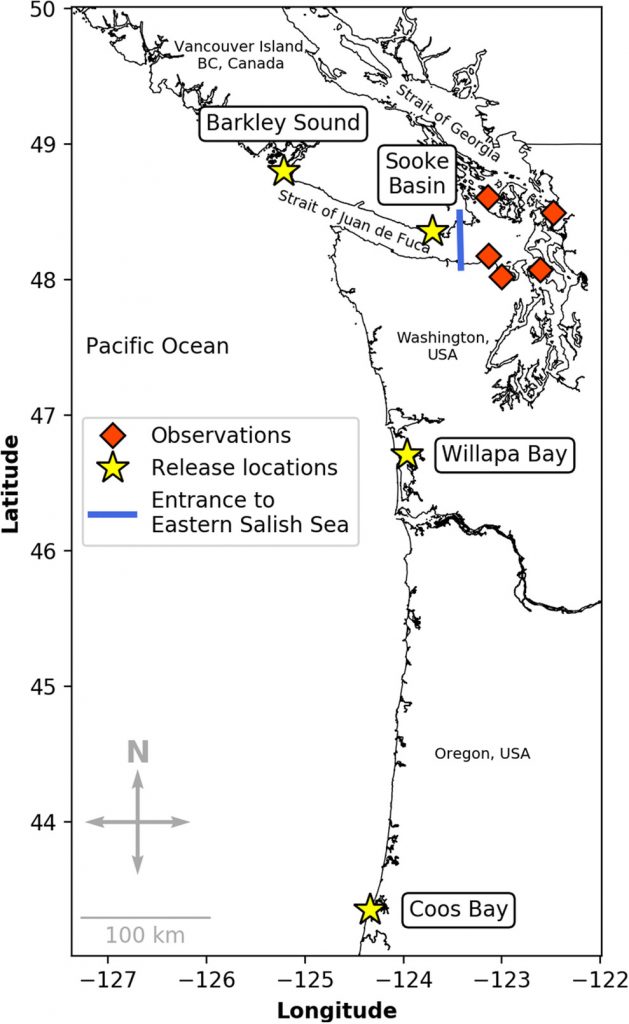
Map of study area. The eastern Salish Sea is delineated from the Strait of Juan de Fuca by a blue line. Orange diamonds represent confirmed green crab observations in the eastern Salish Sea and yellow stars mark larval release locations. Figure from Brasseale et al. 2019. Click to enlarge.
Surfing the Salish Sea
We found a number of surprising results. First of all, green crab larvae could reach the eastern Salish Sea from any of the four sites we tested, but it was a rare occurrence. At every test site, some fraction of the virtual larvae released found a pathway into the Salish Sea on at least one release date, even from as far away as Coos Bay. But, for all of the test sites, there were also some release dates for which no virtual reached the eastern Salish Sea. Often, only a very small fraction of the 10,000 virtual green crab larvae released made it to the eastern Salish Sea.
Was Sooke, the closest test site, significantly more likely to be responsible for the green crabs found in the eastern Salish Sea? Surprisingly, it was not. For all of the experiments run for Sooke Basin, only 1.73% of the virtual larvae released made it to the eastern Salish Sea. The Oregon test site, Coos Bay, which was most distant, had a similar result, with 1.86% of virtual larvae released from Coos reaching the eastern Salish Sea. The most likely site was actually Willapa Bay, from which 3.06% found a way into the eastern Salish Sea. That means that green crab larvae that were spawned in Willapa Bay were almost twice as likely to reach the eastern Salish Sea as larvae that spawned in Sooke. The least likely test site was north of the Strait of Juan de Fuca at Barkley Sound, from which only 0.46% of virtual larvae ended up in the eastern Salish Sea.
Although larvae from some sites were, on average, slightly more likely than others to get swept into the Salish Sea, the differences were not large or consistent enough to conclude that any one site had the most direct pathway. Additionally, when you consider other factors like the size of the adult green crab populations at each site, the picture gets murkier. Willapa Bay, which had the highest overall percentage of virtual larvae that got in, also had the smallest population of adult green crabs of the test sites during those years. So, there might have been a pathway from Willapa to Westcott Bay at the right time, but there might not have been any larvae to take that path. That is to say, these results don’t provide us with a smoking gun for a single source population for green crabs that have been found to date along the inland shorelines.
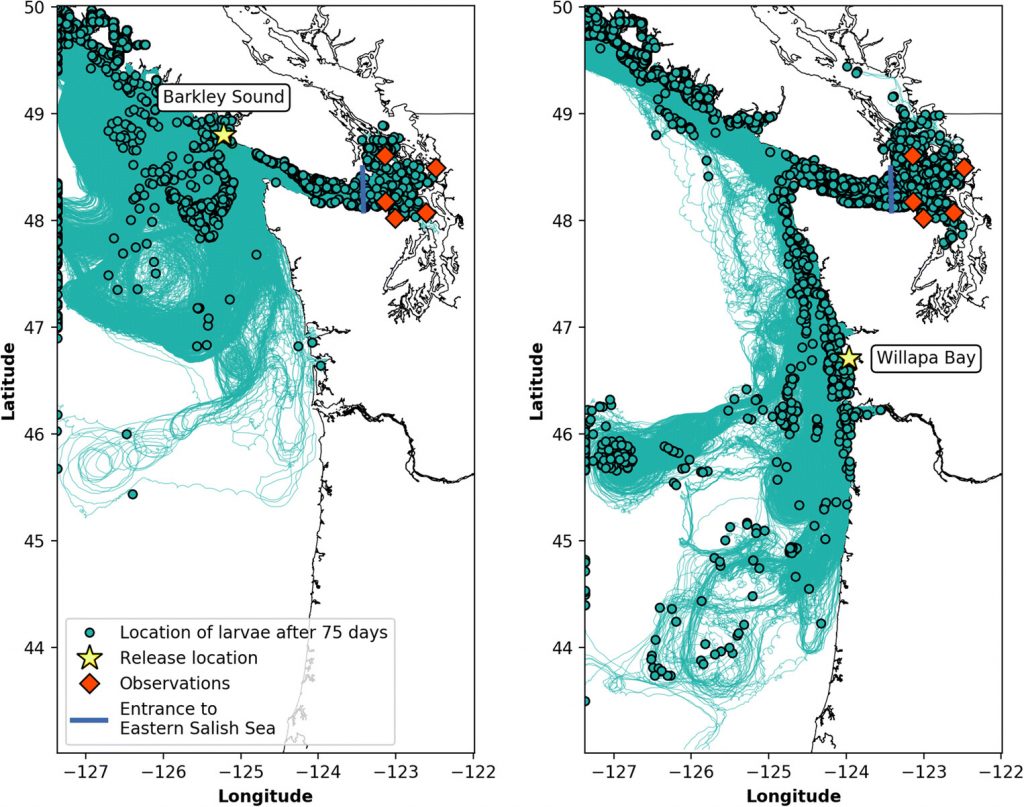
Computer models simulated the pathways of larvae released on August 10, 2014. In these examples, about 4% and 27% of electronic larvae were successfully transported into the eastern Salish Sea from Barkley Sound (BC) and Willapa Bay (WA), respectively. Figure from Brasseale et al. 2019. Click to enlarge.
No Smoking Gun for Salish Sea Green Crabs
What these results do tell us is that, overall, it was hard — but possible — for green crab larvae from all over the Pacific Northwest to reach the eastern Salish Sea in 2014, 2015 and 2016. Considering all experiments at all sites, 2 out of every 100 virtual larvae found a pathway into the eastern Salish Sea. Sooke was not the obvious culprit we had suspected and was only as likely as any other site to be responsible for the green crab found in the eastern Salish Sea. It is worth noting that 2014–2016 were the Warm Blob years and featured a strong El Niño, which is known to facilitate the spread of marine invasive species. Ocean heat waves such as these, which are not ordinary but are becoming more frequent as the climate changes, may open more paths for green crab larvae into the Salish Sea.
The most important conclusion from this work is that the waters of the Pacific Northwest are even more connected than we realized. Therefore, our efforts to protect the Salish Sea can have far-reaching implications.
– Elizabeth Brasseale
Citation: Brasseale E, Grason EW, McDonald PS, Adams J, MacCready P (2019) Larval transport modeling support for identifying population sources of European green crab in the Salish Sea. Estuaries and Coasts. Vol 42:1586-1599. DOI