
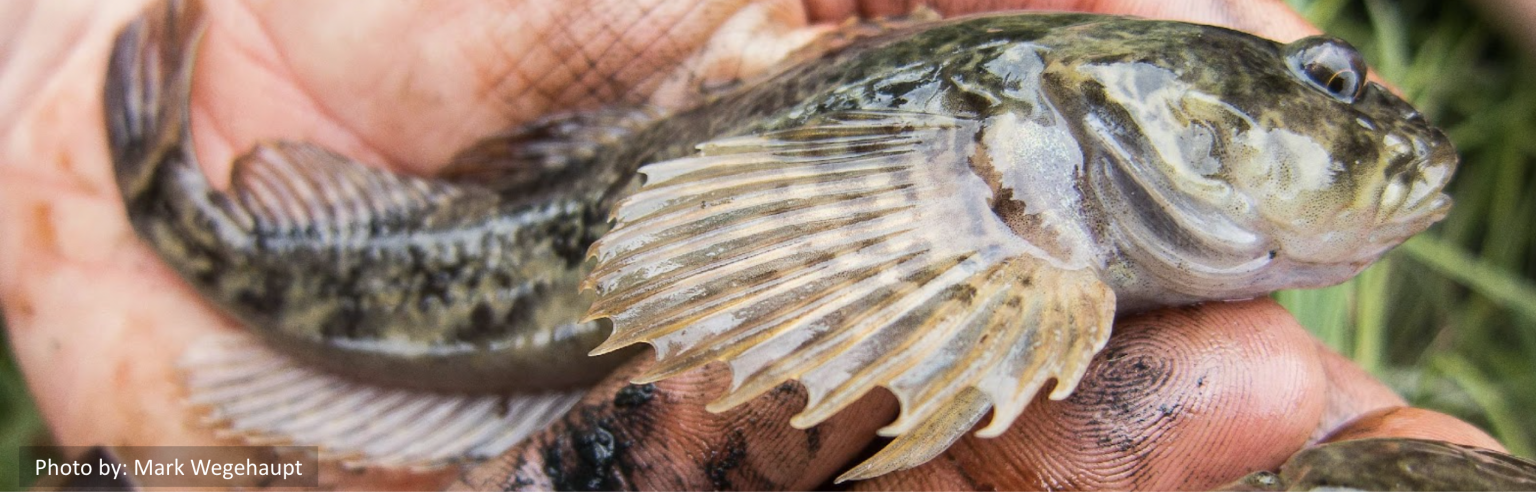
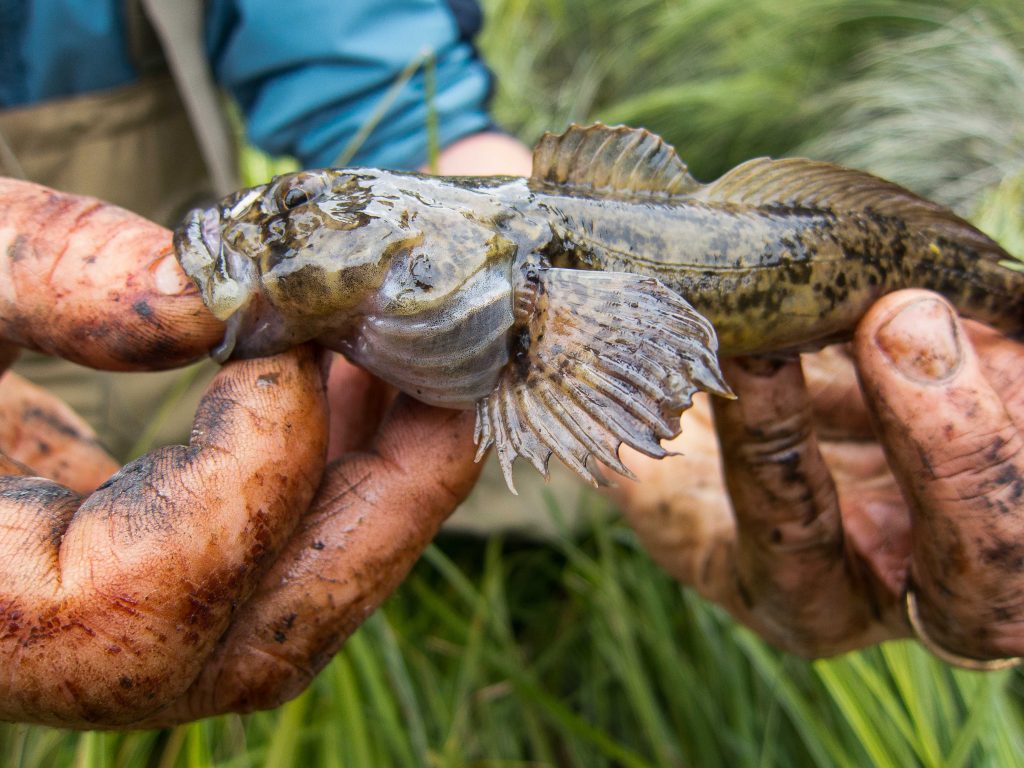
Do you know your sculpins? Despite its affinity for freshwater, the prickly sculpin (Cottus asper, COAS) occasionally appears in Crab Team traps. Photo courtesy of Mark Wegehaupt
Featured Creatures:
Species Name: Oligocottus maculosus
Common Name: Tidepool sculpin
Species Code: OLMA
Geographic Range: Southwest Alaska to southern California
Size: up to about 3.5”
Species Name: Cottus asper
Common Name: Prickly sculpin
Species Code: COAS
Geographic Range: Southcentral Alaska to southern California
Size: up to about 7.5”
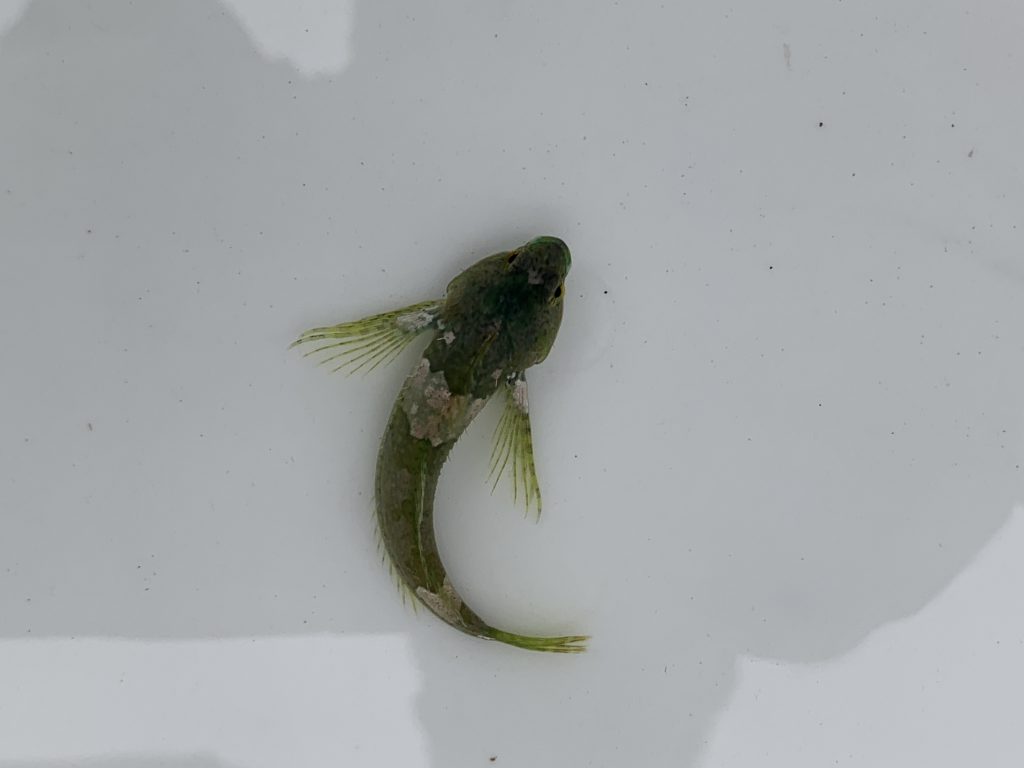
Prickly, Tidepool, Padded and Prongs – Crab Team’s Cadre of Cottidae
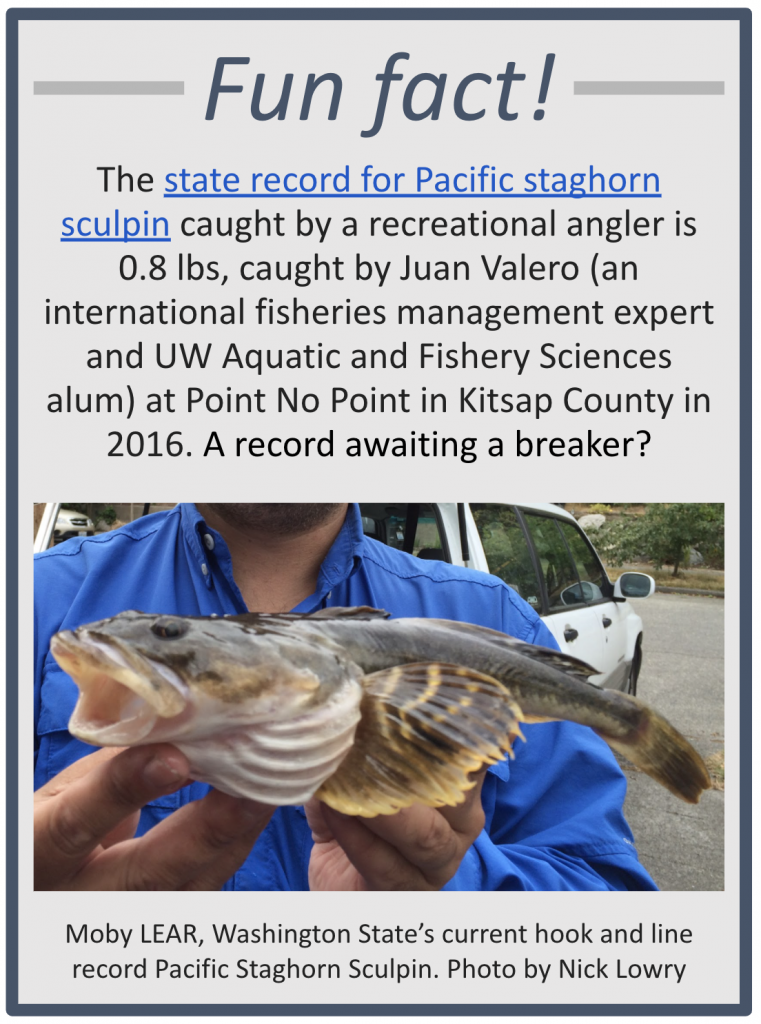
When it comes to Crab Team sculpins, LEAR is king Leptocottus armatus that is, the staghorn sculpin. Ah, staghorn… that tough-as-nails, live-a-while-out-of-water, eat-anything bullhead, who cruises up the beach with the tide and has wound up in traps at every regularly monitored Crab Team site. Crab Team members have now counted more than 20,000 staghorn sculpins! We know our LEAR. But staghorns are far from the only sculpin Crab Teamers encounter, and this year, we added a new species to the roster, so we figured it was time for a broader treatment of Crab Team’s bullheaded brethren.
Sculpins can be tough to identify, especially when we don’t often capture species other than staghorns. As we see more individuals of more species, however, we develop a better search image for the subtle differences. In fact, Crab Team staff are always improving our own search images as we discover new additions to the community of species who think our mackerel smells awesome (or wandered aimlessly into our traps). It’s thanks to all the excellent observations and photos Crab Teamers take that we can pick up on that richness in our samples. Now for some of that bullish-headed richness.
When we look at data from Crab Team sites in the Salish Sea, four sculpin species other than staghorn have been captured:
- Tidepool sculpin. Oligocottus maculosus (OLMA) come in second place to staghorn, with 164 (still 2 orders of magnitude fewer than LEAR) showing up at 11 of our 56 sites;
- Prickly sculpin. More Cottus asper (COAS), have been caught (190) than tidepool, but at fewer sites (7) with almost 90% of them coming from the North Duckabush site, and
- Great sculpin. A single Myoxocephalus polyacanthocephalus (MYPO), weighed down a Fukui trap on Shaw Island in 2020.
- Padded sculpin. In 2021, one new sculpin joined our list with a single Artedius fenestralis (ARFE), captured at each of two sites.
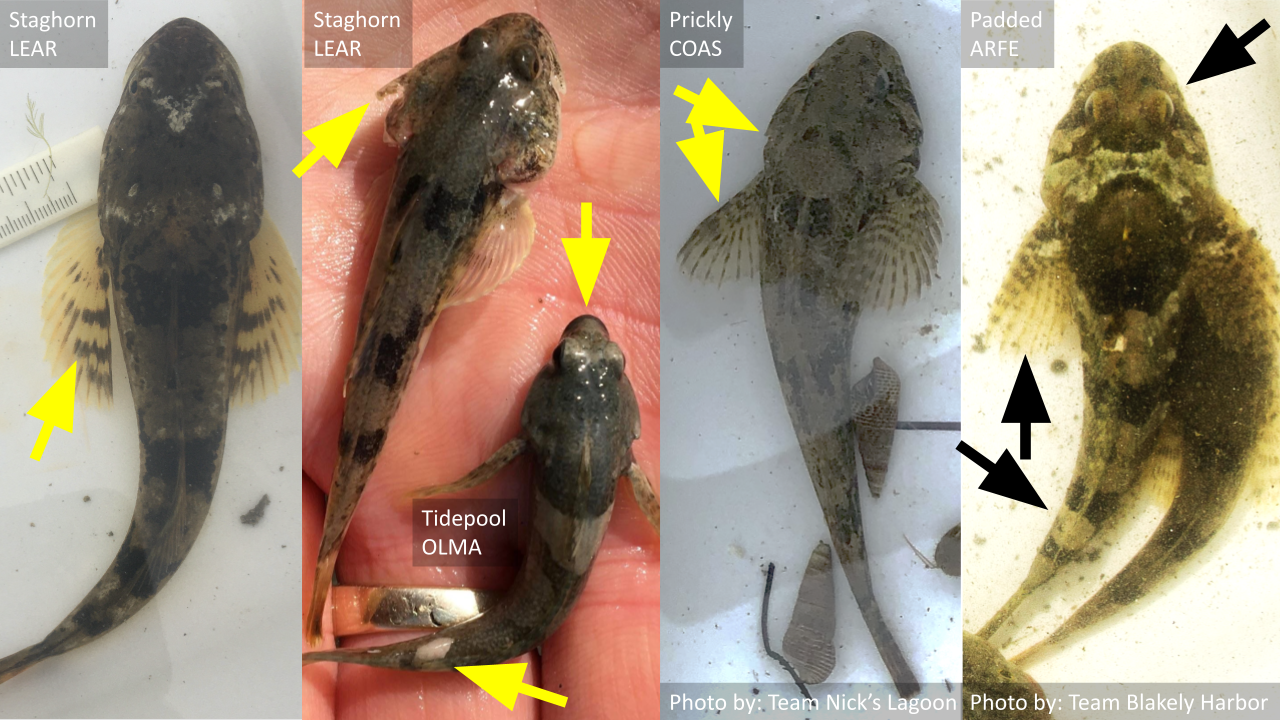
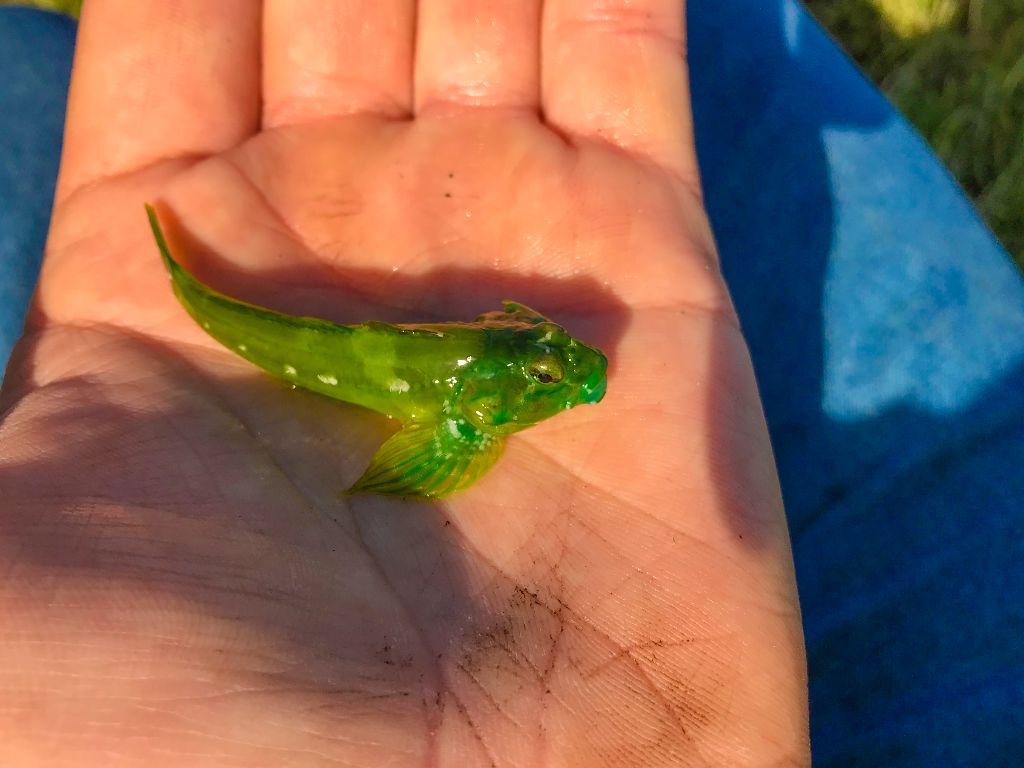
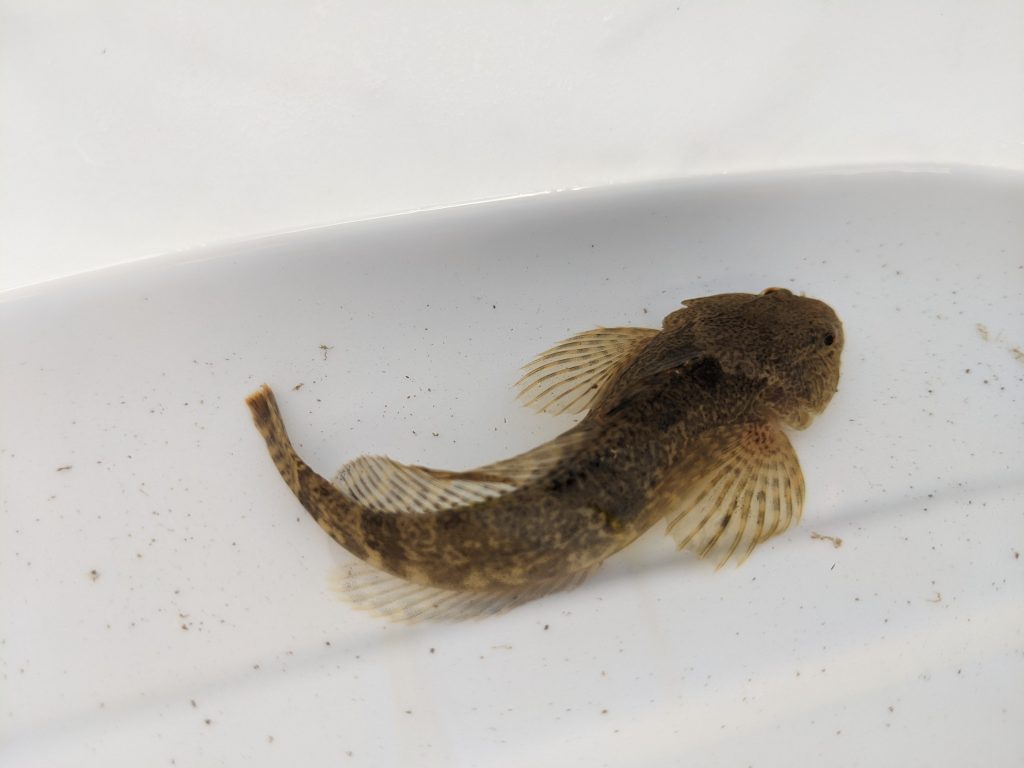
Crab Team’s sculpin to date (minus great sculpin – MYPO). Photos courtesy of the Nick’s Lagoon and Blakely Harbor Crab Teams and Jeff Adams
Oh OLMA
On our first Crab Team staff outing back in 2015, when we were trying to figure out how to put this whole enterprise together, tidepool sculpins were among the first critters we saw together. OLMA are little sculpin, maxing out around 3.5”, who can live in sheltered areas of the beach and get oxygen from the air if need be. They are very common but maybe less so in Crab Team traps because their diet is more buggy and less fishy, so maybe they shuffle into the traps more out of curiosity than the pull of mackerel.
A couple features that really help with identifying OLMA are their long, pinched nose, the thin bands on their pectoral fins and a bright white patch at the tail end of their dorsal fins. They also tend to like to curl their tail to the side when at rest, but that’s not an entirely unique behavioral feature among sculpins. Sharpnose sculpins look a lot like OLMA except with a light patch under their eyes and the first bright saddle patch being at the front of their dorsal fins.
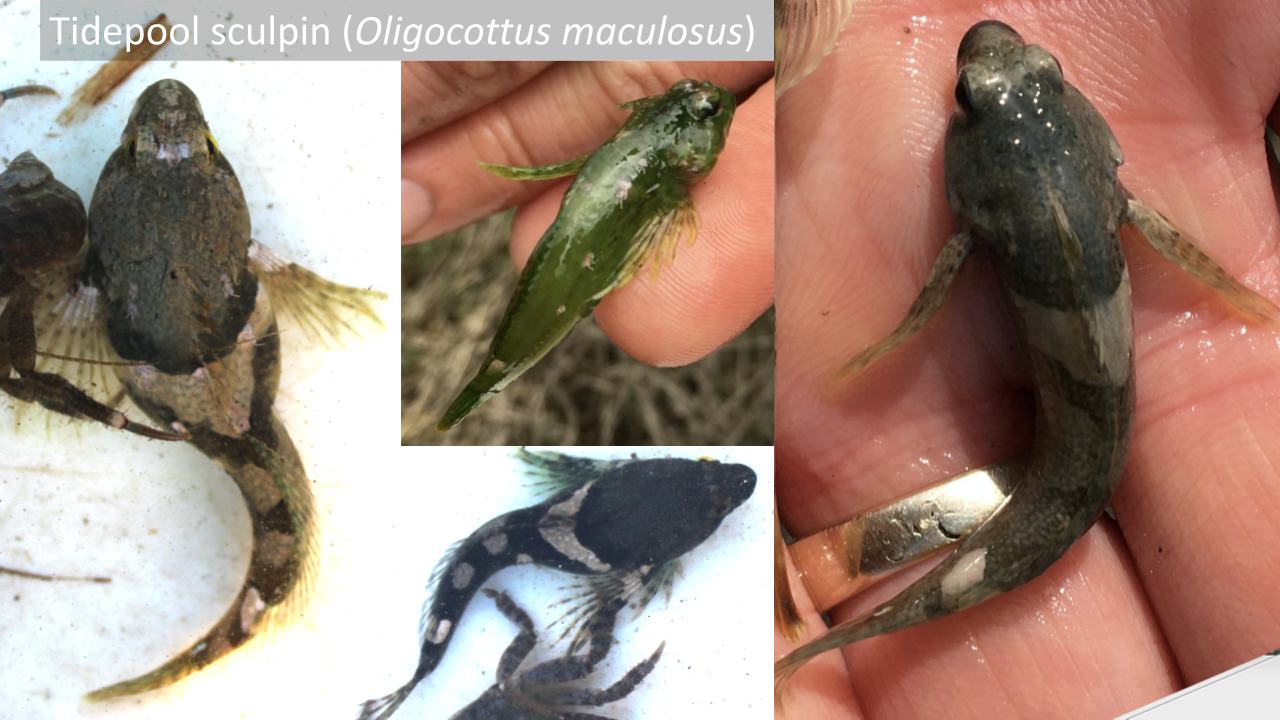
Tidepool sculpin (OLMA) showing their big eyes over a pinched nose, the bright white patch just before their tail and the range of color that is common among lots of sculpins. Photos courtesy of Jeff Adams
Catadromous COAS
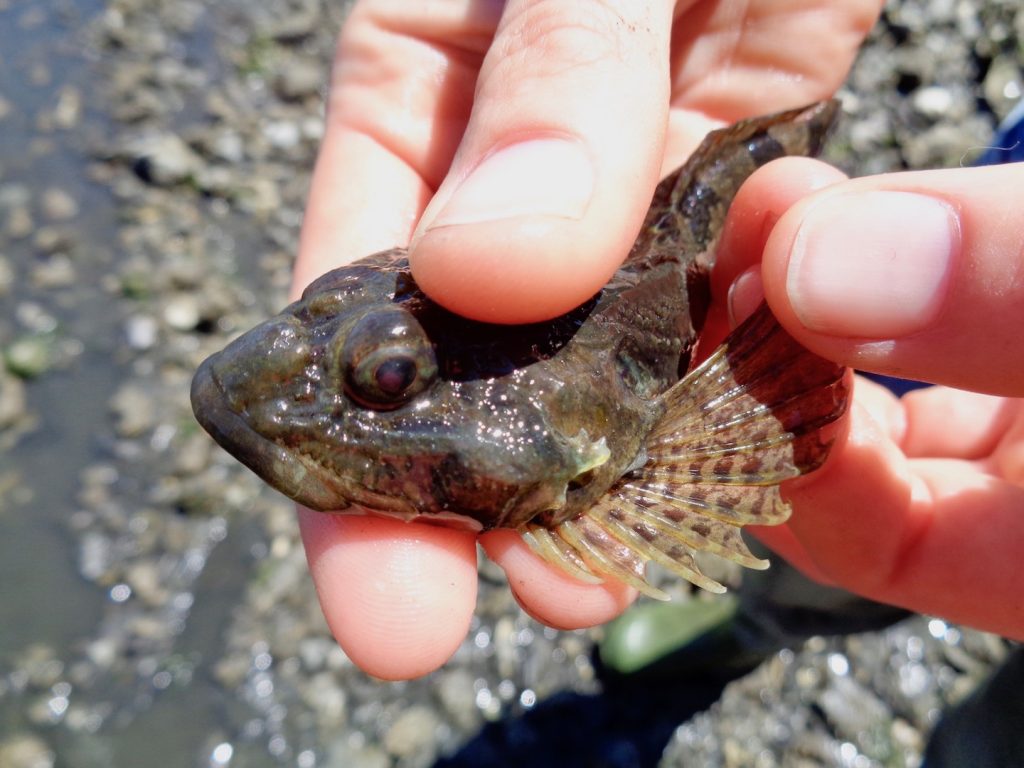
The prickly sculpin is kind of like the staghorn of the stream, minus the stag horns. Their opercular spines are short, single points, which helps distinguish them from LEAR. They also have narrower color bands on their more circular (compared to LEAR’s oblong “lobe-shaped”) pectoral fins, but the two species do otherwise have a pretty similar overall body shape and broad head. Pricklies are primarily freshwater fish that are tolerant of, spend time in and even spawn in estuaries (catadromy), though they spawn in fresh water as well. They don’t get quite as large as staghorns but still reach almost 8”, about half the length of really large staghorns. In Crab Team’s monitoring, we tend to catch more prickly sculpin at sites with more freshwater influence. While doing an expanded trapping effort in the Harper estuary of South Kitsap County (visit the 2019 site spotlight!), Crab Team members captured tidepool and staghorn sculpin low in the estuary, staghorn in the middle and staghorn and prickly in the upper part of the estuary, where the stream enters.
Oddly enough, the prickly sculpin has been introduced into lakes where it has no real evolutionary history, putting it into that realm of potentially invasive species. Washington State agency and UW biologists looked at several introduced prickly populations and their potential ecological effects, highlighting how even short-distance introductions still have the potential to lead to undesirable ecological changes. The researchers found that the sculpin had become abundant in the lakes and they ate what was there for them, targeting their usual aquatic invertebrate prey if available and small crustaceans if necessary. Maybe not the European green crab of Washington’s mountain lakes, but yet another reminder that we have a responsibility to be careful with how we influence species distributions.
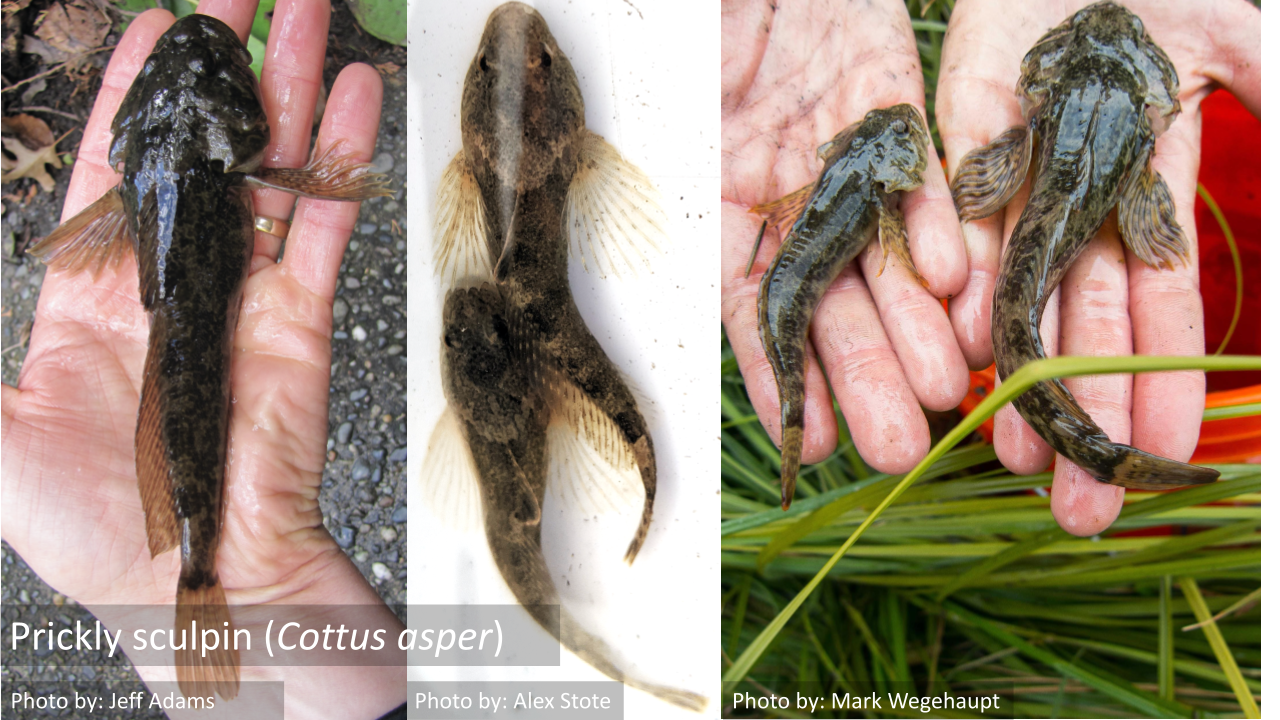
Prickly sculpin (Cottus asper, COAS) from a Washington lake and Washington’s Pacific coast. A typically freshwater fish, they make forays into estuaries to take advantage of abundant prey and habitat. Photos courtesy of Alex Stote, Mark Wegehaupt and Jeff Adams
Crab Team has now observed enough COAS, OLMA and LEAR over the years that we can begin to explore the Crab Team data set for patterns. We can explore how fish abundance has changed from month to month each year. At a quick glance, it’s interesting to see that staghorn come to our traps much more in the spring than later in the summer, and while we don’t have nearly as much data on prickly and tidepool, they appear to show up in Crab Team traps more early and late in the season. Maybe if you’re a small sculpin, you don’t want to be hanging around when the staghorns are on the move? So much to explore with all the amazing data Crab Teamers have collected over the years and continue to build upon!
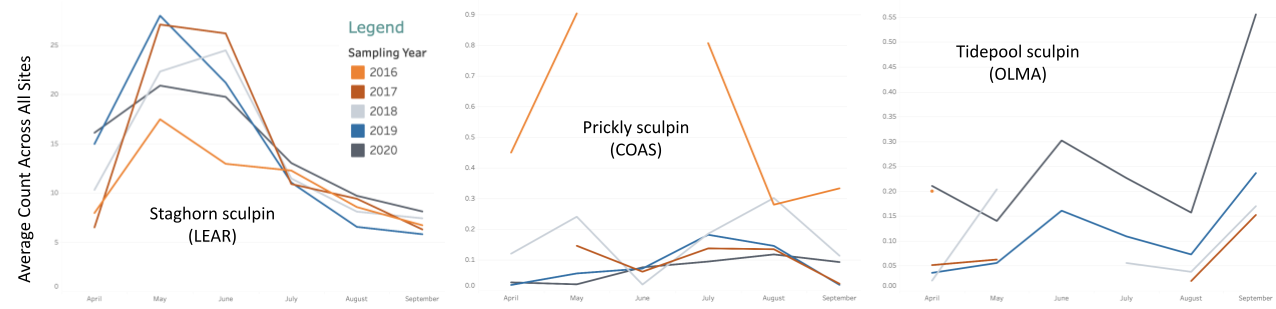
Comparison of Crab Team counts for all sites by year for staghorn (LEAR), prickly (COAS) and tidepool (OLMA) sculpin from 2016-2020. (Click to enlarge figure)
Honorable Mentions
And to round out the bullheads, we have a couple honorable mentions. In 2020, volunteers lugged a single great sculpin (Myoxocephalus polycanthocephalus, MYPO … that scientific name looks like something one would attempt to say while waving a magic wand!) up from one of their Fukui traps at the Crab Team site on Shaw Island. The name “great” isn’t hyperbole, this species is one of the biggies, growing to 2.5’ (yes that’s two and a half feet!) in length and over 20 pounds, second only to the largest sculpin in our region – cabazon, which can exceed three feet in length. Great sculpins sport a truly huge, almost prehistoric-looking head, and enormous mouth. The head is so large their body seems like somewhat of an afterthought. They also have really long (kinda scary) preopercular spines.
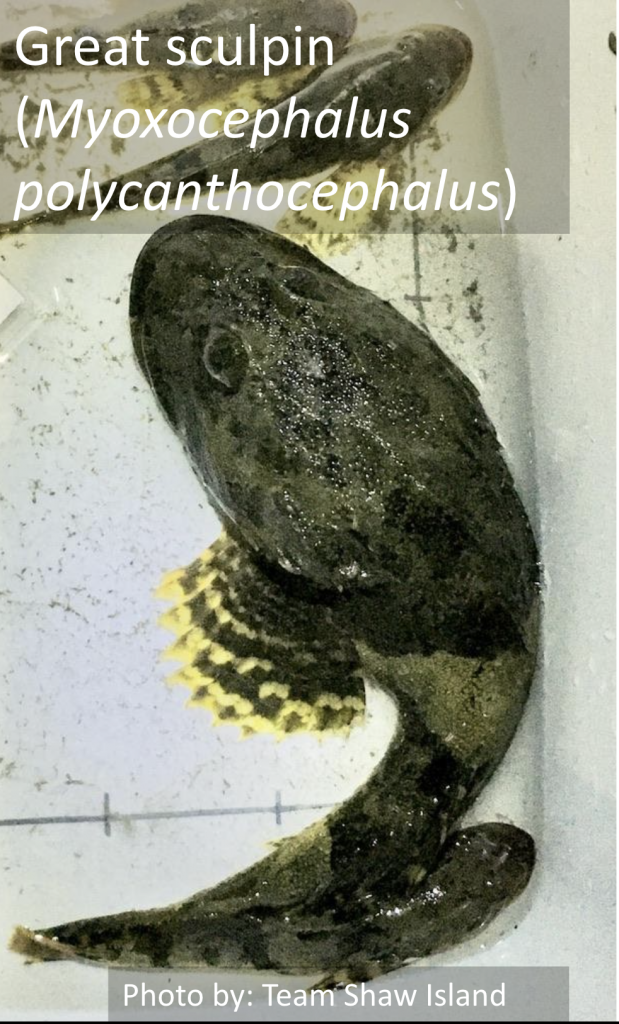
The huge headed great sculpin (Myoxocephalus polyacanthocephalus, MYPO). Photo courtesy of the Shaw Island Crab Team.
And Crab Team’s newest addition is the padded sculpin (Artedius fenestralis, ARFE). It’s another small sculpin with a handful of close relatives and a slew of similar small sculpin species. While this was the first year we observed it in traps, padded sculpin showed up at two sites, one on Vashon and one on Bainbridge Island. Though it has similarities to both tidepool and staghorn sculpins, one feature that’s really noticeable is the padded sculpin has a very rough head. Not that we give all fish noogies, but after rubbing the heads of lots of staghorns to get them to stick out their spines for identification purposes (the “sculping popping” technique), this feature actually becomes really handy. The opercular spines of padded sculpins are forked but without as many branches and far shorter than staghorn, making them somewhat similar to the tidepool in that respect. ARFE’s nose isn’t quite as pinched as a tidepool and it’s less big and broad than staghorn or prickly, and quite upturned when viewed from the side. You can also see fine rows of scales on either side of the dorsal fin, which is different from a lot of sculpins who are relatively scaleless. On the artsy side, the splotchy patterns on the sides of their belly? So cool! A good reminder that sculpins can be strikingly beautiful and that some can also quickly strike a pose, changing color to better match their environment.
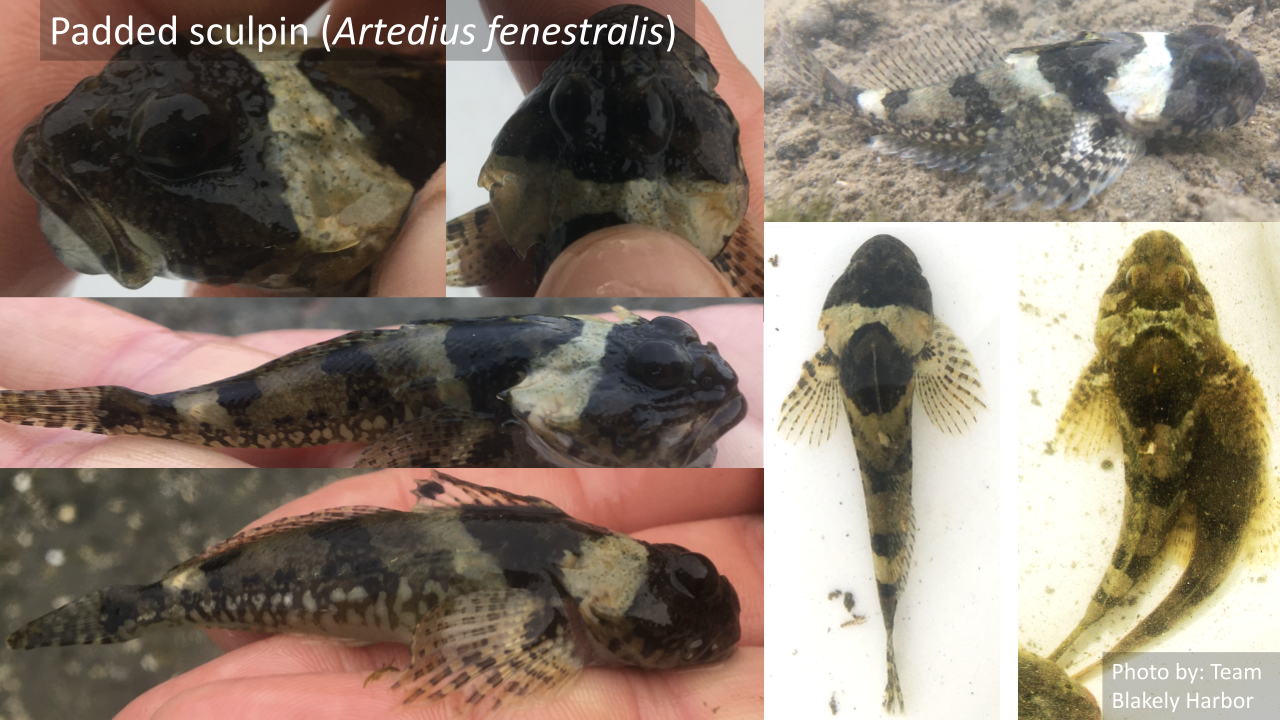
Two different examples and different angles of padded sculpin (Artedius fenestralis, ARFE). Photos courtesy of the Blakely Harbor Crab Team and Jeff Adams.
Can’t Get Enough Sculpin?
Of course the web is full of info on the region’s sculpin species, and they appear in a lot of marine life books. It seems like comprehensive and comprehensible sculpin info is a little harder to find though. A couple fairly comprehensive resources are on the top of our list. For really great images and info at an unbeatable price, you can download Greg Jensen’s Pacific Northwest Sculpins ebook at molamarine.com. Ted Pietsch and James Orr’s Fishes of the Salish Sea: Puget Sound and the Straits of Georgia and Juan de Fuca is comprehensive, in-depth and beautiful. It even includes the prickly sculpin (COAS) which seems to be frequently left off marine guides. It’s a pricey three-book set but might be great for a holiday present or for perusing at the library. You can also hone your own search image of “the big three” (LEAR, COAS, OLMA), in our set of sculpin flashcards. Maybe during the 2022 field season we’ll have a new oddball bullhead or two, and some casual cottid visits from those in this article. Since Crab Teamers are so good at taking lots of pictures of uncertain creatures, we all look forward to further honing our search images and sharing more of the Salish Sea’s sculpin diversity.
– Jeff Adams