Site Spotlight:
Blakely Harbor
Number: 553
Region: Kitsap County
Launched: 2016
Site Captain: Bob Rosenbladt
If you’ve ever conducted a Crab Team shoreline survey, you’ve likely circled “mud” more than once when identifying the substrate type. At the Crab Team site at Blakely Harbor, however, a “sawdust” option may be more relevant, considering what lies beneath the mud in this harbor, a location rich with human history and industry.
Cultural and Industrial History of Blakely Harbor
Before the arrival of Europeans, the land that is now known as Blakely Harbor was traditionally a winter residence for the Suquamish people, who take their name from the traditional Lushootseed phrase for “people of the clear saltwater.” These expert fishermen, canoe builders and basket weavers have traditionally used canoes to travel to temporary camps in the spring, summer and early fall to fish, hunt and gather wild foods.
By the late 1800s, this harbor had changed dramatically with the influx of European settlers. In 1864, Nova Scotia sea captain Captain William Renton transformed the tranquil bay into a bustling sawmill, once touted as one of the world’s largest, highest-producing mills in that time period, turning out 200,000 board feet of lumber each day at its peak.
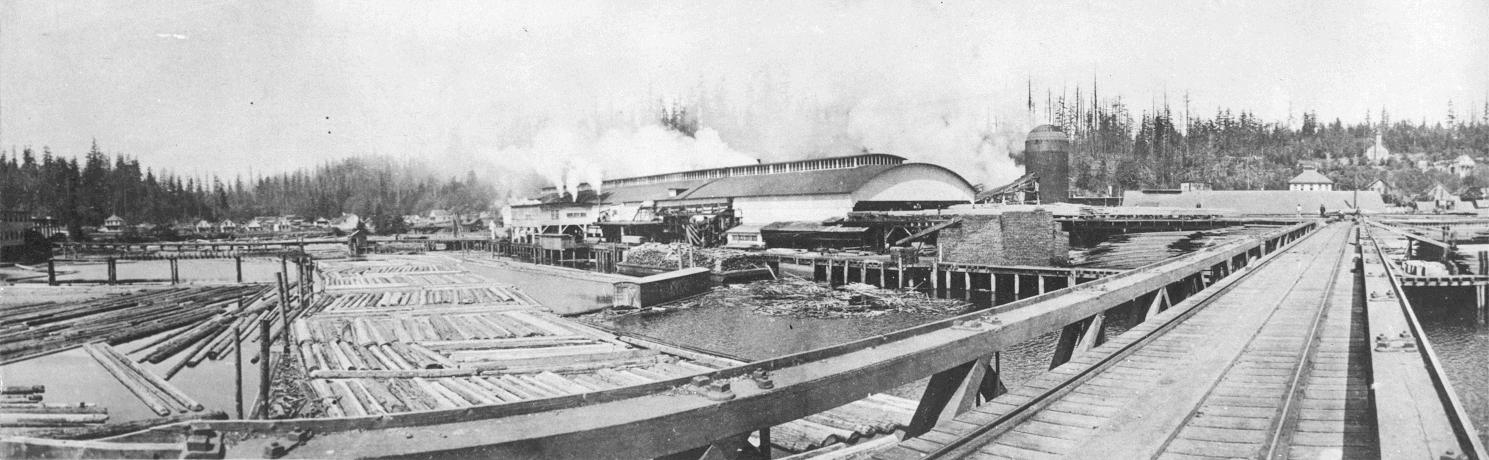
In the early 20th century, the lumber mill and shipyard at Blakely Harbor bustled with activity, a stark contrast to the quiet restoration site and park at the same location today. Photo courtesy of the Bainbridge Island Historical Museum.
In 1880, a shipyard was moved from Port Ludlow, Washington to a site near the Port Blakely Lumber Mill to keep up with the shipping demand, carrying lumber to locations all over the world on a wide diversity of ships, ranging from steamers, tugs and even several yachts. By 1882, the mill began accessing timber from forests to the south of the harbor through a company-built railroad named the Blakely Line, which hauled logs from Mason County to the southern part of Puget Sound. At this point, the mill town was thriving. In 1895, a reporter from the Press-Times wrote that, “the noise of whirring wheels, the heavy pulsations of many engines and the incessant hum of the saws and the planers impress a person with the feeling that these are all a part of a gigantic living being and not mechanical devices that are controlled by human beings” (Price 2005 p. 125).
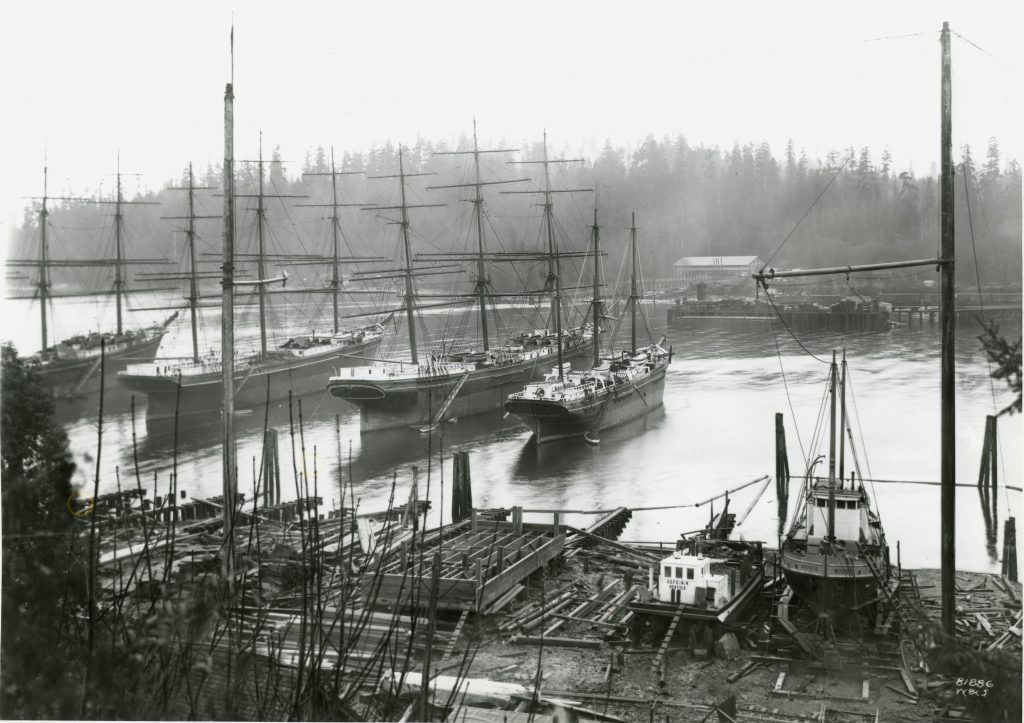
A large number of ships were required to carry lumber from Washington State to locations all over the world. To get the job done, all kinds of ships were utilized for transport, ranging from tugboats to steamers. Photo courtesy of the Bainbridge Island Historical Museum.
The Yama Community
The Port Blakely Mill Company employed mill workers from all over the world. Among the workers who worked at the mill were a large population of Japanese immigrants who eventually settled upland of the harbor in a 7-acre community named Yama, which means “mountain” or “hill” in Japanese. The community was home to as many as 200 residents, complete with a hotel, two churches, a tea room and even a photo studio. Despite Blakely Harbor’s remote location, historical accounts highlight the hand-made ice cream available in an ice cream parlor in Yama, where cream was sourced from a local dairy. By 1907, the mill had burned to the ground twice, was rebuilt, was sold to new owners and eventually closed after the First World War, in 1924 (Price 2005). Consequently, Yama was abandoned and the once thriving community slowly became overgrown with little evidence of it remaining.
In 2014, Olympic College professor Floyd Aranyosi teamed up with other Olympic College staff to lead anthropology students in what they named the “Yama Project,” a project aimed at learning more about the people who inhabited this historic site. Likely due to the steep topography underlying the community, much of this settlement remained relatively undisturbed, offering unique insights into the daily life of these mill-era residents.
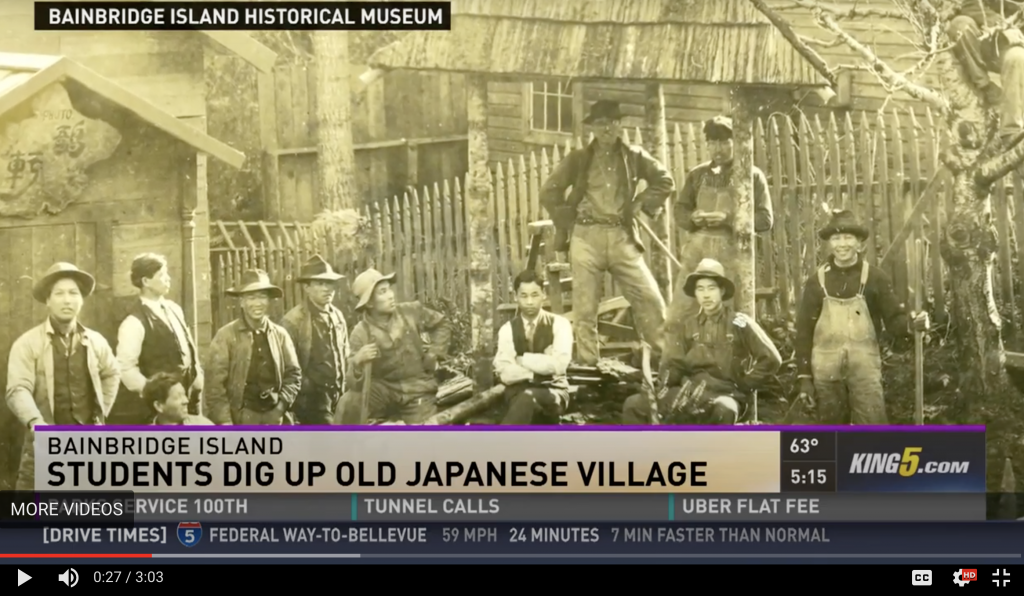
Click to view a short King 5 news clip about Olympic College’s Yama Project.
A Story of Restoration and Monitoring
In the 1990s, the area was slated to become a site for 900 new homes and additional developments, but due to public interest and advocacy for preserving the historic log pond and the surrounding ecosystems, the construction plans were halted and Blakely Harbor Park was formed. Today, the 40-acre park is overseen by Bainbridge Island Metro Park & Recreation District and is a thriving community space, stewarded by volunteers, Park District staff, and members of the Student Conservation Corps and EarthCorps. In 2019, a 65-foot footbridge was constructed to complete a loop of trails that circumnavigate the historic mill pond. This public shoreline access is unique on Bainbridge Island, where less than four percent of shoreline property offers public access.
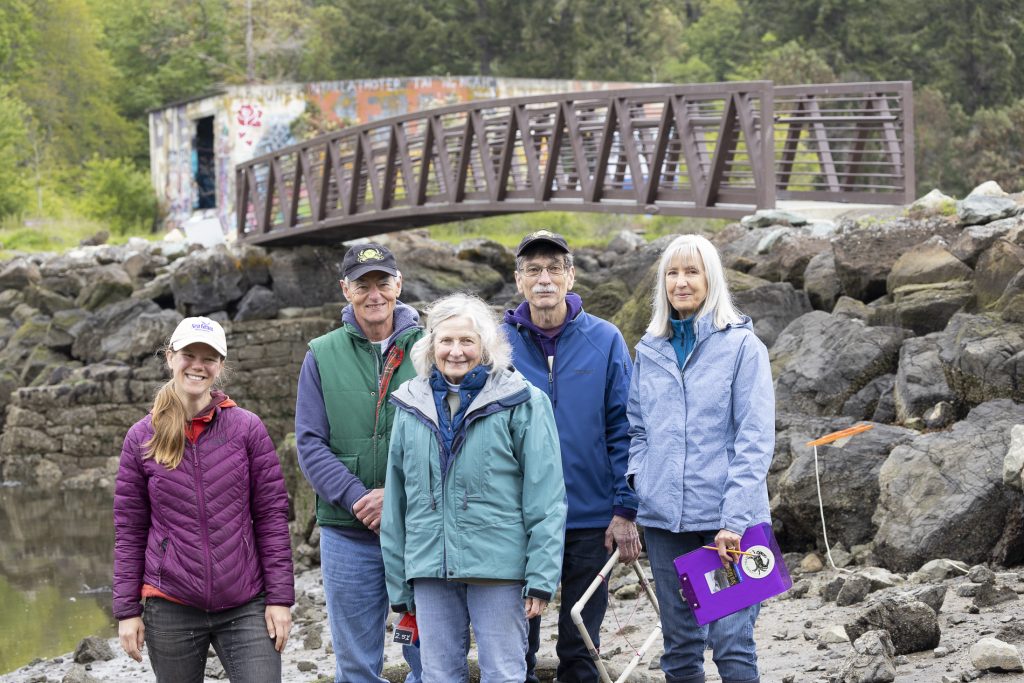
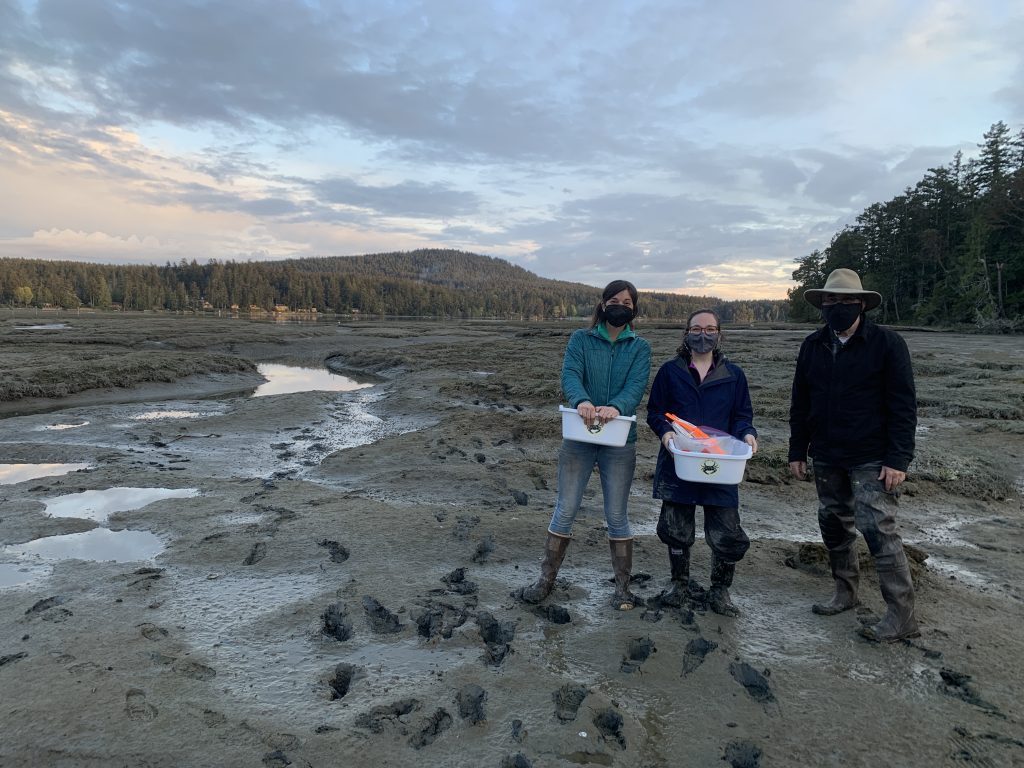
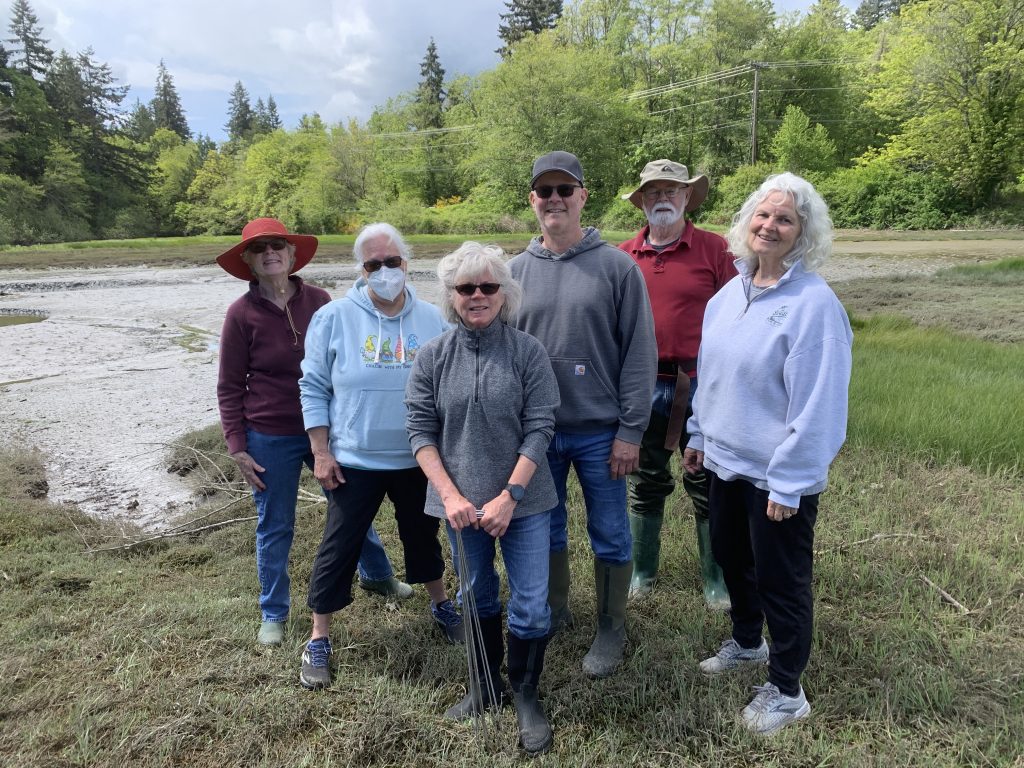
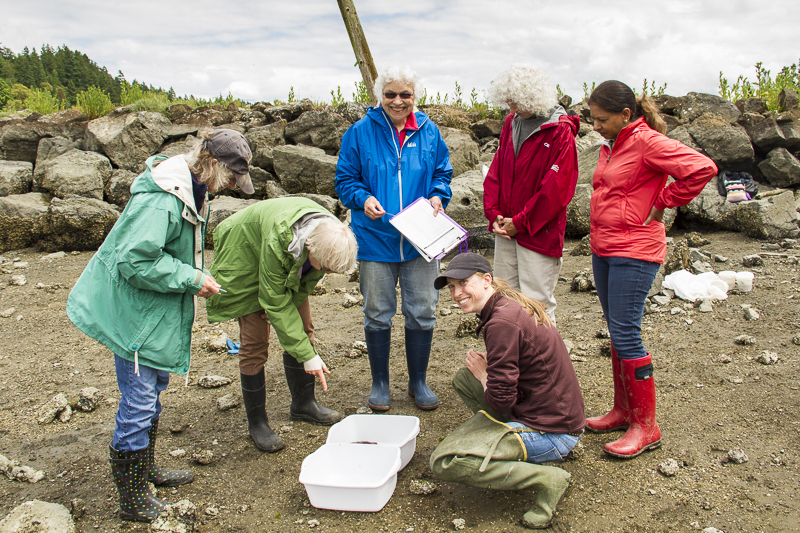
Crab Team volunteers who keep tabs on Blakely Harbor. From left to right: Amy Linhart (staff), Steve Hannuksela, Jane Hannuksela, Bob Rosenbladt, and Cath Bohlke. Not pictured: Maradel Gale and Jeri Meyer. Photo courtesy of Dorothy Rosenbladt.
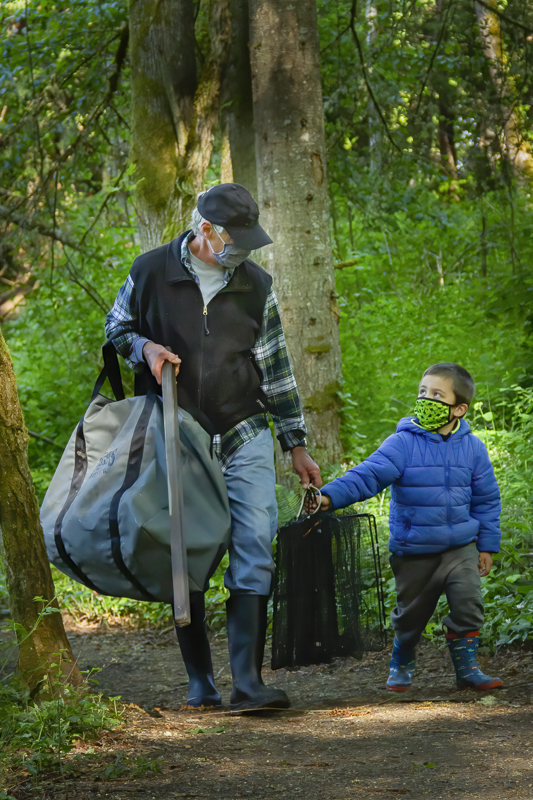
Now, a valiant crew of Crab Team volunteers monitor the shorelines of this unique Crab Team site, bringing with them a wealth of knowledge and passion for local ecosystems. In addition to seamlessly leading monitoring efforts at this site, team captain Bob Rosenbladt has extensive volunteer experience at the SEA Discovery Center and with the Kitsap Beach Naturalist program and is also a talented photographer (see photos in this article for evidence!). Jane and Steve Hannuksela bring their decades of experience working in the marine field for the National Oceanic and Atmospheric Administration (NOAA) and the Navy on environmental conservation issues; Maradel Gale is a retired University of Oregon professor and a trained marine naturalist at the The Whale Museum and a beach naturalist through the Seattle Aquarium and WSU Extension Beach Naturalist program. Cathy Bohlke has a background in hydrogeology where she spent much of her career assessing and cleaning up contaminated sites. Finally, Jeri Meyer has volunteered with Crab Team since the very beginning of monitoring at Blakely Harbor in 2016 and has contributed many hours to this project. When reflecting on their favorite aspects of volunteering with Crab Team, the Blakely Harbor crew expressed appreciation for working with interesting colleagues, the opportunity to learn about native species, connecting with visitors passing by, and ultimately, they all value the opportunity to make a difference in their local community.
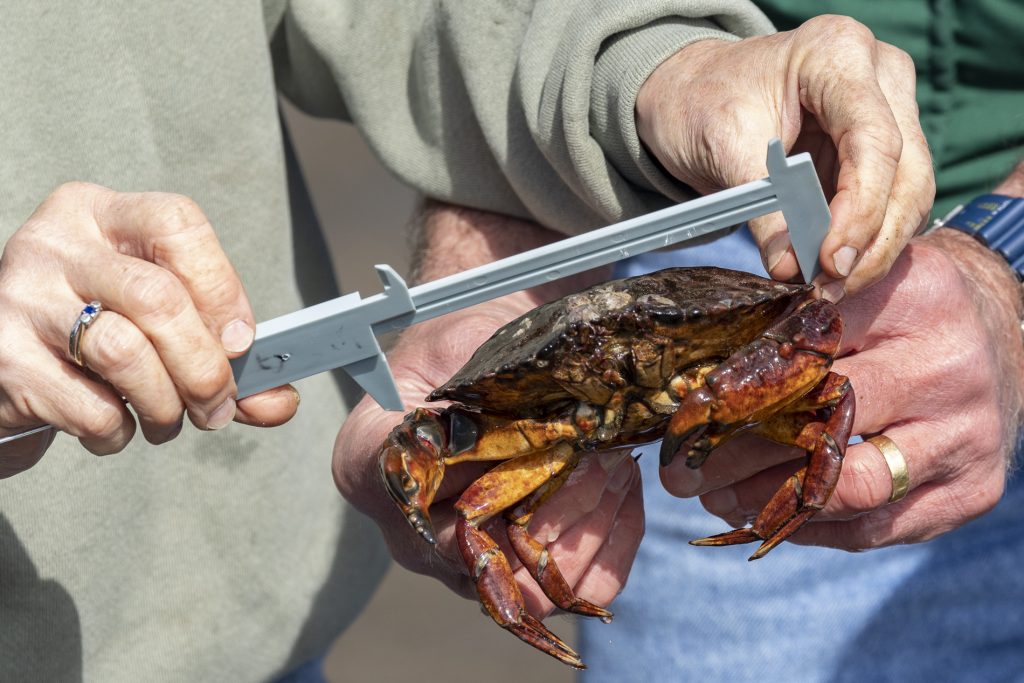
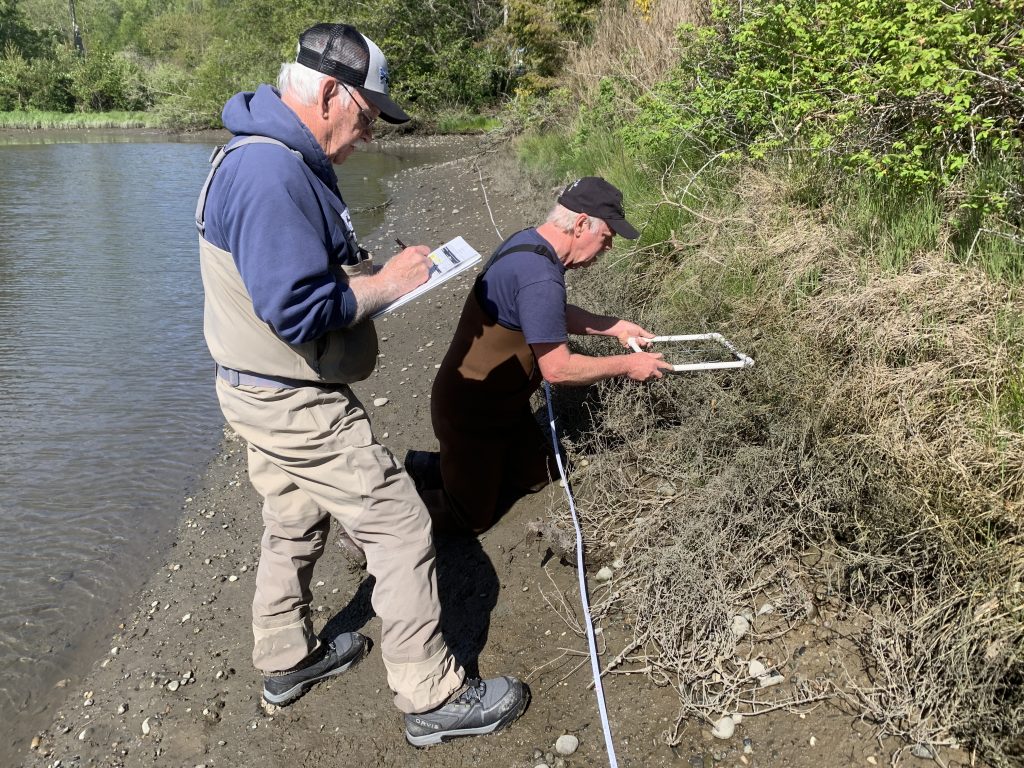
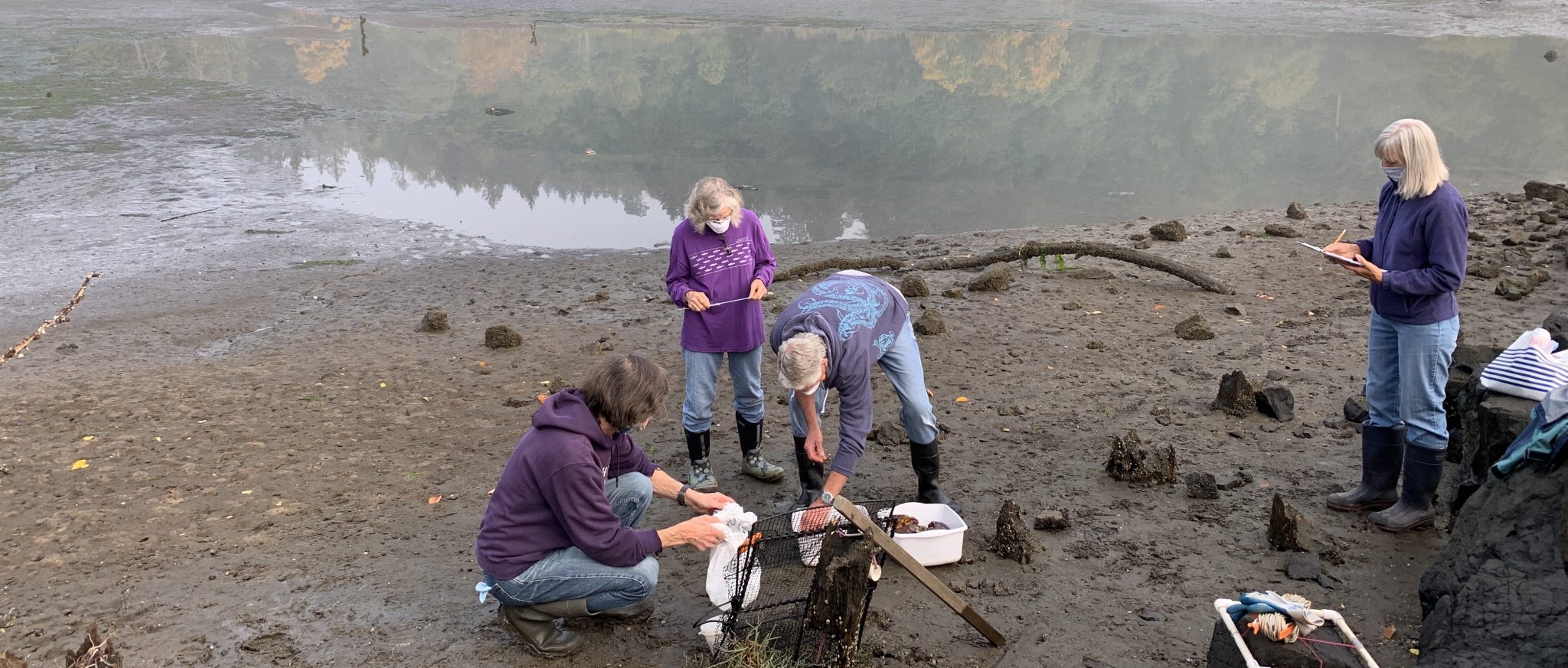
Jane and Steve Hannuksela tag team the precarious chore of measuring carapaces of large red rock crabs captured in traps. Photo courtesy of Dorothy Rosenbladt.
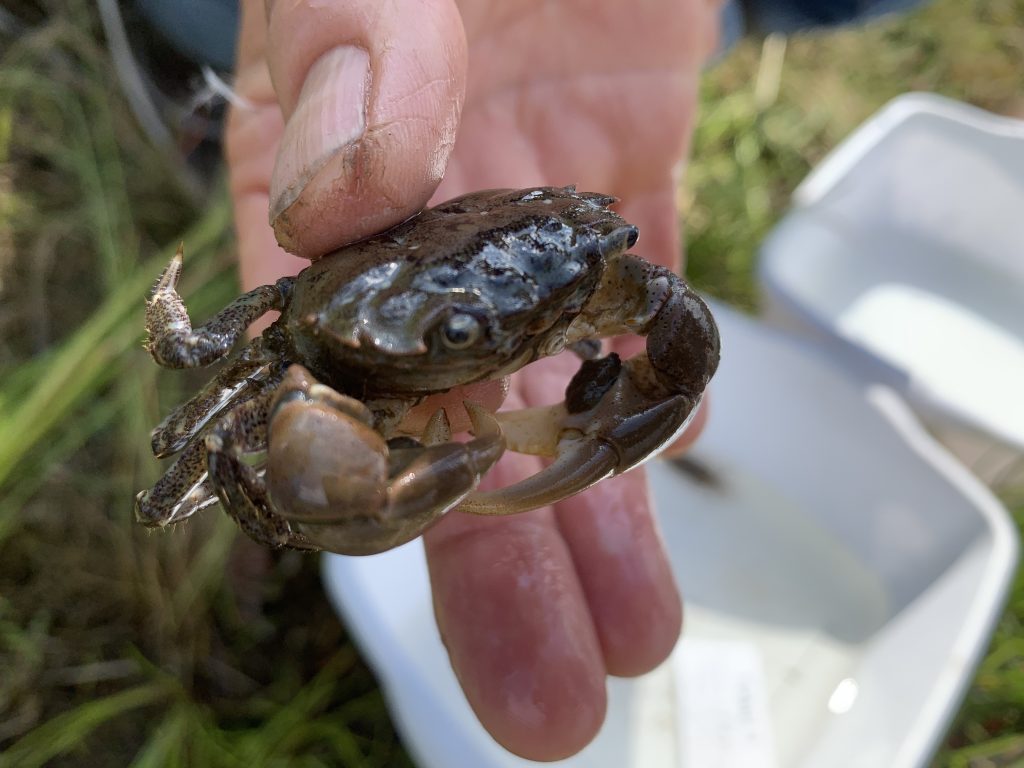
While monitoring at Blakely Harbor, volunteers have learned how to confidently wrangle powerful crab claws. They capture more red rock crabs than any other site in the Crab Team network, and as Maradel noted, “it’s been fascinating to see the number and way that the red rock crabs come in,” as they are often missing claws and legs. Being muddy, this site might be a less-preferred habitat type for rock crabs than for other species, and so it may serve mostly as a refuge for those rock crabs undergoing recovery. (Notably, however, that same mud might make this site more favorable for green crabs, which can tolerate more extreme conditions than large rock crabs.) Steve and Jane have developed a clever two-person system for holding and measuring these bruisers (see our video for a solo approach to handling large crabs) enabling them to safely work their way through the catch. The team suspects rock crabs are occasionally to blame for mangling minnow traps trying to get into the traps – because they can’t fit through the openings, they try to pry their way in to the tasty bait. Monitors at Blakely have also trapped many other interesting species we don’t see frequently across the network, ranging from nudibranchs to pipefish, and recently some of our first padded sculpins.
Underneath the muddy sediment that houses many of these native critters lies remnants of the historic mill, including rotting chunks of bark, milled boards, and dark sawdust, which are visible at low tide in some parts of the harbor. In particular, scientists from the Washington Department of Ecology are concerned about the decomposing wood and associated toxins that are leaching into the marine sediment. Studies show that even the upland soils contain contaminated materials. The agency has provided $150,000 to fund research aimed at assessing the true level of contamination linked to the historic sawmill operations, specifically assessing the presence of metals, phenols, polycyclic aromatic hydrocarbons and dioxins/furans that exceed safe levels. As successor to the historic Port Blakely Mill Company, the Port Blakely Company is the corporation responsible for the clean-up of the site’s substrate and is working closely with the Department of Ecology on this restoration initiative.
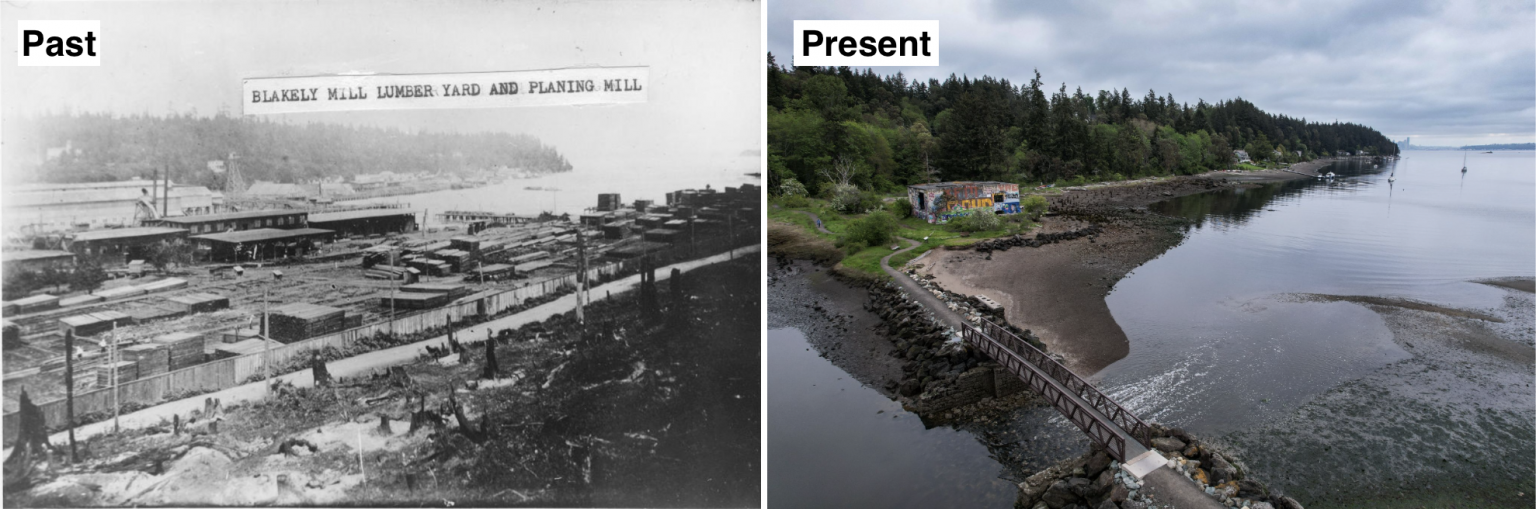
A side-by-side comparison of Blakely Harbor during its lumber mill heyday (left) and today’s peaceful harbor (right). Photos courtesy of the Bainbridge Island Historical Society and Bob Rosenbladt (and his drone!)
Over the past two centuries, Blakely Harbor has seen enormous changes to its local ecosystems. At this point, no European green crabs have been captured anywhere on Bainbridge Island, so we hope that this is one attribute that remains the same into the future!
–Amy B. Linhart
Citation: Price, Andrew (2005) Port Blakely: The Community Captain Renton Built. Bainbridge Island Historical Society.
Photo Gallery
We love to get the virtual experience of monitoring with all of the Crab Team volunteers. Do you have a photo to share? Send it to crabteam@uw.edu. (Click on arrows to scroll, and photos to enlarge for more detail.)