
Understanding green crab population structure, dispersal and spread patterns will help guide management interventions. Crab Team collaborates on several projects that aim to track and predict these patterns, including how, when and where green crabs are moving as larvae, and which populations are oceanographically connected to each other. This understanding will help managers prioritize sites for early detection and population suppression trapping.
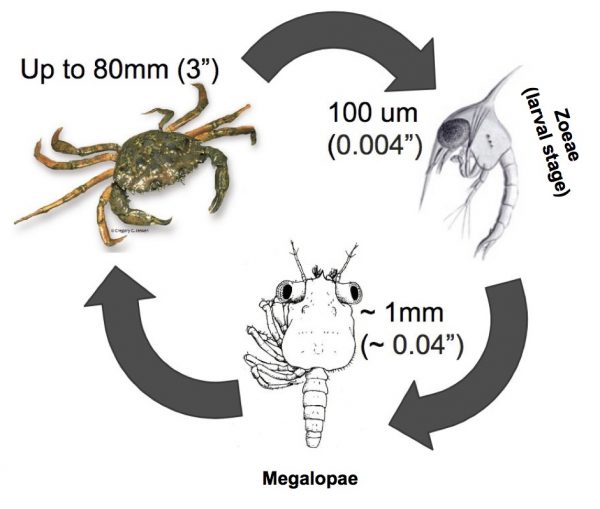
Understanding patterns of green crab spread
Oceanographic dispersal modeling can help us understand and even predict patterns of green crab spread. In the 30 to 70 days green crabs spend as planktonic larvae, they have the potential to travel farther than at any other time of their lives. Using existing computational models of ocean conditions and movement, WSG Crab Team has collaborated with researchers on multiple projects to understand where and when green crab larvae are dispersed. These findings translate to improved prioritization of trapping for both early detection and population suppression efforts.
Mapping the green crab genome
Much like the lab mouse or zebrafish, the green crab is a frequent subject of laboratory research, and we know a great deal about its physiology and development as a result. In biology, we call this a “model system”. Yet, to date, no published mapped genome exists for this species. Crab Team is supporting a collaboration between Carolyn Tepolt, a scientist at Woods Hole Oceanographic Institution, and Washington Department of Fish and Wildlife that aims to sequence and annotate the green crab genome. This will help us understand whether genetic tools could be used for green crab population control. Genome sequencing can also identify other sources of green crab invasion success.
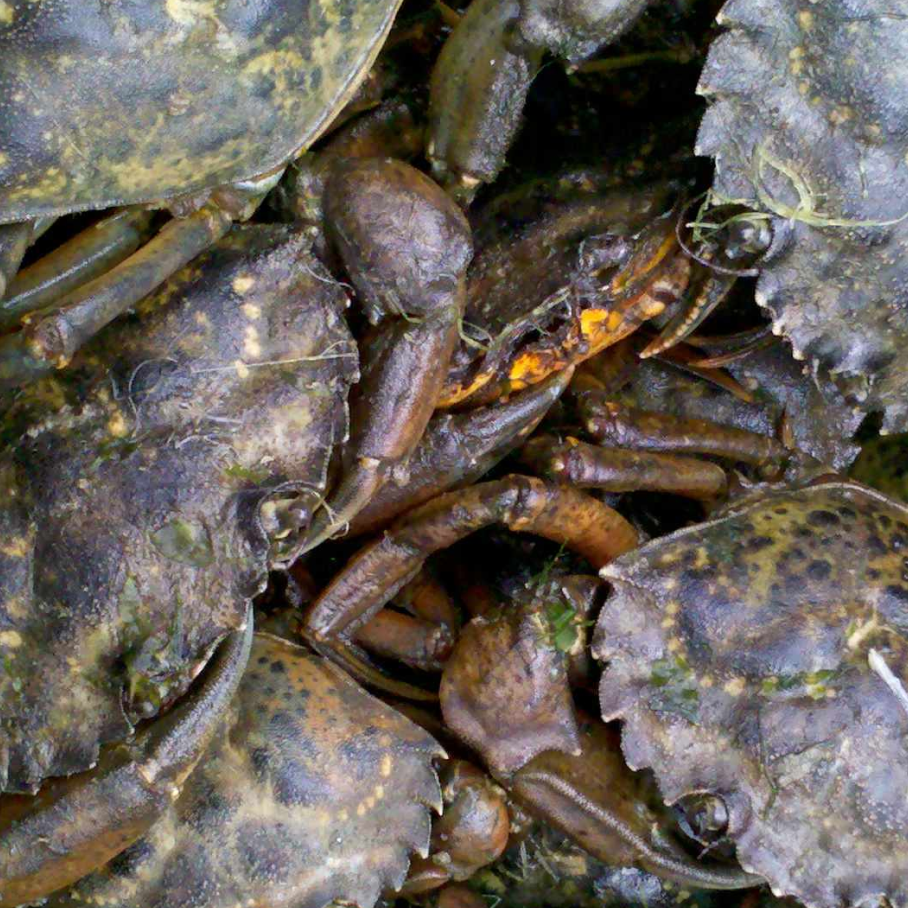
Uncovering green crab population structure
Since 2017, Crab Team has worked closely with Carolyn Tepolt, a researcher at Woods Hole Oceanographic Institution, to track the genetic structure of green crab populations in Washington and regionally. Tepolt’s work identifies regions of the green crab genome that can be used to track connections between populations, and elements of the green crab genome that might be related to their success as invaders. With rapidly advancing genetic technologies, we have uncovered population differences much earlier in this ongoing invasion than would have been possible even a few decades ago.