
The European Green Crab is considered one of the world’s most damaging invasive species. Its presence in Washington could threaten native habitats and species. This leaves many people with questions about how green crab got here in the first place — and what we can do about it.
How does the green crab travel around the planet?
Green crabs have established populations in new parts of the world in many ways. Because this species can survive in a wide range of environmental conditions, and undergoes several life-stage transitions, it is able to travel both by natural and human-mediated transportation.
Human-Mediated Dispersal
Humans can inadvertently bring green crabs to new habitats in several ways. Ballast water — water stored in a ship’s hull to provide stability while sailing — is a major carrier of invasive species. Marine vessels take on millions of tons of water at their home port, which often contains aquatic plants, pathogens and animals — including green crab larvae. These organisms are then discharged with the water at the port of arrival. Some municipalities and ports regulate where and how ballast discharge can occur to reduce the likelihood of introductions.
Green crabs are also moved with live seafood. Small green crabs can stow away in seaweeds used to pack live lobsters, oysters, baitworms. If the packing materials are not properly disposed of, the crabs can find their way into new waterways. Seafood distribution is now more strictly managed to reduce the possibility of accidental transport.
While ship ballast and seafood transport are the best known vectors of moving green crab specifically, a few other methods pose a high risk of moving species more generally. For example, aquaculture activities could also move green crabs if equipment used to manage operations, or shellfish product, is not carefully cleaned before being moved from a site with green crabs. Currently, Washington regulates aquaculture operations and shellfish transfers to reduce this risk.
Additionally, recreational boaters can transport species in bait buckets or boat wells, often without realizing it. Boaters can help by cleaning sea chests and following best practices on Clean, Drain, Dry.
Finally, green crabs can be purchased from marine biological supply companies and shipped anywhere, in any quantity, at any time. If the purchaser doesn’t dispose of the crab properly, or releases it into the wild, the crab is introduced into new habitat. No doubt other human-mediated pathways for introduction of green crab exist as well.
Natural Dispersal
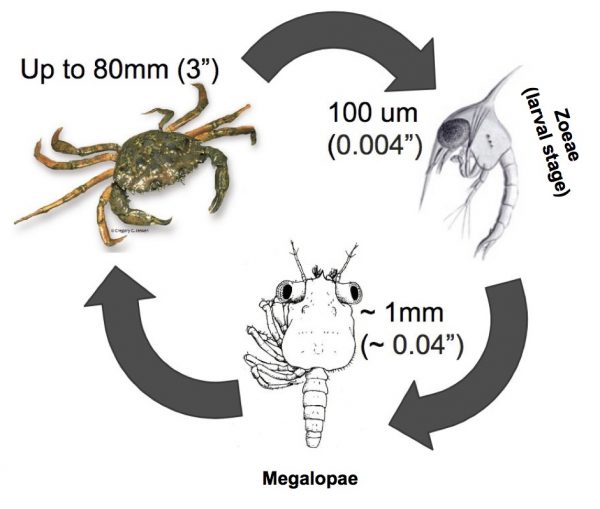
Green crab larvae drift in the open ocean for up to 75 days. In this time, ocean currents can disperse the larvae hundreds of miles along the coast. After a period of growth and development in the open sea, tides and currents sweep the green crab back into coastal waters, where they prepare to transition to life on the shore. In this way, green crabs can travel hundreds of miles without the “aid” of humans – and before they even look like a crab we would recognize.
Eventually, juvenile crabs settle in the upper intertidal zone, just below the high tide line. If the conditions in their new home are suitable, the crabs could survive and reproduce, establishing a new population and extending the species’ range. Natural dispersal can be an important means of spread in a region after green crab has been moved by humans to a new part of the globe.
How did the green crab get to Washington?
There is strong evidence that green crabs were brought to the US West Coast as stowaways in seaweed used as packing material for baitworm or live seafood. Based on genetic evidence, scientists could track the origin of the shipment to northern New England. Genetic evidence from crabs along the West Coast indicates they all have the same geographic origin. This suggests there has only been one introduction of green crabs on the West Coast.
Arrival in San Francisco and Pacific Coast dispersal
First seen in San Francisco Bay in 1989, the green crab began to spread along the coast, dispersing on currents as larvae. They expanded their range both southward to Monterey Bay and northward to Humboldt Bay, California, Coos Bay, Oregon, and many other Oregon estuaries by the late 1990s. Green crabs were sighted in Willapa Bay and Grays Harbor, Washington, and on the west coast of Vancouver Island in 1998 and 1999. Because of the risk posed by this species, green crab management efforts quickly geared up in Washington at that time. Over the next few years, populations decreased in Washington coastal estuaries even as green crabs successfully established populations on the west coast of Vancouver Island. During this period green crabs were never detected in the Salish Sea. Monitoring and management efforts declined in 2002 in Washington as a result.
First Salish Sea sighting and the beginning of Crab Team
In 2012, Fisheries and Oceans Canada discovered an established population of green crabs in Sooke Basin, a small, enclosed embayment west of Victoria. This was the first presence of green crabs confirmed within the Salish Sea. Investigation suggested they were accidentally transported in shipments of live mussels used for biotoxin monitoring from an embayment on the west coast of Vancouver Island. The detection of green crab in the Salish Sea renewed Washington’s concern around green crab; specifically, that they could establish in some of the state’s most productive marine habitats. Crab Team was launched in 2015 with support from Washington Department of Fish and Wildlife to conduct early detection monitoring for green crab along Salish Sea shorelines in the state.
First capture in inland Washington and state-wide monitoring
In September of 2016, Crab Team monitors captured the first confirmed European green crab in inland Washington. The crab was trapped in Westcott Bay on San Juan Island, as recounted in more detail on our blog.
Since then, green crabs have spread within the Salish Sea and along Washington’s coast by natural transport – that is, larvae carried on ocean currents. Researchers are using ocean modeling and genetic approaches to learn how green crab larvae are getting carried into and across the Pacific Northwest region, in the hopes of improving the efficiency of management actions.
Why should we be concerned?
The growing populations of European green crab on Washington shorelines are cause for serious concern. While green crabs did not establish a population following their initial introduction, since 2016 they have expanded their footprint and increased their numbers. These more recent population increases show no signs of a similar “bust.
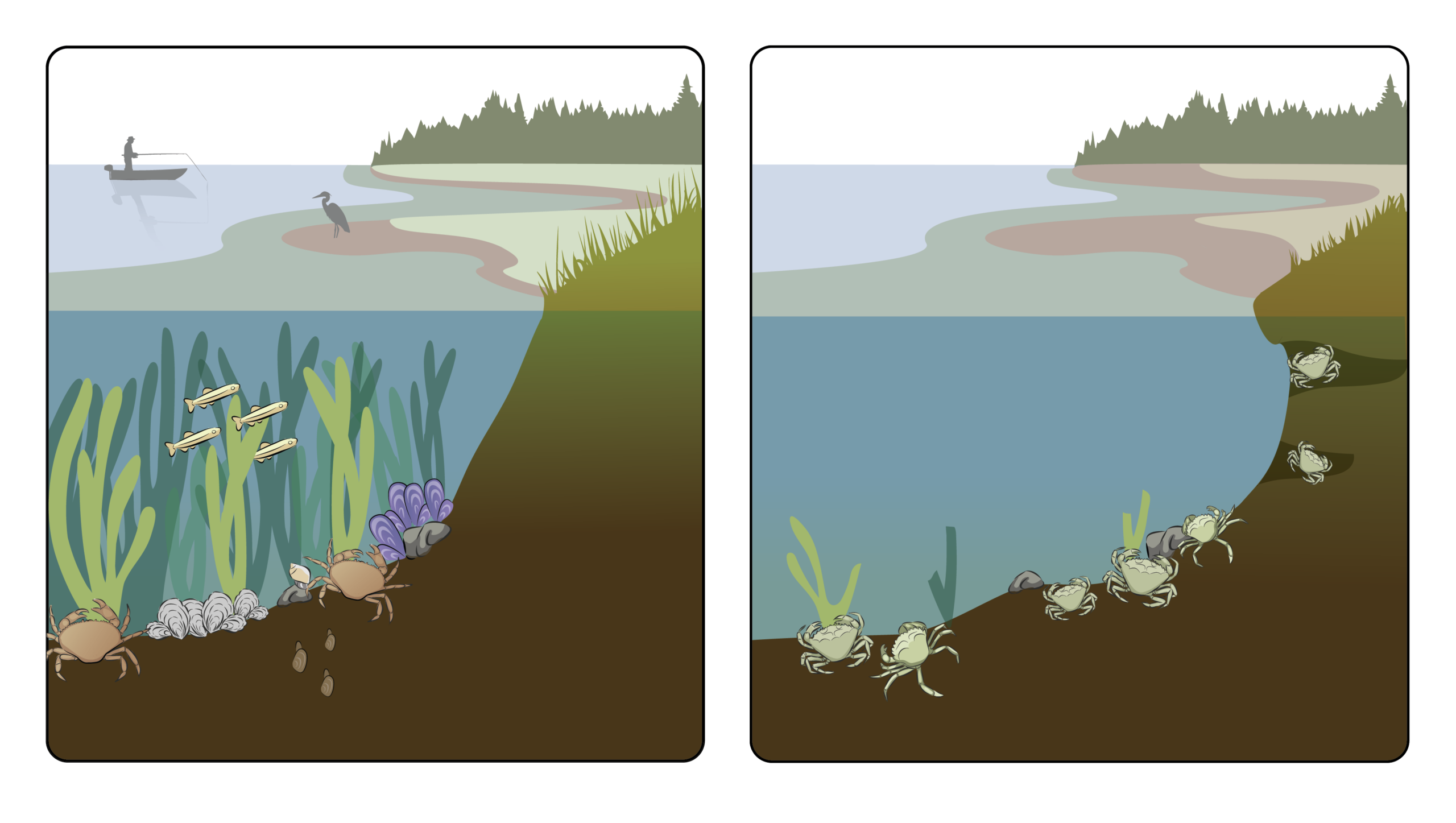
Ecosystems at risk: If European green crab becomes established, it could compete with and prey upon juvenile Dungeness and other small native crabs, consume shellfish such as clams, mussels and oysters, increase erosion of beneficial marshes through burrowing, and damage eelgrass beds, which are critical nursery habitats. These effects would ripple out to the native salmon, migratory shorebirds, and humans that rely on pocket estuaries and salt marshes for protection, recreation, and sustenance. The illustration on the left depicts a healthy nearshore habitat, while the illustration on the right shows the potential impacts of abundant green crab populations. Illustrations by Kate Hourihan.
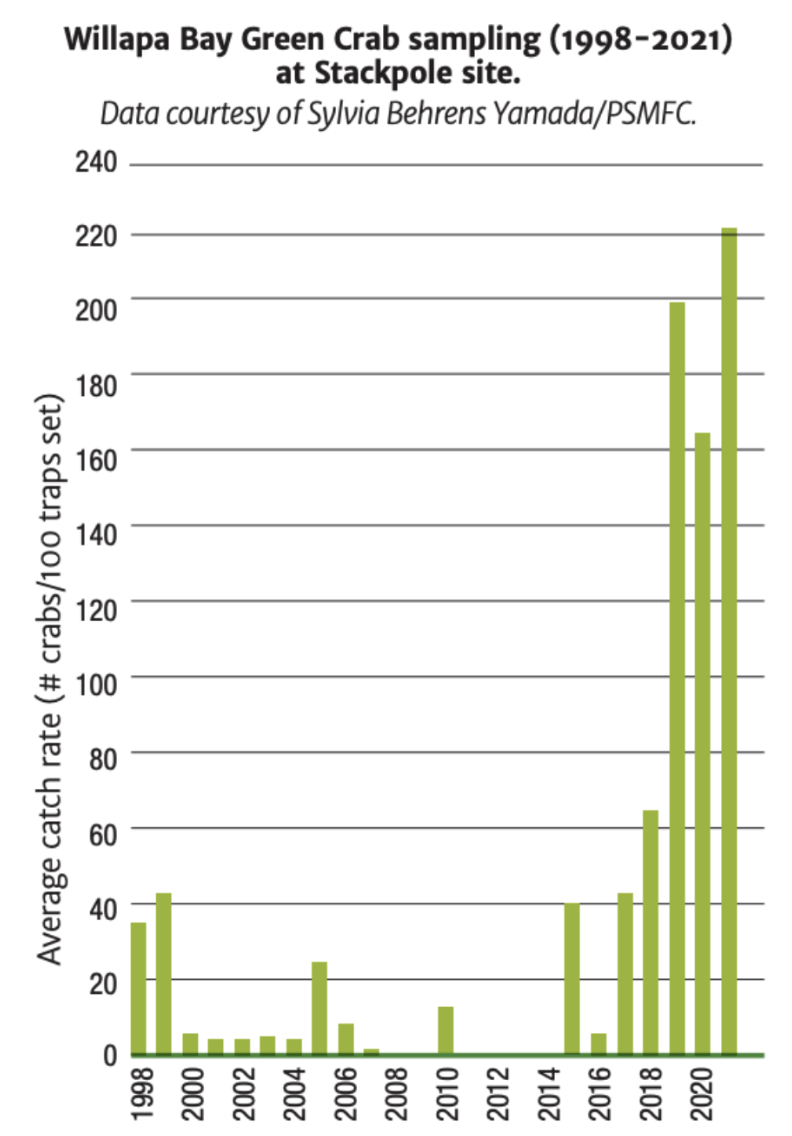
The bar chart documents the abundance of green crabs at Stackpole, in Willapa Bay, Washington going back to 1998. Green crab populations declined after the initial captures and for several years at a time were not detectable. Data from Sylvia Yamada/Pacific States Marine Fisheries Commission.
Though green crabs have been continuing to spread and increase across the state over the last decade, the invasion is progressing differently across different regions of Washington. Coastal estuaries such as Willapa Bay and Grays Harbor currently have the largest and most continuous populations of green crabs. Within the Salish Sea, green crabs are still spreading, but are less abundant and restricted to certain habitat types. Green crabs have not yet been detected in the furthest south reaches of Puget Sound or Hood Canal, but are likely to arrive there soon.
European green crab has already invaded numerous coastal communities outside its native range, including South Africa, Argentina, Australia and both coasts of North America. An able colonizer and efficient predator, this small shore crab has the potential to significantly alter any ecosystem it invades.
The green crab feeds on many organisms, including clams, oysters, mussels, marine worms, and small crustaceans. Because they prey on juvenile crabs and shellfish, large populations of green crabs could put our Dungeness crab, clam, and oyster fisheries at risk. Green crab has been blamed for the collapse of the soft-shell clam industry in Maine, and further evidence from the US East Coast also suggests that green crabs threaten eelgrass by damaging plants while digging for food, impairing restoration and conservation efforts. Further, as competitors with and predators of a wide range of native species, green crab is capable of transforming the ecological communities along Washington shorelines, with changes rippling to migratory birds, salmon, and other important species.
How is green crab being managed in Washington state?
Through monitoring, scientific advising, and partner training, Crab Team has supported the growth of green crab management capacity in Washington since 2015 and helped develop the Salish Sea Transboundary Action Plan.
Following emergency and disaster declarations by the Lummi Nation and Shoalwater Bay Indian Tribe in 2021, Governor Jay Inslee issued an Emergency Proclamation in 2022 related to the expansion of European green crab. The Washington management response is coordinated by Washington Department of Fish and Wildlife and dozens of partner entities, including tribes, federal and state agencies, shellfish growers, and stewardship groups participate in implementation of management actions. This group uses a combination of approaches to manage the ongoing green crab invasion across the state.
These are:
-
Preventing accidental transport of green crabs into and across the region. This is important to slow the spread of crabs and prevent the introduction of new genetic diversity into the current population.
-
Early Detection monitoring in regions and habitats where green crabs have not yet been found. The earlier an invasion is noticed, the more likely the population will be small enough to manage effectively.
-
Rapid Responses when a green crab is confirmed at a site, to assess the scope of green crab presence.
-
Monitoring to track populations where they are known to be present. This provides systematic information to managers about how populations are changing due to environmental changes or management efforts
-
Population suppression at locations where green crabs have a consistent and growing presence. Most of this work takes place through ongoing trapping programs by partner groups.
-
Protecting natural resources strategically; for example, by trapping on shellfish beds to protect clams and oysters. This approach acknowledges that significantly decreasing the entire population of green crabs all over the region could be too resource-intensive to be feasible.
Currently the best tool for both finding and removing green crabs is baited traps. Because this method is labor-intensive, research is ongoing into more efficient and effective strategies.
Potential native predators that might eat green crabs include gulls, sea and river otters, raccoons, and larger crabs. However, while these local heroes might reduce green crab abundances somewhat or keep them out of certain habitats, it is unlikely to be sufficient to exert significant population control. Previously, managers considered introducing a parasite that infects the green crab in their native habitats, but isn’t found on the West Coast. However, scientists determined that the parasite would also infect native crabs, and kill them more quickly, so that method was ruled out for safety concerns. (You can learn more about this investigation into “biological control” in our newsletter archive). Chemical control is not an option for green crab, either, because all known chemical approaches to control green crab populations would harm native species and ecosystems in the process. Research mapping the green crab genome is hoped to shed light on future vulnerabilities of the species that could be exploited for population control.

How can individuals help reduce the spread of green crab?
Ongoing prevention is critical to our management strategy, because even though the species is already present in the region, additional introductions can bring new genetic resources that can exacerbate the invasion.
While it’s not feasible to prevent larvae from getting washed into and around Washington, we can take steps to prevent more crabs from accidentally being moved into or across the region by humans.
Washington State already has a number of prevention measures in place, and their enforcement will help protect shorelines. Movement of shellfish, aquaculture, fisheries, and mariculture equipment and products, even within State waters, is managed by the Washington Department of Fish and Wildlife, precisely to prevent the movement of things like green crab, other invasive species, and shellfish diseases that could harm industry and natural resources. Homeowners, shellfish growers and harvesters can help by:
-
Obtaining permits before moving shellfish.
-
Only purchasing shellfish seed that is permitted by Washington State.
-
Storing purchased shellfish in the refrigerator.
-
Never placing any shellfish purchased from the store, or empty shells from shellfish harvested elsewhere, on their beach.
-
Containing all shell stock (e.g., empty oyster shells) upland.
More information about these measures is available at the Safeguard Our Shellfish website.
Boaters and beachgoers can also help reduce the accidental transport of green crabs from one location to another. Some smaller vessels have sea chests (as part of the water intake system) or livewells that could hold enough water to move green crabs, even as larvae. Even boots, waders, or traps could pick up very small crabs. Inspecting and cleaning your boat and personal gear will help reduce the chances you could have an unwanted stowaway tagging along on your explorations. Learn more about cleaning and inspecting recreational vessels with Clean. Drain. Dry. and more about cleaning your personal gear with Play. Clean. Go.
How can I get involved in Crab Team’s efforts?
If you would like to support Washington Sea Grant’s efforts as a volunteer, check out our two programs – Molt Search and Monitoring Network. If you are a partner group looking to invest staff time in trapping efforts, contact us directly at crabteam@uw.edu.
Molt Search
Eyes on the Beach
Monitoring Network
Boots in the Mud